

Professional Audio for Video: 2026 Industry Guide
Why do so many high-budget productions fail to meet international broadcast standards despite using the latest cinema cameras? The reality is that high-resolution visuals mean nothing if your sound stage collapses under the weight of signal interference or poor synchronization. Investing in the right professional audio equipment for video production is the definitive factor that separates a cinematic masterpiece from a technical failure. You've likely experienced the frustration of discovering RF interference in a critical take or spending hours manually fixing timecode drift during post-production.
We understand that audio is a synchronization challenge as much as a sonic one. This 2026 industry guide will help you master the technical nuances of high-end sound capture to elevate your storytelling to global broadcast levels. We'll examine the ROI of high-tier audio infrastructure; the mechanics of seamless timecode synchronization across multiple units; and the strategies required to achieve broadcast-standard signal-to-noise ratios in high-RF environments. Whether you're building a national broadcast studio or refining a cinema workflow, these insights ensure your technical foundation is as robust as your creative vision.
Key Takeaways
- Identify the psychological link between high-fidelity sound and viewer retention to distinguish your work from entry-level productions.
- Compare shotgun and lavalier technologies to determine the best configuration for directional dialogue and invisible audio capture.
- Explore the technical necessity of high-quality preamps and standalone recorders in achieving a professional signal-to-noise ratio.
- Learn to implement professional audio equipment for video production with LTC timecode and Genlock to maintain synchronization in complex multi-camera environments.
- Discover how specialized system integration for national media houses creates a scalable and reliable audio-visual infrastructure.
The Critical Role of Audio in Professional Video Production
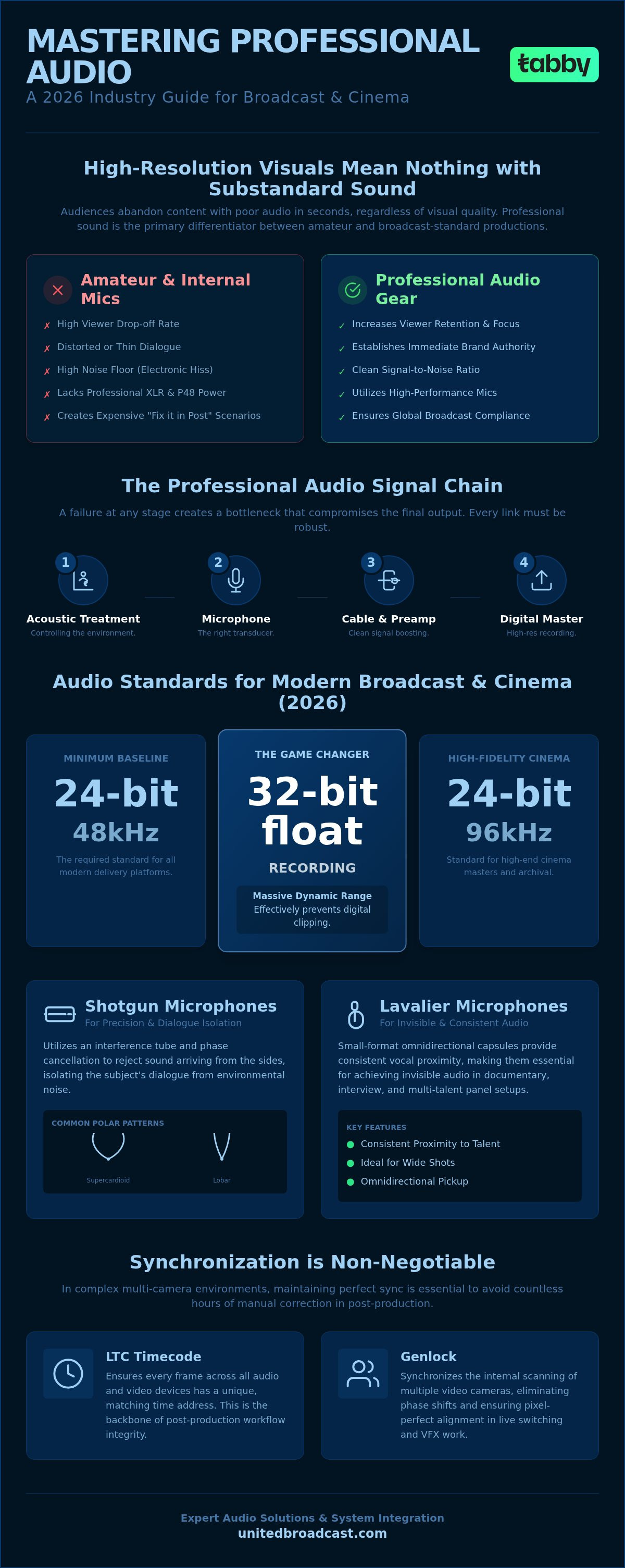
High-end visuals often mask a critical vulnerability: substandard sound. Audiences are surprisingly forgiving of minor visual artifacts, but they'll abandon a stream or broadcast within seconds if the audio is distorted or thin. Utilizing professional audio equipment for video production is the primary differentiator between amateur content and international broadcast standards. It establishes immediate brand authority and ensures that the emotional weight of your storytelling isn't lost to technical inadequacy. High-fidelity audio reduces the cognitive load on the viewer, allowing them to focus entirely on the narrative rather than straining to decipher dialogue.
Understanding the signal chain is essential for any technical partner. This progression begins with the acoustic treatment of the environment and moves through the microphone, cable, and preamp before reaching the digital master. Failing at any stage of this chain creates a bottleneck that compromises the final output. Investing in high-end audio infrastructure also offers a significant return on investment by mitigating "fix it in post" costs. It's far more cost-effective to capture a clean signal-to-noise ratio on set than to attempt expensive digital restoration during post-production.
Beyond the Built-in Mic: Why Internal Audio Fails
Internal camera microphones are designed for reference, not for broadcast output. They rely on low-cost preamps that introduce a high noise floor, manifesting as a constant electronic hiss during quiet dialogue segments. These systems lack balanced XLR connectors and 48V phantom power (P48), which are required to drive high-performance condenser microphones. In the context of high-end cinema sensors, the signal-to-noise ratio is the measurement of the desired audio signal's strength relative to the background electronic interference, determining the ultimate transparency and clarity of the recording.
Audio Standards for Modern Broadcast and Cinema
By 2026, delivery platforms have solidified 24-bit/48kHz as the minimum baseline, with 96kHz becoming standard for high-fidelity cinema masters. The most significant shift in recent years is the adoption of 32-bit float recording. This technology provides an massive dynamic range, effectively preventing digital clipping even during sudden, loud transients. To achieve these results, engineers must align their capture hardware with professional video cameras that support external synchronization and high-quality input stages. This integration ensures that the audio fidelity matches the 4K or 8K resolution of the visual data, providing a cohesive high-tier experience for the end user.
Essential Microphone Categories for Cinema and Broadcast
Selecting the correct transducer is the first step in building a robust chain of professional audio equipment for video production. It isn't just about brand names; it's about matching polar patterns to the specific acoustic challenges of your environment. Whether you are capturing intimate dialogue on a closed set or managing a multi-talent panel in a national broadcast environment, the choice of microphone dictates the transparency of your final mix. Integrating these tools directly into your camera workflow ensures that high-fidelity sound is captured as a primary data point rather than a secondary consideration.
Shotgun Microphones: Precision and Rejection
Shotgun microphones are the industry standard for directional sound and dialogue isolation. Their effectiveness relies on an interference tube that utilizes phase cancellation to reject sound arriving from the sides. Understanding polar patterns is vital here. Supercardioid patterns offer a narrow pickup area, while Lobar patterns provide even tighter focus for long-reach applications. This off-axis rejection is critical in noisy location environments where you must isolate the subject from ambient traffic or machinery noise.
Integrating these microphones with Sony Alpha camera and lenses creates a highly mobile B-roll configuration that maintains professional sonic standards without the bulk of a full cinema rig. By using an XLR-K3M or similar adapter, you can feed balanced signals directly into the mirrorless workflow, ensuring that your compact setups benefit from the same directional precision as your primary A-cam.
Beyond directional mics, lavalier systems are essential for achieving invisible audio in documentary and interview setups. These small-format omnidirectional capsules provide consistent proximity to the talent, regardless of head movement. For complex cinematic staging where a boom cannot reach and lavaliers might be visible, engineers utilize plant mics and boundary microphones. These are hidden within the set design, such as behind furniture or on walls, to capture dialogue in wide shots without compromising the visual frame.
Professional Wireless Systems and RF Management
The transition from analog to digital wireless transmission has redefined on-set reliability. Digital systems offer superior resistance to interference and provide a wider dynamic range, which is mandatory for interference-free production in 2026. Diversity receivers are a key component in this setup. They utilize two or more antennas to constantly compare signal strength, switching to the strongest feed to prevent "dropouts" caused by multi-path interference.
Frequency coordination is the most technical aspect of RF management. In high-density areas, the available spectrum is often crowded by local broadcast signals and other production teams. Modern professional receivers now include scanning tools to identify clean windows in the RF spectrum. If you are unsure which RF solution fits your regional frequency regulations, our technical team can provide customized equipment recommendations to ensure your signal remains stable throughout the shoot.
Professional Audio Recorders and Field Mixing Solutions
While modern digital cinema cameras have improved their internal processing, dedicated standalone field recorders remain the gold standard for high-stakes professional audio equipment for video production. These units provide the redundancy, physical control, and superior clocking required for complex environments. Using a standalone recorder allows the sound recordist to operate independently of the camera's position, ensuring that the most critical data is captured with maximum fidelity. This separation also provides a fail-safe; if a camera cable fails or a file becomes corrupted on the visual side, the primary audio remains intact on the recorder's internal media.
The quality of a recording is largely dictated by the transparency of its preamps. Professional-grade hardware utilizes discrete components to ensure that even when gain is pushed for quiet dialogue, the electronic noise floor remains negligible. This is especially important when managing multitrack recording. Capturing separate ISO tracks for every microphone on set gives post-production engineers the flexibility to isolate specific voices or sound effects during the mix. Managing these tracks requires a methodical approach to power management. On long production days, recordists rely on smart battery systems and Hirose power distribution to keep multiple receivers and the recorder running without interruption.
Field Mixers: The Sound Recordist’s Command Center
A field mixer serves as the central hub for signal integrity. It allows the operator to monitor levels in real-time and make tactile adjustments to the mix on the fly. Digital limiters and safety tracks, which record a secondary channel at a lower gain level, provide an essential buffer against unexpected transients that could otherwise ruin a take. The acoustic environment is also influenced by other departments on set. For instance, the use of high-quality professional lighting equipment is vital because inferior ballasts can introduce audible electronic hum or flicker that contaminates sensitive audio circuits.
32-Bit Float Recording: The Game Changer
The adoption of 32-bit float technology has fundamentally changed gain staging for solo shooters and documentary teams. By using dual Analog-to-Digital Converters (ADCs), these recorders capture a dynamic range so vast that digital clipping becomes virtually impossible. You don't need to worry about setting perfect levels during unpredictable scenes; you can simply recover the data in post-production without adding noise. 32-bit float technology provides a theoretical dynamic range of 1,528 dB, which far exceeds the physical capabilities of any microphone capsule or the limits of human hearing. This ensures that every nuance, from a whisper to an explosion, is preserved with absolute precision.
Synchronization and Workflow Integrity
In high-stakes cinema and broadcast, synchronization is the technical glue that holds the production together. Relying on manual clapper boards for multi-camera shoots is inefficient and prone to error in fast-paced environments. Instead, professional audio equipment for video production utilizes Linear Timecode (LTC) to embed a precise timestamp into every recorded file. This ensures that when the editor receives the data, every audio track and visual frame aligns automatically. For long-form national broadcast, Genlock is equally vital. While timecode tells the system "when" a frame occurs, Genlock ensures that the cameras and recorders are scanning at the exact same frequency, preventing the subtle frame drift that can occur over hours of continuous recording.
Jam-syncing is the standard method for maintaining this alignment. By connecting a master clock to each device, you "jam" the internal clocks to match. High-end recorders and cameras feature temperature-compensated crystal oscillators (TCXO) that maintain accuracy for several hours, though frequent re-jams are recommended for absolute certainty. Beyond the pulse of the timecode, metadata management is the final step in a professional workflow. Naming ISO tracks on set and ensuring iXML metadata is present allows post-production houses to navigate complex dialogue sessions without manual searching or guesswork.
Implementing a Professional Sync Workflow
Establishing a reliable sync chain requires a methodical approach. Follow these three steps to ensure technical integrity:
- Step 1: Select a master clock. Designate a high-stability field recorder or a dedicated sync generator as the "Grandmaster" for the entire set.
- Step 2: Distribute the signal. Use wireless sync boxes or high-quality BNC cables to feed timecode and Genlock signals to every camera and audio unit.
- Step 3: Verify alignment. Check the timecode display on all units at the start of every reel and after every battery change to confirm they are still in perfect phase.
Protecting Equipment in Harsh Regional Climates
Regional conditions present unique challenges for sensitive electronics. High humidity can cause condensation inside microphone capsules, leading to audible "popping" or complete signal loss. Dust and fine sand are equally hazardous, as they can penetrate the cooling fans of recorders or the delicate diaphragms of shotgun microphones. Routine maintenance is non-negotiable. Utilizing the professional camera service center for scheduled audio and optical calibration ensures that your gear remains within manufacturer specifications. Keeping your professional audio equipment for video production clean and stored in climate-controlled environments between shoots will significantly extend its operational lifespan.
Expert Audio Solutions and System Integration
Designing a comprehensive audio-visual ecosystem requires more than just acquiring high-end components. It involves the precise orchestration of signal routing, monitoring, and communication to ensure that every element of your professional audio equipment for video production works in harmony. For national media houses and large-scale studios, custom system integration is the only way to achieve the reliability required for 24/7 broadcast operations. A unified technical infrastructure reduces the risk of signal failure and ensures that your technical operators can focus on creative execution rather than troubleshooting connectivity issues.
Professional technical support is a vital component of this infrastructure. The impact of expert guidance on production uptime cannot be overstated; having a technical partner who understands the nuances of regional frequency regulations and signal flow is essential for maintaining international standards. Whether you are building a new facility or upgrading an existing one, the focus should always be on creating a scalable environment that can adapt to the evolving demands of the media landscape.
Studio Audio Infrastructure
In a broadcast control room, the acoustic environment is as critical as the hardware itself. Proper acoustic treatment ensures that monitoring is transparent, allowing engineers to identify subtle phase issues or background noise that might otherwise go unnoticed. This process begins with selecting the right broadcast studio gear for audio monitoring, ensuring that the sound you hear in the booth is exactly what the audience receives. Integration also extends to intercom systems, which serve as the central nervous system for production communication, linking the director, camera operators, and audio engineers in real-time.
For mobile production needs, OB van system integration allows you to take studio-grade audio capabilities on the road. These mobile units require sophisticated routing to manage complex multitrack feeds over protocols like Dante or MADI, ensuring that remote broadcasts maintain the same sonic integrity as a fixed studio environment.
The UBMS Technical Advantage
As a national leader in cinema and broadcast solutions, UBMS provides a level of expertise that goes beyond simple equipment sales. We act as a seasoned veteran in the field, offering the technical infrastructure and factory-certified service center support needed for precision repairs and routine maintenance. This ensures your professional audio equipment for video production remains a dependable asset throughout its lifecycle. We value long-term partnerships, providing the logistical excellence and technical depth required to support the region's most ambitious media projects.
Consult with our system integration experts for your next production
Future-Proofing Your Sonic Workflow
As the media landscape moves toward 2026, the gap between standard and broadcast-quality content is defined by technical precision in sound capture. Mastering professional audio equipment for video production requires a shift from viewing audio as an accessory to treating it as an integrated data stream. Success on set depends on achieving high signal-to-noise ratios, maintaining perfect timecode synchronization, and utilizing robust 32-bit float recording to protect your dynamic range. Whether you're managing a national broadcast studio or a specialized cinema unit, your hardware must be as dependable as your creative vision.
United Broadcast & Media Solutions stands as a trusted advisor with decades of expertise in high-end media system integration. As an authorized distributor for global broadcast leaders, we provide the technical infrastructure and comprehensive national support needed to ensure your production remains stable. Our factory-certified service center is always available to maintain the longevity and precision calibration of your gear, giving you the confidence to tackle any high-stakes project.
Building a professional audio foundation is an investment in the authority of your brand. We look forward to helping you achieve international standards in every frame.
Frequently Asked Questions
Why is 32-bit float recording essential for professional video production?
32-bit float recording is essential because it captures a dynamic range exceeding 1,500 dB, which effectively eliminates digital clipping. This technology allows you to recover audio from extremely loud or quiet takes during post-production without adding electronic noise. It's particularly useful in unpredictable environments where manual gain adjustments are impossible. By using this with your professional audio equipment for video production, you ensure that no critical dialogue is lost to unexpected volume spikes.
What is the difference between a shotgun and a lavalier microphone for interviews?
The primary difference lies in their pickup patterns and placement. Shotgun microphones are highly directional and typically mounted on a boom pole to isolate dialogue from a distance while rejecting off-axis noise. Lavalier microphones are small, omnidirectional capsules clipped to the talent, providing consistent proximity and "invisible" audio. Most professional sets use both to provide a safety net and a choice of perspectives during the final mix in post-production.
Do I need a separate audio recorder if my cinema camera has XLR inputs?
While high-end cinema cameras feature XLR inputs, a dedicated field recorder offers superior preamps and a lower noise floor. Standalone recorders provide essential redundancy and allow for multitrack ISO recording, which is vital for complex dialogue scenes. This separation also enables the sound recordist to move independently of the camera, ensuring optimal microphone placement without being tethered to the visual rig's physical position or power constraints.
How do I synchronize audio from multiple cameras in post-production?
The most efficient way to synchronize multiple cameras is through the use of Linear Timecode (LTC). When your professional audio equipment for video production shares a master clock, editing software can automatically align every clip based on a shared timestamp. This eliminates the need for manual waveform matching or clapper board alignment. For long-form projects, ensuring your cameras are genlocked further prevents frame drift, keeping audio and video in perfect phase.
What are the best practices for protecting microphones from high humidity?
Protecting sensitive diaphragms from regional humidity requires proactive maintenance and climate-controlled storage. We recommend using desiccants like silica gel in your equipment cases and avoiding sudden temperature shifts that cause internal condensation. If you notice popping or signal loss, your gear should be sent to a factory-certified service center for precision cleaning. Routine maintenance is the only way to ensure that high-end condenser microphones maintain their frequency response in harsh climates.
Why is wireless frequency coordination important in a broadcast environment?
Wireless frequency coordination is vital to prevent signal dropouts caused by competing RF traffic. In a broadcast environment, the spectrum is often crowded with local television signals and other production teams. Coordination involves scanning the RF environment to identify clean windows and assigning specific frequencies to each transmitter. This methodical approach ensures that your wireless microphones and IFB systems remain stable, even in high-density areas where interference is a constant risk.
How does timecode improve the efficiency of a film production workflow?
Timecode serves as the technical backbone of a modern production by providing a unique identifier for every frame. It dramatically speeds up the post-production workflow by allowing for instant "multi-cam" clips and automated sound syncing. Beyond alignment, timecode embeds metadata that helps editors navigate hours of footage efficiently. This precision reduces labor costs in the edit suite and ensures that the technical integrity of the project is maintained from capture to delivery.
Should I choose digital or analog wireless audio systems for location shoots?
For 2026 production standards, digital wireless systems are the preferred choice over analog. Digital transmission offers superior spectral efficiency, allowing more channels to operate in a narrow frequency window. These systems provide a cleaner audio signal with a wider dynamic range and are less susceptible to the static and "hiss" common in analog RF. Additionally, digital systems often include encryption features, which are essential for protecting sensitive or confidential dialogue on high-profile sets.


