

Professional Drives & Storage: The 2026 Media Production Buying Guide
The era of affordable, readily available media storage has officially ended. With major manufacturers reporting near-total inventory sell-outs through 2026 and NAND wafer prices rising significantly, your choice of drives & storage is no longer a peripheral decision; it's a critical component of the camera's imaging chain. In a market where enterprise demand often outpaces supply, securing the right hardware is now a matter of logistical precision and technical foresight.
You understand that capturing 8K RAW or high-bitrate broadcast footage is only half the battle. If your hardware can't maintain sustained write speeds or if data corruption occurs during a high-stakes shoot, the production loses its most valuable asset. It's a frustrating reality when slow transfer speeds delay post-production or when camera media fails to mount correctly at an editing station, causing costly bottlenecks in the workflow.
This guide provides a technical roadmap to choosing high-performance storage that secures your footage and accelerates your 8K+ cinema workflows. We'll explore the transition to Thunderbolt 4 and 5 speeds, the implementation of essential tiered storage strategies, and how to build a scalable infrastructure that guarantees zero-loss data integrity in an increasingly constrained global market.
Key Takeaways
- Understand why 8K and 12K RAW workflows necessitate a transition to NVMe architectures to maintain sustained write speeds and prevent data loss.
- Master the tiered storage strategy of hot, warm, and cold media to optimize your budget while securing your most critical production assets.
- Evaluate the performance gains of Thunderbolt 5 and USB4 Version 2.0 to eliminate transfer bottlenecks in high-pressure broadcast environments.
- Select certified media and proprietary readers tailored to specific camera ecosystems, ensuring seamless compatibility for Sony, ARRI, and RED workflows.
- Secure your production pipeline by investing in professional-grade drives & storage that offer the endurance required for long-term project reliability.
The Critical Role of High-Performance Drives & Storage in 2026
High-resolution acquisition formats like 8K and 12K RAW aren't just larger files; they're fundamentally more demanding on hardware. In 2026, the distinction between storage as a simple repository and storage as a performance engine has solidified. Professional drives & storage must handle the relentless write-load of high-bitrate codecs without dropping frames. While consumer-grade drives might offer impressive burst speeds, they often lack the sustained throughput required for the multi-hour recording sessions common in modern cinema and broadcast.
Understanding core storage concepts is vital for any technical lead or DIT. Primary storage on set must provide the bandwidth for real-time playback and review, while secondary and tertiary tiers manage the massive data volumes generated by today's high-frame-rate sensors. This choice impacts the entire production lifecycle. A bottleneck at the offloading stage ripples through to the edit suite, potentially doubling post-production timelines and increasing labor costs across the board.
Understanding the Data Demands of Modern Cinema
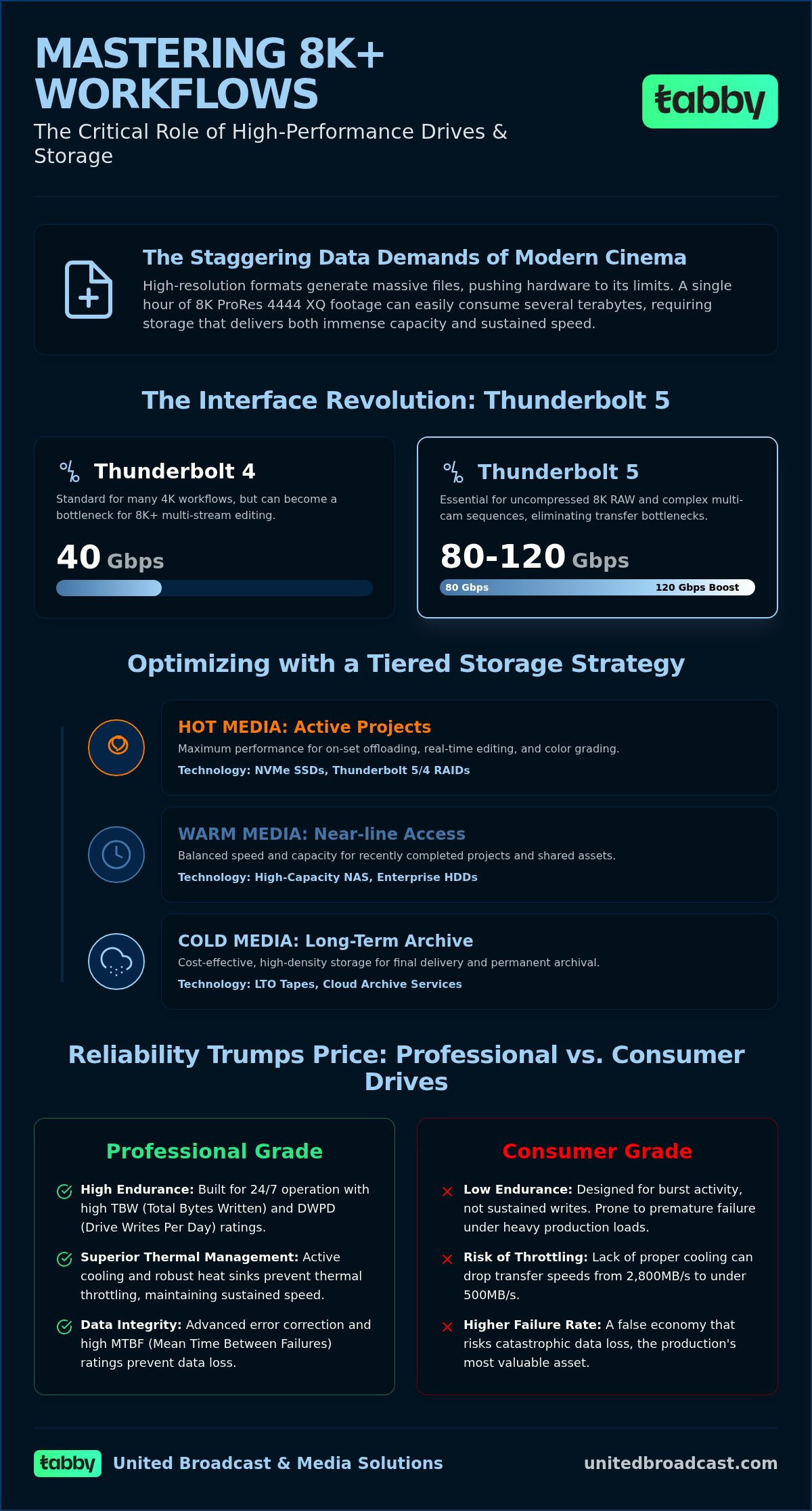
Codecs such as ProRes 4444 XQ and Cinema RAW Light generate data at a staggering rate. A single hour of 8K ProRes 4444 XQ footage can easily consume several terabytes. When you factor in high-frame-rate (HFR) recording, the endurance of the drive becomes just as critical as its speed. 2026 productions often require multi-terabyte daily offloads that push hardware to its thermal limits. If your media isn't rated for high Total Bytes Written (TBW), the hardware can fail prematurely under the stress of constant, high-speed data ingestion.
The Cost of Failure: Why Reliability Trumps Price
The storage market in 2026 is volatile. With enterprise SSD prices having increased significantly since 2025, it's tempting to cut corners with consumer hardware. It's a false economy. Consumer drives often lack the sophisticated error-correction and thermal management found in professional units. Mean Time Between Failures (MTBF) ratings for professional gear are calculated for 24/7 operation under heavy load. Relying on non-certified hardware risks catastrophic data loss that no recovery service can fully guarantee. True production security relies on hardware-level redundancy and rigorous certification rather than just price-per-gigabyte metrics.
Technical Specs That Matter: Speed, Interface, and Endurance
Capacity is often the first metric buyers consider, but for professional drives & storage, performance is defined by architectural endurance and interface bandwidth. NVMe (Non-Volatile Memory Express) has effectively replaced standard SATA SSDs in professional suites. This architecture connects directly to the PCIe bus, providing the low latency required for handling 8K timelines. When you're selecting drives for a high-utilization edit suite, pay close attention to the Drive Writes Per Day (DWPD) rating. A drive with a low DWPD will wear out prematurely under the constant cache writing and rendering cycles typical of modern NLE workflows.
Thermal management is another critical factor often overlooked in consumer reviews. High-speed NVMe drives generate significant heat during sustained transfers. Without active cooling or robust heat-sink designs, these drives will engage in thermal throttling. This can drop your transfer speeds from 2,800MB/s to less than 500MB/s in minutes, effectively stalling your production schedule. In 2026, professional external solutions must maintain their rated speeds for the duration of an entire card offload, not just for a few seconds of burst activity.
Interface Performance Comparison
The transition from Thunderbolt 4 to Thunderbolt 5 represents a massive leap for data-heavy productions. While Thunderbolt 4 serves many 4K workflows well at 40Gbps, Thunderbolt 5 provides up to 80Gbps of bidirectional bandwidth. It even includes a boost mode reaching 120Gbps for video-intensive tasks. You need this headroom when working with multiple streams of uncompressed 8K RAW or complex multi-cam sequences. Sustained write speed is the only metric that prevents dropped frames during high-bitrate recording or real-time playback. Implementing effective storage tiering strategies ensures that your fastest interfaces are reserved for "hot" data, while secondary ports handle background archival tasks.
Form Factors: From CFexpress to Rackmount NAS
Field work demands rugged, portable NVMe SSDs that can withstand the environmental rigors of a location shoot. These portable units are the first link in your data chain, but they must be compatible with the media used in your professional video cameras. In the studio, desktop RAID arrays remain the standard for primary editing, offering both the necessary capacity and hardware-level redundancy. If you're unsure which interface matches your existing workstation hardware, our team can provide a technical compatibility assessment to ensure your new storage integrates seamlessly into your facility.
Tiered Storage Strategy: Hot, Warm, and Cold Media
Effective media management in 2026 requires a structured approach to data lifecycle management. Rather than relying on a single high-capacity drive, professional houses implement a tiered strategy. This methodology categorizes drives & storage into Hot, Warm, and Cold tiers based on the frequency of access and the required throughput for specific tasks. This ensures that expensive, high-speed resources are used efficiently while protecting the long-term integrity of the masters.
Hot storage consists of NVMe-based RAID arrays designed for real-time 8K timeline playback. These systems provide the extreme IOPS needed for uncompressed RAW files. Warm storage typically utilizes high-capacity enterprise HDDs, serving as an active archive for projects currently in post-production. It offers a balance between cost and performance, allowing editors to retrieve assets without the expense of high-speed flash storage for every file. For long-term security, Cold storage involves LTO tape, fulfilling the 3-2-1 backup rule: three copies of data, on two different media types, with one copy stored off-site.
Integrating Network Attached Storage (NAS) solutions is essential for collaborative teams. These systems allow multiple editors to access shared project files simultaneously, streamlining the workflow from ingest to delivery. When selecting professional media storage solutions, scalability and data parity should be the primary considerations to accommodate growing libraries.
Building a Production-Grade RAID Array
Choosing the right RAID level is a trade-off between performance, capacity, and redundancy. RAID 0 offers maximum speed but no protection; a single drive failure results in total data loss. RAID 5 provides a balance by using parity, while RAID 10 combines mirroring and striping for high performance and better fault tolerance. For high-end environments, hardware RAID controllers are preferred over Software RAID (SoftRAID) because they offload processing from the workstation's CPU, ensuring consistent throughput during heavy renders. This level of infrastructure is a core part of advanced broadcast studio gear integration.
LTO and Long-Term Archiving
LTO (Linear Tape-Open) remains the industry gold standard for 30-year data preservation. Unlike HDDs or SSDs, which can suffer from bit rot or mechanical failure during long periods of inactivity, magnetic tape is incredibly stable. The Linear Tape File System (LTFS) allows the tape to be mounted like a standard drive, making it easier to manage assets within modern media asset management (MAM) systems. Planning for migration is critical; ensure your archive strategy accounts for the two-generation backward compatibility limit of LTO drives to keep your masters accessible as technology evolves.
Selecting Storage for Specific Camera Workflows
Every camera ecosystem dictates a unique set of requirements for drives & storage. While a mirrorless setup might prioritize portability, a digital cinema camera requires high-capacity media capable of sustained write speeds for hours of continuous RAW recording. For Sony Alpha and FX users, the choice between CFexpress Type A and SD V90 cards often comes down to the specific recording mode; while V90 cards are sufficient for many 4K bitrates, CFexpress Type A is mandatory for high-frame-rate Slow & Quick (S&Q) modes. High-end cinema brands like ARRI and RED take this a step further by requiring certified media and proprietary readers to ensure the data path remains uncompromised during high-stakes captures.
On national sets, environmental factors like fine dust and extreme heat pose a direct threat to hardware longevity. High ambient temperatures can cause storage controllers to throttle performance or fail entirely during an offload. Professional DIT carts in these environments must be built with active cooling and shaded racks to protect the integrity of the footage. Managing heat isn't just about the camera body; it's about ensuring the external drives receiving the data can maintain their rated speeds even when the mercury rises.
Certified Media vs. Third-Party Alternatives
The temptation to use non-certified third-party media is high, but the risks to a professional production are significant. High-end cinema cameras rely on specific Video Performance Guarantee (VPG) ratings, such as VPG-400 or VPG-800, which certify that the media will never drop below a specific write speed. Using uncertified cards can lead to "buffer full" errors or, worse, corrupted headers that make entire clips unrecoverable. When browsing Sony Alpha camera and lenses media options, always verify that the card meets the minimum VPG rating required for your intended codec and frame rate.
Ruggedized Field Storage
Once footage leaves the camera, it must be protected against physical trauma. Ruggedized portable drives with high IP-ratings for dust and water resistance are standard for field work. These units often feature internal shock-mounting and silicone sleeves to provide drop protection, which is vital when moving gear between locations. Bus-powered drives are essential for remote location work where access to consistent AC power is limited or unavailable. This allows for rapid offloading directly to a laptop or tablet without the need for a complex power infrastructure on set.
Top Professional Storage Solutions to Consider in 2026
The storage market in 2026 is defined by high demand and structural supply shifts. With Western Digital reporting near-total sell-outs of high-capacity hard drives through the end of the year and enterprise SSD prices seeing a 6.5x year-over-year increase for 30TB models, choosing professional drives & storage requires more than just a retail purchase. It's a strategic procurement process. High-performance NVMe portable drives have become the standard for DIT offloads, with 4TB PCIe 4.0 units now priced near $969 as of September 2026. These tools are essential for handling the massive data volumes generated by the cinema cameras discussed earlier in this guide.
For long-term preservation, LTO-10 and LTO-11 systems provide the density required for 8K and 12K masters. While SSDs dominate the "hot" storage tier, magnetic tape remains the most cost-effective and stable medium for archival purposes. Sourcing this hardware through an authorized partner ensures you receive genuine media with full manufacturer warranties, which is critical when enterprise-grade components are frequently diverted to AI data centers. Professional-grade reliability isn't just a preference; it's a necessity when used enterprise NVMe U.2 SSDs are commanding up to $1,172 per terabyte in the current market.
Recommended Desktop Solutions
Studio environments benefit most from multi-bay RAID enclosures that provide massive project libraries with hardware-level redundancy. When choosing between Direct-attached storage (DAS) and Network-attached storage (NAS), editors must consider their collaborative needs. A DAS offers the lowest latency for a single workstation, while a 10GbE or 25GbE NAS allows an entire team to work from a centralized pool of assets. Integrating these storage hubs into a complete environment, alongside professional lighting equipment and calibrated monitoring, creates a high-efficiency workspace capable of meeting 2026 delivery standards.
Why Purchase Your Storage from UBMS?
Purchasing professional hardware from United Broadcast & Media Solutions provides access to expert technical consultation that you won't find in consumer retail channels. We don't just sell boxes; we ensure your storage architecture matches your specific camera kit and performance requirements. Our role as an authorized distributor means we provide access to professional-grade hardware designed for the rigors of the broadcast industry. Should technical issues arise, our specialized service center provides the post-purchase support and maintenance necessary to keep your production pipeline moving without interruption. We value long-term partnership and logistical excellence, ensuring your data remains secure from the first day of principal photography through final delivery.
Browse our full range of professional drives & storage
Securing Your Production Pipeline for the Future
The landscape of media production in 2026 demands a shift from simple capacity to technical endurance. High-performance NVMe architectures and Thunderbolt 5 interfaces are now essential for maintaining the sustained write speeds required by 8K RAW workflows. By implementing a rigorous tiered storage strategy, you ensure that your most valuable assets remain protected through every stage of the production lifecycle, from the environmental challenges of a field shoot to decades of archival safety.
Selecting the right drives & storage is a critical investment in your project's integrity. As an authorized distributor for global media brands, United Broadcast & Media Solutions provides the specialized expertise needed to navigate these complex hardware requirements. We offer expert technical system integration and maintain a dedicated UAE-based service center to support your equipment throughout its operational life.
Building a resilient, high-performance infrastructure is the best way to ensure your vision remains secure and your workflow stays efficient.
Frequently Asked Questions
What is the minimum sustained write speed needed for 8K RAW video?
A minimum sustained write speed of 400MB/s is generally required for 8K RAW, though high-bitrate codecs like ProRes 4444 XQ often demand 800MB/s or more. It's vital to check the Video Performance Guarantee (VPG) rating of your media. Unlike burst speeds, sustained performance ensures the drive doesn't throttle during long takes. For high-end cinema workflows, look for VPG-400 or VPG-800 certified cards to prevent dropped frames and recording interruptions.
Is an SSD always better than an HDD for video editing in 2026?
In 2026, NVMe SSDs are the standard for active timelines and real-time playback due to their superior IOPS and low latency. However, high-capacity enterprise HDDs remain more cost-effective for warm storage and active project archives. While SSDs provide the speed needed for 8K editing, the price-per-terabyte for HDDs makes them indispensable for massive media libraries that don't require instant, high-bandwidth access. A tiered approach uses both technologies efficiently.
What is the '3-2-1' backup rule in professional media production?
The 3-2-1 rule is a fundamental data safety protocol requiring three total copies of your footage. You should maintain these on at least two different types of media, such as an NVMe RAID and LTO tape, with one copy stored in a separate physical location. This redundancy protects against hardware failure, accidental deletion, and site-specific disasters. Implementing this strategy with professional drives & storage is the only way to guarantee zero-loss data integrity.
Can I use consumer-grade external drives for DIT work?
Using consumer-grade drives for DIT work is not recommended due to their lack of thermal management and lower write endurance. These drives often engage in thermal throttling during long offloads, which significantly delays the post-production pipeline. Professional field drives feature robust heat sinks and higher Total Bytes Written (TBW) ratings. They're designed to maintain peak performance under the continuous heavy load of multi-terabyte daily ingestions, ensuring your data remains secure on set.
What is the difference between Thunderbolt 4 and Thunderbolt 5 for storage?
Thunderbolt 4 provides a reliable 40Gbps bidirectional bandwidth, which is sufficient for many 4K and compressed 8K workflows. Thunderbolt 5 doubles this to 80Gbps, with a boost mode of up to 120Gbps for video-intensive tasks. This extra headroom is critical when editing multiple streams of uncompressed 8K RAW or using high-speed NVMe arrays. Choosing the right interface depends on your workstation's port compatibility and the specific bitrate requirements of your camera format.
How do I protect my drives from heat and dust during outdoor UAE shoots?
Protecting your hardware during outdoor national shoots requires active cooling and physical shielding. Use shaded DIT racks to prevent direct sunlight from causing thermal failure and opt for drives with high IP-ratings for dust resistance. It's also effective to use bus-powered SSDs that generate less heat than large desktop arrays. Ensuring proper airflow around your drives & storage units is vital for maintaining sustained transfer speeds when working in high-ambient temperatures across the country.
What RAID level offers the best balance of speed and data safety for video?
RAID 5 and RAID 10 offer the best balance of performance and safety for professional video editors. RAID 5 provides high capacity and data parity, allowing for a single drive failure without data loss. RAID 10 combines mirroring and striping for even higher speeds and better fault tolerance, though it requires more disks for the same capacity. For most studio environments, RAID 5 is the standard choice for active project storage due to its efficient use of hardware.
Why should I invest in LTO tape for archiving instead of just using large HDDs?
LTO tape is superior for long-term archiving because it has a shelf life of up to 30 years and is immune to the mechanical failures or bit rot that can plague HDDs. While large hard drives are useful for active archives, they aren't designed for multi-decade storage. LTO systems also provide an air-gap security layer against ransomware. Investing in LTO ensures your masters remain accessible and uncorrupted as your media library grows over the coming years.


