

Advanced Broadcast Studio Gear in the UAE: The Complete 2026 Professional Guide
A high-end camera is no longer the defining asset of a successful media facility. It's the climate-resilient, IP-integrated ecosystem that keeps your production on air. As the industry shifts toward SMPTE ST 2110 standards, selecting the right broadcast studio gear UAE professionals trust requires more than just browsing a catalog. You're likely feeling the pressure of transitioning from legacy SDI workflows to flexible IP systems while ensuring your sensitive electronics are protected from the intense regional climate.
We understand that maintaining peak performance in the Emirates requires a combination of high-tier equipment and localized technical reliability. This guide provides a clear roadmap for your next procurement phase, helping you master the complexities of modern system integration and the latest National Media Authority regulations. You'll gain a comprehensive breakdown of essential studio components and the technical standards required to build a future-proof facility that delivers world-class results.
Key Takeaways
- Understand the shift toward software-defined infrastructure and how IP-based workflows provide the flexibility needed for modern production environments.
- Identify the essential imaging standards for 2026, including the technical advantages of high-dynamic range (HDR) and specific sensor configurations for studio use.
- Learn to navigate the procurement of broadcast studio gear UAE specialists recommend for maintaining zero-latency signal management and robust infrastructure.
- Discover practical strategies for protecting high-density server racks and optical sensors from the specific environmental challenges of the UAE climate.
- Gain a clear roadmap for successful project delivery by understanding the critical role of professional system integration during the design and commissioning phases.
Defining the Modern Broadcast Studio Ecosystem in 2026
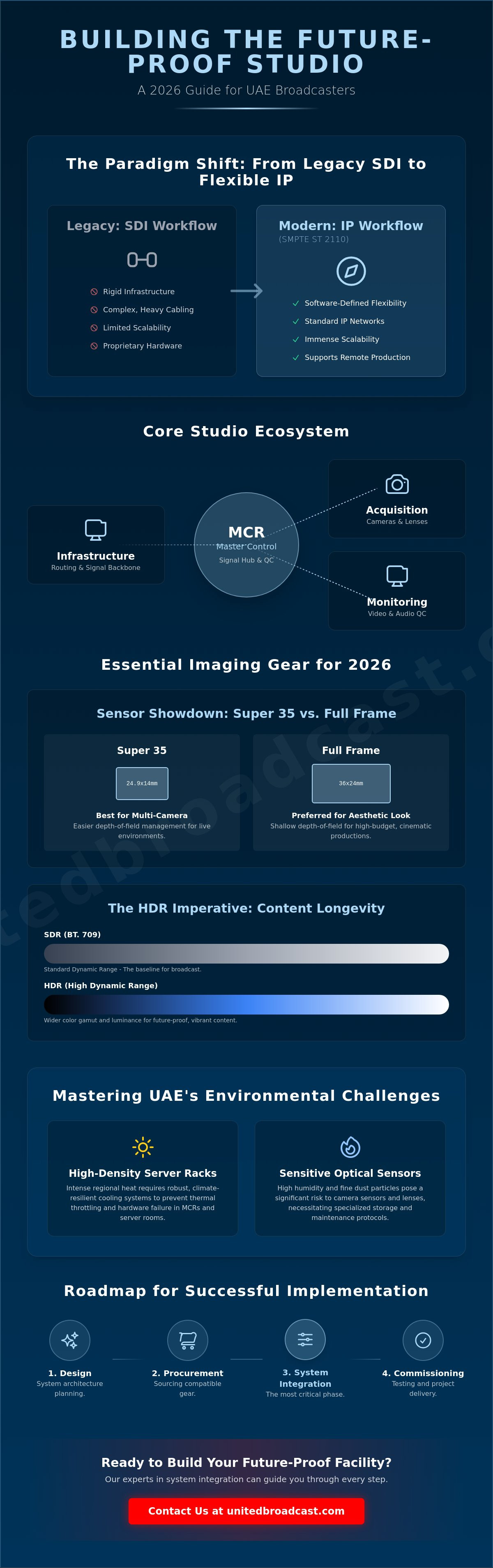
A modern broadcast studio is no longer a collection of isolated hardware units. By 2026, the industry has fully embraced a synchronized network where acquisition, processing, and distribution layers function as a single entity. This shift prioritizes software-defined flexibility over rigid, proprietary hardware. When you invest in broadcast studio gear UAE facilities require, you aren't just buying equipment; you're building a scalable infrastructure capable of handling linear TV, Over-the-Top (OTT) streaming, and hybrid production models simultaneously. Adopting a holistic approach to procurement is essential to prevent technical bottlenecks that often occur when disparate systems fail to communicate effectively.
Establishing these systems requires a deep understanding of Broadcast engineering principles to ensure that every component, from the camera sensor to the final encoder, operates within global standards. In a market as competitive as the Emirates, the ability to pivot between different delivery formats without overhauling physical hardware is a primary advantage for any professional media house.
The Shift from SDI to IP-Based Workflows
The transition from traditional Serial Digital Interface (SDI) to Internet Protocol (IP) based workflows is the most significant change in UAE media centers. The SMPTE ST 2110 standard has become the benchmark for professional facilities, allowing for the transport of uncompressed video, audio, and data over standard IP networks. This move offers immense scalability and significantly reduces the weight and complexity of cabling. For facilities currently operating on 12G-SDI infrastructure, the transition doesn't need to happen overnight. Many broadcasters are successfully implementing hybrid gateways that allow legacy hardware to coexist with new IP-based routing, providing a manageable path toward full remote production capabilities.
Core Components of a Professional Studio
A functional studio environment is typically categorized into three tiers: acquisition, infrastructure, and monitoring. At the center of this sits the Master Control Room (MCR), which serves as the primary hub for signal management and quality control. While the infrastructure provides the backbone, professional video cameras remain the most critical investment for any UAE broadcaster. These devices serve as the entry point for all content, and their ability to integrate with high-speed network switches determines the overall agility of the production. By focusing on gear that supports open standards, studios can ensure long-term viability in a rapidly evolving market.
Essential Video and Imaging Gear for UAE Broadcasters
The visual standard for television in the Emirates has reached a point where viewers expect cinematic quality even in daily news cycles. According to the Middle East Media and Entertainment Market report, the UAE continues to lead regional investment in high-end production infrastructure. Choosing the right imaging core for your broadcast studio gear UAE setup involves a critical decision between Super 35 and Full Frame sensors. Super 35 remains the reliable choice for multi-camera environments due to easier depth-of-field management. However, Full Frame sensors are gaining ground in high-budget talk shows where a shallower, more aesthetic look is preferred.
High Dynamic Range (HDR) and wide color gamut are no longer optional features in 2026. While technical standards like ITU-R BT. 709-5 remain the baseline for many, professional facilities are increasingly mastering in HDR to ensure content longevity. Balancing your budget between camera quantity and lens quality is a delicate process. It's often better to deploy four cameras with superior glass than six with entry-level optics. For secondary angles or automated newsroom environments, PTZ cameras have evolved to include high-quality sensors that match the color science of primary studio units, allowing for seamless visual continuity.
System Cameras vs. Digital Cinema Cameras
Traditional system cameras are designed for the rigors of live broadcast. They offer integrated tally lights, return video feeds, and comprehensive genlock support. These features are vital for fast-paced live environments where the director needs immediate communication with operators. We're seeing a significant trend where digital cinema cameras are integrated into studio chains to provide a "film look" for lifestyle and interview programs. Synchronizing these diverse camera types requires advanced color matching and external synchronization hardware to ensure the switcher receives perfectly aligned signals.
Optics and Lenses for Studio Environments
The shift toward 4K and 8K production makes certified glass a necessity. Lenses must resolve the high pixel density of modern sensors without chromatic aberration. Servo-controlled zoom lenses are the backbone of the studio. They provide smooth focal changes that can be operated remotely from the control room. In specific scenarios, prime lenses are used to prioritize a wide aperture and superior sharpness, though they lack the versatility of a high-end zoom. Investing in quality optics ensures that your imaging chain remains relevant as sensor technology continues to advance.
Infrastructure and Signal Management: The Studio Backbone
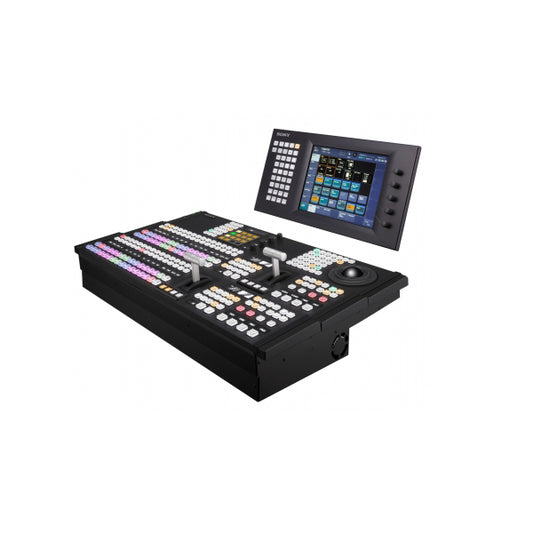
The infrastructure of a media facility acts as its nervous system, ensuring that high-bitrate signals move from acquisition to delivery without degradation. In the UAE's high-stakes media environment, the video switcher serves as the heart of this operation. Broadcasters must choose between dedicated hardware switchers and software-defined platforms. Hardware-based systems offer deterministic latency and physical reliability, which are essential for live sports and news. Software-defined platforms, however, provide the agility to add features like 4K support or advanced keying through simple updates. Selecting the right broadcast studio gear UAE professionals rely on requires balancing this immediate performance with long-term scalability.
Signal routing and distribution have moved beyond simple matrix switchers. Achieving zero-latency across a facility now involves sophisticated IP fabric or high-bandwidth 12G-SDI routers. This backbone is only as stable as its synchronization. Master clock generators and Precision Time Protocol (PTP) are critical for keeping every device in the chain aligned. Without perfect synchronization, frames drop and digital artifacts appear, compromising the professional standard required by the National Media Authority. Audio integration follows a similar path, with the industry moving toward Audio over IP (AoIP) standards like Dante and AES67. These protocols allow for hundreds of uncompressed audio channels to travel over a single network cable, simplifying the once-complex task of studio wiring.
Video Switchers and Production Servers
Modern production switchers are defined by their Mix/Effects (M/E) banks. For complex live transitions, having multiple M/Es allows directors to prepare layered compositions before they go on air. We're also seeing the rise of AI-assisted switching, which automates routine camera cuts and graphics integration. On the backend, ingest servers must handle multi-channel, high-bitrate footage without bottlenecking. These servers are the bridge between live production and post-production, making their reliability a non-negotiable factor.
Monitoring and Multiviewer Solutions
Accuracy in the Master Control Room depends on high-quality monitoring. OLED panels have become the standard for critical color grading and quality control (QC) due to their perfect black levels. LCDs remain popular for multiviewer walls where high brightness and longevity are prioritized. Configuring multiviewer layouts is a strategic task; directors and producers need clear, customizable oversight of all active feeds. Using essential scopes and waveform monitors ensures that every signal complies with ITU-R BT. 709-5 standards before it leaves the facility.
Environmental and Technical Challenges in the UAE
The harsh environmental conditions of the Arabian Peninsula present unique operational risks that standard equipment lists often ignore. High-performance broadcast studio gear UAE facilities utilize must be shielded from extreme ambient temperatures and pervasive fine dust. In the UAE, high-density server racks can quickly exceed safe thermal thresholds if cooling systems aren't specifically engineered for the regional climate. Dust mitigation is equally critical; even microscopic particles can settle on optical sensors or clog the internal cooling fans of high-speed processors, leading to premature hardware failure. This requires a multi-layered approach to filtration and air purification within the machine room to prevent abrasive particles from entering sensitive chassis.
Power stability is another local priority. While the UAE power grid is modern, the high load from industrial cooling systems can cause subtle voltage fluctuations or surges. Implementing online Uninterruptible Power Supply (UPS) systems is the only way to ensure a clean, consistent power feed for sensitive electronics. Additionally, managing humidity within air-conditioned studios is vital. If levels aren't controlled, moisture can lead to lens fungus, which permanently damages expensive optics. Maintaining a relative humidity between 40% and 50% is the professional standard for preventing biological growth on glass elements and internal circuitry.
Protecting High-End Electronics
Thermal management for 8K processing gear requires dedicated cold-aisle containment to prevent heat recirculation within high-density racks. Effective airflow management involves using blanking panels to seal unused rack spaces, ensuring that chilled air is forced through the equipment rather than around it. Regular maintenance schedules should include monthly filter inspections and sensor cleaning to identify environmental wear before it causes a system-wide failure. Establishing these protocols ensures that your investment remains protected against the specific stresses of the local environment.
Ensuring 24/7 Uptime with Redundant Systems
Designing for N+1 redundancy ensures that a single failure in a signal path or power supply doesn't take the entire facility off air. This involves having secondary routers and power modules ready to take over the load instantly. This physical redundancy must be backed by reliable technical support. Accessing an authorized service center is essential for maintaining manufacturer warranties and ensuring that spare parts are available within the country. Relying on unauthorized repairs often leads to incompatible components and long-term instability in your broadcast chain. If your equipment requires specialized care, our Service Center Repairs provide the technical infrastructure needed to keep your facility operational.
Strategic Implementation of Your Broadcast Solution
Successful studio deployment is defined by the transition from a bill of materials to a fully commissioned production environment. Procuring broadcast studio gear UAE professionals trust is only the first phase. The real value lies in a turnkey partnership that bridges the gap between hardware delivery and the first live broadcast. This process begins with a comprehensive design phase, followed by physical installation and technical commissioning. It's a strategic move that ensures your acquisition and distribution layers are perfectly synchronized from day one. Moving from procurement to deployment without a structured integration plan often leads to technical bottlenecks that can delay your launch by weeks.
Staff training and technical handover are the final, critical steps of a successful build. Your crew needs to understand the new software-defined interfaces and IP routing logic to maximize the equipment's potential. We don't just hand over the keys; we ensure your operators are comfortable with the new signal flow and control surfaces. Looking toward the 2030 roadmap, your studio should be designed with modularity in mind. This allows for future upgrades in processing power or storage without requiring a complete rebuild of the physical infrastructure. It's about building a facility that evolves as new standards emerge in the regional media landscape.
The Role of Professional System Integration
Professional system integration involves meticulous cable management and infrastructure labeling. In a complex IP environment, clear documentation is essential for long-term serviceability and prevents hours of downtime during troubleshooting. Integration also requires precise software configuration and firmware alignment across the entire hardware chain. Making sure a digital cinema camera correctly communicates with a software-defined switcher over a high-speed network is a specialized task. Before the first live broadcast, we conduct rigorous stress-testing to ensure the network can handle peak bitrates and redundant failovers without dropping a single frame.
The technical precision required for broadcast infrastructure often mirrors the standards found in high-end residential technology. For those seeking to implement similar levels of sophisticated automation and network reliability in a home setting, PREMIERE SYSTEMS DESIGN offers HTA-certified custom integration services that bring professional-grade control to luxury smart homes.
Partnering for Long-Term Technical Success
Mission-critical broadcast gear requires national-level support to minimize operational risks. Having a local partner means you aren't waiting for international shipping or remote time zones when a critical component needs attention. Accessing specialized repair services for cinema and broadcast cameras is vital for maintaining the high standards of production expected in the UAE. A dependable technical partner provides the stability needed to focus on content creation rather than hardware maintenance. For those ready to move from planning to execution, we invite you to Contact United Broadcast & Media Solutions (UBMS) for bespoke studio integration and equipment solutions.
Future-Proofing Your Broadcast Infrastructure
Building a resilient media facility in the Emirates requires a shift from viewing equipment as individual units to seeing them as a synchronized, IP-driven ecosystem. You've learned that mastering the transition to modern standards and implementing climate-specific protection strategies are essential for long-term operational success. High-quality imaging and robust signal management form the backbone of any professional studio; however, the true differentiator is a strategic implementation plan that includes expert system integration and specialized local support.
United Broadcast & Media Solutions (UBMS) brings 25+ years of industry expertise to every project, offering turnkey system integration for national broadcasters and independent creators alike. As an Authorized UAE Service Centre, we provide the technical infrastructure and spare parts availability necessary to keep your broadcast studio gear UAE facility on air around the clock. Whether you're upgrading legacy hardware or designing a new IP-based facility, our team is ready to support your vision. Explore our comprehensive range of broadcast studio gear and take the first step toward a world-class production environment. It's time to build a studio that isn't just ready for today but fully equipped for the challenges of the next decade.
Frequently Asked Questions
What is the most important piece of gear for a new broadcast studio in the UAE?
The video switcher is the most important component as it acts as the central hub for all visual sources. While cameras capture the image, the switcher defines the production's complexity and final output quality. In the local market, selecting a switcher that supports both hardware and software-defined workflows ensures you can scale as your production requirements grow over time.
How do I choose between SDI and IP-based broadcast infrastructure?
Choose SDI for smaller, fixed installations where simplicity and lower initial costs are priorities. Opt for IP-based infrastructure, specifically SMPTE ST 2110, if you require high scalability and plan to implement remote production. IP allows for significantly reduced cabling but requires a robust IT network and specialized engineering knowledge to manage the uncompressed data flows effectively.
Can cinema cameras be used effectively in a live TV studio environment?
Yes, digital cinema cameras are increasingly used in live studios to achieve a high-end, shallow depth-of-field look. To do this effectively, you must ensure the cameras support genlock and can be integrated with a Camera Control Unit (CCU) for live color shading. This ensures they match the visual profile of your other system cameras during a multi-cam production.
What are the specific maintenance requirements for broadcast gear in the UAE climate?
Maintenance focuses on air filtration and thermal management to combat the high heat and fine dust of the region. You should inspect cooling fans and clean optical sensors at least once a month. Maintaining a stable, air-conditioned environment with controlled humidity levels prevents lens fungus and ensures the longevity of your high-density server racks and processing hardware.
How much space is required for a professional 4K broadcast control room?
A professional 4K control room typically requires a minimum of 25 to 30 square meters to accommodate ergonomic console layouts and rack space. This ensures enough distance between operators and the multiviewer wall for accurate monitoring. Proper acoustics and separate machine room cooling are also vital considerations that you must address during the initial design phase.
What is the difference between a video switcher and a production server?
A video switcher is used for real-time mixing of live video sources during a broadcast. A production server, however, is designed for the ingest, storage, and playout of pre-recorded clips or multi-channel recordings. Both are essential for a professional 2026 workflow, but they serve distinct roles in the signal chain that cannot be replaced by the other.
How can I ensure my broadcast studio gear is future-proofed for 8K?
Future-proofing requires an infrastructure that supports high data rates, such as 12G-SDI or 100GbE IP networks. When purchasing broadcast studio gear UAE facilities should prioritize components that are software-upgradeable. This allows you to increase resolution and frame rates without replacing the physical routing backbone as 8K standards and higher bitrates become more prevalent in regional media.
Does United Broadcast & Media Solutions (UBMS) provide technical training for new equipment installations?
Yes, United Broadcast & Media Solutions (UBMS) provides comprehensive technical training and handover as part of our system integration services. We ensure your team understands the specific operational logic of your new broadcast studio gear UAE setup. This includes guidance on signal flow, technical troubleshooting, and routine maintenance to guarantee your facility operates at peak efficiency from the very first broadcast.


