

OB Van System Integration: The Professional Guide to Mobile Broadcast Solutions 2026
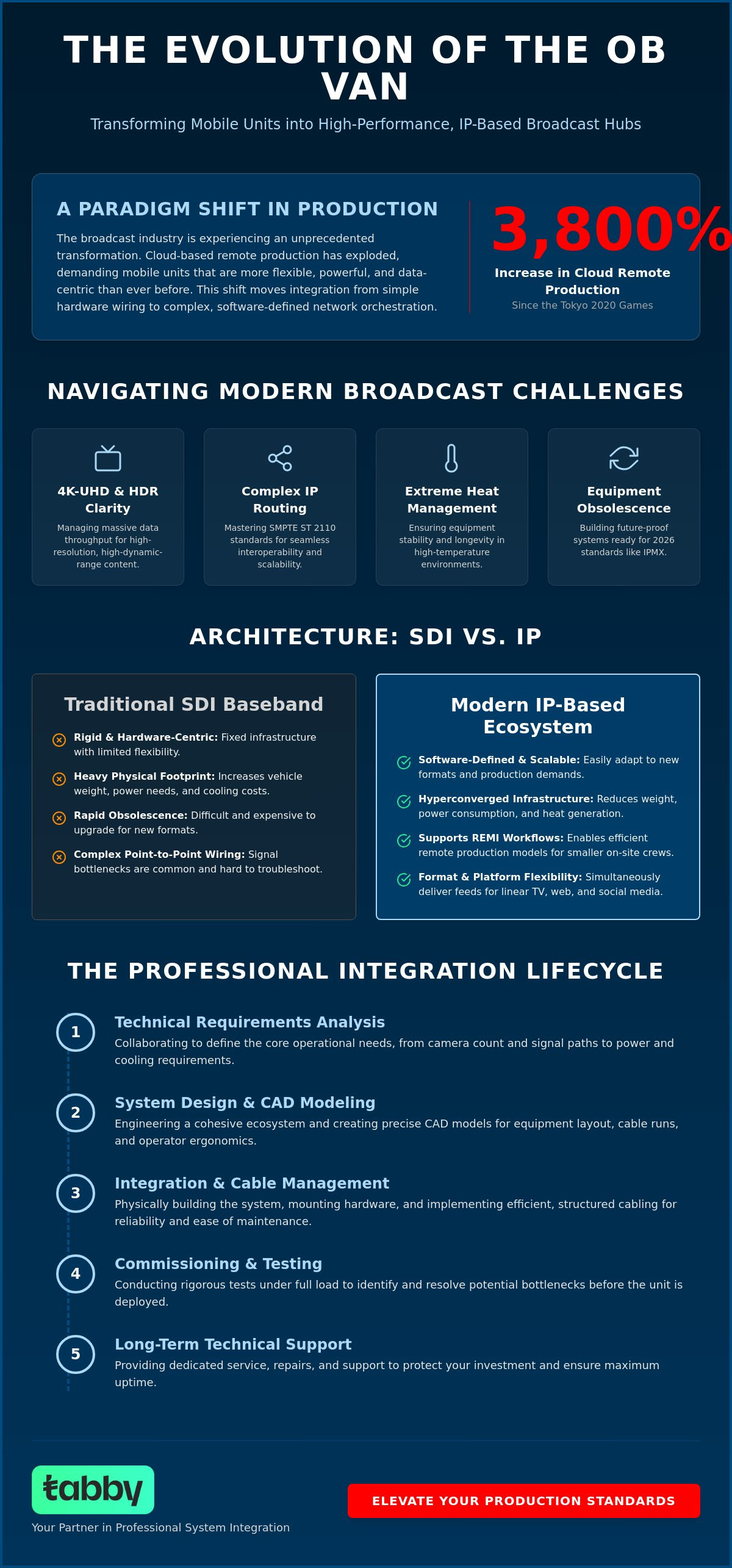
With cloud-based remote production seeing a 3,800% increase in adoption since the Tokyo 2020 Games, the traditional mobile unit is undergoing its most radical transformation in decades. You're likely feeling the weight of this shift as you balance the need for 4K-UHD HDR clarity with the daunting complexity of SMPTE ST 2110 IP routing. In high-demand environments, these technical hurdles are often compounded by extreme heat management requirements and the constant risk of equipment obsolescence.
Successful OB van system integration is no longer just about coachbuilding—though the structural precision required, much like the standards maintained by Swiss Build Ltd, remains a vital foundation—it's about engineering a software-defined ecosystem that remains stable under pressure. This guide provides a professional roadmap to transforming your mobile units into high-performance broadcast hubs using the latest IP and UHD technologies. We'll examine the 2026 launch of the IPMX standard, the implications of the revised ST 2110-30:2025 audio protocols, and strategies for achieving seamless interoperability between cinema cameras and broadcast switchers. You'll discover how a turnkey approach ensures your investment is backed by the long-term technical support necessary to keep you on air.
Key Takeaways
- Understand why modern integration shifts from physical coachbuilding to software-defined IP networking to meet evolving 2026 broadcast standards.
- Identify the critical technical components, including high-performance switchers and advanced intercom systems, required to build a resilient mobile production hub.
- Evaluate the benefits of SMPTE ST 2110 and NMOS architectures to achieve the scalability and format flexibility offered by professional OB van system integration.
- Follow a structured project lifecycle that moves from technical requirements analysis to precise CAD modeling and efficient cable management.
- Discover how specialized regional expertise and dedicated service center repairs protect your investment and ensure long-term technical reliability.
The Strategic Role of System Integration in Modern Outside Broadcast
Professional OB van system integration is the technical architecture that allows discrete hardware components, software protocols, and human workflows to function as a unified, high-performance production hub. It isn't merely a matter of mounting equipment into racks. It's a precise engineering discipline that ensures signal paths remain clear, power distribution stays stable, and operators can work efficiently under the intense pressure of live events. In 2026, as broadcast standards demand higher resolutions and lower latencies, the role of the integrator has shifted from simple wiring to complex network orchestration.
The transition toward software-defined mobile units represents a major shift in how we approach production. Traditional hardware-centric designs were rigid and heavy, often leading to rapid equipment obsolescence. Modern integration focuses on hyperconverged infrastructure. This approach combines video routing, audio processing, and multiviewing into single, scalable platforms. The economic impact is immediate. By reducing the physical footprint of the gear, you lower the vehicle's weight and power requirements. This is particularly vital in Middle Eastern climates where heat management and cooling efficiency directly affect the operational lifespan of your electronics.
The Evolution of the OB Van Workflow
The fundamental nature of Outside broadcasting (OB) is changing. We've moved from traditional SDI baseband setups to hybrid and pure IP architectures. This shift allows for greater format flexibility, but it increases the complexity of signal management. Modern units must also accommodate Remote Integration Model (REMI) workflows. REMI allows a smaller on-site crew to capture content while the heavy lifting of vision mixing and editing happens back at a central studio. This requires a van design that prioritizes data connectivity and low-latency encoding. Additionally, your unit must now handle multi-platform delivery, simultaneously pushing high-quality feeds to linear TV, web streams, and social media platforms from a single technical core.
Professional Integration vs. In-House Builds
Choosing professional OB van system integration over an in-house build is primarily about risk mitigation. In-house projects often suffer from signal bottlenecks or power imbalances that don't appear until the system is under full load. A professional integrator provides a single point of technical accountability. You don't have to manage five different vendors when a synchronization issue occurs; you have one partner who understands the entire ecosystem. Professional builds also grant access to specialized tools for precision camera calibration and signal testing. These ensure that every professional video camera in your fleet delivers consistent color and luminance across the entire production, protecting the visual integrity of your brand.
Essential Technical Components for High-Performance Mobile Units
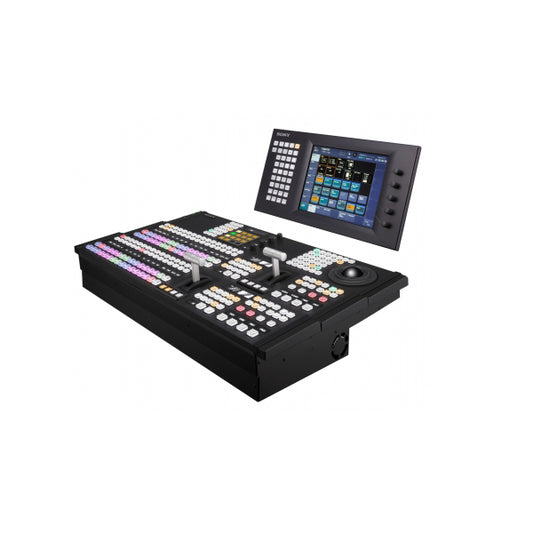
High-performance video switchers and routers serve as the central nervous system of any mobile production unit. In a professional OB van system integration project, these components must handle massive data throughput with zero latency. While traditional SDI routers were the standard for decades, modern builds increasingly rely on to manage complex signal paths. This infrastructure allows for the seamless distribution of UHD signals while maintaining the flexibility to scale as production needs grow. It's the difference between a rigid hardware setup and a fluid, adaptable environment.
Coordination is the backbone of live production. Advanced audio monitoring and intercom systems aren't just accessories; they're essential for crew synchronization. We integrate multi-channel intercoms that bridge the gap between the director, camera operators, and the engineering room. High-tier broadcast monitors further ensure that what the director sees is color-accurate. This provides the necessary confidence for live HDR grading and quality control in the field. Every component must be selected for its ability to withstand the rigors of travel and the demands of continuous operation.
Bridging Digital Cinema and Live Broadcast
The demand for a cinematic look in live sports and high-profile events has led to the integration of professional video cameras equipped with large sensors into traditional broadcast switchers. By using cinema lenses, operators can achieve a shallow depth-of-field that was previously impossible in outside broadcasting. Our OB van system integration solutions adapt these cinema sensors for live shading and tally control. This ensures that the visual aesthetic of a film production meets the functional requirements of a live broadcast environment without compromising on technical control.
Lighting and Grip Infrastructure
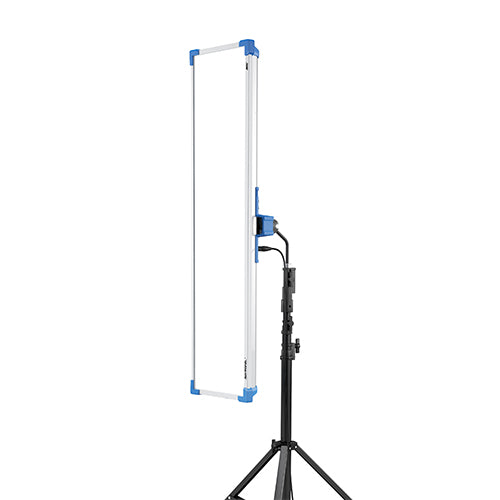
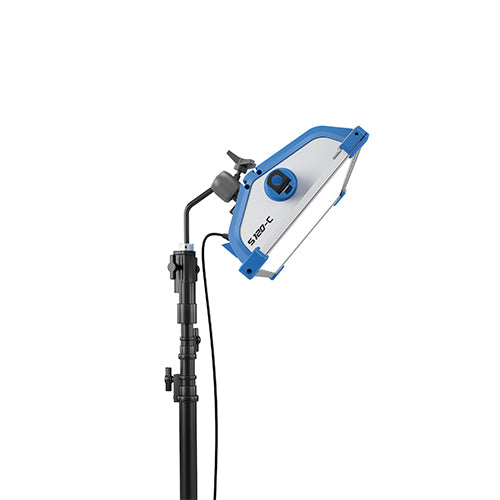
Lighting is often overlooked in mobile units, but it's critical for studio-on-wheels configurations. We incorporate ARRI lighting to provide high-end, flicker-free illumination that matches the quality of fixed studios. Managing power for high-output LED fixtures in a confined mobile environment requires precise load balancing to prevent thermal issues. Space-saving grip solutions further optimize the limited floor space, allowing for stable camera support without obstructing vital walkways. If you're looking to upgrade your current fleet's technical capabilities, you can consult with our technical team for a customized integration plan.
IP-Based vs. Traditional SDI Integration: Choosing the Right Architecture
The choice between Serial Digital Interface (SDI) and Internet Protocol (IP) is the most critical architectural decision in modern OB van system integration. While SDI has been the industry workhorse for decades, the transition to the SMPTE ST 2110 suite is now the standard for high-tier mobile units. As of June 17, 2026, SMPTE has made its entire library of standards freely accessible. This policy shift has removed the traditional barriers to entry, allowing engineering teams to implement ST 2110-30:2025 audio protocols and NMOS discovery standards with greater transparency. Unlike SDI, which bundles signals into a single physical cable, IP architectures separate video, audio, and ancillary data into independent essence streams. This allows for unprecedented format flexibility and more efficient signal routing.
Transitioning to IP isn't without its challenges. Bandwidth management is a primary concern. A single uncompressed 4K stream requires significant throughput, necessitating robust 25GbE or 100GbE network backbones. Security is also a vital consideration in a mobile broadcast environment. Since IP-based vans are essentially data centers on wheels, they require advanced network security protocols to prevent unauthorized access or signal interference during live transmissions. Our approach focuses on creating a secure, high-capacity network that serves as a stable foundation for your production tools.
The Scalability of IP Infrastructure
IP infrastructure offers scalability that traditional baseband cannot match. You can expand a fleet from four to over 30 cameras by simply adding network switches rather than rewiring the entire vehicle. This architecture is inherently future-proof. It allows you to transition to 8K and beyond without replacing physical copper cables. Furthermore, the virtualization of broadcast functions within the OB network means that many tasks previously handled by dedicated hardware can now run on commercial off-the-shelf (COTS) servers. This reduces the physical weight of the van and simplifies the internal cooling requirements.
SDI and Hybrid Workflows
Despite the push for all-IP, hybrid workflows remain a practical choice for many broadcasters. SDI provides a "plug-and-play" reliability that's hard to beat for mission-critical, high-stakes productions where simplicity equals stability. We use high-performance gateways to bridge legacy baseband equipment with modern IP cores. This allows you to leverage existing professional video cameras while benefiting from the routing efficiency of an IP backbone. A hybrid model often provides the best cost-to-performance ratio for mid-tier production fleets that don't yet require a pure IP ecosystem.
The Step-by-Step Lifecycle of a Broadcast Integration Project
Professional OB van system integration follows a methodical progression that transforms a conceptual production need into a commissioned technical reality. This lifecycle begins with an exhaustive technical requirements analysis. We work closely with your engineering teams to define the camera count, signal protocols, and delivery formats. This initial phase is critical for preventing scope creep and ensuring the final unit meets both current operational demands and future scalability requirements. Every decision made here informs the structural and electronic design of the vehicle.
Once the requirements are finalized, the project moves into detailed system design and CAD modeling. This stage involves mapping every rack layout, cable run, and signal path with mathematical precision. We don't just plan for the equipment; we plan for the heat it generates and the power it consumes. Following the design approval, we move to equipment procurement and off-site pre-staging. By building and testing the technical core in a controlled studio environment before installation, we identify and resolve potential software conflicts or hardware failures early. This significantly reduces the time the vehicle spends in the workshop and ensures a faster path to commissioning and on-site training.
Technical Design and Ergonomics
A mobile unit is a high-pressure workspace where operators often pull 12-hour shifts during major live events. Optimizing internal space for comfort and workflow efficiency is just as important as the signal chain. Our designs incorporate custom furniture for broadcast control surfaces that prioritize ergonomic reach and line-of-sight to multiviewers. We also implement sophisticated acoustic treatments to manage noise floor levels, ensuring that audio engineers can make critical monitoring decisions without interference from the hum of technical racks or external ambient noise.
Environmental Engineering for the UAE
Operating a mobile production unit in the Middle East presents unique challenges that standard global builds often ignore. We design heavy-duty HVAC systems specifically engineered to maintain stable internal temperatures even when ambient heat exceeds 50°C. Dust filtration is another priority; we use specialized sealing techniques to protect sensitive cinema camera sensors and optical components from fine desert sand. Additionally, our OB van system integration process includes advanced vibration damping for all technical racks. This protects delicate electronics from the mechanical stress of transit across varied terrain, ensuring your equipment arrives at the venue in perfect working order. To begin planning your next mobile project, you can request a technical consultation with our integration specialists.
Elevating Production Standards with UBMS Integration Solutions
Choosing a partner for OB van system integration is a decision that impacts your production capabilities for years. United Broadcast & Media Solutions (UBMS) brings decades of specialized expertise to the UAE market, acting as a bridge between complex global engineering standards and local operational requirements. We don't just deliver a vehicle. We provide a lifecycle partner that understands the high stakes of live broadcasting. Our role is to ensure that your mobile unit remains a reliable asset, even as IP standards and UHD requirements continue to evolve through 2026 and beyond.
Our integration philosophy relies on strategic partnerships with industry leaders like Sony and ARRI. These relationships grant us early access to technical roadmaps and specialized firmware, ensuring your hardware and software are perfectly synchronized. Beyond the initial build, we provide a dedicated service center for long-term equipment maintenance and repairs. This infrastructure addresses a critical pain point for regional broadcasters: the need for specialized, local technical support that can minimize downtime when hardware issues arise in the field.
Local Expertise and Global Standards
Working with a national partner offers the distinct advantage of immediate spare parts availability and on-site technical assistance. We strictly adhere to international broadcast standards, including those set by the EBU and SMPTE, ensuring your unit is ready for international co-productions and high-stakes live events. Our experience in the region means we've already solved the environmental and logistical challenges mentioned in previous sections. We've refined our workflows through years of practical application in one of the world's most demanding climates, giving you the confidence that your system will perform when the "On Air" tally lights up.
Turnkey Solutions for Media Professionals
We provide comprehensive turnkey solutions that range from compact, single-camera vans to multi-trailer mobile units. Each project includes customized broadcast studio gear packages tailored to your specific production style. This holistic approach covers everything from the initial CAD modeling to comprehensive after-sales technical training for your production teams. We ensure your crew is fully proficient with the new IP-based routing and UHD signal chains before the first live transmission. If you're ready to modernize your mobile fleet or design a new production hub from the ground up, you can contact UBMS for a detailed system integration consultation to discuss your technical requirements.
Future-Proofing Your Mobile Broadcast Infrastructure
The broadcast landscape is moving fast. Adopting SMPTE ST 2110 IP architectures and UHD workflows isn't just a technical upgrade; it's a strategic necessity for remaining competitive. As we've explored, success depends on more than just selecting the right equipment. It requires a meticulous design lifecycle that accounts for environmental resilience, ergonomic efficiency, and seamless signal orchestration. Modern OB van system integration effectively bridges the gap between high-end cinema aesthetics and the rigorous demands of live transmission.
Since 1997, United Broadcast & Media Solutions has served as a trusted advisor to the regional media community. As an official distributor for Sony and ARRI, we provide direct access to world-class technology backed by a dedicated UAE-based service center for long-term maintenance. Our team is ready to help you navigate the complexities of software-defined production and hybrid workflows. Consult with our System Integration Experts today to begin designing a turnkey solution that meets your specific production goals. Your next high-performance broadcast hub is within reach.
Frequently Asked Questions
What is the typical timeline for an OB van system integration project?
A professional OB van system integration project typically requires a timeline of six to twelve months from initial consultation to final commissioning. This duration accounts for the technical requirements analysis, specialized procurement of global components, and the off-site pre-staging of technical racks. Complex multi-trailer units may extend beyond this window, while smaller van conversions can often be completed more quickly depending on the vehicle chassis availability.
Can an existing SDI-based OB van be retrofitted for IP workflows?
Existing SDI-based vans can be successfully retrofitted for IP workflows using a hybrid architecture. By integrating high-performance gateways, we bridge your legacy baseband equipment with a modern IP core. This approach allows you to maintain your current investment in professional video cameras while gaining the scalability of a software-defined network, providing a cost-effective path toward a full IP transition without replacing every component.
How does IP-based integration improve remote production capabilities?
IP-based integration facilitates remote production (REMI) by allowing separate video, audio, and data streams to be transported efficiently over managed networks. Unlike SDI, which requires heavy cabling for every signal, IP uses standardized protocols to send high-quality feeds to a central studio with minimal latency. This reduces the number of on-site staff required and lowers the overall operational costs of live event coverage across long distances.
What are the cooling requirements for broadcast equipment in the UAE climate?
Cooling systems in the UAE must be engineered for extreme ambient temperatures that frequently exceed 50°C. We implement redundant, high-capacity HVAC units that provide positive pressure within the technical racks to prevent dust ingress. It's essential to use high-velocity airflow management and thermal monitoring sensors to protect sensitive electronics from heat-related failures during prolonged outdoor operations in desert environments.
Why is SMPTE ST 2110 important for modern system integration?
SMPTE ST 2110 is the foundational standard for uncompressed professional media over managed IP networks. It's critical for modern OB van system integration because it ensures seamless interoperability between equipment from different manufacturers. By separating media into independent essence streams, it provides the format flexibility needed for 4K-UHD and HDR production without the constraints of traditional hardware-bound signal paths.
Does UBMS provide training for the integrated systems?
Yes, UBMS provides comprehensive technical and operational training as a standard part of our turnkey integration services. We ensure your production team and engineering staff are fully proficient with the new signal chains, control surfaces, and network management tools. This hands-on guidance is vital for maximizing the performance of your system and ensuring a smooth transition to new technologies after the build is complete.
What is the difference between a mobile studio and a traditional OB van?
A traditional OB van is primarily a signal processing hub designed for routing and switching live feeds, whereas a mobile studio often includes dedicated space for sets, talent, and content creation. While an OB van focuses on technical infrastructure and connectivity, a mobile studio is built to serve as a self-contained production environment for talk shows, news, or interviews directly in the field.
How do you ensure signal redundancy in a mobile production environment?
Signal redundancy is achieved through the implementation of dual, independent network paths, often referred to as Red and Blue networks. We utilize SMPTE ST 2022-7 for hitless switching, which ensures that if one path fails, the other takes over instantly without any disruption to the broadcast. This hardware and software redundancy is essential for maintaining 99.99% uptime during mission-critical live transmissions where failure isn't an option.


