

Cinema Lens Repair Dubai: The Professional’s Guide to Optical Maintenance
A single grain of fine desert sand is often all it takes to compromise a hundred thousand dollars worth of precision-engineered cinema glass. You know that in high-stakes production, there's no room for technical error. A lens that isn't perfectly calibrated or has developed internal fungal growth due to the local humidity can turn a masterpiece into a costly technical failure. Relying on international shipping for cinema lens repair Dubai often results in weeks of downtime that your production schedule simply won't allow.
It's vital to have a technical partner who understands the rigorous standards required to maintain professional optics within the UAE's unique climate. This guide explores the specialized solutions needed to keep your glass performing at factory specifications. We'll examine the technical processes used to combat environmental degradation, the necessity of authorized calibration for modern 8K and 12K sensors, and expert strategies for maximizing the operational longevity of your most valuable equipment. You'll gain the insights necessary to ensure your lenses remain reliable assets on every shoot.
Key Takeaways
- Learn why the UAE’s unique environmental factors necessitate a higher standard of preventative maintenance compared to consumer-grade servicing.
- Understand the critical role of lens projectors and collimation in professional cinema lens repair Dubai to ensure optical precision for high-resolution sensors.
- Identify the essential infrastructure requirements, such as clean room environments and manufacturer certifications, when selecting a technical partner for your glass.
- Discover how to diagnose common mechanical and optical faults, including back-focus issues and lubricant degradation, before they impact your production schedule.
- Explore the logistical advantages of utilizing local, authorized technical support to minimize turnaround times while maintaining factory-standard performance.
Why Professional Cinema Lens Maintenance is Non-Negotiable
Professional cinema glass represents a significant capital investment. Unlike standard photography lenses, these precision instruments are built to survive the rigors of a film set while delivering consistent results across an entire production. However, the complexity of their internal mechanics means that maintenance isn't a luxury; it's an operational requirement. When you're shooting in the UAE, the stakes are even higher. Specialized cinema lens repair Dubai services are essential because the difference between a functional lens and a calibrated one can determine the success of a high-budget project.
The Anatomy of a Cinema Lens vs. Photography Lenses
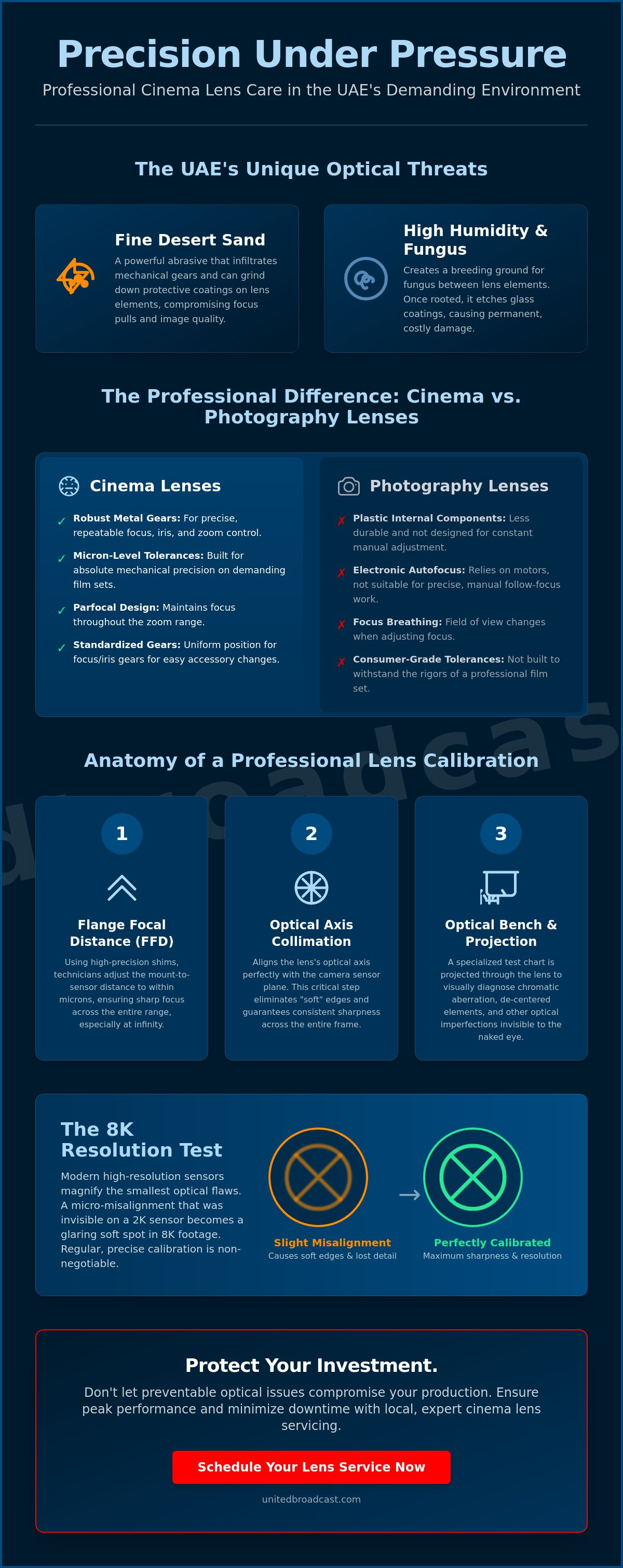
The mechanical design of Cine lenses is fundamentally different from their still-photography counterparts. While a photography lens might rely on electronic autofocus and plastic internal components, cinema glass uses robust metal gears for focus, iris, and zoom. These components must move with absolute fluid precision. If the focus ring develops a slight "hitch" or the iris doesn't hit its T-stop exactly, the lens is effectively compromised for professional use. Standard repair shops often lack the specialized lens projectors and collimators required to verify that the optical elements are perfectly centered and that the back-focus is accurate to the micron.
Environmental Challenges for Optics in the Middle East
The local climate in Dubai poses unique threats to optical glass. High humidity, especially in coastal areas, creates a breeding ground for fungus between lens elements. Once fungus takes root, it can etch the glass coatings, causing permanent damage that's far more expensive to fix than a routine cleaning. Additionally, fine desert sand acts as a powerful abrasive. It infiltrates the mechanical gears and can grind down the protective coatings on the front element. Proactive maintenance, including professional deep cleaning, is the only way to mitigate these risks. You can find more detailed strategies for Protecting Cinema Cameras from Humidity and Dust to help extend the life of your equipment between service intervals.
Beyond environmental factors, the rise of 8K sensors has narrowed the margin for error. A micro-misalignment that was invisible on a 2K sensor becomes a glaring soft spot in high-resolution footage. Regular cinema lens repair Dubai ensures that your glass can resolve the detail these modern sensors are designed to capture. Preventative servicing identifies worn lubricants or loose internal screws before they lead to a total mechanical failure in the middle of a shoot day. It's about protecting your image quality and your bottom line simultaneously.
Essential Technical Standards for Cinema Lens Calibration
Cinema lens calibration is an exacting discipline that bridges the gap between creative intent and technical execution. Unlike consumer gear, which often relies on software-based autofocus corrections, professional cinema glass requires manual, hardware-level adjustments based on optical engineering principles. This ensures that every element within the lens barrel is perfectly aligned and that the distance between the rear element and the sensor is accurate to within microns. Achieving this level of precision is the cornerstone of cinema lens repair Dubai services.
Collimation and Flange Focal Distance
Flange Focal Distance (FFD) is the measurement from the lens mount's mounting surface to the sensor plane. If this distance is off by even 0.01mm, a lens might lose its ability to hit infinity focus or fail to maintain focus throughout a zoom range. Technicians use high-precision stainless steel shims to adjust this distance for PL, LPL, and EF mounts. Collimation is the process of aligning a lens’s optical axis with the camera sensor plane. Without perfect collimation, you risk "soft" edges and inconsistent sharpness across the frame. This becomes painfully obvious on modern high-resolution sensors where every pixel is scrutinized.
Optical Bench Testing and Projection
A professional service center uses a lens projector to cast a specialized test chart through the lens onto a wall. This allows technicians to see exactly how the lens performs in a controlled environment. By analyzing the projected image, they can identify chromatic aberration, edge softness, and "de-centered" elements. A de-centered element occurs when an internal glass piece has shifted slightly, often due to physical impact or extreme temperature changes. This results in one side of the image being sharper than the other, a flaw that can't be fixed in post-production.
Technicians also use the projector to verify the tracking of zoom lenses. It's critical that the center of the image doesn't "drift" as you move from wide to tight. They also check for "breathing," which is the change in focal length that occurs when the focus is pulled. While some breathing is inherent to certain vintage lens designs, excessive image shift during a focus pull often indicates mechanical wear or loose internal components. If you suspect your glass is losing its edge, you can consult with our technical team for a full diagnostic evaluation.
Choosing a Professional Cinema Lens Repair Dubai Centre
Selecting a technical partner for your cinema glass is a business decision that directly impacts your production's reliability. While many generalist shops offer camera body repairs, cinema lenses require a specific laboratory environment. The presence of a certified clean room is the first indicator of a professional cinema lens repair Dubai facility. Opening a lens in a standard workshop allows airborne particulates to settle on internal elements, leading to permanent optical degradation once the lens is reassembled. Laboratory-grade environments ensure that your glass remains as pristine as the day it left the factory.
Authorized Service vs. Independent Shops
Authorized service status is a critical differentiator for professional filmmakers. When a centre is certified by brands like Sony or ARRI, they gain access to proprietary factory diagnostic software and specialized tools that are never released to the open market. This software is essential for communicating with the lens's internal electronics to calibrate metadata and electronic iris control. Furthermore, using an authorized facility protects your manufacturer warranty. If an uncertified technician opens the lens barrel, any existing coverage is typically voided instantly.
The choice of materials used during a repair is equally important. Professional technicians use proprietary lubricants specified by the manufacturer. Lower-grade, non-standard lubricants can "outgas" over time. This phenomenon occurs when oils within the lubricant evaporate and then condense as a thin film on the internal glass elements, severely reducing contrast and image clarity. Only an authorized centre guarantees the use of genuine parts and factory-spec consumables.
What to Look for in a Service Agreement
A professional service relationship should be built on transparency and logistical efficiency. High-end service centres provide detailed fault reporting and clear estimations before any work begins. This allows production houses to make informed decisions regarding repair versus replacement. Turnaround time is another vital metric. In the fast-paced UAE media landscape, every day a lens is in the shop is a day it isn't generating revenue. Look for partners who offer clear timelines and have a robust local inventory of spare parts to avoid the delays associated with international shipping.
For a deeper look at the technical requirements for maintaining your equipment, you can read our guide on Precision Camera Calibration Service in the UAE. This resource details the synergy between lens and camera body calibration. Finally, consider the scale of the service network. A provider with a national footprint offers better logistical support for shoots moving between Dubai, Abu Dhabi, and other regions, ensuring that expert cinema lens repair Dubai standards are accessible wherever your production takes you.
Identifying Common Optical and Mechanical Faults
Identifying a fault before it compromises a high-budget shoot is a critical skill for any camera assistant or owner-operator. In the harsh environment of the UAE, mechanical issues often manifest subtly before leading to total equipment failure. Professional cinema lens repair Dubai services frequently address issues that stem from a combination of environmental stress and the high-intensity usage patterns typical of professional sets. Recognizing these red flags early can save thousands in potential element replacements.
One of the most frequent complaints technicians receive involves stiff focus or iris rings. This resistance is usually the result of dried-out lubricants or the infiltration of fine desert dust into the mechanical helicoids. If you ignore this friction, it can eventually grind down internal brass or aluminum components, leading to permanent damage. Similarly, back-focus issues, where a lens fails to hit infinity focus on a calibrated sensor, often indicate that the flange focal distance has shifted due to physical shock or mount wear.
Mechanical Wear and Tear in Cinema Glass
The widespread use of high-torque wireless follow-focus motors has changed the nature of lens maintenance. These powerful motors apply significant pressure to internal gears and cam followers, especially when hitting hard stops. Over time, this stress leads to mechanical "play" or a perceptible wobble in the lens barrel. Smoothness isn't just a tactile preference; it's a technical indicator that the internal cam followers and helicoids are properly seated. If the movement feels gritty or uneven, the internal mechanisms likely require a deep clean and re-lubrication with factory-spec compounds.
Optical Surface Damage and Coatings
Optical faults such as internal "haze" or dust significantly impact image quality by reducing contrast and increasing unwanted flare. In many cases, this haze is a precursor to fungal growth, which thrives in humid coastal environments. Surface damage, including scratches on the front or rear elements, requires expert assessment. While minor coating scratches might only affect flare characteristics, deeper gouges necessitate element replacement to maintain the optical standards required for Professional Video Cameras.
Re-coating an element is a complex factory-level process, and in most instances, replacing the glass element entirely is the most reliable path to restoring factory performance. If you notice any irregularities in your lens's movement or a sudden drop in image contrast, contact our technical service team for a comprehensive diagnostic evaluation. Addressing these faults early ensures your glass remains a reliable asset for years to come.
The UBMS Service Centre Advantage for Cinema Optics
United Broadcast & Media Solutions (UBMS) has operated as a foundational pillar of the regional media industry for over 25 years. This extensive history provides our technical team with unparalleled insight into how the UAE's environmental conditions affect high-end optics over time. As an authorized service centre for the world's leading cinema and broadcast brands, our facility is equipped to restore your equipment to its original factory specifications. When professionals require cinema lens repair Dubai, they choose a partner that combines deep technical expertise with the specific diagnostic tools needed for modern PL, LPL, and anamorphic glass.
Our Technical Workflow
Our technical workflow prioritizes precision and clear communication. Every piece of glass undergoes a rigorous intake inspection and digital fault reporting process. This digital tracking allows production managers to see exactly where their assets are in the repair cycle. It eliminates guesswork and provides a clear roadmap for the restoration of the lens.
Technicians perform all work in controlled environments to prevent dust contamination. We use only manufacturer-approved lubricants and specialized cleaning agents to ensure that internal mechanisms operate with zero friction. The final stage of our process involves testing on high-precision lens projectors. This optical bench testing verifies that the lens resolves detail correctly across the entire sensor area before it's cleared for delivery to the client.
National Support Across the UAE
The UBMS service network supports the entire UAE production community. We provide dedicated assistance to major production houses and solo freelancers from Abu Dhabi to Fujairah. Our logistical infrastructure simplifies equipment transport, ensuring that your valuable glass is handled with care from pick-up to return. We understand the high stakes of a production schedule, so our team works efficiently to minimize downtime.
Our expertise covers a vast range of equipment, from high-end cinema primes to the versatile Sony Alpha Cameras and Lenses used in modern hybrid workflows. By maintaining a local inventory of genuine spare parts, we significantly reduce the turnaround times typically associated with international shipping. This localized, professional approach ensures that cinema lens repair Dubai services remain a reliable resource for the region's most demanding cinematographers and broadcast specialists.
Maintaining Optical Excellence for Your Next Production
Professional cinema glass is more than just a tool; it's a significant financial and creative asset that requires specialized care to perform at its peak. By prioritizing regular calibration and environmental protection, you ensure that your lenses can resolve the extreme detail of today's 8K and 12K sensors. We've explored how technical standards like collimation and projection testing are essential to identifying faults before they disrupt a shoot. Maintaining this level of precision is what separates a standard repair from a factory-grade restoration.
United Broadcast & Media Solutions provides the technical infrastructure needed for high-tier cinema lens repair Dubai, backed by over 25 years of industry experience. As an authorized service centre for Sony and ARRI, we utilize advanced optical bench testing and factory-spec materials to restore your glass to its original performance levels. This professional approach minimizes downtime and protects the longevity of your most valuable equipment in the challenging UAE climate.
Contact the UBMS Service Centre for Expert Cinema Lens Support and ensure your equipment is ready for the rigors of the field. Let's keep your vision sharp and your production schedule on track.
Frequently Asked Questions
How often should I have my cinema lenses professionally serviced?
You should have your cinema lenses professionally serviced at least once every 12 months for standard use, or immediately following an intensive desert or coastal production. Regular maintenance prevents the build-up of micro-particulates in the gear mechanisms and identifies early signs of fungal growth common in the UAE. For high-utilization rental fleets, a six-month inspection interval is recommended to ensure consistent performance across all units.
Can you repair fungus inside a cinema lens in the UAE climate?
We can often remove fungus from internal elements if the growth hasn't yet etched the glass coatings. The high humidity in Dubai and surrounding coastal areas makes fungal development a significant risk for stored optics. Our technicians perform deep cleaning in a clean-room environment to stop the spread and restore clarity, though permanent damage to the coating may require a full element replacement to restore original contrast.
What is the difference between lens calibration and lens repair?
Lens calibration is the precision alignment of optical and mechanical components to ensure the lens hits its technical specifications, such as flange focal distance. Lens repair involves the replacement or fixing of physically damaged or worn-out parts, like broken gears or scratched glass elements. Both services are standard components of professional cinema lens repair Dubai to maintain factory-grade performance and mechanical reliability.
Do you provide a warranty on cinema lens repairs?
We provide a limited warranty on the specific labor and parts used during the service process. This coverage ensures that the mechanical adjustments and optical alignments meet manufacturer standards upon delivery to the client. It's standard practice for out-of-warranty repairs to be quoted after a physical inspection, with work commencing only after your formal approval of the provided technical estimate.
Can you calibrate a lens to a specific camera body?
We can calibrate your lenses to a specific camera body to ensure the sharpest possible results at the sensor plane. This process involves shimming the lens mount or adjusting the camera's flange focal distance to match perfectly. This "matching" is especially critical when using high-resolution 8K sensors where even a micron of misalignment becomes visible as a soft spot in the final image.
What is the typical turnaround time for a cinema lens service in the UAE?
Typical turnaround times for a standard cleaning and calibration range from three to seven business days, depending on current workshop volume and fault complexity. If specific replacement parts must be sourced from international manufacturers, this timeline will extend accordingly. We prioritize providing accurate estimates and digital fault reports to keep your production schedules on track without unnecessary or unexpected delays.
Is it worth repairing an older vintage cinema lens?
Repairing vintage cinema glass is often worth the investment because these lenses possess unique optical characters that modern lenses cannot replicate. Our technicians handle vintage glass with extreme care, focusing on preserving the original coatings while restoring mechanical smoothness. Maintaining these assets correctly ensures they retain their market value and remain viable for specialized creative projects and high-end commercial work.
How do I know if my lens has a back-focus issue?
You have a back-focus issue if your lens fails to hit sharp focus at infinity or if the focus shifts significantly as you zoom. This usually indicates that the distance between the rear element and the sensor is slightly incorrect. Utilizing cinema lens repair Dubai services for a professional collimation check is the only way to confirm and correct this mechanical misalignment with laboratory-grade accuracy.


