

Upgrading Broadcast Studio Equipment: The 2026 Professional Guide to Future-Proofing Production
Your legacy SDI infrastructure is no longer just a technical limitation; it's a barrier to the high-fidelity, cinematic standards that modern audiences now expect. As we look toward 2026, the process of upgrading broadcast studio equipment has shifted from a simple hardware replacement to a complete strategic realignment. You're likely facing the frustration of trying to sync new digital cinema cameras with traditional switchers or wondering how to move to 4K without discarding your entire existing setup. It's a complex challenge that requires more than just new boxes on a rack.
We understand that a total facility overhaul is rarely financially viable. This guide provides a clear, technical roadmap for transitioning your broadcast environment to IP-based workflows and 4K standards through intelligent, phased integration. You'll learn how to bridge the gap between cinematic aesthetics and broadcast reliability while identifying the infrastructure shifts that offer the highest return on investment. We also examine how a dedicated technical partner can help you navigate these complex hardware transitions to ensure your studio remains competitive in an increasingly demanding media landscape.
Key Takeaways
- Understand why 2026 is the pivotal year for transitioning to SMPTE ST 2110 IP-based production and high-dynamic-range delivery.
- Discover how upgrading broadcast studio equipment with Super 35 and Full Frame sensors can elevate your production's visual brand to cinematic standards.
- Identify the critical routing and switching hardware required to maintain signal integrity across multi-format 4K and IP environments.
- Learn the operational benefits of shifting to high-CRI LED lighting systems and remote management via DMX protocols.
- Follow a structured technical roadmap for system integration to ensure seamless interoperability between legacy SDI gear and modern IP infrastructure.
The Strategic Imperative for Upgrading Broadcast Studio Equipment in 2026
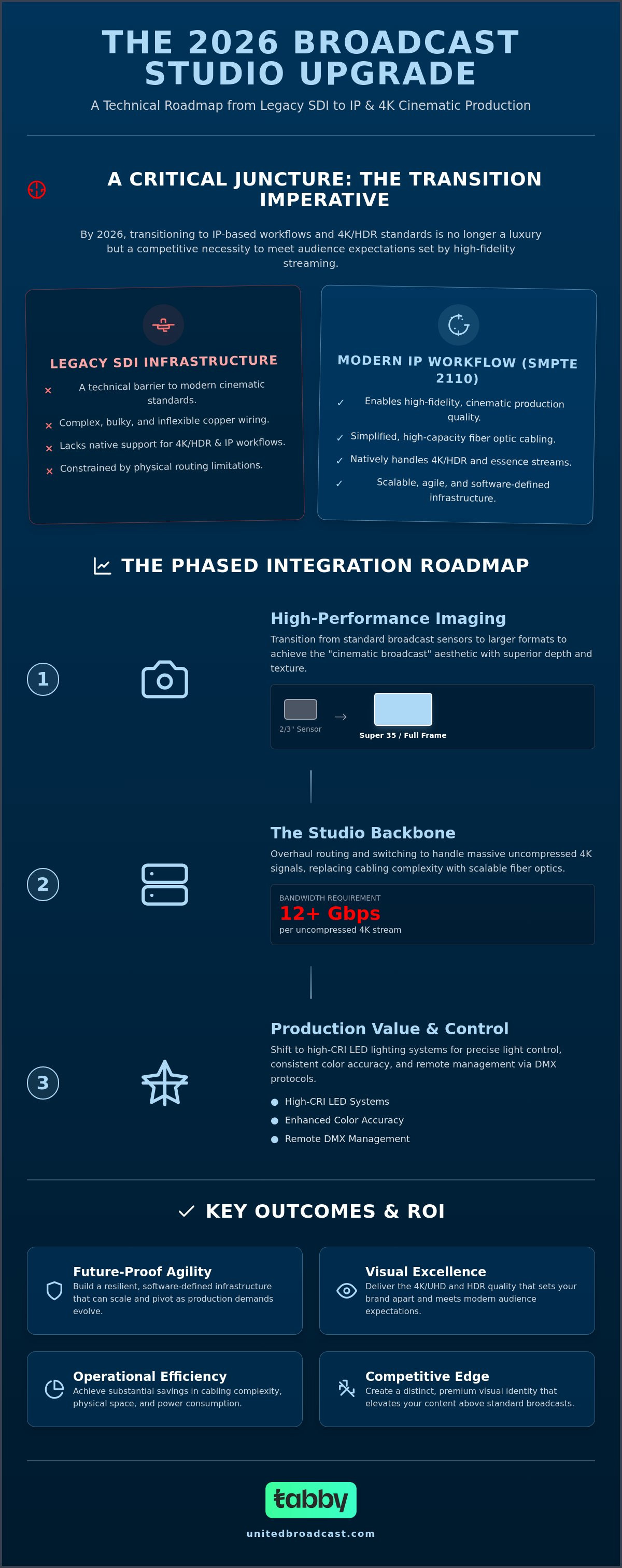
The year 2026 represents a critical juncture for media organizations. Standard definition and even basic HD are no longer sufficient to retain audience engagement in a market saturated with high-fidelity streaming content. The transition to High-Dynamic Range (HDR) and 4K/UHD delivery is now a competitive necessity rather than a luxury. When you begin upgrading broadcast studio equipment, the focus must shift from simply replacing failing hardware to building a resilient, software-defined infrastructure. This change allows a professional television studio to scale its output without the physical constraints of traditional copper-based wiring.
Balancing capital expenditure (CAPEX) with long-term operational efficiency is the primary hurdle for most facilities. While the initial investment in IP-capable hardware may seem high, the savings in cabling, space, and power are substantial. A modern studio floor needs to be agile. By investing in multi-format hardware today, you avoid the expensive "forklift upgrade" of tomorrow, ensuring your facility can pivot as production requirements evolve.
Transitioning to IP and 12G-SDI Workflows
Handling uncompressed 4K signals requires massive bandwidth, often exceeding 12Gbps per stream. While 12G-SDI offers a familiar point-to-point solution for smaller facilities, larger operations are moving toward IP for its inherent scalability. IP workflows reduce cabling complexity by replacing hundreds of BNC cables with a few high-capacity fiber optics. SMPTE ST 2110 is a suite of standards that allows for the transport of individual essence streams, such as audio, video, and metadata, over professional IP networks to ensure seamless interoperability. This level of granularity means you can route audio and video independently across your facility without expensive de-embedders or complex signal conversion stages.
The Rise of Cinematic Broadcast Aesthetics
Viewers have grown accustomed to the "film look" found in high-end streaming series. This expectation has bled into live news and sports, where shallow depth of field is used to isolate presenters and create a premium feel. Utilizing professional video cameras with Super 35 or Full Frame sensors allows for this aesthetic, but it also impacts studio lighting and set design. Large-format sensors require more precise light control to maintain consistent exposure and color accuracy. Integrating cinema-grade color science into live broadcast switchers ensures that the rich, textured look of a digital cinema camera isn't lost during the live transmission process. Upgrading broadcast studio equipment to include these cinematic tools creates a distinct brand identity that sets your production apart from standard, flat-looking broadcasts.
High-Performance Imaging: Upgrading Cameras and Cinema Lenses
The 2/3-inch sensor is no longer the sole king of the studio floor. As broadcasters look to differentiate their content, the shift toward Super 35 and Full Frame sensors has become a defining characteristic of modern facility overhauls. When you're upgrading broadcast studio equipment, the imaging chain is where the most visible ROI occurs. Audiences notice the difference. High-end optics and large-format sensors provide a texture and depth that traditional broadcast cameras simply cannot replicate. This "cinematic broadcast" aesthetic isn't just for documentaries; it's increasingly used in news and sports to create a premium, authoritative brand identity, which can be further enhanced through the specialized authoring and post-production services of 3DUX Media Hub.
Integrating modern professional video cameras into a live environment requires a careful balance. You need the shallow depth of field that viewers love, but you also need the reliability of a traditional broadcast workflow. As noted in recent reports on trends shaping broadcast and media production, the move toward large-format sensors is accelerating. This transition demands a new approach to lens selection, focusing on cinema glass that can withstand the rigors of 24/7 studio use while providing the necessary metadata for modern control systems.
Digital Cinema Cameras in the Studio Environment
Using digital cinema cameras in a live setting was once a technical nightmare. Today, features like global shutters, genlock, and tally support are standard on high-tier models, making them perfect for the studio. The synergy between Sony Alpha cameras and broadcast control units has improved significantly, allowing these compact systems to function as full-fledged studio heads with remote iris and shading control. The trick is balancing cinematic bokeh with the need for deep focus during fast-moving news segments. Modern autofocus systems have made this easier, but the process of upgrading broadcast studio equipment should always prioritize lens compatibility across the entire production chain.
PTZ Cameras and Robotic Integration
Robotics are no longer a luxury; they're an operational necessity. Upgrading to 4K PTZ units allows for high-quality automated production with minimal staff. These units now support NDI and SRT protocols, which are essential for low-latency remote control over standard networks. When paired with robotic pedestals, these cameras can mimic the smooth, sweeping movements of a human operator, significantly elevating the production value of a set. This automation doesn't just save on labor; it ensures perfectly repeatable shots for every broadcast. If you're unsure which imaging path fits your facility, you can consult our system integration specialists for a tailored hardware assessment.
Cinema lenses are precision instruments that require more care than traditional B4-mount lenses. In a high-usage studio environment, regular maintenance and calibration at a dedicated service center are vital. Dust, mechanical wear, and back-focus shifts can quickly degrade your image quality if left unchecked. A well-maintained set of cinema glass can last for decades, making it one of the most stable long-term investments in your production arsenal.
The Studio Backbone: Routing, Switching, and Signal Integrity
The signal routing and switching core acts as the nervous system of any production facility. While cameras and lenses provide the visual flair, the backbone ensures that every pixel reaches its destination without degradation. When you begin upgrading broadcast studio equipment, the primary objective is to move away from rigid, single-format hardware toward agile systems that handle HD, 4K, and IP essences simultaneously. For a detailed look at specific regional hardware trends, you can explore our comprehensive guide on Advanced Broadcast Studio Gear in the UAE.
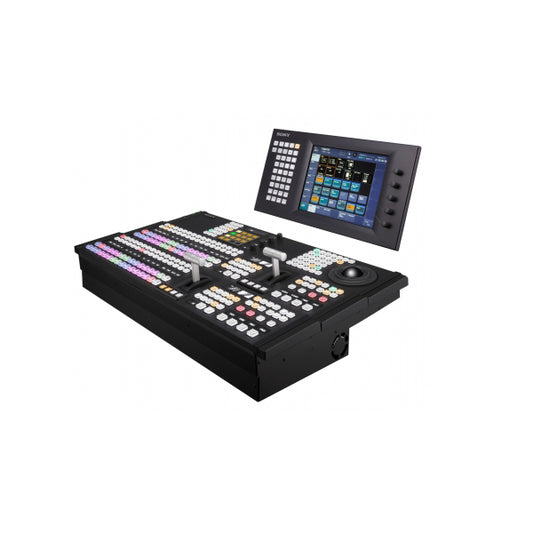
Modern production switchers must now offer more than just basic cutting and mixing. They serve as multi-format hubs that can ingest 12G-SDI feeds while outputting IP-based streams for digital platforms. This flexibility is vital for maintaining signal integrity across a diverse production chain. Broadcast routers have also evolved, shifting from simple crosspoint matrices to sophisticated software-defined engines that manage massive data throughput with built-in redundancy.
Hybrid SDI-IP Infrastructures
Few facilities can afford a total transition to IP in a single budget cycle. The practical approach to upgrading broadcast studio equipment involves creating a hybrid environment where legacy SDI gear coexists with a new IP core. High-density gateways are used to bridge these two worlds, converting traditional signals into SMPTE ST 2110 streams. While 3G-SDI is limited to 3 gigabits per second for 1080p, 12G-SDI offers 12 gigabits per second, allowing for the transmission of uncompressed 4K/UHD video over a single coaxial cable. This makes 12G-SDI an excellent intermediate step for facilities that want 4K capabilities without the immediate complexity of a full network overhaul.
Ensuring Redundancy and Uptime
In live broadcast, downtime is not an option. Redundancy must be baked into the architecture at every level. Implementing 'Hitless Merge' (SMPTE ST 2022-7) is a critical strategy for IP-based production; it sends identical signal streams over two separate network paths, ensuring that if one fails, the receiver switches to the other without a single frame of packet loss. Beyond video, professional audio monitoring and robust intercom systems are essential for maintaining production flow. Our extensive work in OB van system integration has taught us that signal integrity is paramount when equipment is pushed to its operational limits. Addressing signal latency is also a priority in IP environments. By utilizing low-latency network switches and PTP (Precision Time Protocol) synchronization, you can achieve the sub-frame timing accuracy required for high-stakes live sports and news broadcasts.
Elevating Production Value through Professional Lighting and Grip
Lighting is the final layer that transforms a technical setup into a professional broadcast environment. While previous sections focused on the signal core and the sensor, the way light hits the subject determines the ultimate fidelity of the 4K image. When you're upgrading broadcast studio equipment, the shift from traditional Tungsten to high-CRI LED systems is a logistical and creative necessity. These modern fixtures provide consistent color rendering without the massive heat output of legacy bulbs, protecting both your talent and your sensitive electronics.
Remote management has also become a standard requirement for agile facilities. Protocols like DMX and CRMX allow operators to adjust intensity, color temperature, and even RGB effects from a central console. This speed is essential for studios that host multiple programs with different visual identities in a single day. For a deeper look at regional trends and specific hardware recommendations, see our guide on Professional Lighting Equipment in Dubai.
Advanced LED Studio Lighting Solutions
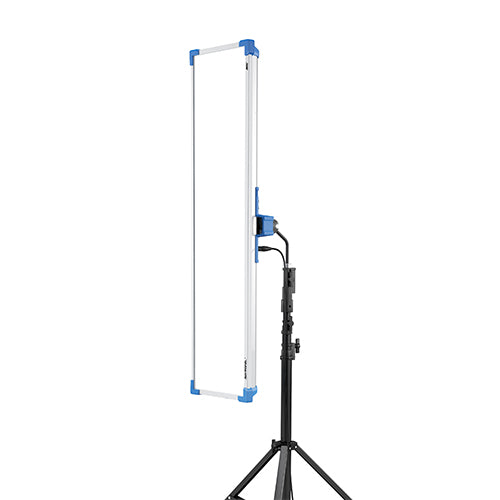
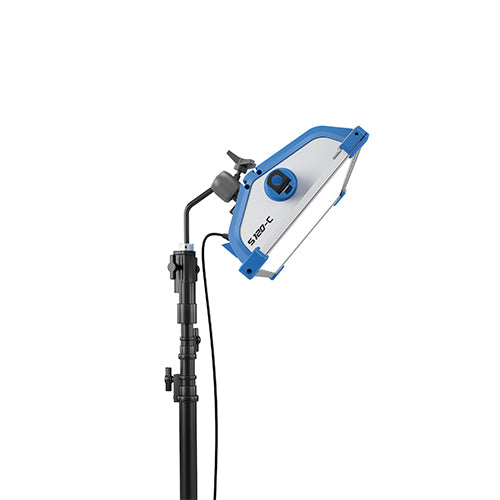
The choice between soft panels and Fresnel lights depends on your set's specific needs. Soft panels are ideal for talent lighting because they minimize harsh shadows and provide a natural, wrap-around glow. Conversely, Fresnel lights offer the punch and beam control required for hair lights or set accents. Integrating ARRI lighting into your workflow ensures that your studio meets global industry standards for color rendering. Beyond the visual benefits, the heat reduction from LED systems significantly lowers the load on HVAC systems, providing substantial operational savings in 24/7 broadcast environments.
Professional Grip and Support Systems
As we noted when discussing large-format imaging, the weight of a digital cinema camera and high-end optics is considerably higher than traditional broadcast heads. Standard tripods and pedestals often lack the fluid dampening and weight capacity required for these configurations. The ARRI Omnibar Production Kit provides a reliable solution for versatile studio rigging, allowing for secure mounting of accessories and heavy payloads. Ensuring safety in overhead lighting grids is equally important. When upgrading broadcast studio equipment, you must verify that your existing pantographs and rails can handle the weight of modern, high-output LED fixtures.
Navigating the Integration: From Technical Planning to Long-term Support
Successful execution when upgrading broadcast studio equipment requires more than just purchasing high-tier hardware. It demands a holistic approach to technical planning where every component, from the camera sensor to the final transmission encoder, works in unison. Much like the strategies employed by PLM-Sme FZC to architect the industrial digital thread, this structured roadmap ensures that even the most expensive 4K or IP-based gear delivers its full potential without bottlenecks in the signal chain. System integration serves as the essential glue that binds disparate hardware brands into a single, reliable production environment.
A professional facility upgrade typically follows a five-step process to ensure operational success:
- Technical Audit: Evaluating existing infrastructure to identify what can be salvaged and what must be replaced.
- System Architecture: Designing the network topology and signal flow, whether 12G-SDI, hybrid, or full SMPTE ST 2110.
- Procurement and Logistics: Sourcing authorized hardware and managing the delivery of complex components.
- Installation and Commissioning: Physical rack mounting, custom cabling, and software configuration.
- Training and Handover: Ensuring technical staff can operate and troubleshoot the new systems with confidence.
The Role of Professional System Integration
Designing a unified control environment is the hallmark of a sophisticated studio. It's not enough to have great cameras; they must be shaded and controlled through a centralized interface that communicates perfectly with your switchers and lighting consoles. Custom cabling and infrastructure design are critical for maintaining 4K signal integrity over long distances. A professional integrator understands the nuances of fiber optic termination and high-bandwidth networking that standard IT providers might overlook. Beyond the hardware, training and workflow optimization are vital. If your team isn't comfortable with the new IP-based routing or cinematic camera menus, the transition will be slow and prone to errors.
Maintenance, Calibration, and After-Sales Support
The relationship with your technical partner shouldn't end at the handover. High-performance gear requires ongoing care to maintain its value and performance. Regular sensor cleaning and lens calibration are necessary to ensure image consistency across multi-camera sets. Our Professional Camera Service Center provides the specialized tools and expertise required for rapid hardware repairs and precision optical maintenance. Establishing a preventative maintenance schedule is a vital final step when upgrading broadcast studio equipment, as it prevents minor issues from becoming catastrophic failures during live airtime. In the high-stakes world of 24/7 production, having access to national support and a dedicated service centre is the difference between a minor technical hiccup and a total broadcast blackout. We prioritize long-term partnerships to ensure your mission-critical uptime remains uncompromised as your facility evolves toward the standards of 2026 and beyond.
Future-Proofing Your Production Infrastructure for 2026
The transition toward IP-based workflows and cinematic aesthetics is no longer a distant goal; it's the current standard for competitive media organizations. Successfully upgrading broadcast studio equipment requires a precise balance of high-performance imaging, robust signal routing, and intelligent lighting control. By prioritizing interoperability through standards like SMPTE ST 2110 and investing in large-format sensor technology, your facility can deliver the high-fidelity content that 2026 audiences demand.
United Broadcast & Media Solutions (UBMS) stands ready to support this transition as your trusted technical partner. Our expert team specializes in complex system integration, ensuring that your disparate hardware components function as a unified, high-efficiency core. With an extensive inventory of world-class brands like Sony and ARRI, and the backing of our authorized regional service centre, we provide the technical infrastructure and long-term support necessary for mission-critical uptime.
We look forward to helping you build a resilient production environment that remains at the forefront of the industry for years to come.
Frequently Asked Questions
What is the most important piece of equipment to upgrade first in a broadcast studio?
Prioritize your signal routing and switching infrastructure when upgrading broadcast studio equipment. While new cameras provide immediate visual impact, your facility's backbone must be capable of handling the increased bandwidth of 4K and IP essences. Upgrading the core first ensures that any subsequent hardware additions can be integrated without creating technical bottlenecks or requiring expensive secondary overhauls to your cabling and network switches.
Should I choose 12G-SDI or IP for my 4K studio upgrade?
Choose 12G-SDI if you require a straightforward, point-to-point 4K solution that utilizes familiar coaxial cabling. It's often the most cost-effective path for smaller studios. However, IP (SMPTE ST 2110) is the superior choice for larger facilities requiring massive scalability and the ability to route audio and video independently. Your decision should be based on your long-term growth plans and current networking expertise.
Can I use cinema cameras for live television broadcasting?
You can absolutely use cinema cameras for live broadcasting. Many modern digital cinema cameras now include the necessary genlock, tally, and remote control ports required for studio integration. This allows you to achieve a cinematic look with shallow depth of field while maintaining the same level of control as a traditional system camera. Just ensure your lenses are compatible with the studio's remote shading units.
What are the benefits of SMPTE ST 2110 for modern media facilities?
SMPTE ST 2110 offers essence-based transport, meaning audio, video, and metadata travel as separate streams. This flexibility allows you to route an audio feed to a mixer without first de-embedding it from the video signal. It significantly reduces hardware complexity and allows your facility to scale its production capacity using standard high-speed network switches rather than proprietary SDI matrices.
How do I ensure my new studio lighting is compatible with my existing cameras?
Ensure your new LED lighting has a high TLCI (Television Lighting Consistency Index) score, ideally above 90. This rating is specifically designed to measure how light interacts with camera sensors rather than the human eye. You should also verify that the fixtures offer flicker-free dimming at high frame rates to prevent visual artifacts when shooting in 4K or high-speed modes.
What is the difference between a broadcast switcher and a video production switcher?
Broadcast switchers are engineered for 24/7 mission-critical environments and offer extensive redundancy features like dual power supplies and redundant signal paths. They are designed to handle complex multi-format environments with sub-frame latency. Standard video production switchers often lack these robust fail-safes and may not support the sophisticated synchronization required for high-tier live television environments.
Is it necessary to hire a system integrator for a studio equipment upgrade?
Hiring a professional system integrator is highly recommended when upgrading broadcast studio equipment to 4K or IP standards. These experts ensure that disparate hardware brands work together seamlessly; they prevent costly interoperability issues during the installation phase. An integrator handles the complex technical planning and custom cabling that internal teams might lack the time or specialized tools to execute efficiently.
How can I protect my broadcast gear from technical failure during live shows?
Protect your live production by implementing hitless merge redundancy (SMPTE ST 2022-7) and robust UPS systems. This ensures that if a network path or power source fails, your broadcast continues without interruption. Additionally, establishing a preventative maintenance schedule with an authorized service centre helps you identify mechanical wear or sensor issues before they result in a catastrophic failure on air.


