

Stabilizers & Gimbals: The 2026 Professional Buying Guide for Filmmakers
In the demanding environment of 2026 cinema production, the success of a handheld shot is no longer determined by raw motor torque, but by how well your support system integrates into a complex technical workflow. Professional filmmakers understand that choosing the right stabilizers & gimbals requires a balance of payload precision and ergonomic sustainability. You've likely felt the physical exhaustion of a twelve-hour day with a poorly balanced rig or the frustration when a high-end cinema lens exceeds the limits of a standard motor.
It's clear that as camera systems become more sophisticated, your stabilization gear must do more than just counteract movement. This guide provides the technical expertise needed to master these nuances and discover the ideal gimbal or vest system for your specific production requirements. We'll explore the latest hybrid solutions, AI-enhanced tracking capabilities, and professional support rigs designed to achieve cinematic fluid motion while protecting your equipment and your health.
Key Takeaways
- Distinguish between mechanical stabilizers and electronic motorized systems to choose the right tool for specific narrative or broadcast storytelling requirements.
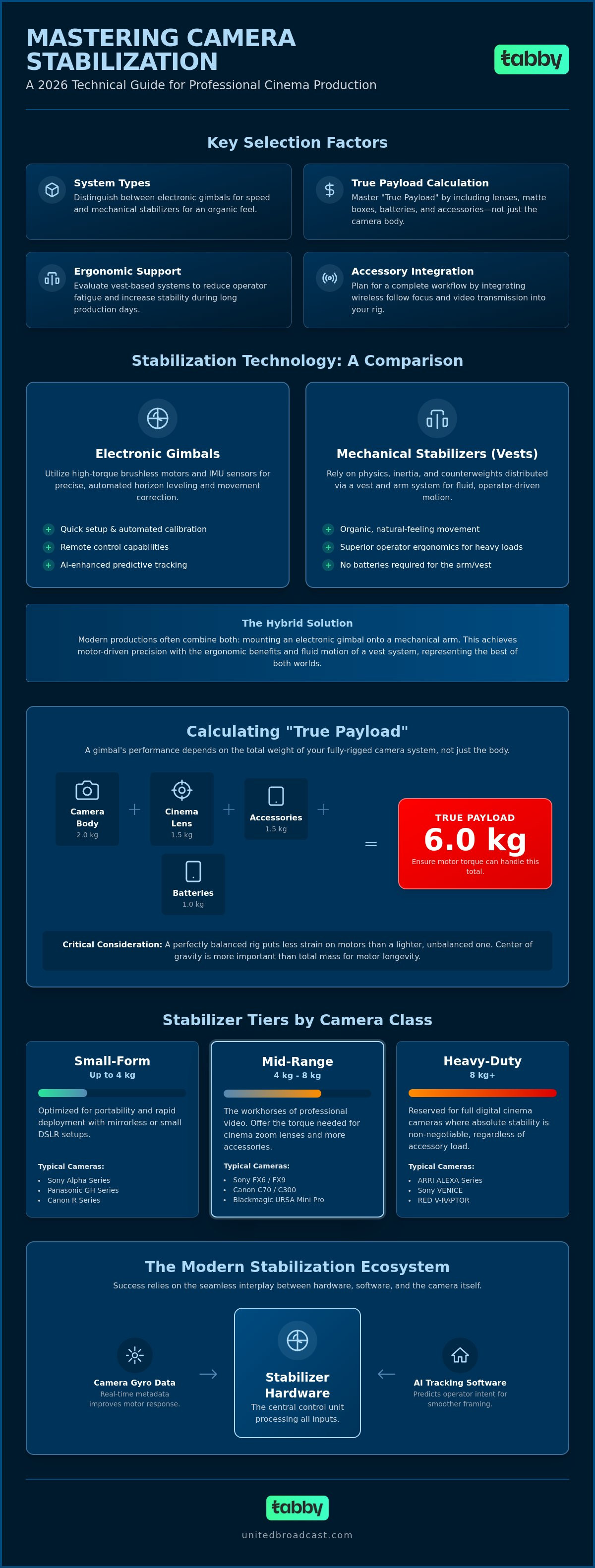
- Master the calculation of "True Payload" by accounting for cinema lenses, matte boxes, and batteries to ensure motor torque remains effective during high-speed movement.
- Evaluate the ergonomic advantages of vest-based support systems over handheld units to significantly reduce operator fatigue during full-day professional productions.
- Learn how to integrate essential accessories like wireless follow focus and video transmission into your stabilizers & gimbals workflow for precise control and monitoring.
- Identify high-performance solutions from industry-leading brands that align with the rigorous standards of modern digital cinema and professional video cameras.
Understanding Modern Camera Stabilization in 2026
In 2026, the role of camera stabilization has expanded far beyond the simple goal of eliminating unwanted vibration. For modern narrative and broadcast productions, these tools are essential for establishing a specific visual language. A perfectly smooth tracking shot can convey a sense of omniscience or tension, while a subtly stabilized handheld shot maintains raw energy without distracting the viewer. The choice of hardware directly dictates how an audience perceives the movement on screen.
The core technology relies on a pivoted support that allows an object to rotate about an axis. While the basic principles haven't changed, the execution has moved into the realm of high-speed computation. By 2026, we've seen a definitive transition from basic 3-axis stabilization to AI-enhanced systems. These modern stabilizers & gimbals now use machine learning to predict operator intent, smoothing out transitions and maintaining subject framing with unprecedented accuracy. This shift ensures that technical limitations don't stifle creative choices on set.
Electronic Gimbals vs. Mechanical Stabilizers
Electronic gimbals utilize high-torque brushless motors and sophisticated IMU sensors to maintain level horizons. They're prized for their quick setup times and the ability to be controlled remotely. However, mechanical systems like the Steadicam still hold a vital place in professional cinema. Because they rely on physics and inertia rather than active motor correction, they provide a more organic feel to the movement. Many high-end productions now employ hybrid solutions, mounting an electronic gimbal onto a mechanical arm to achieve the best of both worlds: motor-driven precision combined with physical weight distribution.
The Shift Toward Lightweight Cinema Rigs
Material science has fundamentally altered the weight-to-payload ratio in 2026. High-grade carbon fiber and magnesium alloys allow operators to carry heavier professional video cameras without the immediate onset of fatigue. We're also seeing a deeper integration between internal camera sensors and external rigs. Metadata from the camera's gyro is now frequently shared with the gimbal in real-time to improve motor response. In the modern production environment, we define the "stabilization ecosystem" as the seamless interplay between the camera's internal stabilization, the external support hardware, and the software-driven AI tracking that keeps the shot locked.
Critical Selection Criteria: Payload, Torque, and Balance
Selecting the right stabilizers & gimbals requires a technical assessment that goes far beyond checking a manufacturer's maximum weight limit. Professional operators must calculate the "True Payload." This figure includes the camera body, cinema lenses, matte boxes, wireless follow focus motors, and the batteries required to power the entire stack. When you rig professional video cameras for a high-end production, a setup that starts at 2kg can easily swell to 6kg or more once production-ready.
Motor torque is another vital factor, especially for exterior shoots. High-torque motors aren't just for carrying weight; they provide the resistance needed to combat wind drag or the G-forces experienced during high-speed vehicle tracking. However, brute strength shouldn't compensate for poor physics. The longevity of your equipment's motors depends more on the center of gravity than the total mass. A heavy cinema rig that's perfectly balanced will put less strain on the system than a lightweight mirrorless camera with an offset center of gravity.
Payload Thresholds for Different Camera Classes
In 2026, we categorize support systems into three distinct tiers based on their operational capacity. Small-form gimbals are optimized for mirrorless setups like the Sony Alpha series, focusing on portability and rapid deployment. Mid-range stabilizers are the workhorses for cameras such as the Sony FX6 or Canon C70, offering the torque necessary for heavier zoom lenses. Finally, heavy-duty rigs are reserved for full digital cinema cameras like the ARRI ALEXA or Sony VENICE, where stability must be absolute regardless of the accessory load.
Balancing Workflow and Quick Release Systems
On a fast-paced set, time spent struggling with a hex key is time lost. Modern professional gimbals now feature tool-less balancing and independent axis locks to streamline the setup process. Standardizing your workflow on Manfrotto or Arri-style quick release plates allows you to move the camera between a tripod and a gimbal in seconds without rebuilding the rig. By 2026, most high-end systems also utilize automated calibration routines. These software-driven tools sense the specific inertia of your setup and adjust motor stiffness in real-time to prevent micro-jitters. If you're unsure about the total weight of your planned production rig, you can consult with our technical specialists to ensure your support system matches your payload requirements.
Stabilizer Categories: Choosing the Right Support
Understanding your payload is the technical foundation, but the physical interface between the operator and the rig determines the shot's duration and quality. The market for stabilizers & gimbals has branched into specialized categories designed to solve specific ergonomic and narrative challenges. While a handheld unit offers unmatched speed for rapid deployment, a vest-based system is often required to maintain professional standards during an eighteen-hour production day. Choosing the wrong category doesn't just affect the footage; it risks operator injury and equipment strain.
Handheld Gimbals: The DJI and Zhiyun Standard
DJI and Zhiyun have established the industry benchmark for motorized 3-axis stabilization in "run-and-gun" environments. Single-handle designs are the preferred choice for documentaries and events where agility is paramount. However, these systems often lead to significant operator fatigue in the wrists and forearms. To combat this, many professionals are adopting dual-handle configurations or ring mounts. These frames improve ergonomics and provide essential mounting points for monitors and wireless receivers. In 2026, the addition of a 4th axis (vertical stabilization) has become a standard modification for handheld rigs to eliminate the natural "step" motion that occurs during fast-paced walking shots.
Body-Worn Support: Easyrig and ReadyRig
When the camera package exceeds the limits of comfortable handheld operation, body-worn support becomes a logistical necessity. Systems like the Easyrig utilize a suspension line to transfer the rig's weight from the arms and shoulders directly to the hips. This setup is particularly effective in complex studio environments where you might be coordinating movements around professional lighting equipment and multiple crew members. For dedicated gimbal operators, the ReadyRig provides a dual-arm design that stabilizes vertical travel and allows for effortless transitions between high and low shooting modes. These systems don't just reduce physical strain; they enable the long, sweeping takes that modern cinematography demands.
Beyond standard handheld and vest setups, specialized support tools handle the extremes of production. Car mounts utilize high-strength suction cups and sophisticated vibration isolators to maintain a level horizon during high-speed tracking. Meanwhile, cable cam systems allow for overhead movement in locations where drones are restricted. For the most demanding sequences, ring mounts have evolved into comprehensive accessory hubs, allowing for seamless hand-offs between operators during complex "one-take" narrative scenes. Each category serves a specific tactical purpose in the filmmaker's toolkit.
The Ecosystem: Integrating Accessories and Control
A high-performance stabilization rig in 2026 is rarely just a camera and a motor. It functions as a central hub for a complex array of production tools. For professional filmmakers, the challenge lies in adding essential accessories without compromising the balance of their stabilizers & gimbals. Expansion ports on modern rigs allow for the mounting of microphones and secondary lights, but every addition must be calculated to avoid overtaxing the motors. Efficient power distribution is equally critical; using a single high-capacity V-Mount battery to power both the gimbal and the camera simultaneously reduces complexity and cable clutter on set.
Lens Control Systems
Integrating precise lens control is essential for shallow depth-of-field cinema shooting. Systems like the Tilta Nucleus or DJI Focus motors provide the tactile response needed for critical focus pulling. These motors require cinema lenses that feature standard 0.8 MOD gearing to ensure consistent engagement and reliable torque delivery. Achieving sharp results during dynamic movement requires a level of wireless focus precision that only a dedicated lens control ecosystem can provide. This setup allows a dedicated focus puller to manage the image while the operator focuses on camera movement.
Video Transmission and Remote Monitoring
Directors and cinematographers need real-time, low-latency feeds to evaluate a take as it happens. High-brightness monitors mounted directly to the rig or the operator's support vest allow for accurate framing even in direct sunlight. Wireless video transmitters now integrate directly into the gimbal's power rail, sending encrypted feeds to multiple receivers across the set. This connectivity is vital for maintaining a collaborative workflow during complex tracking shots where the operator cannot be tethered to a traditional video village.
Remote Operation and Gimbal Heads
Remote control options have evolved significantly, moving beyond simple joysticks to include professional wheels and motion-sensing controllers. The rise of "Smart" gimbals with built-in LiDAR focusing has also revolutionized solo operation, allowing the system to maintain subject focus automatically. These advanced control systems allow for seamless integration with broadcast studio gear, enabling gimbals to be used as remote heads in live multi-camera environments. If you need assistance building a production-ready rig with integrated accessories, you can speak with our system integration team to design a custom solution that meets your technical requirements.
The UBMS Selection: Industry-Standard Solutions
Selecting the right hardware is the final step in mastering professional camera movement. As an authorized distributor, UBMS provides a curated range of 98+ stabilizers & gimbals from the world's leading manufacturers. Our inventory reflects the diverse needs of the Middle Eastern media landscape, from independent content creation to national broadcast productions. We don't just supply equipment; we ensure every system is calibrated and production-ready before it leaves our facility. This commitment to quality ensures that your gear performs reliably from the first day on set.
The DJI RS series remains the benchmark for versatility and high-performance stabilization. For filmmakers utilizing mirrorless systems or mid-range cinema cameras, the DJI RS 4 Pro and the high-end RS 5 models offer the torque and AI-tracking required for complex sequences. Brands like Tilta and Zhiyun-Tech provide competitive features, such as the Zhiyun-Tech CRANE 3S, which handles heavy payloads at a professional price point. For high-end cinema and national broadcast projects, Easyrig and Steadicam systems remain the gold standard. These tools provide the physical support necessary for the most demanding technical shots and help operators comply with 2026 airline regulations regarding lithium-ion batteries by offering modular power options.
Top Picks for Cinema and Broadcast
Professional workflows involving the Sony FX series or ARRI ALEXA systems require more than a standard handheld motor. We recommend configurations that prioritize stability and accessory integration. You can customize your cinema rig with the ARRI Omnibar Production Kit, which provides the necessary mounting points for follow focus motors and wireless transmitters. These setups ensure your camera remains balanced even when using heavy anamorphic or long-range zoom lenses. Integrating these tools into a unified rig allows for the cinematic fluid motion that defines modern high-tier productions.
Why Buy from UBMS?
Our role extends beyond being a vendor; we act as a technical partner for filmmakers across the UAE. The UBMS service center provides dedicated maintenance and repair services, ensuring your equipment performs reliably under the harsh environmental conditions of the region. Whether you're setting up a permanent broadcast studio or a mobile production unit, our team provides expert system integration to help you build a seamless workflow. We offer nationwide delivery. Our technical support ensures your production never faces unnecessary downtime. You can browse the full Stabilizers & Gimbals collection at UBMS to find the right support system for your professional needs.
Elevating Your Production Standards in 2026
Mastering professional camera movement requires a technical approach that balances motor precision with operator ergonomics. We've explored how accurate "True Payload" calculations and the integration of AI-driven tracking are redefining the modern set. Whether you're deploying a lightweight handheld unit for a fast-paced documentary or a heavy-duty vest system for a national broadcast, selecting the right equipment ensures your visual language remains consistent and high-quality.
Since 1997, United Broadcast & Media Solutions has been a pillar for the UAE filmmaking community. As an authorized distributor for leading brands like DJI, Tilta, and Easyrig, we provide more than just the latest stabilizers & gimbals. Our in-house technical service center ensures your rigs are calibrated to the highest standards, protecting both your investment and your production timeline.
If you're ready to upgrade your support system or need a custom integration for your cinema camera, our experts are here to help. Explore Professional Stabilizers & Gimbals at UBMS to find the precision tools your next project demands. We look forward to supporting your creative vision on set.
Frequently Asked Questions
What is the difference between a 3-axis and 4-axis gimbal?
A 3-axis gimbal stabilizes pan, tilt, and roll movements, while a 4-axis system includes an additional active or passive vertical stabilization arm. This fourth axis is specifically designed to eliminate the vertical "bobbing" motion that occurs when an operator walks or runs. For high-end narrative work, 4-axis stabilization is often preferred to achieve a perfectly smooth, floating aesthetic.
Can I use a professional gimbal with a heavy cinema camera like the ARRI Alexa?
Yes, you can use a professional gimbal with heavy cinema cameras, provided the system's motor torque and payload capacity are rated for the total weight. Systems like the DJI RS 4 Pro or heavy-duty Steadicam rigs are designed to handle these payloads. You must calculate the "True Payload," including the body, cinema lenses, and all mounted accessories, to ensure the motors don't overheat or fail during a take.
How much payload can a standard handheld gimbal handle in 2026?
Standard professional handheld stabilizers & gimbals in 2026 typically support payloads ranging from 3kg to 6.5kg. For example, high-performance models like the DJI RS 4 Pro support up to 4.5kg, while specialized heavy-lift units can reach higher thresholds. Always check the specific weight of your fully rigged camera before selecting a support system to maintain motor longevity.
Is an Easyrig necessary for every gimbal shoot?
An Easyrig isn't mandatory for short takes, but it's a vital tool for long-form productions or heavy cinema rigs. It transfers the weight of the equipment from your arms and shoulders to your hips, significantly reducing physical fatigue. If your production requires all-day operation or complex tracking shots, body-worn support becomes a logistical necessity for maintaining shot consistency.
How do I balance a gimbal with a zoom lens that changes length?
You should balance the gimbal at the lens's midpoint focal length or the position where you'll spend the most time shooting. Modern high-torque motors are generally capable of compensating for the minor center-of-gravity shifts that occur when zooming. However, if the lens extension is extreme, you may need to re-balance or use a counterweight system to prevent motor strain.
What are the best stabilizers for smartphone filmmaking in a professional context?
Professional smartphone filmmaking in 2026 is best served by systems like the DJI Osmo Mobile 7P or the Insta360 Flow 2 Pro. These units offer advanced subject tracking and high-quality stabilization for social media content or rapid B-roll. While they don't replace cinema rigs, their portability and AI-enhanced features make them valuable tools for professional creators on the move.
Do I need a wireless follow focus if my gimbal has a focus wheel?
A wireless follow focus is essential if you're working with a focus puller or shooting with a very shallow depth of field. While a built-in focus wheel is helpful for solo operators, it often limits your hand placement and can introduce micro-vibrations. A dedicated lens control system allows for greater precision and frees the operator to focus entirely on camera movement.
How do I protect my gimbal motors from sand and heat during UAE outdoor shoots?
You can protect your equipment by using weather-sealed covers and ensuring the motors aren't overtaxed, which prevents thermal shutdown in high temperatures. After shooting in sandy environments across the UAE, use compressed air to clean the motor gaps and pivots. Regular maintenance at a dedicated service center is also recommended to remove fine particulates that can cause internal motor wear.


