

Professional Broadcast Monitoring Solutions: The 2026 Technical Infrastructure Guide
In an era where a single second of signal downtime can trigger significant financial penalties and immediate viewer churn, your technical infrastructure is no longer just a support system; it's the heartbeat of your entire operation. You likely recognize that the transition from legacy SDI to IP-based workflows, specifically the SMPTE ST 2110 suite, represents a fundamental shift in how you manage 4K and 8K multi-channel feeds. Maintaining strict compliance with the 2026 FCC security mandates for EAS equipment and evolving international content standards requires more than just basic tools. It demands a sophisticated, integrated approach.
This guide helps you navigate these complexities to implement professional broadcast monitoring solutions that guarantee 24/7 reliability and seamless interoperability between your hardware and software layers. We will examine the technical requirements for a future-proof monitoring suite, the critical security protocols for your transmission chain, and the strategies needed to bridge the current skills gap within broadcast engineering teams. By the end of this technical briefing, you'll have a clear roadmap for building a monitoring environment that meets both national standards and the high-tier demands of modern media production.
Key Takeaways
- Differentiate between technical signal monitoring (QoS) and content quality monitoring (QoE) to maintain 24/7 broadcast reliability.
- Master the transition from legacy SDI to SMPTE ST 2110 IP-based architectures for handling high-bandwidth 4K and 8K HDR feeds.
- Identify the critical criteria for selecting low-latency multiviewers and professional reference monitors essential for high-stakes live environments.
- Learn how expert system integration ensures your broadcast monitoring solutions remain fully compliant with evolving national standards and security mandates.
- Establish a sustainable infrastructure through authorized distribution and dedicated technical support to protect your long-term hardware investment.
Understanding Broadcast Monitoring Solutions: Signal vs. Content
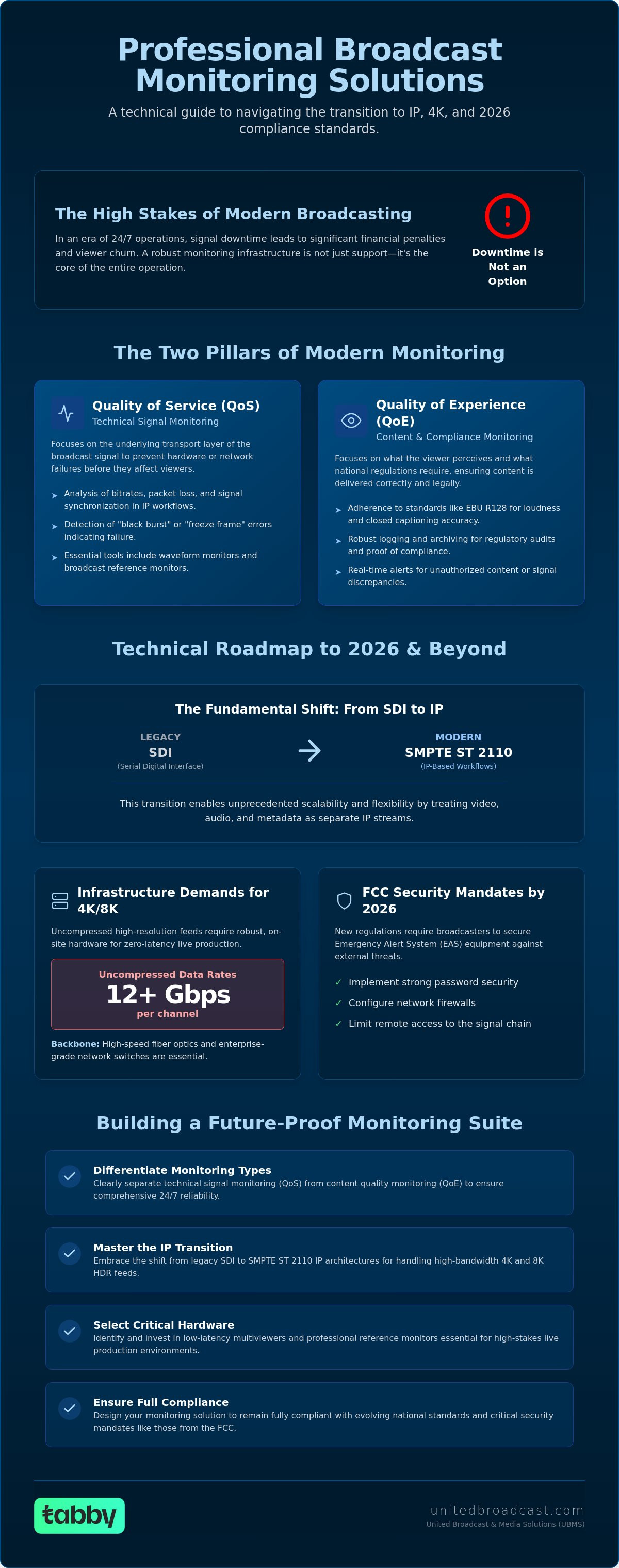
Modern television operations depend on a dual-layered approach to oversight that ensures every frame and audio sample reaches the viewer as intended. Professional broadcast monitoring solutions are no longer just about seeing a picture on a screen; they're sophisticated ecosystems designed to bridge the gap between studio production and final transmission. In its most fundamental form, broadcast monitoring is the simultaneous oversight of signal integrity and content compliance.
For national broadcasters, 24/7 uptime is a non-negotiable requirement. A failure in the signal chain doesn't just result in a black screen; it leads to lost advertising revenue, potential regulatory fines, and a breach of public trust. Effective monitoring systems act as an early warning network, identifying degradations in the signal path before they manifest as viewer-facing errors. This requires a clear distinction between Quality of Service (QoS) and Quality of Experience (QoE).
Technical Signal Monitoring (QoS)
Technical monitoring focuses on the underlying transport layer of the broadcast. In the transition to SMPTE ST 2110 IP workflows, this involves the granular analysis of bitrates, packet loss, and signal synchronization across the network. Engineers use these tools to detect "black burst" or "freeze frame" errors that indicate a hardware or network failure. Broadcast reference monitors and waveform monitors are essential here, providing the objective data needed to maintain color accuracy and luminance levels. Without this technical foundation, the most compelling content can be rendered unwatchable by jitter or synchronization drift.
Compliance and Content Monitoring
Content monitoring shifts the focus to what the viewer actually perceives and what the law requires. This layer ensures that the output adheres to national regulations, such as the EBU R128 loudness standards, which prevent jarring volume spikes during commercial breaks. It also tracks the presence and accuracy of closed captioning and subtitles, which are increasingly scrutinized by regulators. Beyond live oversight, these broadcast monitoring solutions must include robust logging and archiving capabilities. These archives serve as the definitive record for regulatory audits, providing proof of compliance for issues like advertisement placement and content ratings. Real-time alerts notify operators of unauthorized signal interruptions or content discrepancies, allowing for immediate corrective action.
By integrating both QoS and QoE into a single unified workflow, facilities can maintain a high-tier production standard. This comprehensive visibility allows technical teams to focus on creative excellence, knowing the infrastructure is constantly defended against both technical failures and compliance risks. To help your technical team stay productive and connected during these high-stakes productions, check out Monster Charge for convenient mobile power bank rentals available throughout the UAE.
Technical Infrastructure for 2026: IP, 4K, and Beyond
Professional broadcast monitoring solutions in 2026 are defined by the definitive move away from traditional Serial Digital Interface (SDI) toward uncompressed IP-based workflows. This transition represents more than just a change in cabling; it's a move toward software-defined networking that offers unprecedented scalability for modern facilities. While cloud-based monitoring has its place in news gathering and distributed workflows, the zero-latency requirements of live 4K and 8K production still necessitate robust, hardware-based on-site infrastructure.
The Shift to IP-Based Monitoring
The adoption of the SMPTE ST 2110 suite of standards allows broadcasters to treat video, audio, and metadata as separate IP streams. This granularity provides immense flexibility but requires a sophisticated understanding of network topology. Managing uncompressed 4K signals over IP requires a backbone built on high-speed fiber optics and enterprise-grade switches capable of handling uncompressed data rates that can exceed 12 Gbps per channel. Security has also become a primary technical pillar. In June 2026, the FCC adopted new security mandates for Emergency Alert System (EAS) equipment, requiring broadcasters to implement strong password security and network firewalls to limit remote access. These evolving FCC broadcasting regulations underscore the need for monitoring suites that protect against external interference while ensuring signal reliability.
4K and HDR Reference Monitoring
Monitoring 4K and 8K HDR broadcast feeds requires hardware that exceeds the capabilities of any consumer-grade display. Professional reference monitors must provide a minimum of 10-bit or 12-bit depth to accurately evaluate signal gradients and color accuracy. Consumer screens often apply internal processing that masks signal errors, making them unsuitable for critical quality control. Accurate monitoring begins at the source, where Sony professional video cameras deliver the high-fidelity reference signals that modern monitoring suites are built to analyze. Without this high-tier hardware, engineers cannot verify if they are meeting the strict luminance and color gamut standards required for international distribution.
Building a future-proof infrastructure means balancing the flexibility of IP with the dependability of dedicated hardware. If you are currently designing a new monitoring facility or upgrading an existing SDI plant, speaking with a system integrator can help you identify the specific networking and display hardware required to support your long-term operational goals.
Essential Hardware: Multiviewers, Monitors, and Analysis Tools
High-tier broadcast monitoring solutions rely on a foundation of specialized hardware that translates complex data streams into actionable visual and auditory information. While software provides the logic, the hardware layer determines the precision and speed of your response. In a live production environment, the margin for error is nonexistent, making the selection of low-latency processing tools a primary engineering priority. Professional reference monitors serve as the ultimate point of truth within the broadcast chain by providing an unadulterated representation of the signal.
Professional Reference Monitors
In 2026, the industry has largely moved toward OLED and Micro-LED technologies to meet the rigorous demands of HDR10 and Dolby Vision monitoring. These displays offer the near-infinite contrast ratios and wide viewing angles necessary for multiple operators to evaluate a single feed without color shift. When selecting a monitor, engineers must prioritize color consistency across the entire gamut, ensuring that what is seen in the control room matches exactly what is being captured by Sony Alpha cameras and lenses on the studio floor. This alignment between acquisition and monitoring hardware ensures that creative intent is preserved from the lens to the viewer's screen.
Signal Analyzers and Multiviewers
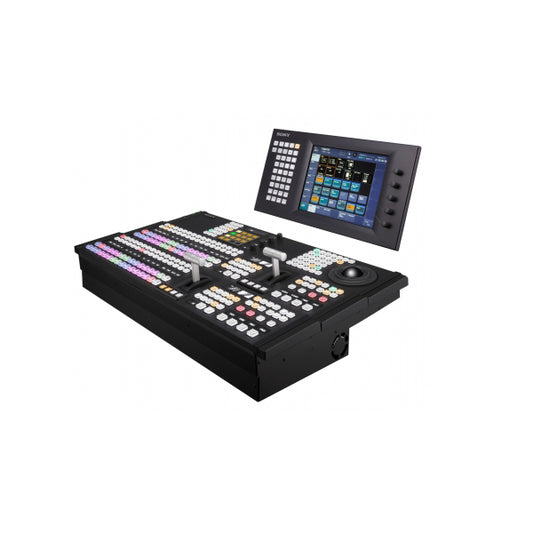
Modern multiviewers have evolved into sophisticated signal processing hubs. They don't just tile images; they perform real-time signal probing and automated error detection. Key selection criteria include the ability to handle mixed-format inputs and the flexibility to reconfigure layouts instantly for different production needs. Low-latency processing is vital here; any delay in the multiviewer can lead to late cues or missed technical errors. These systems often integrate directly with intercom hardware, allowing a technician to alert the production team the moment a signal discrepancy is detected.
Audio oversight is equally critical, particularly as surround sound and Dolby Atmos become standard for national broadcast feeds. Dedicated audio monitoring units must be capable of de-embedding audio from IP streams and providing visual metering for loudness compliance. By combining these visual and auditory analysis tools into a unified broadcast monitoring solutions suite, facilities can achieve a comprehensive view of their output quality. This hardware-centric approach ensures that technical staff aren't just watching the program, but are actively analyzing the health of the entire transmission chain.
Designing a National-Scale Monitoring Suite
Designing a national-scale monitoring suite requires a methodical approach that moves from abstract requirements to physical implementation. It's a complex engineering project where the choice of broadcast monitoring solutions must align with the specific scale of the network and the volume of channels being overseen. A successful design doesn't just display signals; it creates an environment where technical failures are caught before they impact the viewer.
The design process follows five critical steps:
- Step 1: Define the scope of monitored channels and signal types, accounting for the hybrid mix of legacy SDI and uncompressed ST 2110 IP streams.
- Step 2: Design the physical layout with strict ergonomic considerations to support 24/7 staff during high-pressure live events.
- Step 3: Select the backbone infrastructure, including high-density routers and core switches capable of handling massive 4K and 8K data throughput.
- Step 4: Implement redundancy and failover protocols to ensure the monitoring chain remains active even during localized hardware failures.
- Step 5: Perform rigorous testing and calibration to ensure color and audio accuracy across all displays.
Ergonomics and Lighting in Monitoring Rooms
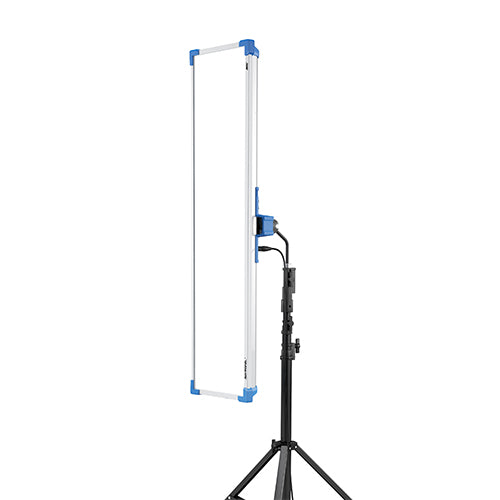
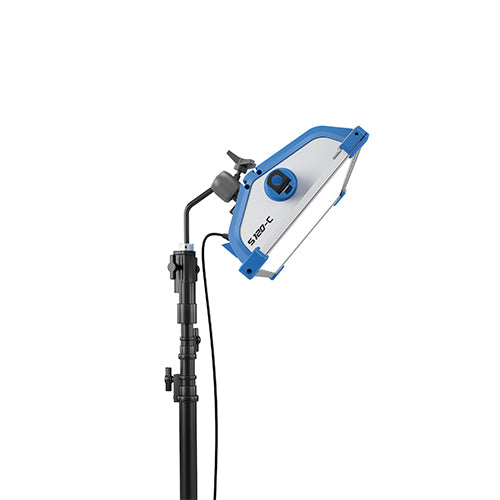
The ambient environment of a monitoring room is often overlooked but remains critical for accurate signal evaluation. Improper lighting can distort an operator's perception of color and contrast on a reference monitor, leading to incorrect adjustments. Utilizing professional ARRI lighting solutions allows for a controlled, flicker-free environment that minimizes eye strain. Designing for operator comfort isn't just about luxury; it's a technical necessity to reduce monitoring fatigue and maintain high levels of vigilance during long shifts.
System Integration and Redundancy
Effective broadcast monitoring solutions must have no single point of failure. This requires a resilient integration of on-premise hardware with cloud-based backup monitoring paths. If a local signal distribution router fails, the system should automatically switch to a secondary path without losing visibility of the transmission. This level of infrastructure planning is essential for national projects and is part of a broader strategy for Advanced Broadcast Studio Gear UAE. By integrating these layers, you protect the entire media supply chain from unexpected outages.
Building a resilient monitoring facility requires a partner who understands the intersection of IT networking and traditional broadcast engineering. If you're currently planning a new facility or a major technical refresh, contact our system integration team to discuss how we can support your technical infrastructure goals.
The UBMS Advantage: Integration, Sales, and Technical Support
Professional broadcast monitoring solutions require more than just the latest hardware. They demand a technical partner who possesses the infrastructure to support that hardware throughout its entire lifecycle. Since 1997, United Broadcast & Media Solutions (UBMS) has served as a foundational pillar for the UAE's media ecosystem. We bridge the gap between global manufacturers and local operators, providing the stability and logistical excellence required for national-scale production environments.
Choosing an authorized distributor ensures your investment is protected by genuine manufacturer warranties and direct access to factory-trained support. In a field where equipment standards evolve rapidly, having a partner with established relationships with brands like Sony and ARRI is vital for maintaining a competitive edge. We understand that implementing these broadcast monitoring solutions correctly involves a deep understanding of how high-tier hardware interacts with your specific network topology.
Custom System Integration Services
We don't just sell equipment; we design and implement comprehensive technical environments. Our system integration team works with you from the initial consultation phase through to final commissioning and staff training. Whether you're transitioning to a SMPTE ST 2110 IP workflow or expanding an existing SDI facility, we tailor our approach to your specific organizational needs. For those requiring mobile oversight, our expertise extends to OB Van system integration, ensuring your monitoring capabilities remain robust even in the field.
Technical Maintenance and Repair
Long-term uptime is the only metric that matters in a 24/7 broadcast environment. The UBMS service center provides the technical backbone for our clients, offering specialized repairs and regular maintenance for professional monitoring gear. Our technicians handle the precise calibration and firmware updates necessary to stay compliant with 2026 standards, including the latest FCC security protocols and EBU loudness regulations discussed in previous sections.
This commitment to after-sales support ensures that your monitoring suite remains a reliable point of truth for years to come. We value long-term partnerships over one-off transactions, providing a sense of stability that national broadcasters depend on. If you're ready to secure your technical future, contact United Broadcast for a consultation on your monitoring infrastructure to see how our expertise can support your next project.
Future-Proofing Your Broadcast Infrastructure
Implementing high-tier broadcast monitoring solutions in 2026 requires a precise balance of advanced IP networking and uncompromising hardware accuracy. By prioritizing the transition to SMPTE ST 2110 uncompressed workflows and investing in reference-grade displays, your facility ensures full compliance with evolving global standards while maintaining 24/7 signal reliability. As technical requirements for 4K and 8K HDR feeds become more stringent, having a dependable partner for system integration and after-sales support is a strategic necessity for any professional operation.
United Broadcast & Media Solutions has been a trusted advisor to the UAE media community since 1997. As an authorized distributor for global leaders like Sony and ARRI, we provide the technical infrastructure and genuine manufacturer support your projects demand. Our dedicated UAE-based technical service center ensures your equipment stays calibrated and operational, protecting your long-term hardware investment. Whether you're upgrading a production control room or designing a national-scale monitoring suite, our team possesses the expertise to help you achieve operational excellence. Explore Professional Broadcast Monitoring Gear at United Broadcast and start building your future-proof infrastructure today.
Frequently Asked Questions
What is the difference between QoS and QoE in broadcast monitoring?
Quality of Service (QoS) focuses on the technical integrity of the signal transport layer, measuring parameters like bitrate, packet loss, and jitter. Quality of Experience (QoE) evaluates the end-user's perception of the content, including visual artifacts, audio synchronization, and compliance with loudness standards. While QoS ensures the data arrives intact, QoE ensures the content is watchable and meets regulatory requirements.
Do I need a hardware multiviewer if I have a software-based monitoring system?
Hardware multiviewers remain essential for live production because they offer near-zero latency processing that software-based systems often can't match. In high-stakes environments where cues must be frame-accurate, the processing delays inherent in software can lead to missed technical errors. Hardware solutions provide the dedicated processing power required to handle uncompressed 4K and 8K feeds without lagging behind the real-time transmission.
How does SMPTE ST 2110 change the way we monitor broadcast signals?
The SMPTE ST 2110 suite of standards allows for the separate monitoring of video, audio, and metadata as individual IP streams rather than a single bundled SDI signal. This granularity enables more flexible broadcast monitoring solutions where engineers can analyze specific components of the stream without the need for de-embedding. It also allows for greater scalability, as monitoring paths can be software-defined and routed across a standard high-speed network.
What are the regulatory requirements for broadcast monitoring in the UAE?
Broadcasters in the UAE must comply with technical and content standards set by the Telecommunications and Digital Government Regulatory Authority (TDRA) and local media councils. These requirements typically include maintaining strict adherence to international loudness standards and ensuring that all aired content is logged and archived for a specific period. These archives serve as a definitive record for regulatory audits and public interest compliance reviews. For entrepreneurs setting up a new media business, it is also essential to explore Professional Service Fees for Company Formation to ensure all legal and licensing requirements are met from the outset.
Can professional cinema cameras be used as part of a monitoring reference chain?
Professional cinema cameras act as the high-fidelity source in a monitoring chain, providing the reference signal that the entire system is built to evaluate. Cameras from manufacturers like Sony and ARRI offer precise color science that allows engineers to establish a known baseline for quality. By using these cameras as a reference point, technical teams can ensure that their monitors are calibrated to preserve the creative intent of the production from the lens to the transmitter.
Why is color calibration essential for broadcast monitors?
Color calibration is vital because it ensures the monitor remains an objective "point of truth" for the technical team. Without regular calibration, display panels can drift over time, leading operators to make incorrect adjustments to the signal based on false visual data. Proper calibration prevents these subjective errors and ensures that the output remains consistent across various delivery platforms and compliant with international color gamut standards.
What happens if a broadcast monitoring system fails during a live event?
A monitoring failure during a live event leaves the engineering team without visibility into the signal chain, making it impossible to detect errors before they reach the audience. Modern broadcast monitoring solutions prevent this by incorporating hardware redundancy and automated failover protocols. If the primary monitoring path is interrupted, the system instantly switches to a secondary path to maintain continuous oversight of the transmission.
How often should broadcast monitoring hardware be serviced or calibrated?
Professional monitoring hardware should be serviced and calibrated every six to twelve months to maintain technical accuracy and operational reliability. Critical reference monitors in high-tier suites may require more frequent color profiling to account for panel aging. Regular maintenance at an authorized facility helps identify failing components and ensures that firmware is updated to support the latest security and transmission standards.


