

Professional Guide to Cinema Zoom Lenses in 2026
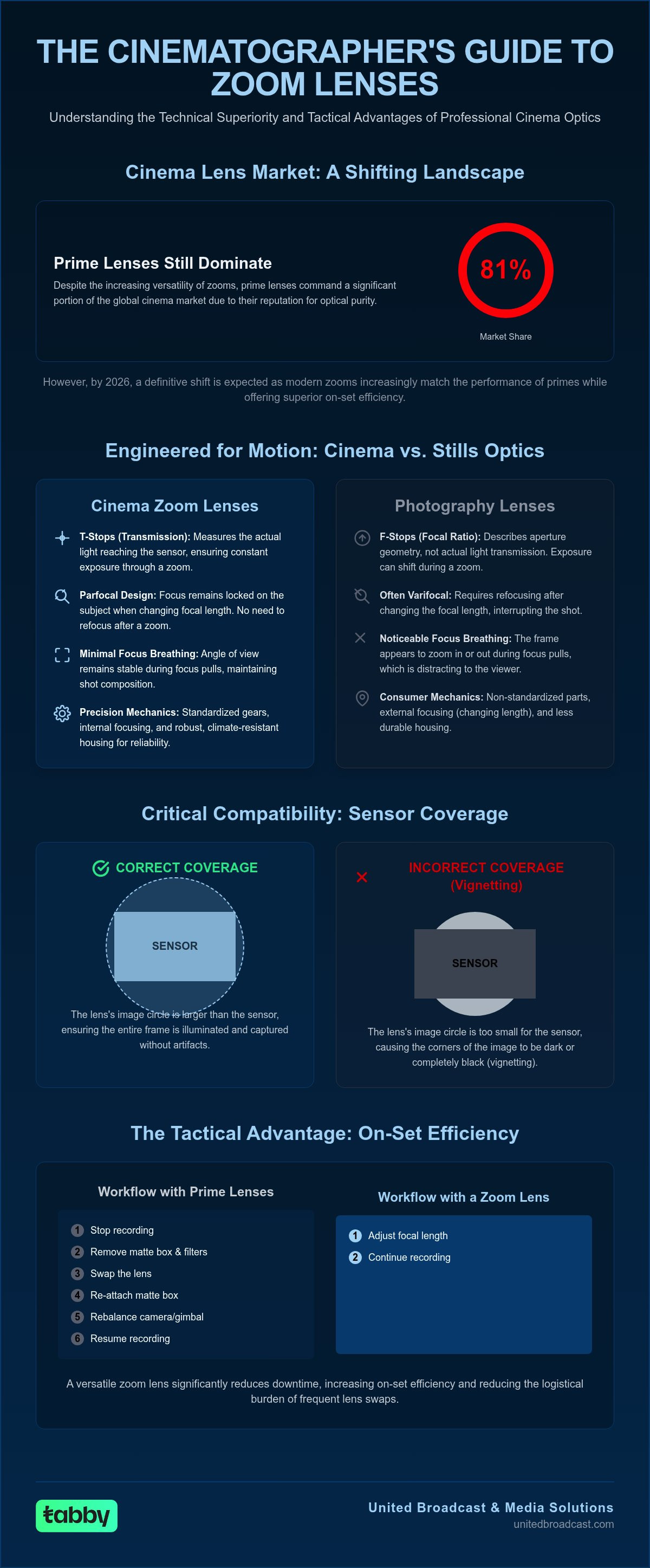
Did you know that prime lenses still command a staggering 81% of the global cinema market share? While the industry has long favored the optical purity of primes, 2026 marks a definitive shift in how cinematographers approach their glass. You've likely felt the frustration of a shot ruined by a subtle image shift during a push-in or the physical toll of swapping heavy primes on a gimbal between setups. Many professionals still struggle with distracting focus breathing and the logistical nightmare of matching zoom lenses for cinema cameras to modern large-format sensors.
This guide will help you master the technical nuances and tactical advantages of professional zoom lenses to elevate your production efficiency and visual storytelling. Whether you're balancing the ROI of a versatile zoom against a prime set or ensuring compatibility with metadata protocols like Cooke /i, we provide the technical clarity you need. We will analyze sensor coverage, mechanical stability, and the latest industry trends to help you identify the ideal optics for your specific camera system. Our goal is to ensure your equipment choices support both your creative vision and your operational bottom line.
Key Takeaways
- Understand the mechanical superiority of cinema optics by differentiating between optical geometry and constant T-stop light transmission for consistent exposure.
- Master the technical criteria for evaluating zoom lenses for cinema cameras, specifically focusing on parfocal stability and minimizing distracting focus breathing.
- Evaluate the tactical advantages of a versatile zoom lens to increase on-set efficiency and reduce the logistical burden of frequent lens swaps.
- Identify the correct sensor coverage for your camera system to avoid vignetting and ensure full compatibility with modern large-format imaging.
- Learn why regular professional calibration and technical support are vital for maintaining the precision and longevity of high-end cinema glass.
What Defines a True Cinema Zoom Lens?
A true cinema zoom lens is more than just a variable focal length tool; it's a piece of precision engineering designed for consistent, repeatable performance under the pressures of a professional set. While stills lenses prioritize capturing a single moment, What Defines a True Cinema Zoom Lens? is the ability to maintain image integrity during motion. These optics prioritize mechanical repeatability and optical consistency, ensuring every frame remains usable regardless of focal shifts or operator adjustments.
One of the most critical distinctions lies in light transmission. Photographers use F-stops, which describe the physical geometry of the lens opening. In contrast, zoom lenses for cinema cameras use T-stops (Transmission stops). These values account for the actual amount of light reaching the sensor after passing through the glass elements. This ensures that when you zoom through a range, your exposure remains perfectly consistent. This reliability makes them the backbone of high-stakes broadcast and documentary filmmaking where lighting conditions are often unpredictable and there's no time for technical retakes.
Optical Performance vs. Stills Lenses
Modern lens design for 4K and 8K sensors requires more than just clinical sharpness. High-end cinema zooms are engineered for color consistency across the entire focal range, preventing color shifts that would complicate post-production grading. While stills lenses often chase technical perfection, cinema glass often leans into "character," providing a specific aesthetic or texture that enhances the narrative. This includes controlled flare characteristics and a pleasing roll-off in the highlights that feels more natural to the human eye.
Mechanical Reliability and Housing
The exterior of the lens is just as important as the glass inside. Professional housings feature standardized 0.8mm pitch gears on the focus, iris, and zoom rings. This allows follow-focus systems and lens motors to stay in place without adjustment during lens changes. For professionals using professional video cameras, these mechanical standards are non-negotiable for maintaining a fast, efficient workflow.
- Standardized Front Diameters: Most professional zooms feature 95mm or 114mm fronts for easy matte box compatibility across different focal lengths.
- Internal Focusing: Unlike consumer glass, these lenses don't change physical length when focusing, which is vital for use with matte boxes and gimbals.
- Climate Resistance: The robust, all-metal construction ensures performance in the extreme heat of the UAE or high-humidity environments without mechanical binding.
Key Technical Features: Parfocal Stability and Focus Breathing
Selecting zoom lenses for cinema cameras requires looking at technical specifications that go far beyond focal length and maximum aperture. Two critical factors define the professional utility of a zoom: parfocal stability and focus breathing. Parfocal stability is the hallmark of high-end cinema optics. It ensures that the focal plane remains locked on the subject even as the focal length changes. For a Director of Photography, this means the ability to execute a crash zoom or a slow, dramatic push-in without losing sharpness. Beyond focus, image shift occurs if the optical center moves during a zoom. This produces a wobbly effect that professional housings are designed to prevent.
Focus breathing refers to the distracting change in the angle of view when the focus ring is turned. In inferior glass, pulling focus from a foreground subject to a background one causes the frame to "zoom" slightly. This shift breaks the immersion of the viewer. High-quality zoom lenses for cinema cameras utilize complex internal optical groups to mitigate this effect. The Tactical Decision: Cinema Zooms vs. Primes often hinges on these specific optical behaviors, as modern zooms now rival the stability once only found in fixed focal lengths.
The Mechanics of Parfocal Design
Maintaining a consistent focal plane requires sophisticated internal cam-driven systems. These mechanical linkages physically move the glass elements to compensate for the shift in focus that naturally occurs during zooming. While some modern hybrid lenses use electronic correction to simulate this, true cinema glass relies on mechanical precision. This accuracy depends heavily on back-focus calibration. If you don't maintain your back-focus, the parfocal performance will fail, even on the most expensive optics.
Controlling Focus Breathing
Optical designers minimize breathing by isolating the focusing groups from the magnification elements. It's particularly challenging in wide-angle zooms where the field of view is expansive. In telephoto zooms, breathing is often less noticeable but can still alter the composition of a tightly framed shot. Minimizing this shift is vital for narrative storytelling. It allows for seamless transitions between characters without the lens drawing attention to its own mechanics.
Achieving this level of precision requires regular maintenance and expertise. If you notice your optics drifting or require assistance with back-focus adjustments, you can consult our specialized service center for professional lens calibration and support.
Cinema Zooms vs. Prime Lenses: The Tactical Decision
Deciding between a fixed focal length and a variable range is rarely about optical quality alone; it's about the tactical demands of your production environment. While prime lenses historically offered superior sharpness and wider apertures, modern engineering has narrowed this gap significantly. For many cinematographers, the choice hinges on the speed of production. In fast-paced environments, zoom lenses for cinema cameras act as a "one lens" solution. This eliminates the need for frequent lens swaps, which can take several minutes each time and risk exposing the sensor to dust or moisture. On a high-stakes commercial set, those saved minutes translate directly into more time for creative lighting and performance adjustments.
There are optical trade-offs to consider, particularly regarding physical footprint and maximum aperture. Primes are typically lighter and faster, often reaching T1.3 or T1.5, whereas most professional zooms sit between T2.8 and T4.0. However, the creative flexibility of finding the perfect focal length instantly, without moving the camera or swapping glass, is a powerful advantage. From an economic perspective, a single high-end cinema zoom often represents a smarter investment than a basic five-lens prime set. When you factor in the cost of multiple lens cases, additional filters for different front diameters, and the increased time required for assistant cameras to recalibrate motors, the ROI of a versatile zoom becomes clear.
When to Choose a Cinema Zoom
Documentary and live broadcast professionals find a focal range necessity rather than a luxury. In these unscripted environments, you don't get a second chance to capture a moment. Zooming allows for an immediate transition from a wide establishing shot to a tight emotional close-up. For commercial sets with tight schedules, using a zoom minimizes downtime between setups. To ensure your optics are matched with the right sensor technology, consult The Ultimate Guide to Professional Video Cameras for expert pairing advice.
The "Prime Look" in a Zoom Lens
Modern lens coatings have evolved to mimic the distinct bokeh and texture once exclusive to primes. Manufacturers now design zooms with specific flare characteristics and contrast ratios that feel organic rather than clinical. This has led to a rise in "Cine-Zooms" being used in high-end feature film production. These lenses maintain a consistent aesthetic across their entire range, ensuring that a shot at 35mm looks identical in character to a shot at 85mm. This level of consistency is vital for maintaining the visual narrative without distracting the audience with subtle shifts in lens personality.
Selecting the Right Zoom: Sensor Coverage and Mounts
The evolution of sensor technology has fundamentally changed the criteria for selecting zoom lenses for cinema cameras. While Super 35 was the industry standard for decades, the industry-wide shift toward full-frame and large-format imaging has made sensor coverage a primary technical concern. Using a lens designed for a smaller sensor on a large-format body results in heavy vignetting or a loss of edge-to-edge sharpness. Beyond the glass, the choice of lens mount, typically PL or EF, dictates the stability of the camera-to-lens connection. Modern professionals often prioritize modular mount systems that allow a single lens to transition between different camera platforms, ensuring that high-end optics remain a long-term asset.
Metadata integration is another critical factor often overlooked during the procurement process. Protocols like Cooke /i Technology and ZEISS eXtended Data provide real-time information on lens settings, including focal length, T-stop, and focus distance. This data is essential for modern post-production workflows, particularly in visual effects and virtual production. Investing in glass with robust metadata capabilities ensures your workflow remains efficient as production standards evolve. High-quality optics frequently outlast several generations of camera bodies, so choosing glass with universal compatibility is a vital form of future-proofing.
Full Frame Cinema Zooms
Large format sensors, found in systems like the ARRI Alexa 35 or Sony VENICE, require optics with a larger image circle. These lenses provide a shallower depth of field and a wider field of view compared to their S35 counterparts at the same focal length. For operators utilizing hybrid systems, exploring Sony Alpha Camera and Lenses offers a gateway into versatile zoom solutions that bridge the gap between cinema and high-end photography. Ensuring your glass maintains sharpness across the entire frame is vital for 8K acquisition where any optical fall-off becomes immediately apparent.
Super 35 and Specialized Zooms
Despite the rise of full-frame, Super 35 remains a dominant standard for television and commercial production due to its balance of size, weight, and depth of field. Specialized zoom lenses for cinema cameras in the S35 category often offer more compact housings and faster apertures. Additionally, anamorphic zoom options allow filmmakers to achieve wide-screen cinematic aesthetics without the logistical complexity of a prime set. These specialized tools are often paired with modular mounts to maximize their utility across a diverse fleet of professional video cameras.
Optimizing Your Cinema Lens Workflow with United Broadcast & Media Solutions (UBMS)
Acquiring high-end zoom lenses for cinema cameras represents a significant capital investment that requires a comprehensive support structure to yield professional results. United Broadcast & Media Solutions (UBMS) provides the technical infrastructure and expertise necessary to integrate these sophisticated optics into your existing production pipeline. A lens is only one part of the imaging chain; its performance is heavily influenced by the quality of light hitting the sensor. Pairing your glass with the ARRI Lighting collection allows you to maximize the contrast and color rendition inherent in premium cinema glass. This synergy is vital for maintaining a consistent visual aesthetic across complex multi-camera setups or long-form narrative projects.
Beyond the hardware, successful production relies on seamless system integration. United Broadcast & Media Solutions (UBMS) leverages decades of experience to ensure that your lenses, camera bodies, and control systems communicate without latency or metadata errors. This holistic approach to workflow optimization minimizes technical downtime on set. By choosing a partner that understands the nuances of both cinema and broadcast environments, you gain access to a level of technical support that extends far beyond a simple transaction. We focus on creating stable, repeatable workflows that allow your creative team to focus on storytelling rather than troubleshooting equipment compatibility issues.
Lens Maintenance and Longevity
The regional climate across the UAE presents specific challenges for delicate optical instruments. Fine desert dust and fluctuating humidity levels can infiltrate lens housings, leading to mechanical binding or internal fungal growth if not properly managed. Regular maintenance is a requirement for long-term reliability. The United Broadcast & Media Solutions (UBMS) service center specializes in precision optical alignment and mechanical calibration. For detailed insights on protecting your investment, consult our guide on Professional Cinema Lens Maintenance in the UAE. Consistent servicing ensures that your parfocal stability remains accurate and your focus gears rotate with the precision required for high-torque wireless motors.
Complete Production Solutions
Integrating zoom lenses for cinema cameras into a modern broadcast or studio environment involves more than just mounting the glass. You need a robust ecosystem of accessories to maintain full control over your image. This includes wireless lens control systems for gimbal work and precision follow-focus units for studio configurations. United Broadcast & Media Solutions (UBMS) provides end-to-end support for these complex setups, offering technical guidance on everything from matte box compatibility to advanced metadata workflow integration. Our team ensures that your lens choice supports your specific production requirements, whether you're shooting unscripted documentaries or high-end commercial content.
Explore our full inventory of Cinema Lenses
Elevate Your Production Standards with Professional Optics
As the industry moves toward 2027, the role of zoom lenses for cinema cameras has transitioned from a convenience to a tactical necessity. We've detailed how mastering parfocal stability, managing sensor coverage, and leveraging metadata can significantly streamline your production workflow. These technical considerations are the foundation of high-tier visual storytelling, allowing for greater flexibility without compromising the optical character your project demands. Investing in the right glass today ensures your toolkit remains relevant as sensor technology continues to evolve.
United Broadcast & Media Solutions (UBMS) remains committed to supporting the regional filmmaking community with more than just high-end equipment. Since 1997, our role as an industry pillar has been built on providing the technical infrastructure, authorized brand support, and precision calibration services required for professional success. Whether you're outfitting a new studio or upgrading a single kit, our expertise ensures your investment is future-proofed and maintained to global standards. We understand the high stakes of professional production and provide the reliability your workflow requires.
We invite you to consult with our specialists to find the perfect optical balance for your next production. Let's work together to ensure your equipment supports every frame of your creative vision with absolute precision and dependability.
Frequently Asked Questions
What is the difference between a cine zoom and a standard photography zoom?
A cine zoom differs from a photography zoom primarily through its mechanical construction and optical consistency. Zoom lenses for cinema cameras feature standardized 0.8mm pitch gears for follow-focus systems and maintain a constant physical length during operation. While photography lenses often prioritize autofocus speed and compact size, cine zooms focus on manual repeatability, minimal focus breathing, and constant T-stop values to ensure exposure remains identical throughout the entire focal range.
Are cinema zoom lenses parfocal?
Most professional zoom lenses for cinema cameras are designed to be parfocal, meaning they maintain sharp focus on a subject even as you change the focal length. This is a critical feature for narrative filmmaking and live broadcast where refocusing during a zoom is impractical. Standard photography zooms are typically varifocal, requiring the operator to adjust focus after every zoom adjustment. Parfocal stability relies on precise internal mechanical cams and accurate back-focus calibration.
What does "focus breathing" mean in cinema lenses?
Focus breathing describes the distracting shift in the angle of view that occurs when you adjust the focus ring. In lower-quality optics, pulling focus from the foreground to the background causes the image to appear as if it's zooming slightly. High-end cinema glass uses sophisticated internal optical groups to isolate the focus movement from the magnification elements. Minimizing this effect is essential for maintaining the viewer's immersion during complex narrative scenes.
Can I use a Super 35 zoom lens on a Full Frame camera?
You can physically mount a Super 35 zoom on a Full Frame camera, but the image circle won't cover the entire sensor. This results in significant vignetting or "port-holing" around the edges of the frame. To use these zoom lenses for cinema cameras effectively, you must set your camera to a Super 35 or "crop" mode. While this reduces the effective resolution, it allows you to utilize specialized glass on modern large-format camera bodies.
Why are cinema zoom lenses more expensive than prime lenses?
Cinema zooms are generally more expensive because they require significantly more glass elements and more complex mechanical housings than primes. Achieving parfocal stability and constant T-stops across a variable focal range demands extreme manufacturing tolerances. Every internal moving part must be perfectly synchronized to prevent image shift or focal drift. This high level of engineering ensures that a single zoom can replace multiple primes while maintaining the same level of optical performance.
What metadata protocols should I look for in a cinema zoom lens?
Professional productions should prioritize lenses supporting Cooke /i Technology or ZEISS eXtended Data protocols. These systems transmit real-time metadata, including focal length, T-stop, and focus distance, directly to the camera's recording files. This information is vital for visual effects teams and virtual production environments where the digital world must match the physical lens characteristics. Having this data automated saves hours of manual logging on set and ensures accuracy in post-production workflows.
How often should cinema lenses be calibrated at a service center?
We recommend a professional calibration at least once a year or after any production in extreme environments. High-value optics are sensitive to the fine dust and humidity common in the UAE. Regular maintenance at a dedicated service center ensures that the back-focus remains accurate and the internal lubricants haven't dried out. Proper alignment prevents mechanical binding in the focus and zoom rings, extending the operational life of your investment while maintaining peak performance.
Is a T-stop different from an F-stop on a zoom lens?
Yes, a T-stop measures the actual light transmission reaching the sensor, while an F-stop is a purely geometric calculation of the lens opening. In professional cinematography, T-stops are used because they account for light lost as it passes through the glass elements. This ensures that a T2.8 setting provides the exact same exposure across different lenses. For zoom lenses, maintaining a constant T-stop throughout the range is essential for consistent exposure during a shot.


