

Dynamic Range in Digital Cinema Cameras Explained: The Professional Guide
High resolution might sell cameras, but dynamic range is what actually sells the story. While pixel count defines the size of your canvas, dynamic range defines the emotional depth and texture of the image held within it. You've likely experienced the frustration of a high-stakes outdoor shoot where the sky clips to a digital white, or a low-light interior where the shadows dissolve into unusable noise. It's a common challenge for cinematographers who find that the "marketing stops" promised on a spec sheet don't always match the usable latitude available during a color grade.
In this professional guide, we provide dynamic range in digital cinema cameras explained through both technical and artistic lenses. You'll master the relationship between stops and fine image detail to ensure your productions maintain a true cinematic aesthetic. We will examine how to maximize your sensor's potential on set and provide the clarity needed to make informed equipment investments for your studio. From understanding sensor calibration to evaluating the latest industry-standard models, this overview prepares you to capture every detail from the brightest highlight to the deepest shadow.
Key Takeaways
- Identify the difference between manufacturer-claimed stops and the actual usable latitude available for post-production grading.
- Understand why photosite size and sensitivity are often more critical than total resolution for achieving clean, professional imagery.
- Master technical foundations with dynamic range in digital cinema cameras explained through the lens of sensor physics and light mapping.
- Learn practical on-set workflows, including ETTR and Log gamma selection, to capture the widest possible range of tonal detail.
- You'll learn to evaluate professional sensor architectures and dual-gain designs to select the optimal camera body for your specific production requirements.
Defining Dynamic Range in the Digital Cinema Landscape
Dynamic range is the linear ratio between the brightest highlights and the darkest shadows a sensor can capture simultaneously. While resolution defines the sharpness of an image, dynamic range defines its depth and realism. This measurement is the primary differentiator between consumer-grade equipment and professional video cameras. Having dynamic range in digital cinema cameras explained starts with understanding that this isn't just about brightness; it's about the ability to preserve texture in extreme exposure areas. When a sensor lacks sufficient range, highlights clip into a flat, digital white and shadows dissolve into a muddy block of noise.
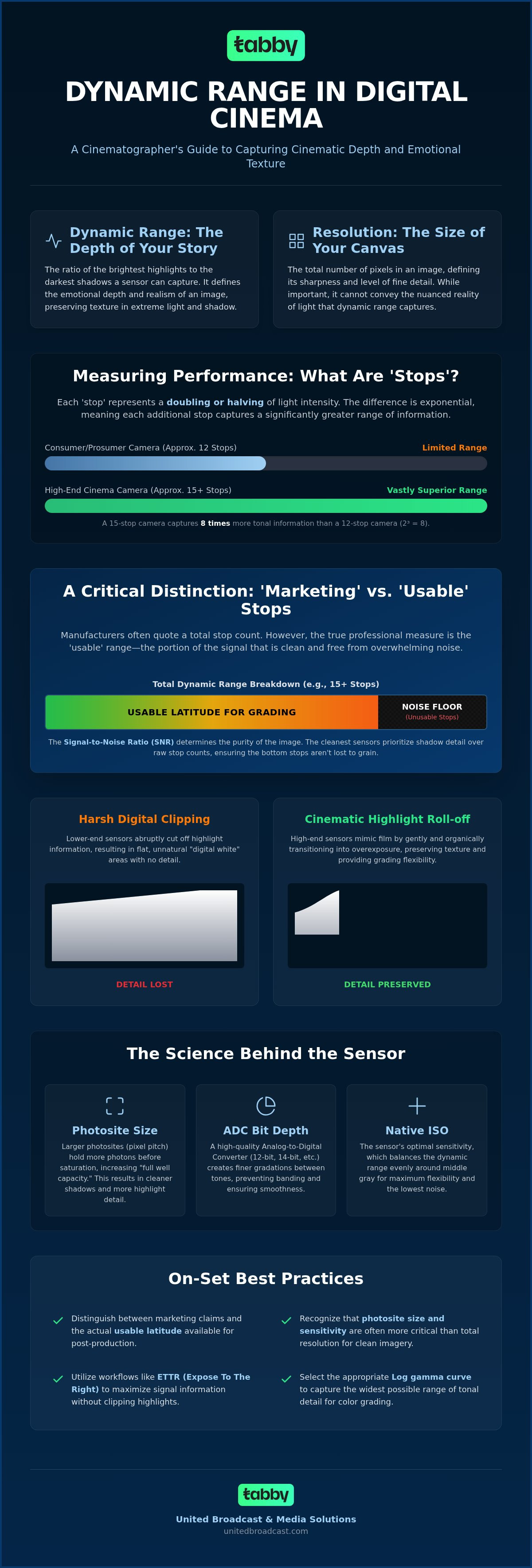
Light intensity is measured in 'stops,' a logarithmic scale where each stop represents a doubling or halving of the light reaching the sensor. This means a camera with 15 stops of range is significantly more capable than one with 12 stops, as each additional stop provides an exponential increase in captured information. A wide dynamic range allows a cinematographer to handle high-contrast scenes, such as an interior shot with a bright window in the background, without losing the fine details of the subject's face or the texture of the clouds outside.
The Difference Between Total and Usable Dynamic Range
Marketing materials often highlight a total stop count that might not reflect real-world performance. Professional testers distinguish between 'marketing stops' and 'usable stops.' The latter is determined by the noise floor, which is the point where the image signal becomes indistinguishable from electronic interference. For instance, while high-end models like the Sony FX3A or Canon EOS C50 are rated for 15+ stops, the actual usable range for a clean master depends heavily on the Signal-to-Noise Ratio (SNR). Understanding High-Dynamic-Range Imaging principles helps operators realize that the cleanest sensors prioritize shadow purity over raw stop counts. If the bottom three stops of a sensor are filled with heavy grain, they don't contribute to a professional-grade image.
Dynamic Range and the 'Film Look'
The sought-after 'film look' is largely defined by how a sensor handles the transition into overexposure. High-end cinema cameras feature sophisticated highlight roll-off, mimicking the organic aesthetic of celluloid film. Instead of a harsh, digital 'clip,' the image gently loses saturation and detail in the brightest areas. This latitude provides immense flexibility during color grading, allowing the colorist to pull detail back from what might initially look like lost information. In modern cinematography, this tonal flexibility is often more valuable than resolution. A 4K image with 15 stops of usable range will almost always look more cinematic than an 8K image with only 10 stops, as the former captures the nuanced reality of light and shadow that resolution alone cannot convey.
Measuring Performance: Stops, Latitude, and Sensor Physics
Quantifying sensor performance requires a firm grasp of the f-stop. In optics, a single stop represents a doubling or halving of the light intensity reaching the sensor. For a professional sensor to achieve high performance, it must utilize a high-quality Analog-to-Digital Converter (ADC). This component is responsible for mapping the analog voltage from the sensor into digital values. A 12-bit or 14-bit ADC allows for finer gradations between the brightest and darkest points, which is a core part of dynamic range in digital cinema cameras explained for technical operators. Without a precise ADC, the sensor's physical capability to capture light is wasted by poor digital translation.
Photosite size, often referred to as pixel pitch, plays a massive role in this equation. Larger photosites can hold more photons before reaching saturation, effectively raising the "full well capacity." This physical characteristic allows the sensor to maintain detail in bright highlights while keeping the noise floor low in the shadows. Additionally, the camera's native ISO determines the distribution of these stops. At a native ISO, the camera typically splits its dynamic range evenly above and below middle gray. Shifting the ISO can move this window, prioritizing highlight protection at higher sensitivities or shadow depth at lower ones.
Latitude vs. Dynamic Range: A Crucial Distinction
While often used interchangeably, latitude and dynamic range serve different purposes in a professional workflow. Dynamic range is the total capacity of the sensor, whereas latitude is the practical "wiggle room" available to a cinematographer to recover exposure errors. High-end digital cinema cameras with 14 or more stops provide significant latitude. This means that if an image is accidentally underexposed by two stops, the detail remains recoverable in post-production without introducing catastrophic noise. It's the safety net that allows for creative risk-taking on set.
The Impact of Bit Depth on Dynamic Range
Capturing a wide range of light is only half the battle; the data must be stored in a format that preserves those nuances. This is where bit depth becomes critical. Using 10-bit, 12-bit, or 16-bit RAW formats ensures that the gradients in a sunset or a dimly lit face don't suffer from "banding." According to Adobe's guide to Dynamic Range, higher bit depths provide the mathematical precision needed to map wide-gamut color and high-DR data. This performance is further enhanced when paired with high-performance cinema lenses that maintain contrast and minimize internal flare.
Maintaining this level of precision requires regular technical oversight to ensure sensor health and calibration. If you're looking to optimize your current setup for maximum performance, you can consult with our technical specialists for professional sensor maintenance and lens pairing advice.
Dynamic Range vs. Resolution: Prioritizing Image Quality
The drive for higher resolution has dominated camera marketing for years, yet resolution is often the least important factor in creating a cinematic image. A 2K image with 15 stops of dynamic range frequently appears more "expensive" and textured than an 8K image limited to 11 stops. This happens because dynamic range dictates the tonal depth that the human eye associates with high-end production. When we look at dynamic range in digital cinema cameras explained through the lens of sensor design, we see a physical conflict between pixel count and sensitivity. More pixels isn't always the solution for a professional workflow.
On a fixed sensor area, increasing the resolution requires shrinking the size of individual photosites. Smaller photosites have a reduced capacity to hold a charge, which leads to a lower signal-to-noise ratio and a narrower dynamic range. Industry-standard cameras, such as the Sony FX3A or the Canon EOS C50, are engineered to balance these factors. They provide 15 or more stops of range by ensuring photosites are large enough to capture significant light data. This priority on "quality over quantity" ensures the sensor maintains the highest possible latitude for the colorist.
Highlight Roll-off: The Professional Edge
Professional sensors are distinguished by how they handle the transition into overexposure. Consumer cameras typically exhibit "hard clipping," where detail simply vanishes into a harsh, digital white block. Professional systems utilize a "soft roll-off" that preserves subtle gradations. This is essential for natural skin tone reproduction. Even in high-contrast outdoor scenes, a sensor with superior roll-off keeps the highlights on a subject's face looking organic rather than plastic. It's the difference between a video-like appearance and a true cinematic aesthetic.
Shadow Recovery and the Noise Floor
True image quality is also found in the deep shadows. Professional sensors must maintain color accuracy in dark areas without introducing digital artifacts or "chroma noise." Thermal management is a key factor here. Advanced cooling systems keep the sensor at a consistent temperature to minimize thermal noise, which can otherwise eat into your usable dynamic range. To ensure your equipment stays within these tight tolerances, the UBMS service center provides specialized calibration and maintenance for professional video cameras, ensuring sensor performance remains at peak levels for every production.
Practical Techniques: Maximizing Dynamic Range on Set
Capturing the full latitude of a sensor requires more than just pointing the camera at a subject. It demands a deliberate exposure strategy. Having dynamic range in digital cinema cameras explained technically is the first step, but applying it on set involves using Log gamma curves like S-Log3 or Log-C. These curves mathematically "squeeze" the wide dynamic range of the sensor into a recordable file format, preventing highlight clipping and shadow crushing. To ensure the cleanest possible image, many professionals employ the Expose to the Right (ETTR) technique. This involves pushing the exposure as bright as possible without clipping the highlights, which keeps the shadow detail well above the sensor's noise floor for better recovery in post-production.
In regions with intense natural sunlight, such as the high-contrast environments found in the Middle East, managing exposure becomes even more critical. You can't always rely on the sensor's raw latitude alone to handle the harsh transition between direct sun and deep shadow. This is where the strategic use of professional lighting equipment becomes an extension of your camera's sensor. By using LUTs (Look-Up Tables) on your monitor, you can visualize the final graded look while ensuring the raw sensor data remains protected and unclipped.
Tools for Measuring DR on Location
Gauging exposure by eye is unreliable on a professional set. False Color is perhaps the most effective tool for identifying exactly where highlights are reaching the clipping point. It provides a color-coded map of exposure values across the frame. A Waveform monitor is equally essential, allowing you to see the distribution of luminance across the sensor's range. For the highest level of precision, a traditional spot meter remains a staple. It allows you to measure the exact contrast ratio between your key light and the background, ensuring your scene stays within the camera's usable stops.
Controlling Contrast with Lighting
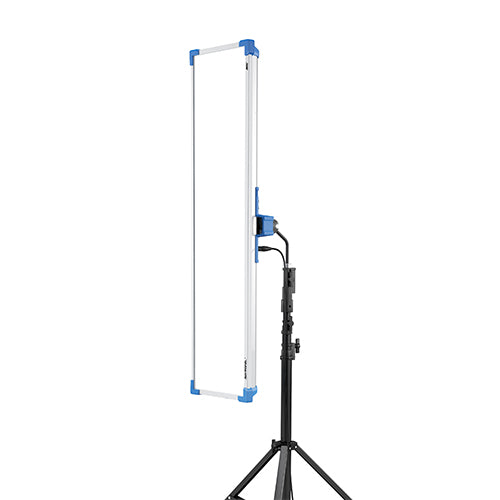
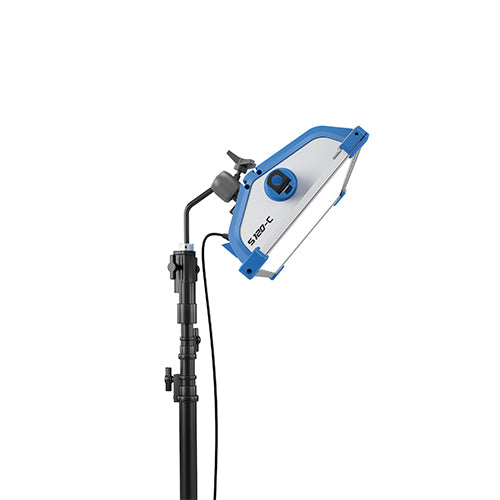
When the natural dynamic range of a scene exceeds what the camera can capture, you must intervene with lighting. Fill light is used to lift shadows just enough to bring them above the noise floor, while negative fill, using black solids, is used to add shape and depth to an image that might otherwise look flat. Utilizing ARRI lighting allows cinematographers to maintain consistent contrast ratios even in the most challenging outdoor conditions. These tools give you the power to "shrink" the scene's dynamic range to fit the sensor's capabilities perfectly.
Selecting the Right Gear for High Dynamic Range Production
Choosing a camera system requires an understanding of how different manufacturers approach sensor architecture. Industry leaders like ARRI utilize a dual-gain architecture, which captures two separate signal paths for every pixel to maximize highlight and shadow detail simultaneously. In contrast, Sony leverages high-speed sensor readout and advanced ADC technology to achieve similar results. For instance, as of August 2026, models like the Sony FX3A and the Canon EOS C50 consistently deliver 15 or more stops of range, setting a high benchmark for professional productions. Having dynamic range in digital cinema cameras explained through these hardware differences helps you select a tool that matches your specific aesthetic requirements.
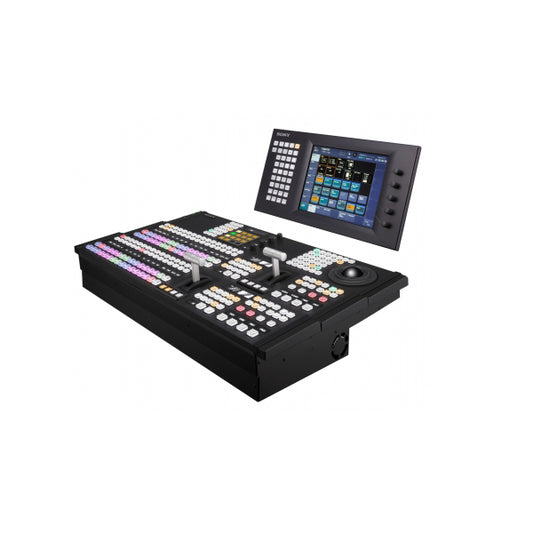
Sensor size also influences your perceived latitude. While a Super 35 sensor provides a classic cinematic crop, a Full Frame sensor often features larger individual photosites. These larger sites improve the signal-to-noise ratio, which effectively pushes the noise floor lower and allows for cleaner shadow recovery. Another critical hardware feature is the inclusion of internal ND filters. These allow you to manage exposure in bright environments without being forced to close down your aperture, which preserves the lens's "sweet spot" and depth of field. For larger operations, integrating these high-DR cameras into a comprehensive broadcast studio gear environment ensures that your high-quality acquisition translates perfectly through the entire signal chain.
Workflow Considerations: RAW vs. Compressed
The choice of recording format dictates how much of the sensor's dynamic range you can actually use in post-production. Uncompressed RAW provides the maximum flexibility for HDR grading, as it stores the linear data directly from the sensor. However, modern codecs like ProRes RAW or Sony’s X-OCN offer a more efficient balance of file size and data retention. It's essential that your monitoring chain supports HDR standards during the shoot. If your monitors aren't calibrated for high dynamic range, you won't be able to accurately judge the highlight roll-off or shadow detail you're capturing.
Expert Support and System Integration
A high-performance sensor is a precision instrument that requires regular maintenance. Professional calibration ensures that your camera continues to deliver accurate color and the full advertised stop count over years of heavy use. United Broadcast provides end-to-end solutions that go beyond simple equipment sales. From initial camera selection to complex system integration for mobile or studio environments, our technical team ensures your workflow is optimized for the highest possible image quality.
Explore our full range of digital cinema cameras at United Broadcast
Advancing Your Cinematic Vision with High-Latitude Systems
Mastering the nuances of sensor performance separates standard video from high-end cinematography. You've seen how dynamic range serves as the foundation for organic highlight roll-off and shadow detail, often proving more critical to the cinematic look than resolution alone. With dynamic range in digital cinema cameras explained from both technical and practical perspectives, you're now equipped to make equipment decisions that prioritize image depth and color accuracy. It's about ensuring your sensor has the latitude to handle challenging lighting conditions without compromise.
United Broadcast & Media Solutions stands as a dedicated partner in this journey. As an authorized distributor for global leaders like Sony and ARRI, we provide more than just hardware. Our national service center offers technical support and sensor calibration to maintain peak performance throughout your camera's lifespan. From camera selection to expert system integration, we ensure your professional workflow remains seamless and efficient.
We look forward to helping you achieve the precise visual standards your professional projects demand.
Frequently Asked Questions
What is a 'stop' of dynamic range in digital cinematography?
A stop represents a doubling or halving of the light intensity reaching the camera sensor. In the context of dynamic range in digital cinema cameras explained, it measures the ratio between the brightest and darkest recordable values. Each additional stop provides exponentially more tonal information, allowing for smoother gradients and better highlight preservation during the grading process.
Why do cinema cameras have more dynamic range than DSLRs?
Digital cinema cameras utilize specialized sensor architectures, such as dual-gain designs, that prioritize tonal depth over raw pixel count. Unlike standard DSLRs, these professional systems feature larger photosites and advanced cooling to maintain a low noise floor. This design allows them to capture subtle detail in extreme shadows that consumer-grade cameras typically crush into digital noise.
How does ISO affect the dynamic range of my camera sensor?
Adjusting your ISO shifts the distribution of available stops above and below middle gray. At a camera's native ISO, the dynamic range is typically balanced for optimal performance. Increasing the ISO often sacrifices highlight protection to gain shadow sensitivity, whereas lower ISOs may provide cleaner shadows but risk clipping highlights more quickly in high-contrast scenes.
Can I increase my camera's dynamic range in post-production?
You cannot increase the physical dynamic range of a sensor after the footage is recorded. Post-production allows you to recover and manipulate the data already present in the file, but it cannot invent detail in clipped highlights or crushed shadows. This is why using Log gammas and RAW formats is essential for preserving the maximum latitude available during acquisition.
What is the difference between HDR video and a camera's dynamic range?
Camera dynamic range refers to the sensor's ability to capture light, while HDR video refers to the display standard used to show that content. A high-DR camera provides the necessary data to create an HDR master. Without a sensor capable of wide latitude, an HDR display won't have enough highlight or shadow information to show a truly expanded tonal range.
How many stops of dynamic range are needed for a professional film look?
Most industry professionals consider 13 to 15 usable stops as the benchmark for a true cinematic look. This range provides the soft highlight roll-off and shadow texture that mimics the aesthetic of traditional film. While lower ranges can work for broadcast, high-end narrative and commercial productions rely on this extra latitude to maintain image integrity in uncontrolled environments.
Does the lens affect the dynamic range of the camera system?
While the sensor defines the range, the lens significantly impacts how that light is delivered to the photosites. High-quality cinema lenses minimize internal flares and maintain high micro-contrast, which prevents stray light from washing out shadow detail. A poor lens can effectively reduce your perceived dynamic range by introducing veiling glare that raises the black level of your image.
What are the best professional cameras for high dynamic range in 2026?
In 2026, the Sony FX3A and Canon EOS C50 are leading choices, both offering 15 or more stops of range. High-end ARRI models remain the industry standard for their dual-gain sensor architecture and superior highlight roll-off. These systems provide the most comprehensive dynamic range in digital cinema cameras explained through real-world performance, ensuring maximum flexibility for professional colorists and cinematographers.


