

Broadcast Studio Upgrade Solutions: The 2026 Strategic Implementation Guide
Why are some of the most capital-intensive 4K studio investments failing to deliver a measurable return while smaller, phased deployments are dominating the market in 2026? It's a question many media professionals face as they struggle to justify high-end cinema sensors within traditional television environments. You've likely encountered the technical friction of bridging legacy SDI hardware with modern IP standards, only to find that signal integrity suffers at higher resolutions. It's a common challenge to balance the need for cinematic aesthetics with the rigid demands of a live broadcast workflow.
This strategic guide provides a technical roadmap for implementing high-performance broadcast studio upgrade solutions that solve these interoperability issues. We'll show you how to execute a phased modernization of your infrastructure without compromising your current output. You'll learn how to integrate cinema-quality cameras into existing workflows while maintaining full 4K/HDR delivery standards. We're moving beyond simple hardware swaps to focus on a future-proof architecture that ensures your studio remains competitive and fully supported for the long term.
Key Takeaways
- Identify technical production bottlenecks by aligning internal studio workflows with 2026 delivery standards for resolution and color depth.
- Learn to integrate large-format cinema sensors into live broadcast environments while ensuring sensor consistency across multi-camera configurations.
- Evaluate the technical advantages of 12G-SDI versus IP-based architectures to choose the most scalable broadcast studio upgrade solutions for your facility.
- Understand why modern imaging sensors require lighting equipment with higher CRI and TLCI ratings to maintain color accuracy.
- Master phased implementation strategies that utilize professional system integration to minimize studio downtime during complex infrastructure transitions.
Identifying Technical Bottlenecks: When to Upgrade Your Studio Infrastructure
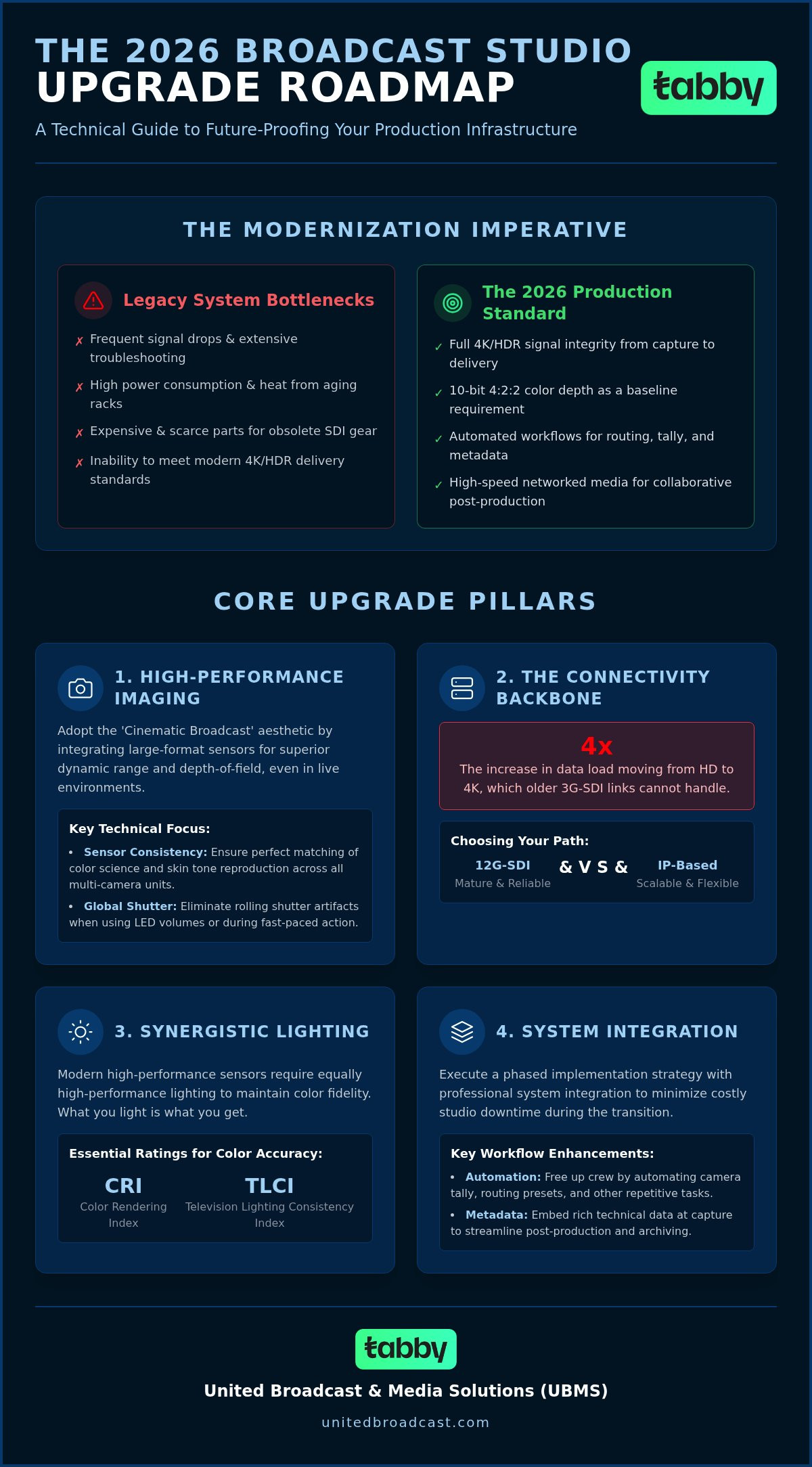
Technical obsolescence in a broadcast environment rarely happens overnight. It's usually a gradual accumulation of small inefficiencies that eventually hinder your ability to meet modern delivery standards. If your engineering team spends more time troubleshooting signal drops than optimizing production, it's time to evaluate broadcast studio upgrade solutions. Identifying these bottlenecks requires a deep look at resolution, frame rates, and color depth limitations that prevent you from reaching 2026 market expectations. You can't produce competitive content on infrastructure designed for a previous decade's requirements.
Maintaining legacy hardware carries hidden financial burdens that often go unnoticed until they impact the bottom line. Aging studio racks suffer from high power consumption and significant heat dissipation issues, which strain HVAC systems and increase monthly utility costs. Finding replacement parts for discontinued Serial Digital Interface (SDI) equipment is also becoming increasingly difficult and expensive. Choosing the right broadcast studio upgrade solutions involves a phased approach, replacing these high-maintenance points before they lead to a catastrophic system failure during a live production.
The Shift to 4K and HDR Delivery
By 2026, 10-bit 4:2:2 color depth has transitioned from a premium feature to a baseline requirement for professional broadcasting. This shift places immense pressure on existing cable infrastructure. Moving from HD to 4K quadruples the data load, often exceeding the capacity of older 3G-SDI links. Implementing High Dynamic Range (HDR) also requires a complete rethink of your monitoring and switching needs. You can't deliver what you can't accurately see. Upgrading to high-performance professional video cameras and HDR-compliant displays is essential for maintaining signal integrity throughout your signal chain.
Workflow Efficiency and Automation
High-Performance Imaging Solutions: Upgrading Cameras and Cinema Lenses
The visual language of television has undergone a radical transformation. Audiences now expect a cinematic aesthetic even in live news and talk show environments. This shift, often called 'Cinematic Broadcast,' involves integrating large-format sensors into traditional live sets to achieve superior dynamic range and depth-of-field. Selecting broadcast studio upgrade solutions in 2026 requires a focus on achieving multi-cam consistency across these high-end sensors. It's not enough to simply buy the best camera; you need to ensure that every unit in your gallery can be matched perfectly in terms of color science and skin tone reproduction.
Achieving this consistency requires a deep understanding of sensor technology. While large-format sensors provide a beautiful shallow depth-of-field, they also present challenges for live focus pulling. Professional operators need tools that balance artistic bokeh with the precision required for live tracking. High-quality Professional Video Cameras designed for this hybrid role allow for seamless integration into existing vision mixers while providing the 'film look' that modern viewers demand.
Selecting Professional Video Cameras for Multi-Cam Sets
Technical specifications like global shutter are no longer optional for studios utilizing LED volumes or high-frequency lighting. A global shutter eliminates the rolling shutter artifacts that can ruin a shot during fast movement or strobe effects. Additionally, high ISO sensitivity and internal ND filters are vital for maintaining exposure consistency without swapping hardware mid-production. The Sony Alpha camera range has emerged as a leader in this space, effectively bridging the gap between portable ENG units and full-scale cinema systems. For those managing diverse hardware, ensuring robust genlock and timecode sync is the only way to maintain frame-accurate switching during a live broadcast.
The Importance of Precision Cinema Lenses
Glass is often the most significant long-term investment in any studio. While prime lenses offer the ultimate optical performance, high-performance zooms are typically more practical for the fast-paced nature of studio environments. As sensors move toward 8K-ready resolutions, the demand on lens coatings and glass purity increases. Chromatic aberration and soft edges that were acceptable in HD are glaringly obvious in 4K and beyond. To protect these assets, regular calibration and maintenance through a professional service center is mandatory. If you're unsure which focal lengths will best suit your new studio layout, you can consult our technical team for a detailed lens mapping analysis.
The Connectivity Backbone: Transitioning to 12G-SDI and IP-Based Workflows
The heart of any modern facility is its routing and distribution architecture. As you transition to 4K and UHD, the bandwidth demands on your infrastructure grow exponentially. Implementing effective broadcast studio upgrade solutions requires a clear choice between traditional baseband and emerging IP standards. This decision dictates not only your current signal integrity but also your facility's ability to scale as production requirements evolve throughout 2026. You must choose a backbone that supports high-bitrate content without introducing latency or synchronization errors.
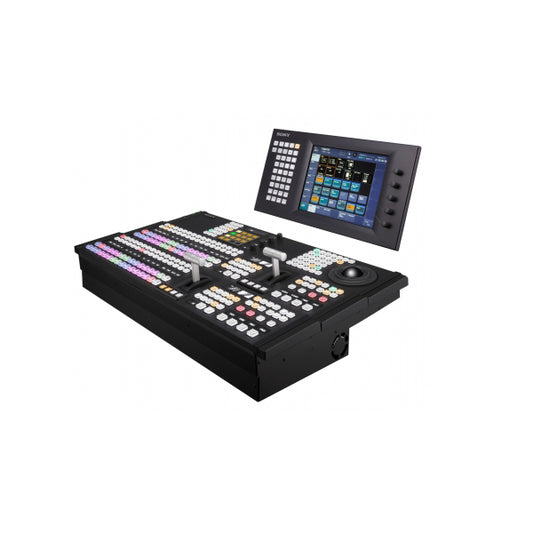
Modern video switchers and routers serve as the central nervous system of the studio. They must handle massive data loads while maintaining frame-accurate switching. For many professionals, the goal is to find a balance between the reliability of dedicated hardware and the flexibility of software-defined routing. Selecting the right Advanced Broadcast Studio Gear ensures that your backbone can support 10-bit 4:2:2 workflows without signal degradation. A robust connectivity plan prevents the technical bottlenecks that often plague haphazardly upgraded facilities.
Implementing 12G-SDI for 4K Simplicity
12G-SDI has become the preferred choice for studios that need immediate 4K capabilities without a complete network overhaul. It uses a single-link BNC cable to carry what previously required four separate 3G-SDI cables. This reduction in cable complexity significantly cleans up rack rooms and simplifies troubleshooting. However, signal attenuation is more aggressive at these higher frequencies. High-quality re-clocking and premium cabling are necessary to maintain signal integrity over distances exceeding 50 meters. If you're working with a mix of newer 12G cameras and older 3G infrastructure, professional-grade converters allow for a seamless, phased integration without replacing every component at once.
The Scalability of IP-Based Studio Networks
While SDI offers plug-and-play simplicity, SMPTE ST 2110 provides the ultimate scalability for complex operations. IP-based studio networks create a software-defined environment where any source can be routed to any destination on the network without physical patch panels. This flexibility comes with a learning curve for traditional broadcast engineers who must now master network security, PTP (Precision Time Protocol) synchronization, and redundancy protocols. An all-IP studio isn't just about moving video; it's about managing high-bandwidth data. Ensuring your network switches and infrastructure are purpose-built for media is critical for a successful broadcast studio upgrade solutions strategy.
Synergistic Production Environments: Lighting and Grip Integration
Lighting is often the most overlooked component of broadcast studio upgrade solutions, yet it directly dictates the performance of your high-end imaging sensors. While the previous sections focused on capturing and moving the signal, the quality of that signal begins with the photons hitting the sensor. Modern 4K and HDR cameras are incredibly sensitive to spectral gaps in low-quality light sources. To achieve true-to-life skin tones and vibrant colors, your facility must prioritize fixtures with high Color Rendering Index (CRI) and Television Lighting Consistency Index (TLCI) ratings. A high TLCI score, specifically above 90, ensures that the camera sees exactly what the human eye perceives, reducing the need for intensive color correction in post-production.
Transitioning to an all-LED environment in 2026 is no longer just about energy efficiency. While reduced power consumption and lower heat loads are significant benefits for your HVAC system, the primary advantage is control. Modern Professional Lighting Equipment allows for instantaneous color temperature adjustments and full-spectrum tuning. Integrating these fixtures into a central studio automation system via DMX or IP-based protocols enables lighting designers to trigger complex scene changes with a single command. This synergy between lighting and automation is essential for studios running multiple back-to-back productions with minimal turnaround time.
Advanced LED Lighting Solutions
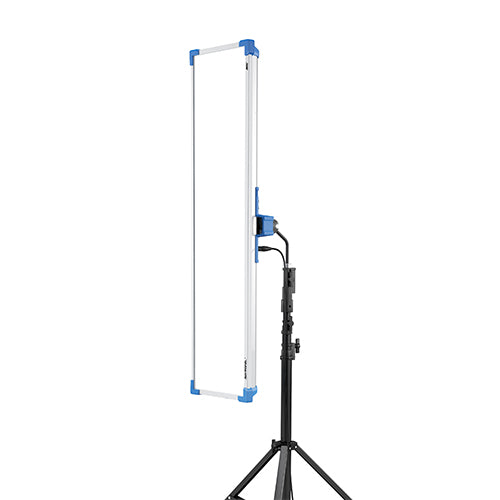
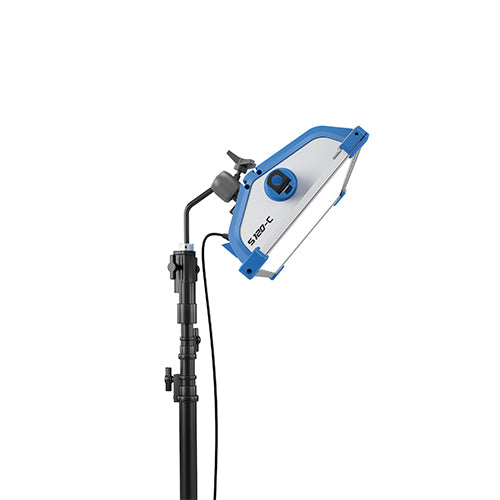
Versatility in a modern set requires fixtures that can adapt to various skin tones and set designs without physical gel changes. RGBWW and bi-color fixtures provide this flexibility by allowing precise control over the white point and color saturation. For many professionals, ARRI Lighting remains the gold standard because of its exceptional color fidelity and build quality. These fixtures are engineered to eliminate flicker, a common issue when using high-speed camera sensors or filming at non-standard shutter angles. Maintaining sync between your lighting's pulse-width modulation and your camera's global shutter is critical for a clean, professional broadcast.
Grip and Studio Infrastructure
Upgrading your imaging chain often means dealing with increased weight and complexity. A cinema-style multi-cam setup, complete with large-format lenses and accessories, requires more robust mounting solutions than older ENG cameras. Utilizing specialized production kits ensures that heavy equipment is mounted safely and can be repositioned with precision. You may also need to upgrade your pedestals and cranes to handle the higher payload of 4K configurations while maintaining smooth, fluid movement. Finally, don't ignore the physical environment. Acoustic treatment is vital in 2026 as higher resolution audio monitoring becomes standard, requiring a room that is as technically sound as the equipment within it.
Executing the Upgrade: System Integration and Long-term Technical Support
The final stage of a modernization project isn't just about plugging in new hardware. It's about a disciplined execution that ensures every component functions as a unified whole. Implementing broadcast studio upgrade solutions in 2026 requires a phased strategy to prevent total production blackouts. By upgrading one signal chain or control gallery at a time, you maintain operational continuity while gradually introducing new capabilities. This approach allows your team to adapt to the new technology without the pressure of a full-scale system overhaul.
Professional System Integration is the bridge between a collection of high-end hardware and a functional studio. Interoperability is the primary goal here. Pre-staging and off-site testing are critical steps in this process. By configuring routers, switchers, and IP networks in a controlled environment before they reach the studio floor, you identify and resolve configuration errors early. It's much easier to fix a network handshake issue in a lab than it is during a high-stakes installation window.
Technical Planning and Documentation
Accurate documentation is the foundation of long-term stability. You need detailed signal flow diagrams and comprehensive cable schedules that reflect every connection in the facility. "As-built" documentation is particularly vital for future troubleshooting. It acts as a technical map for any engineer who needs to trace a signal path months or years later. Beyond the hardware, training your staff on the 2026 interfaces is essential. Even the most advanced broadcast studio upgrade solutions are only as effective as the operators who use them daily. Knowledge transfer ensures that your team can exploit the full potential of your new infrastructure.
Post-Installation Support and Repairs
The work doesn't end once the first broadcast goes live. Live production environments demand quick-turnaround technical support to handle unforeseen hardware failures or software glitches. Having access to a local UAE-based authorized service center provides a layer of security that international shipping simply can't match. Regular preventative maintenance, including hardware calibrations and managed firmware updates, extends the lifespan of your investment. It's about moving from a reactive mindset to a proactive strategy that ensures your studio remains at peak performance. Establishing a maintenance schedule with a dedicated technical partner is the best way to protect your ROI.
Building a Future-Proof Media Infrastructure
Transitioning your facility to meet 2026 delivery standards requires more than just purchasing high-end hardware. It's about creating a unified ecosystem where cinematic aesthetics, robust connectivity, and automated lighting work in perfect harmony. We've explored how identifying technical bottlenecks and choosing between 12G-SDI and IP architectures can define your studio's operational efficiency. By focusing on interoperability and phased implementation, you ensure that your production environment remains both flexible and reliable for years to come.
As a national distributor of professional media solutions with a specialized UAE system integration team, we understand the complexities of modernizing high-stakes environments. Protecting your investment means relying on a partner who provides authorized Sony and ARRI service center support for ongoing maintenance and technical calibrations. Implementing the right broadcast studio upgrade solutions today prepares your facility for the technical demands of tomorrow while ensuring a seamless workflow for your entire production crew.
To complement your technical infrastructure with professional aesthetics, you can work with SignZone LLC to explore Custom Signage and Branding Solutions that ensure your studio's physical identity matches its high-end production capabilities.
Our team is ready to help you build a high-performance studio that exceeds global industry standards and delivers exceptional results for your audience.
Frequently Asked Questions
What are the most critical broadcast studio upgrade solutions for 2026?
The most essential upgrades focus on IP-based routing, high-CRI LED lighting, and large-format cinematic sensors. These components ensure your facility meets 4K and HDR delivery requirements while maintaining operational flexibility. It's about building a future-proof ecosystem that balances high-end artistic quality with technical reliability. Prioritizing these areas allows your studio to produce competitive content that aligns with modern global standards.
Should I choose 12G-SDI or IP for my 4K studio upgrade?
Your choice depends on your existing infrastructure and the scale of your operations. 12G-SDI offers a reliable, plug-and-play solution using single-link BNC cables, which is ideal for rapid, smaller-scale improvements. Conversely, IP-based workflows like SMPTE ST 2110 provide unmatched scalability for complex, multi-studio environments. Both architectures are valid broadcast studio upgrade solutions depending on your facility's long-term growth and networking capabilities.
How does cinematic lighting impact broadcast camera performance?
Modern high-resolution sensors require lighting with high CRI and TLCI ratings, typically above 90, to reproduce accurate skin tones. Low-quality LEDs can cause flicker or spectral gaps that sensors capture as unnatural color shifts. Investing in professional fixtures ensures that your cameras perform at their peak dynamic range. This prevents technical issues and reduces the need for intensive color correction during live production.
Can I integrate cinema cameras like the Sony FX series into a live broadcast workflow?
You can integrate these cameras by using professional converters or dedicated camera control units that support genlock and timecode. This allows you to achieve a cinematic aesthetic with shallow depth-of-field while maintaining the control and synchronization needed for live, multi-camera switching. It's an effective strategy for talk shows and news sets that want to elevate their visual production value in 2026.
What is the typical timeline for a professional studio equipment upgrade?
Timelines vary based on project complexity, but a phased implementation usually spans several weeks to several months. This period includes initial technical planning, off-site pre-staging, and physical installation. A structured approach minimizes studio downtime by ensuring that new systems are fully tested and staff are trained before the final cut-over. Proper documentation and planning are essential to keep the project on schedule.
Why is system integration more important than buying individual gear?
System integration ensures that disparate pieces of hardware communicate flawlessly within a unified signal chain. Buying individual gear without a cohesive plan often leads to interoperability issues between legacy SDI and modern IP equipment. Professional integration focuses on the synergy of the entire workflow, which is the foundation of successful broadcast studio upgrade solutions. It guarantees that your investment works as a reliable, high-performance system.
How do I ensure signal integrity when upgrading to 4K resolutions?
Ensuring signal integrity in 4K requires high-quality re-clocking and premium cabling capable of handling increased bandwidth. If you're using 12G-SDI, cable lengths must be carefully managed to avoid signal attenuation. For IP setups, you need purpose-built network switches that prioritize media traffic. Regular testing with professional waveform monitors helps identify jitter or data loss before they impact your broadcast output.
What role does an authorized service center play in a studio upgrade?
An authorized service center provides essential long-term support through preventative maintenance, sensor calibrations, and firmware management. Access to a local, UAE-based technical team ensures quick-turnaround repairs that are critical for live broadcast environments. This partnership protects your capital investment and ensures your equipment continues to meet manufacturer specifications. Regular servicing is the best way to prevent unexpected hardware failures during production.


