

Turnkey Broadcast Studio Solutions: The 2026 Professional Integration Guide
Why do some multi-million dollar media facilities suffer from catastrophic downtime during their first live broadcast while others operate with seamless reliability for years? You're likely aware that the margin for error in professional media has never been thinner. Building a modern turnkey broadcast studio involves much more than just unboxing the latest Sony or ARRI cameras; it requires solving the complex puzzle of hardware interoperability. If different brands don't communicate perfectly, your investment risks becoming a collection of expensive, isolated tools rather than a cohesive production powerhouse.
This guide will show you how to design, equip, and launch a fully operational facility that prioritizes zero-failure performance and future-proof scalability. We'll explore the essential components of a 2026-ready ecosystem, the critical role of professional system integration, and why local technical support is your ultimate safety net. From selecting the right cinema lenses to establishing reliable calibration protocols, you'll discover the roadmap to a high-performance studio that minimizes technical friction and maximizes uptime.
Key Takeaways
- Learn why a modern turnkey broadcast studio is a custom-engineered ecosystem designed for zero-failure performance rather than just a collection of hardware.
- Identify the essential core infrastructure components, from digital cinema sensors to high-performance video switchers, that form the backbone of a professional facility.
- Understand the five critical phases of broadcast system integration to ensure your workflow is efficient and your technology remains future-proof.
- Evaluate the differences between pre-configured packages and custom-built solutions to avoid the hidden costs of interoperability issues.
- Discover how a dedicated local service center provides the necessary technical support and calibration to maintain peak studio uptime.
Defining the Turnkey Broadcast Studio: A 2026 Industry Perspective
In the high-stakes media environment of 2026, a turnkey broadcast studio is no longer just a collection of high-end hardware. It's a precision-engineered ecosystem where every component is pre-configured, tested, and ready to go live the moment the power is switched on. Modern media houses are rapidly moving away from piecemeal equipment acquisition. This shift is driven by the sheer complexity of modern workflows, where the transition from traditional SDI to hybrid NDI and IP-based infrastructures requires specialized technical oversight. Relying on a fragmented build-out often leads to interoperability failures that can jeopardize a launch.
Designing a contemporary television production studio requires a deep understanding of how hardware and software converge. A system integrator acts as the essential bridge in this process, ensuring that the technical architecture supports the creative vision without friction. By focusing on a unified turnkey delivery, organizations can bypass the logistical headaches of managing multiple vendors and focus entirely on content creation.
The 'Ready-to-Air' Standard for Professional Facilities
The difference between a simple gear list and a functional ecosystem lies in the "Ready-to-Air" standard. In 2026, professional facilities must meet rigorous benchmarks for 4K, 8K, and HDR delivery. Achieving these standards requires more than just purchasing professional video cameras; it demands meticulous system-wide calibration. Every signal path must be verified for low-latency performance to ensure that high-resolution data moves through the facility without bottlenecks. Professional testing ensures that when a studio is handed over, it's not just a room full of tools, but a reliable production engine capable of sustained, high-quality output.
Why System Integration is the Foundation of Success
System integration serves as the "brain" of any professional facility. In an era where production involves brands like Sony and ARRI working alongside diverse networking protocols, the risk of multi-brand interoperability issues is high. Professional integration mitigates this risk by creating a centralized control layer that simplifies complex operations. This approach doesn't just solve immediate technical hurdles; it reduces long-term operational costs by minimizing downtime and streamlining maintenance. Strategic planning during the integration phase also ensures future scalability, allowing for technology refreshes without requiring a complete structural overhaul. A well-integrated studio is a stable investment that grows alongside the industry's evolving standards.
Core Infrastructure: The Essential Gear for Modern Broadcasting
A turnkey broadcast studio relies on a foundation of high-performance hardware that operates as a single, cohesive unit. In 2026, the distinction between a traditional newsroom and a cinematic production space has significantly blurred. This requires infrastructure capable of handling diverse frame rates, color spaces, and bit depths without compromise. Signal processing units and routers form the backbone, ensuring that data flows from acquisition to the control room with minimal latency. Industry professionals often look to the Society of Broadcast Engineers for the technical benchmarks that guide these high-end installations.
High-End Acquisition: Cameras and Lenses
Modern studios often utilize a mix of traditional broadcast cameras for live news and digital cinema cameras for high-end feature production. While broadcast units excel in live multi-camera environments, digital cinema sensors from brands like Sony and ARRI provide the shallow depth of field and dynamic range required for a "premium" broadcast look. High-performance cinema lenses are equally important, as they determine the clarity and character of the image before it even hits the sensor. You can explore professional video cameras to see how these acquisition tools integrate into a modern workflow.
Lighting and Grip: Defining the Studio Environment
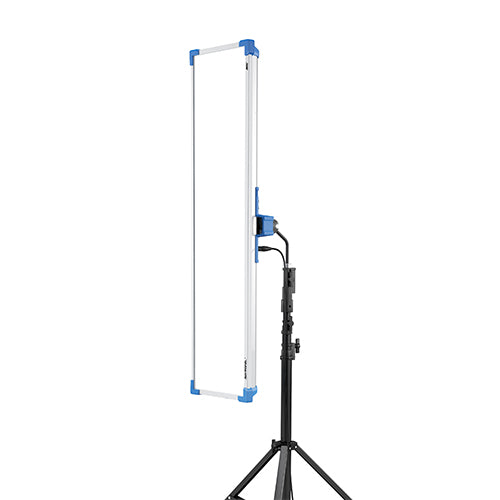
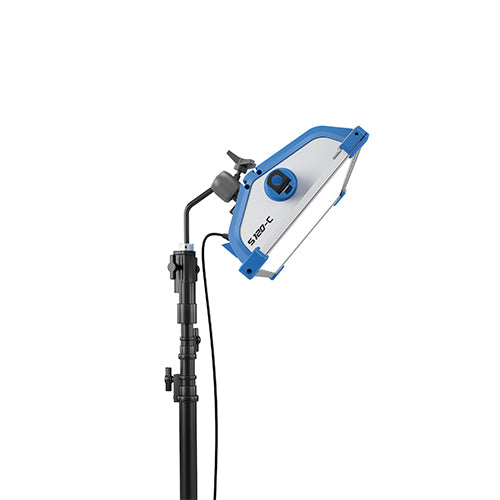
Lighting defines the studio’s visual identity and emotional tone. The industry has shifted almost entirely to energy-efficient LED solutions that offer full RGB spectrum control and silent operation. Automated lighting grids allow for rapid set changes, which is vital for facilities running multiple programs daily. Essential grip and support equipment, such as heavy-duty pedestals and robotic heads, provide the camera stability necessary for high-resolution 4K and 8K production. Implementing professional lighting solutions ensures that your facility meets the aesthetic demands of modern viewers.
The Control Room: Switchers and Monitoring
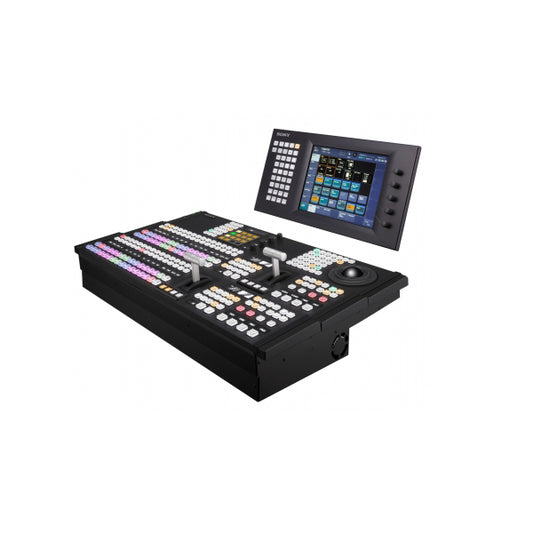
The control room serves as the nervous system of the facility, housing the switchers, monitoring, and communication tools. High-performance broadcast monitors are vital for accurate color grading and quality control, ensuring that the signal leaving the building matches the intended look. Video switchers manage the complexity of multi-camera live productions, while audio monitoring and intercom systems provide the critical communication layer for the crew. A robust control room setup typically includes:
- Multi-format video switchers for seamless source transitions.
- Reference-grade monitors for precise color and signal QC.
- Digital intercom systems for clear production team coordination.
- Redundant power management systems to ensure zero-failure broadcasting.
To prevent failure during live broadcasts, engineers must design these systems with redundant signal routing and power management. If you're unsure which specific components fit your technical goals, you can speak with an integration specialist to refine your equipment list.
Custom Integration vs. Pre-Configured Studio Packages
Choosing between a boxed solution and a custom-built facility is a pivotal decision for any media organization. While the allure of a rapid launch is strong, the technical reality of a turnkey broadcast studio often favors precision over speed. Pre-packaged kits typically target a "one-size-fits-all" model. This can lead to hidden costs when you realize certain components don't sync with your existing networking hardware or resolution requirements. A bespoke build allows you to optimize every square meter of your space and every watt of your power supply, ensuring that the infrastructure supports your specific creative output.
Scalability is the primary differentiator here. A custom-engineered ecosystem is designed to grow. It's built with the future in mind, allowing for modular upgrades as production needs evolve. Organizations like the Society of Broadcast Engineers emphasize that engineering excellence starts with matching the infrastructure to the operational load. If you plan to transition from 4K to 8K or expand your multi-camera array, a custom-integrated solution provides the necessary backbone to do so without a complete teardown.
When to Choose a Pre-Configured Setup
Standardized packages serve a specific purpose. They're often the ideal choice for small corporate studios or educational labs where the production requirements are predictable and consistent. These kits offer a streamlined deployment timeline, which is beneficial for organizations that need to be operational within a tight window. However, the trade-off is often a lack of technical flexibility. You're restricted to the brand choices and signal paths defined by the manufacturer. If your facility must meet national broadcast standards for signal quality, you must verify that the "all-in-one" kit isn't cutting corners on essential processing or redundancy.
The Case for Bespoke System Integration
Bespoke integration allows you to tailor your gear to specific production genres. A news environment has vastly different operational demands than a digital cinema facility. By choosing custom integration, you can incorporate specialized tools like the ARRI Omnibar Production Kit to gain superior control over your lighting and grip environment. This level of precision extends to the physical cabling. High-end facilities require custom fiber-optic and data networking to maintain low-latency, high-resolution workflows. This custom approach eliminates the "filler" gear found in many packages, ensuring that every piece of equipment serves a direct purpose in your production pipeline.
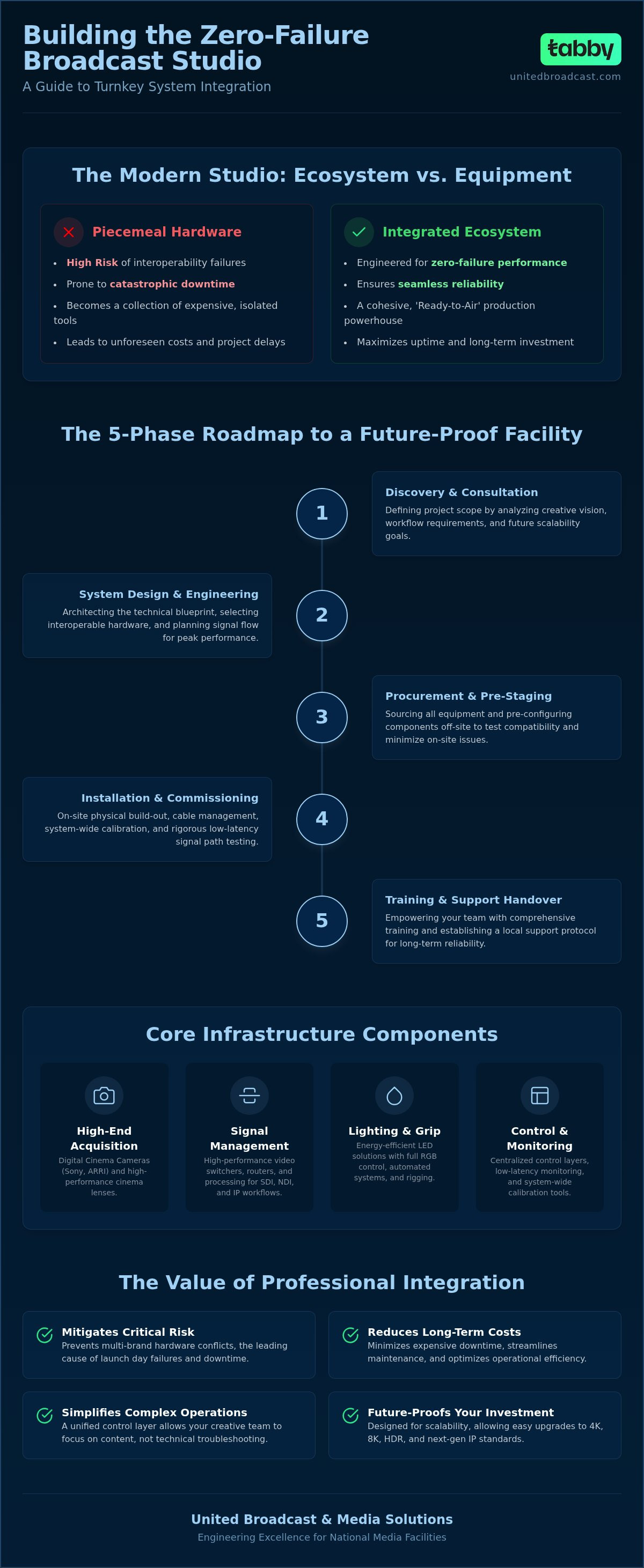
The Roadmap to Launch: 5 Phases of Broadcast System Integration
Launching a turnkey broadcast studio isn't a singular event but a methodical progression from concept to transmission. This structured roadmap ensures that technical infrastructure perfectly matches your production goals while eliminating the risks of interoperability failure. By following a five-phase integration model, media organizations can transition from empty space to a fully operational facility with total confidence in their system's reliability.
- Phase 1: Consultation and Workflow Design – Identifying technical and business goals to define the project scope.
- Phase 2: Equipment Procurement – Sourcing high-tier hardware from authorized global distributors to ensure genuine parts and local support.
- Phase 3: Installation and Cabling – Establishing the physical racks, digital networking, and high-speed signal paths.
- Phase 4: Commissioning and Testing – Stress-testing the entire ecosystem to identify potential failure points before the first live broadcast.
- Phase 5: Training and Handover – Providing hands-on technical instruction so the crew is proficient with the new gear and workflows.
Consultation and Technical Design
Technical design is the most critical step in the integration process. Engineers perform comprehensive site surveys to evaluate power loads, HVAC cooling requirements, and acoustic properties. This data informs the placement of equipment for maximum ergonomic and thermal efficiency. During this phase, you'll select the foundational protocol for your facility. Whether you opt for the reliability of SDI, the flexibility of NDI, or the advanced IP-based SMPTE ST 2110 standard, this choice dictates your studio's long-term scalability and signal flow logic. Getting this right prevents costly re-wiring or hardware replacements later.
Installation, Training, and Support
The physical installation must prioritize organization and accessibility. Professional cable management and meticulous labeling aren't just aesthetic choices; they're essential for rapid troubleshooting and maintenance. A messy rack room is a liability during technical emergencies. After the hardware is in place, operational training ensures the crew can maximize the ROI of advanced systems. This reduces the learning curve and prevents operator errors during high-stakes broadcasts. Long-term success also depends on a reliable maintenance schedule. Partnering with a local service center ensures that equipment repair and calibration are handled by authorized technicians, keeping your studio operational year-round.
United Broadcast: Engineering Excellence for National Media Facilities
Since 1997, United Broadcast & Media Solutions (UBMS) has served as a foundational pillar for the UAE's media industry. We don't just supply equipment; we engineer the technical infrastructure that powers national broadcasters and independent production houses alike. Building a turnkey broadcast studio requires a partner that understands the specific logistical and environmental challenges of the region. Our team leverages decades of hands-on experience to ensure that every system integration project meets global benchmarks for reliability and performance. We focus on creating a stable production environment where technical friction is eliminated, allowing your creative team to focus entirely on their output.
Our commitment extends far beyond the initial handover. We view every turnkey broadcast studio project as the start of a long-term technical partnership. This approach involves regular system audits and technology consultations to ensure your facility remains competitive as standards evolve toward 8K and advanced IP workflows. Our engineers work closely with your technical directors to plan for future scalability, ensuring that your investment today doesn't become obsolete tomorrow. This dedication to logistical excellence and engineering precision is what distinguishes United Broadcast as a trusted advisor in the professional media landscape.
Local Expertise and Authorized Support
Partnering with an authorized national distributor is the only way to guarantee that your facility is built with genuine parts and supported by valid manufacturer warranties. UBMS provides direct access to industry-leading brands like Sony, ARRI, and ZEISS. This authorized status means our clients receive the latest firmware updates and technical bulletins directly from the source. Beyond the initial sale, our local technical team is available for on-site troubleshooting. This proximity is vital when the stakes of live broadcast are high and downtime isn't an option. We're committed to supporting the national media ecosystem by providing the professional expertise required to maintain a world-class facility.
The UBMS Service Center Advantage
The core of our support infrastructure is our dedicated, on-site service center. This facility provides precision repairs for digital cinema cameras, professional lenses, and complex broadcast infrastructure. By maintaining a local repair hub, we significantly reduce the turnaround time for equipment maintenance, ensuring your studio stays operational. We offer proactive calibration services to keep your sensors and monitors performing at peak accuracy. This technical infrastructure acts as the ultimate safety net for studio uptime. For a deeper look at the specific technology driving these facilities, you can read our guide on Advanced Broadcast Studio Gear in the UAE.
Engineering the Future of Professional Media
Developing a high-performance media facility requires a shift from viewing hardware as isolated tools to seeing them as a unified ecosystem. By prioritizing professional system integration and authorized equipment sourcing, you'll eliminate technical friction and ensure your facility is ready for the demands of 2026 and beyond. A successful turnkey broadcast studio balances cutting-edge acquisition tools with a robust, scalable backend. Reliability isn't accidental; it's the result of meticulous planning and professional calibration.
United Broadcast has been a leader in this specialized field since 1997. Our authorized system integration experts and dedicated UAE-based service center provide the technical infrastructure needed to support your production goals for the long term. We focus on building stable environments where multi-brand interoperability is a certainty rather than a risk. It's about more than just a gear list; it's about engineering a facility that won't fail when the stakes are at their highest.
Your vision deserves a facility that operates with absolute precision and dependability. We're ready to help you build a production environment that empowers your creative team and secures your competitive edge in the national media landscape.
Frequently Asked Questions
What exactly is included in a turnkey broadcast studio solution?
A comprehensive turnkey broadcast studio solution includes everything from initial consultation and technical design to equipment procurement and final commissioning. It typically covers professional video cameras, digital cinema sensors, lenses, and lighting grids. The backbone consists of video switchers, routers, signal processing, and a fully configured control room. Integration also includes custom cabling, audio monitoring, and intercom systems, ensuring all hardware brands work together as a tested, ready-to-air ecosystem.
How long does it typically take to design and install a turnkey studio?
The timeline for a turnkey broadcast studio project varies based on complexity, but most professional installations take between three to six months. This duration accounts for the five phases of integration: consultation, procurement of high-end gear from global distributors, physical installation, and rigorous stress-testing. Factors like site survey results and custom furniture requirements can influence the schedule. We prioritize a methodical approach to ensure zero-failure performance on launch day.
Can a turnkey studio be upgraded later, or is it a fixed system?
Professional turnkey studios are designed as modular ecosystems that allow for future technology refreshes and scalability. A well-engineered integration plan uses a flexible backbone, such as a hybrid NDI or IP-based infrastructure, which makes adding 8K capabilities or extra camera chains straightforward. Strategic planning during the initial build ensures that power and cooling loads can accommodate future expansions without requiring a complete structural overhaul or a new system integrator.
What is the difference between NDI and SDI in a turnkey setup?
SDI provides a traditional, highly reliable point-to-point connection, while NDI offers a flexible, network-based workflow over standard Ethernet. SDI (Serial Digital Interface) remains the industry standard for low-latency, uncompressed video within the facility. In contrast, NDI (Network Device Interface) allows multiple devices to access video sources across a local network, simplifying cable management. Many facilities adopt a hybrid approach to balance the stability of SDI with the scalability of IP.
Do I need a separate system integrator if I buy a gear package?
Yes, a professional system integrator is essential for bridging the gap between a list of gear and a functional production ecosystem. While a gear package provides the tools, an integrator ensures interoperability between different brands and manages the complex signal routing. They handle technical site surveys, custom cabling, and system calibration. Without professional integration, you risk technical friction and downtime caused by hardware components that don't communicate correctly during live broadcasts.
What kind of maintenance does a professional broadcast studio require?
Professional facilities require a combination of proactive software updates, physical equipment cleaning, and regular technical calibration. Maintenance involves checking fiber-optic connections for signal loss, updating firmware for digital cinema cameras, and re-calibrating broadcast monitors for color accuracy. Partnering with a local service center ensures that authorized technicians can perform precision repairs and preventative checks. This routine maintenance is the ultimate safety net for maximizing studio uptime and protecting your long-term investment.
How do I choose between broadcast cameras and cinema cameras for my studio?
The choice depends on your primary production genre and the specific "look" you want to achieve for your audience. Broadcast cameras are optimized for live, multi-camera environments with integrated tally and intercom support. Digital cinema cameras, like those from Sony or ARRI, offer larger sensors and higher dynamic range for a premium, cinematic aesthetic. Many modern facilities utilize a mix of both, integrated into a unified workflow to handle news, talk shows, and high-end feature content.


