

Modern Live Production Workflow Solutions: The 2026 Professional Guide
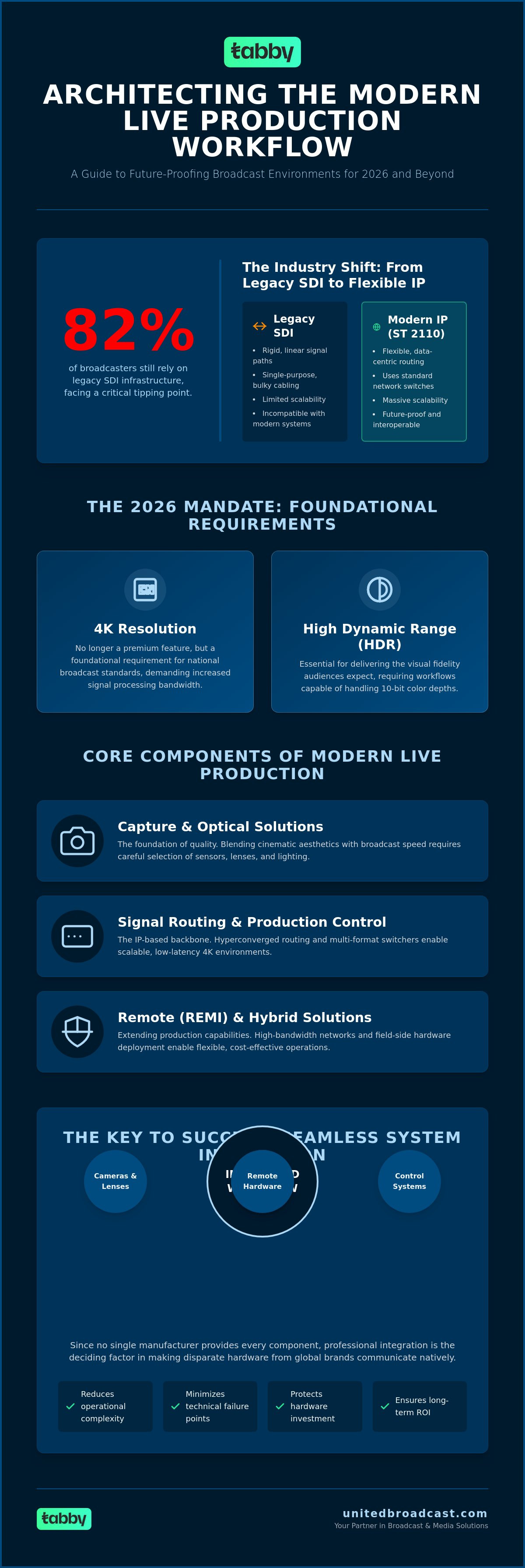
While 82% of broadcasters still rely on legacy SDI infrastructure, the transition to SMPTE ST 2110 has reached a critical tipping point in 2026. You likely face the daily challenge of equipment incompatibility between your existing hardware and modern IP systems. It's frustrating to balance the demand for cinema-style capture with the rigid requirements of traditional broadcast functionality, all while fighting high latency in remote production setups. Finding robust live production workflow solutions requires a sophisticated approach to signal processing and hardware integration that protects your current assets.
We believe that a future-proof broadcast environment should be characterized by reliability and precision, not technical workarounds. This guide will show you how to architect a high-performance production space using the latest hardware standards and expert integration strategies. You'll learn to integrate high-end lenses and cameras seamlessly while significantly reducing technical downtime. We'll provide a clear overview of the essential components needed to build a scalable, low-latency 4K environment that meets the rigorous standards of professional media today.
Key Takeaways
- Learn how to transition from legacy SDI to flexible IP and hybrid architectures to meet 2026 national broadcast standards for 4K and HDR content.
- Discover the technical criteria for selecting professional video cameras and cinema lenses that deliver high-end storytelling without sacrificing broadcast functionality.
- Identify the core components of modern live production workflow solutions, including hyperconverged routing and multi-format video switchers.
- Gain a clear roadmap for implementing remote (REMI) and hybrid production through high-bandwidth network foundations and field-side hardware deployment.
- Understand the role of professional system integration and specialized service centers in protecting your hardware investment and ensuring long-term ROI.
Defining the Modern Live Production Workflow Solution
The architecture of a broadcast facility has undergone a fundamental transformation over the last few years. Traditional SDI-based linear setups, once the industry standard, are being replaced by flexible IP and hybrid architectures. This shift isn't just about changing cables; it's a complete rethink of how signals move through a facility. Modern live production workflow solutions now prioritize scalability and the ability to route massive amounts of data across standard network switches. In 2026, 4K resolution and High Dynamic Range (HDR) are no longer premium features. They've become foundational requirements for national broadcast standards. Audiences now expect the visual fidelity of high-end streaming in their live feeds, which forces production houses to upgrade their signal processing chains to handle increased bandwidth and 10-bit color depths.
Effective live television production relies on seamless interoperability between various hardware components. Since no single manufacturer provides every piece of the puzzle, professional system integration is the deciding factor in a project's success. A well-architected workflow reduces operational complexity by centralizing control and minimizing the technical failure points that often plague fragmented systems. When hardware from disparate global brands communicates natively, your technical team can focus on the creative output rather than troubleshooting signal drops or synchronization issues.
The Shift to IP-Based Infrastructure
The adoption of SMPTE ST 2110 has revolutionized how engineers handle uncompressed video, audio, and metadata as separate streams. This granular control allows for much more efficient routing compared to the rigid nature of traditional SDI. For corporate environments or mid-tier studios, NDI (Network Device Interface) offers a more accessible entry point by utilizing existing gigabit networks to deliver high-quality video with minimal latency. IP-based workflows serve as the essential backbone for modern scalability in any professional media environment.
Balancing Cinematic Aesthetics with Broadcast Speed
There's a growing demand for a "cinematic look" in live sports and entertainment. This trend has led to the widespread adoption of professional video cameras that feature large sensors, which were once reserved strictly for digital cinema. Managing shallow depth-of-field in a real-time, multi-camera environment requires precise remote control of iris and focus. To achieve this without slowing down the broadcast pace, engineers must integrate specialized lens controllers and shading stations. These tools allow vision mixers to maintain a consistent aesthetic across all angles while handling the technical requirements of high-speed data links for real-time color grading.
The Core Hardware Foundation: Capture and Optical Solutions
The quality of any live broadcast is ultimately capped by the performance of its capture hardware. When evaluating professional video cameras, decision-makers must look beyond simple resolution. Dynamic range and sensor architecture determine how well a system handles high-contrast environments, such as stadium lighting or outdoor festivals. While traditional 2/3-inch sensors remain the workhorse for deep depth-of-field coverage, the 2026 market shows a clear preference for large-format sensors to achieve a premium, cinematic aesthetic. Integrating these cinema-style bodies into live production workflow solutions requires a technical bridge to ensure that 4K signal outputs remain stable and synchronized across the entire chain.
Lighting also plays a critical role that's often overlooked during the hardware selection phase. Professional lighting equipment with high CRI and TLCI ratings ensures that sensors capture accurate skin tones from the start. This reduces the workload for vision shaders and colorists in the control room. As the International Telecommunication Union notes in their technical documentation on advanced audio production workflows, maintaining signal integrity from the point of capture is essential for delivering immersive, high-fidelity content to the end user.
High-Performance Camera Systems
The choice between large-format and 2/3-inch sensors often comes down to the specific requirements of the event. Large format sensors provide superior low-light performance and a shallower depth of field, which is ideal for entertainment and high-stakes interviews. However, for fast-motion live sports, the presence of a global shutter is non-negotiable. Global shutters eliminate the "jello effect" associated with rolling shutters, ensuring that fast-moving objects remain geometrically accurate. For those managing smaller footprints, you can explore the latest Sony Alpha cameras and lenses for hybrid production environments that require both agility and high image quality.
Optical Precision in Live Environments
Cinema lenses are no longer restricted to film sets. They're increasingly used in live environments to provide a distinct visual texture that standard broadcast glass can't replicate. Prime lenses, in particular, offer superior sharpness and faster apertures, though they require a more disciplined approach to camera placement. Maintaining these optics is a rigorous task. Refer to our guide on cinema lens repair for maintenance standards to ensure your glass performs reliably under the heat and dust of field production. If you're looking to upgrade your capture chain, speak with our technical team for a customized hardware assessment.
Signal Routing and Production Control Infrastructure
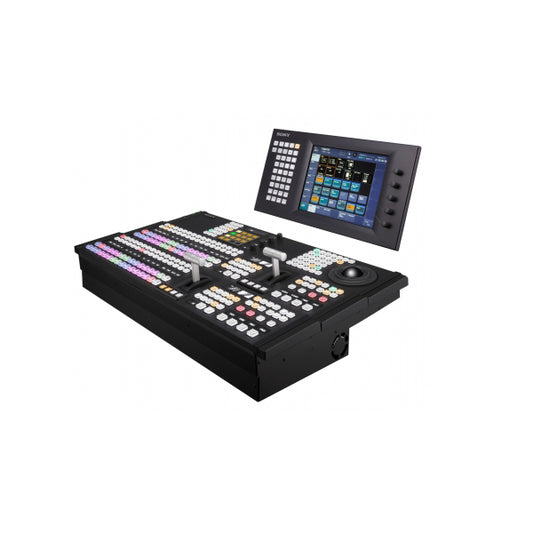
The efficiency of a broadcast environment depends on its signal routing and control infrastructure. As facilities transition to higher resolutions and more complex delivery formats, the demand for versatile live production workflow solutions has never been higher. You need a system that handles multi-format inputs, including legacy 12G-SDI, modern IP (ST 2110), and agile NDI streams, without introducing significant latency. Implementing a robust video switcher is the first step toward managing these disparate signals. However, the true power of a modern setup lies in its ability to maintain color accuracy and synchronization across every camera angle. High-performance broadcast monitors are essential here, providing the visual reference needed to ensure what you see in the control room is exactly what the viewer receives at home.
Managing a complex multi-camera setup involves more than just video. You also have to coordinate tally, intercom, and sync signals to keep the production team in perfect alignment. Hyperconverged routing has become a necessity for modern studios looking to reduce physical rack space and power consumption. By consolidating several functions into a single chassis, you simplify the signal path and reduce potential failure points. For a deeper look at the specific hardware required for these setups, see our detailed guide on broadcast studio gear. These integrated live production workflow solutions allow engineers to manage massive data throughput with fewer individual devices, leading to a more stable and cost-effective operation.
Hyperconverged Signal Processing
Combining routing, multi-viewing, and signal processing into a single platform is the most effective way to optimize your facility's footprint. This approach minimizes the cabling required and significantly reduces latency through hardware-based processing solutions. It's a strategic move for broadcasters who need to remain agile while maintaining the highest possible signal integrity throughout the production chain. By centralizing these core functions, you create a more resilient architecture that's easier to monitor and maintain over time.
Professional Lighting and Grip Integration
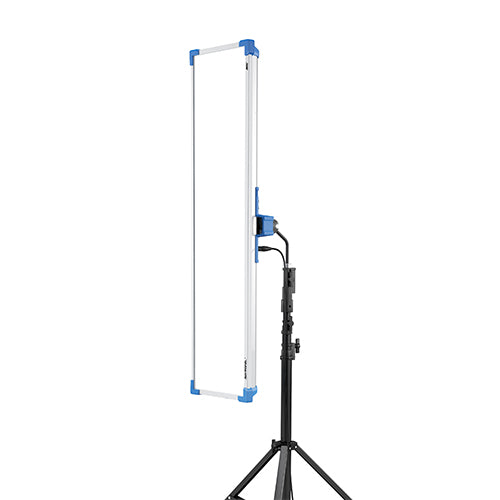
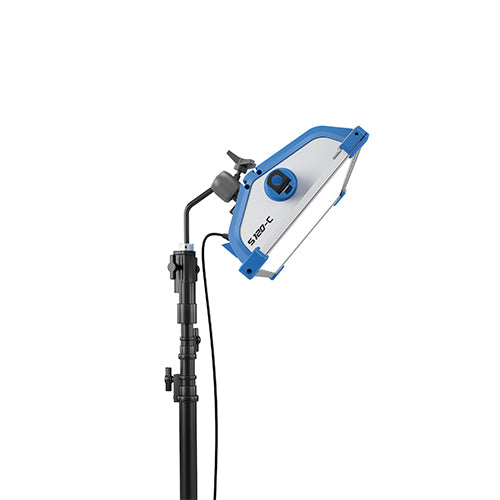
Modern studio control systems now extend to the ceiling. Integrating ARRI lighting into your automated workflow allows for instant scene recalls and precise color temperature adjustments. The shift to LED technology has transformed thermal management, reducing the need for heavy-duty HVAC systems and lowering operational costs. For versatile and rapid studio setups, the ARRI Omnibar production kit provides a modular solution that fits seamlessly into professional environments, ensuring that your lighting is as dynamic as your video content.
Implementing Remote (REMI) and Hybrid Production Solutions
Remote Integration Model (REMI) has shifted from a proof-of-concept to a primary operational standard. According to industry data from March 2026, 41% of broadcasters now identify enabling remote production as their top technology priority. This transition requires a structured approach to hardware deployment that ensures signal integrity over long distances. Implementing effective live production workflow solutions in a remote context depends on five critical steps:
- Step 1: Establish a high-bandwidth, low-latency network foundation. This serves as the essential pipeline for all remote signal transport.
- Step 2: Deploy field-side encoding and home-base decoding hardware. These units must support high-efficiency codecs like JPEG XS to maintain visual quality while minimizing delay.
- Step 3: Integrate cloud-based production switchers. This allows distributed teams to access the control interface from any location, facilitating real-time collaboration.
- Step 4: Implement remote-capable intercom and IFB systems. New cellular-based wireless systems, such as those operating on LTE and 5G networks, ensure the production crew remains in constant communication regardless of the venue's local infrastructure.
- Step 5: Perform rigorous stress-testing of redundant signal paths. Uptime is non-negotiable; therefore, secondary paths via bonded cellular or satellite are mandatory for high-stakes broadcasts.
The success of these steps relies on the hardware's ability to handle the "Efficiency Imperative." Broadcasters are under constant pressure to produce more content for more platforms without increasing resources. By centralizing the core processing hardware at a home base, you reduce travel costs and logistical complexity. If you're planning a remote deployment, consult with our system integration experts to design a resilient network architecture.
The Hardware Requirements for REMI
Reliable remote production begins with high-performance encoders and decoders. In 2026, 54% of broadcasters use cellular networks for contribution workflows, relying on units that feature internal 5G modems and eSIM technology for stable connectivity. Mobile units and flightpacks also play a vital role, providing a localized hub for camera signals before they're sent to the master control room. For a detailed look at how these systems are housed, read more about OB van system integration.
Cloud-Hybrid Workflows
Choosing between on-premise hardware and cloud-based processing depends on your specific latency requirements and budget. While the cloud offers unmatched scalability, on-premise hardware remains the gold standard for zero-latency environments. Security protocols are also paramount when protecting live feeds in transit. You must implement robust encryption and secure handoff points to prevent unauthorized access. Additionally, managing audio sync and multi-camera phase in remote environments requires precise timing protocols, such as PTP (Precision Time Protocol), to ensure all signals arrive at the home base in perfect alignment. These live production workflow solutions provide the flexibility needed to cover global events with a localized footprint.
System Integration and Technical Support: Ensuring Long-Term ROI
The complexity of modern live production workflow solutions demands more than just a collection of high-tier hardware. While previous sections detailed the necessity of advanced capture and routing, the actual performance of these systems depends on how they're unified. Professional system integration is critical for high-stakes national broadcasts where a single point of failure can result in significant financial and reputational loss. Designing for scalability ensures that your facility can adapt to future resolution standards and increased data throughput without requiring a complete infrastructure overhaul. By building workflows that grow with your production needs, you protect your initial capital expenditure and ensure a sustainable path for expansion.
Technical training for your production team is equally vital to maximizing equipment potential. Even the most sophisticated signal processing chain is ineffective if the operators can't utilize its full feature set. Empowering your staff through expert-led training sessions reduces human error and allows for faster adaptation to new technologies, such as the IP-based routing and cloud-hybrid models discussed earlier. This holistic approach to integration and education creates a resilient environment capable of meeting the rigorous demands of the 2026 media landscape. It's about turning complex hardware into a seamless extension of the creative process.
Expert System Integration Services
Customizing a broadcast environment requires a deep understanding of specific production requirements, from studio-based talk shows to high-motion sports coverage. Rigorous technical testing is necessary to ensure global brand compatibility, especially when mixing legacy SDI gear with new ST 2110 or NDI interfaces. Professional integration justifies the initial investment by maximizing system uptime through optimized signal paths and redundant fail-safes. This methodical approach ensures that every piece of hardware performs at its peak efficiency from day one, reducing the likelihood of mid-broadcast technical hitches.
Maintenance and Technical Longevity
Establishing a preventative maintenance schedule is the most effective way to extend the lifecycle of cinema and broadcast gear. High-value optical assets and camera sensors require specialized care, including professional cleaning and calibration, to maintain their performance standards. Authorized service centres play a pivotal role here, offering the technical infrastructure needed for complex repairs that go beyond basic field maintenance. To ensure your studio remains a reliable environment, you can explore our lighting collections for gear that meets professional-grade reliability standards. Consistent maintenance protects your hardware from the wear and tear of daily production, ensuring that your live production workflow solutions remain operational for years to come.
Future-Proofing Your Broadcast Infrastructure
The shift toward IP-based architectures and cinematic capture is no longer a trend; it's a standard requirement for 2026. Success in this landscape depends on your ability to bridge the gap between legacy SDI and high-bandwidth IP systems while maintaining optical precision. Implementing robust live production workflow solutions ensures your facility remains agile, reliable, and capable of meeting the "Efficiency Imperative" of modern broadcasting. Protecting your investment requires a lifecycle approach, combining professional integration with proactive maintenance from authorized specialists.
United Broadcast & Media Solutions (UBMS) serves as a leading system integrator for national media infrastructure. We operate an authorized service centre for global broadcast brands and provide expert technical support to ensure your equipment performs at its peak. Whether you're upgrading a studio or deploying a remote REMI setup, we possess the technical infrastructure to support your long-term goals. Consult with our system integration experts for your next live production project. We look forward to helping you build a workflow that empowers your creative vision and secures your operational success.
Frequently Asked Questions
What is the difference between an SDI and an IP-based live production workflow?
SDI relies on dedicated coaxial cables for point-to-point linear transmission, whereas IP-based workflows use standard network infrastructure to route uncompressed video as data packets. IP offers significantly greater scalability and flexibility by allowing multiple streams to share the same physical connection. This transition is a central component of modern live production workflow solutions, enabling facilities to expand their capacity without the rigid physical limitations of traditional copper routing.
How do I integrate cinema cameras into a traditional live broadcast environment?
Integration is achieved by using specialized fiber adapters or base stations that convert the camera's high-bandwidth output into standard broadcast signals. This hardware bridge allows for real-time shading, tally control, and return feeds, which are essential for any multi-camera environment. It enables directors to utilize the shallow depth of field and high dynamic range of cinema sensors while maintaining the operational speed required for live television.
What are the essential hardware components for a REMI remote production setup?
A REMI setup requires high-performance encoders at the field site and matching decoders at the home base to ensure low-latency signal transport. You also need bonded cellular units or dedicated high-speed internet links to provide a stable network pipeline. Additionally, remote-capable intercom systems and cloud-based production switchers are necessary to allow the production crew to communicate and direct the show from a centralized location.
Why is SMPTE ST 2110 important for modern live production workflow solutions?
SMPTE ST 2110 is the industry standard that allows for the separate routing of video, audio, and metadata streams over a managed IP network. This granular control improves efficiency and ensures interoperability between different hardware brands. It serves as the technical foundation for professional live production workflow solutions, providing the precision and timing required for uncompressed media environments without the overhead of traditional SDI mapping.
Can I use existing cinema lenses for live 4K broadcast productions?
Yes, cinema lenses are compatible with live environments as long as you have the correct mounts and remote control systems for iris and focus. Prime lenses offer superior optical quality and faster apertures, though they require more disciplined camera placement than broadcast zooms. In a 4K environment, these lenses provide a distinct visual texture and superior sharpness that helps your production meet the high expectations of modern audiences.
How does hyperconverged routing improve studio efficiency?
Hyperconverged routing improves efficiency by combining signal routing, multi-viewing, and processing into a single hardware chassis. This consolidation reduces the amount of physical rack space and power required for your infrastructure. It also simplifies the signal path, which minimizes potential failure points and reduces the overall latency of the production chain. This allows engineers to manage complex, high-bandwidth workflows with fewer individual devices.
What should I look for in a broadcast system integrator?
Look for an integrator with a documented history in national media infrastructure and deep expertise in both legacy SDI and modern IP standards. A reliable partner should offer comprehensive services, including custom design, technical testing, and ongoing support. It's also beneficial to choose an integrator that operates an authorized service centre to ensure your high-value equipment receives professional maintenance and repairs throughout its operational lifecycle.
How do I protect high-end camera sensors during outdoor live productions?
Protecting sensors requires using high-quality optical filters and environmental housing to shield the camera from dust, heat, and moisture. Regular sensor cleaning at an authorized service centre is essential to prevent long-term damage from environmental contaminants. Using professional-grade rain covers and sunshades during the event helps maintain optimal operating temperatures and prevents debris from entering the internal components of the camera body during lens changes.


