

Wireless Transmission Systems: The 2026 Professional Buying Guide
In a congested RF environment, a single dropped frame isn't just a technical glitch; it's a failed take that can cost thousands in production time. You've likely felt the frustration of signal interference during a critical shot or noticed the slight delay that makes precision focus pulling nearly impossible. Most professionals agree that the stability of wireless transmission systems is the true backbone of a modern set. It's the difference between a seamless workflow and a day spent troubleshooting connectivity issues.
This 2026 guide will help you master the technical nuances of wireless video to choose a system that ensures zero-latency, rock-solid stability, and seamless set integration. We will examine the latest standards in frequency management, multi-receiver scalability for director's villages, and cross-brand compatibility. You'll gain the expertise needed to select a solution that maintains a stable link for high-stakes gimbal work or long-range drone operations, ensuring your production remains efficient and precise.
Key Takeaways
- Identify why professional wireless transmission systems must prioritize uncompressed, zero-delay signals to maintain the integrity of a modern film or broadcast set.
- Distinguish between theoretical "Line-of-Sight" range and real-world set conditions to ensure your signal remains rock-solid during complex gimbal or drone maneuvers.
- Master the technical differences between Amimon chipsets and Wi-Fi-based solutions to avoid the latency pitfalls that compromise precision focus pulling.
- Learn to build scalable monitoring environments, including multi-receiver configurations for director's villages, without sacrificing signal stability or synchronization.
- Understand the importance of professional technical support and firmware management in maintaining DFS compliance and hardware longevity in high-interference zones.
Understanding Wireless Transmission Systems in Modern Production
Professional wireless transmission systems represent a specialized category of hardware designed to replace physical SDI and HDMI cabling without compromising signal integrity. Unlike consumer-grade streaming solutions that rely on heavy compression and significant buffering, these systems deliver uncompressed, zero-delay video across the set. The core hardware typically consists of a Transmitter (TX) unit mounted directly to the camera and one or more Receiver (RX) units connected to monitors, recorders, or switchers. This setup allows the production team to see exactly what the sensor sees, in real time, without the physical limitations of a tethered connection.
The transition from traditional wired monitoring to wireless freedom has redefined the speed and flexibility of modern production environments. However, this freedom depends entirely on the stability of the connection. In high-stakes environments, RF (Radio Frequency) reliability is the primary concern for technical directors and camera assistants. A foundational grasp of Understanding Wireless Transmission Systems is essential for managing the crowded airwaves of a modern film set. Ensuring that your signal doesn't drop when a crew member walks between the TX and RX is the baseline for professional-grade gear.
The Role of Wireless Video in Professional Workflows
Wireless monitoring has become an essential tool for focus pullers. They require real-time, high-definition feedback to maintain surgical precision on modern high-resolution sensors. It also facilitates the creation of "director's villages," where multiple stakeholders can view the action simultaneously from a safe distance. For operators using gimbals, cranes, or stabilized heads, wireless systems remove the physical drag and snag hazards of cables. This allows for fluid, complex camera movements that were previously impossible or required extensive rigging to manage a heavy cable loom.
Broadcast vs. Cinema: Different Needs, Different Systems
While the ultimate goal is always a stable image, the specific technical requirements often differ by discipline. Cinema productions prioritize absolute image fidelity and zero-latency to support the creative decisions of the DP and the technical needs of the focus puller. In contrast, broadcast environments often prioritize long-range stability and the ability to integrate into complex multi-camera switchers across large venues or stadiums. Regardless of the specific application, these systems are typically paired with high-end professional video cameras to ensure the signal chain begins with the highest possible quality. Choosing the right system involves balancing these needs against the specific RF challenges of your location.
Key Technical Criteria: Latency, Range, and Stability
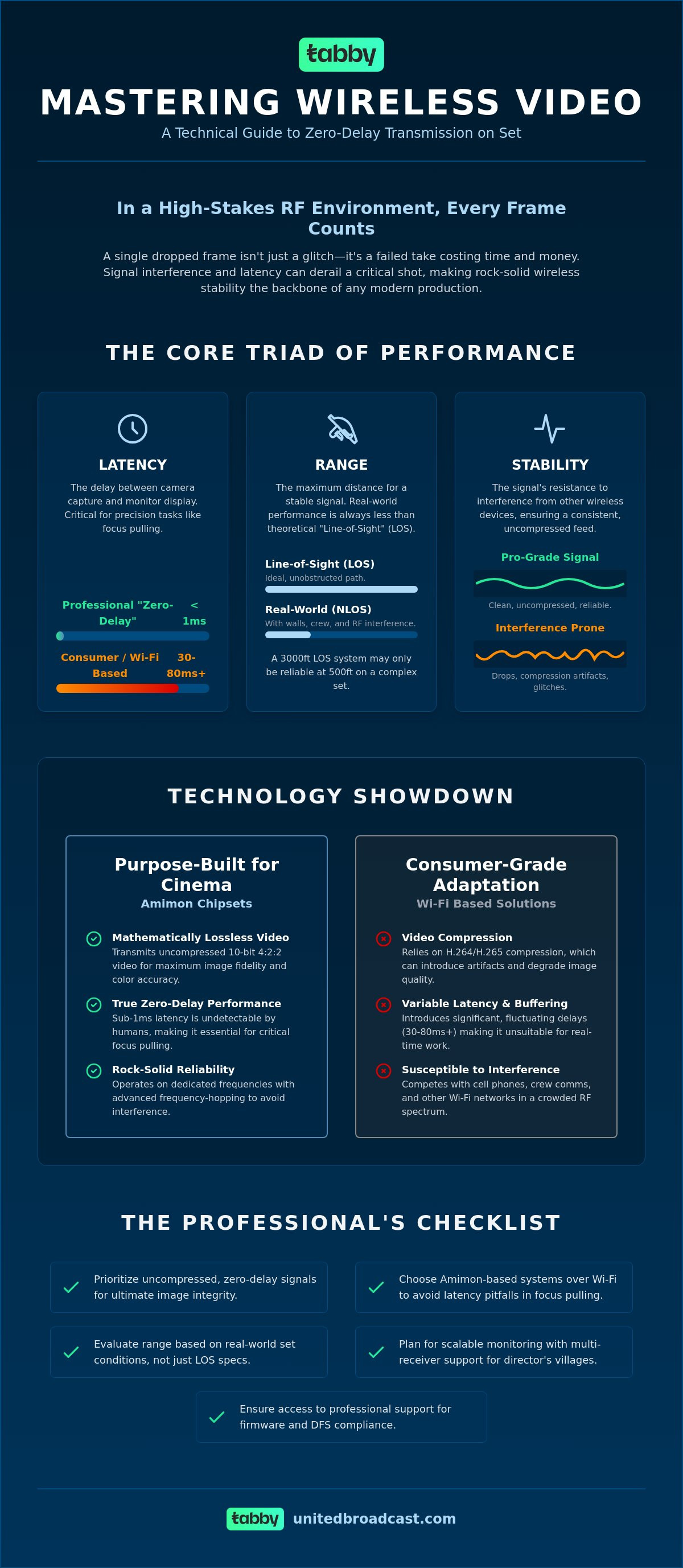
Evaluating wireless transmission systems requires a focus on three non-negotiable metrics: latency, range, and signal stability. For focus pullers, the industry standard is "zero-latency," which technically translates to a delay of less than 1 millisecond. Anything higher creates a disconnect between the actor's movement and the monitor, leading to missed marks and wasted takes. While consumer-grade devices often advertise low latency, they rarely meet this professional threshold under actual set conditions.
Range is another area where marketing specifications can be misleading. Manufacturers usually provide Line-of-Sight (LOS) distances, which assume no obstacles between the transmitter and receiver. In practice, walls, equipment, and even the human body can significantly attenuate the signal. A system rated for 3,000 feet LOS may only provide a reliable 500 feet in a dense urban environment or a studio with heavy interference. High-end systems prioritize uncompressed video transmission to ensure color-accurate monitoring for DPs and DITs. Understanding the underlying protocols is vital when selecting wireless transmission systems and Comparing Transmission Technologies: Amimon vs. Wi-Fi Solutions, as the former is designed specifically for this zero-delay, uncompressed requirement.
Powering these units must be seamless to avoid downtime. Most professional transmitters offer integrated battery plates for V-mount, Gold Mount, or NP-F batteries. This allows the unit to draw power directly from the camera rig or a dedicated source, ensuring the link doesn't drop during a battery swap. If you're unsure which powering configuration fits your current camera cage, you can speak with our technical team for a compatibility assessment.
Managing Frequency and Interference
The 5GHz spectrum has long been the standard, but it's increasingly crowded in metropolitan areas. Professional systems utilize Dynamic Frequency Selection (DFS) to find open channels, though the emergence of 6GHz (Wi-Fi 6E) offers a much cleaner environment for high-density productions. Manual channel selection remains a critical skill for large-scale events where automated frequency hopping might not be sufficient to avoid interference from local networks or other production crews.
Signal Robustness and Encryption
Security and stability are the final pillars of a professional setup. AES-256 encryption is the gold standard for protecting sensitive footage from unauthorized viewing. To maintain a link in challenging urban environments, Multiple Input Multiple Output (MIMO) technology uses multiple antennas to manage multipath interference. This effectively uses signal reflections to strengthen the connection rather than weaken it, ensuring your monitoring remains rock-solid even in "noisy" RF areas.
Comparing Transmission Technologies: Amimon vs. Wi-Fi Solutions
The core of professional wireless transmission systems lies in the protocol used to move data through the air. The industry currently splits into two primary camps: specialized hardware-based chipsets, most notably from Amimon, and software-based Wi-Fi solutions. Amimon technology is the foundation of high-end monitoring because it provides uncompressed video with zero delay. It achieves this by transmitting data across multiple frequencies simultaneously without the need for traditional compression or buffering. This differs fundamentally from Wi-Fi-based systems, which utilize H.264 or H.265 encoding. While Wi-Fi is cost-effective and compatible with mobile devices, the encoding and decoding process introduces inherent latency that's often visible to the naked eye.
Signal recovery is another critical differentiator. When an Amimon-based system loses its link, it reconnects almost instantly once the obstruction is removed. Because there's no software buffer to clear, the image snaps back into place immediately. Wi-Fi systems often struggle with "handshaking" delays, where the transmitter and receiver must re-establish a network connection, leading to several seconds of black screen. While the history of wireless power transmission highlights the long-standing ambition to move energy without cables, modern video transmission focuses on moving vast amounts of data with zero delay, which remains the ultimate test for RF engineering.
High-End Standards: Teradek and the Bolt Series
Teradek remains the benchmark for digital cinema production, largely due to the exclusive implementation of the Bolt series. These units are designed for the rigors of a professional set, offering consistent performance where other systems fail. Their compact form factor makes them ideal for small setups, such as those using Sony Alpha cameras and lenses. Additionally, professional sets must account for interference from other electronics. High-quality lighting equipment is designed with RF shielding to ensure that your wireless video signal remains clean and uninterrupted.
Reliable Alternatives: SWIT and Vaxis
For productions that require a balance between high-end performance and budget, brands like SWIT and Vaxis provide excellent alternatives. SWIT is particularly well-regarded in the broadcast sector for its rugged construction and reliable multi-cast capabilities. These systems allow a single transmitter to feed four or more receivers simultaneously, which is perfect for complex productions where the director, client, and hair or makeup team all need dedicated monitors. While they don't always reach the absolute zero-latency of the highest-tier cinema gear, they provide a stable and professional solution for mid-tier production houses.
Selection Framework: Choosing the Right System for Your Production
Selecting the correct hardware requires a systematic evaluation of your production's logistical constraints. It isn't a simple one-size-fits-all decision. You must first identify if the primary user is a focus puller requiring absolute precision or a director needing a general overview. This distinction dictates whether you invest in zero-latency wireless transmission systems or more flexible, multi-cast solutions. Physical footprint also plays a decisive role. A bulky transmitter can compromise a gimbal's balance or make a handheld rig unnecessarily fatiguing. Conversely, a studio build can easily support a larger, more robust unit with high-gain antennas and dedicated V-mount power plates.
Wireless transmission systems must also be evaluated based on the expected RF congestion of your environment. In a studio, you might have control over the local networks. A live event in a stadium presents a chaotic frequency landscape. Assessing how many receivers you'll need to support simultaneously is equally important. If your workflow involves a director's village, a DIT station, and a separate monitor for the hair and makeup team, your system must support scalable multi-receiver configurations without signal degradation.
The Indie Cinema and Commercial Setup
Commercial sets and indie films often prioritize mobility and rapid deployment. A 500ft range is typically the "sweet spot" for these environments. It provides enough coverage for most interior locations while keeping the hardware footprint small enough for handheld or gimbal work. These compact units don't require complex rigging. They're ideal for fast-paced productions where time is a critical factor. If you're currently building out a new rig, see our collection of professional video cameras for practical integration tips.
The High-End Broadcast and Live Event Setup
Large-scale broadcast productions and live events demand a different level of performance and reliability. Here, a range of 1500ft or more is often a necessity to ensure signal penetration through dense crowds, metal scaffolding, and structural obstacles. These setups frequently involve integrating wireless receivers into comprehensive broadcast studio gear, such as rack-mounted units in OB vans or DIT carts. Utilizing array antennas and high-gain panels becomes essential to maintain a stable link across vast distances. This ensures the feed remains rock-solid even in the most challenging RF conditions where multiple crews might be competing for the same limited spectrum.
Why Technical Support and Service Matter for Wireless Gear
The longevity of professional wireless transmission systems depends heavily on consistent maintenance and expert technical support. High-frequency antennas and SMA connectors are notoriously fragile in the field. A single accidental knock during a lens change or a hasty pack-down can compromise the internal wiring, leading to intermittent signal drops that are difficult to diagnose during a shoot. Beyond physical damage, the software layer is equally critical. Regular firmware updates are essential for maintaining DFS compliance, ensuring your gear operates within legal frequency limits while avoiding interference from radar and other priority signals.
Purchasing from unauthorized or grey-market sources carries significant operational risks. While the initial price might seem lower, these units often lack a valid regional warranty and won't be supported by local service centers. For a production where downtime costs thousands of dollars per hour, the inability to get a rapid repair or calibration is a liability. Choosing an authorized distributor ensures that your hardware is backed by genuine parts and technical expertise. We focus on providing the full technical solution, ensuring your gear remains mission-critical ready at all times.
UBMS Service Center: Protecting Your Investment
Our in-house service center is equipped to handle complex repairs for professional RF and video equipment. As an authorized partner for global brands like Teradek and SWIT, we provide the specialized calibration required to keep your wireless links stable. It's often beneficial to schedule this service alongside your routine cinema lens maintenance. Ensuring that both your optical and electronic components are in peak condition is the best way to prevent technical failures on set.
Custom System Integration and Consultation
For complex studio environments or large-scale national events, a standard out-of-the-box solution is rarely enough. We offer custom system integration services to build bespoke wireless ecosystems tailored to your specific workflow. This includes expert advice on frequency coordination to manage dozens of simultaneous signals without conflict. Our team understands the high stakes of professional production and provides the infrastructure needed to support your creative vision. We value long-term partnership, offering the technical guidance required to scale your setup as your production needs evolve.
Explore our complete collection of Wireless Transmission Systems
Future-Proofing Your Production with Reliable Wireless Video
Mastering the technical landscape of wireless video ensures your set remains efficient and professional. You've identified how zero-latency performance and robust frequency management are the foundations of successful monitoring. Choosing between specialized Amimon hardware and cost-effective Wi-Fi alternatives depends entirely on the specific demands of your production environment. Whether you're pulling focus on a fast-paced commercial or managing a massive director's village, the stability of your link is the primary metric of success.
As an authorized distributor for global brands like Teradek and SWIT, UBMS provides more than just gear. We offer the mission-critical reliability needed for high-stakes broadcast and cinema sets. Our in-house technical service center and expert system integration services ensure your wireless transmission systems are always calibrated for peak performance in any RF environment. We understand the high stakes of professional production and provide the technical infrastructure to support your creative vision.
We're here to support your long-term success with the tools and logistical excellence your work requires.
Frequently Asked Questions
What is the difference between zero-latency and low-latency in wireless video?
Zero-latency systems provide a delay of less than 1 millisecond, which is visually instantaneous for the operator. This standard is achieved through uncompressed hardware-based transmission, making it essential for precision focus pulling. Low-latency systems typically utilize Wi-Fi or H.264 compression, resulting in a delay of 30 to 100 milliseconds. While suitable for general monitoring, that slight lag makes it difficult to time critical movements or focus shifts in real time.
Can I use multiple wireless transmission systems on the same set?
Yes, you can operate several systems simultaneously by assigning them to different frequency channels. High-end hardware allows for manual channel selection to ensure each transmitter has a dedicated slice of the spectrum. It's important to maintain physical distance between transmitters to prevent near-field interference. Using a frequency coordinator or a spectrum analyzer is a standard practice for large productions to manage multiple wireless transmission systems without signal collisions.
How does DFS (Dynamic Frequency Selection) affect my wireless signal?
DFS allows your equipment to operate on 5GHz channels shared with radar systems. If your transmitter detects a radar signal, it must legally vacate that channel and move to another frequency immediately. This process can cause a brief signal drop of several seconds while the transmitter and receiver re-establish their link. For mission-critical shots, professionals often prefer using non-DFS channels to avoid these unexpected interruptions.
What is the maximum realistic range for professional wireless video?
While manufacturers often advertise Line-of-Sight ranges of 3,000 feet or more, real-world performance is typically lower. In a studio or urban environment, you can realistically expect 500 to 1,500 feet of stable signal depending on the number of walls and other RF noise. Achieving the upper limits of a system's range usually requires high-gain array antennas and a clear path between the units. Always test your signal during the tech scout to identify potential dead zones.
Do I need to use specific antennas for my wireless transmitter?
Antennas are tuned to specific frequency ranges and should not be swapped with mismatched parts. Using an antenna that isn't optimized for your system's frequency band can significantly reduce range and potentially damage the transmitter. Professional systems use SMA or RP-SMA connectors, and it's vital to ensure these are tightened correctly. Directional panel antennas are often used on the receiver side to increase stability over long distances.
Is it better to use SDI or HDMI for wireless transmission?
SDI is the preferred choice for professional sets due to its locking BNC connector and support for long cable runs. It also carries essential metadata like timecode and record triggers, which are critical for DIT and editorial workflows. HDMI is common on smaller cameras but the connectors are fragile and lack a locking mechanism. Most professional wireless transmission systems offer cross-conversion, allowing you to take an HDMI input and output SDI to a professional monitor.
How do I protect my wireless system from signal interference on a crowded set?
The most effective way to protect your signal is to perform a frequency scan before the shoot begins. Modern receivers often include built-in scanners to identify the cleanest available channels. You can also use directional antennas to focus the receiver's "vision" toward the camera while ignoring interference from other directions. Ensuring your transmitters are mounted as high as possible on the camera rig helps maintain a clear line of sight over the heads of the crew.
Why should I buy from an authorized distributor like UBMS?
Buying from an authorized distributor ensures you receive genuine hardware backed by a full regional warranty and professional support. Grey-market units often lack access to critical firmware updates and cannot be serviced by local repair centers. At UBMS, we provide the added value of an in-house technical service center and expert system integration. This ensures your investment is protected by specialists who understand the logistical demands of a professional production environment.


