

Professional Camera Supports & Rigs: The 2026 Buying Guide for Filmmakers
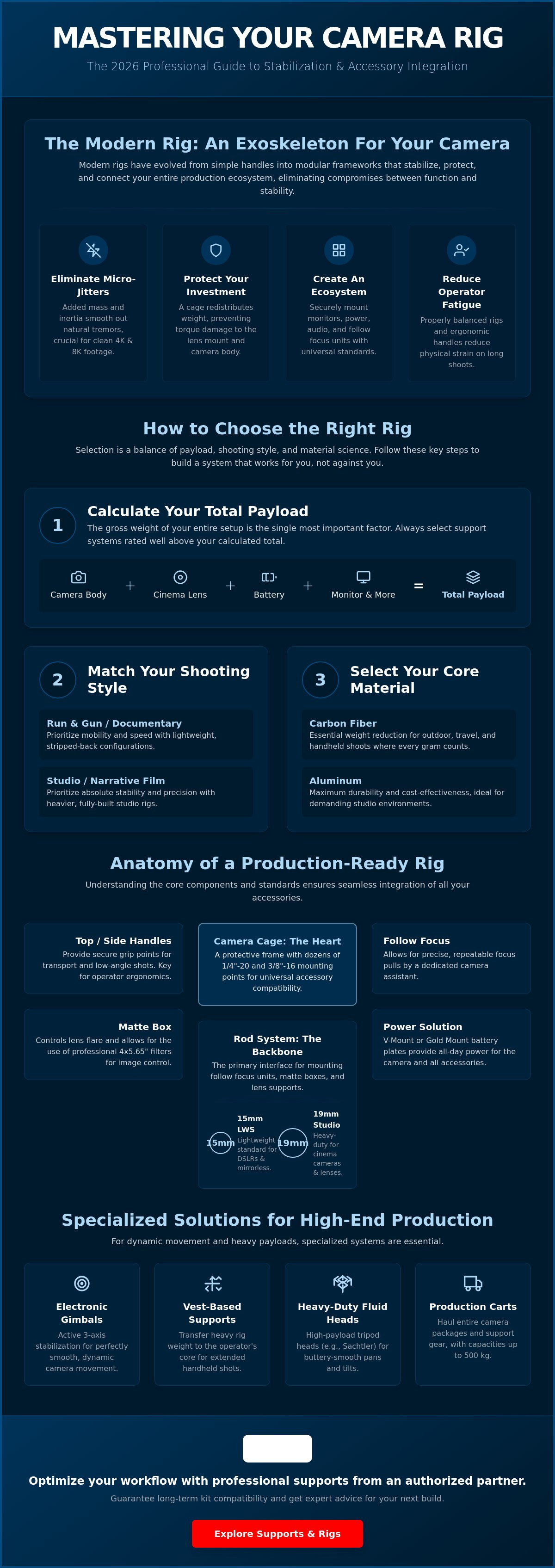
A professional camera rig isn't just a handle; it's a precision-engineered exoskeleton that transforms a standalone body into a production-ready ecosystem. You've likely felt the frustration of high-resolution footage being compromised by micro-jitters or the physical exhaustion that sets in during a twelve-hour handheld shoot. Managing the complex web of monitors, follow focus units, and batteries shouldn't feel like a compromise between stability and functionality. Selecting the right supports & rigs is the difference between a kit that fights you and one that feels like a natural extension of your creative intent.
We've designed this 2026 guide to help you master the art of camera stabilization and accessory integration for any environment. You'll learn how to choose professional support systems that eliminate compatibility issues and significantly reduce physical strain on the operator. We'll examine the latest industry innovations, including modular ecosystems from Tilta and SmallRig, alongside the newest heavy-duty fluid heads from Sachtler. From lightweight smartphone solutions to production carts capable of hauling 500 kg, this guide ensures your gear grows as your production demands evolve.
Key Takeaways
- Learn how modern supports & rigs function as modular frameworks, moving beyond simple stabilization to create a complete, production-ready ecosystem.
- Master the process of calculating total payload requirements, including optics and power solutions, to select a system that maintains balance and safety.
- Understand the critical differences between 15mm and 19mm rod standards to ensure seamless integration of matte boxes and follow focus units.
- Discover specialized solutions like electronic gimbals and vest-based supports to manage dynamic movement and reduce operator fatigue during high-stakes shoots.
- Identify the technical advantages of sourcing professional-grade hardware from an authorized partner to guarantee long-term kit compatibility and expert maintenance.
The Foundation of Every Professional Shot: Understanding Camera Supports & Rigs
A professional camera support system is far more than a collection of handles and screws. It's a modular framework engineered to stabilize the imaging system while providing secure mounting points for essential peripherals. In the past, stabilization often meant a simple tripod or a basic shoulder pad. However, the rise of compact Professional Video Cameras has shifted the industry toward comprehensive rigging. These systems act as a bridge between the camera body and the environment, ensuring the sensor remains protected and the optical path stays perfectly aligned under the weight of heavy cinema glass.
High-quality supports & rigs are vital for maintaining the integrity of your hardware. When you mount a heavy lens or a large battery, the physical stress on the camera's native mounting points can be immense. A dedicated rig redistributes this weight, preventing torque from damaging the lens mount or internal electronics. This structural security is why professionals view their rigging as an essential insurance policy for their equipment. Historically, establishing The Foundation of Every Professional Shot has required specialized tools that balance these mechanical needs with the creative requirements of the director of photography.
Stability vs. Mobility: Finding the Right Balance
Modern 4K and 8K sensors are incredibly sensitive to movement. Minor vibrations that were invisible on older systems now appear as distracting micro-jitters in high-resolution footage. Rigs mitigate this by adding necessary mass. While it might seem counterintuitive, a heavier rig often produces more "organic" cinematic movement because the added weight creates inertia, smoothing out the operator's natural tremors. You must evaluate your shooting environment to find the sweet spot. A stripped-back run-and-gun setup offers speed for documentary work, while a full studio build provides the absolute stability required for narrative precision.
Modular Design: The Exoskeleton Concept
Think of modern rigging as an exoskeleton for your camera. This "building block" approach allows you to scale your kit based on the specific needs of the day. At the heart of this system is the camera cage. These precision-machined frames protect expensive camera bodies from physical impact and mounting stress. They provide a grid of industry-standard 1/4"-20 and 3/8"-16 mounting points, allowing for universal compatibility with accessories. By utilizing these standardized interfaces, you can transition your supports & rigs from a handheld configuration to a tripod or gimbal in seconds, maintaining a consistent workflow across different production styles.
Choosing the Right Rig: Payload, Ergonomics, and Shooting Style
Selecting the right supports & rigs requires an objective assessment of your daily production workflow. It starts with a precise calculation of the total payload. You must account for the camera body, cinema lenses, high-capacity batteries, and any wireless monitoring gear. This gross weight determines the mechanical grade of hardware required for your build. Material science plays a huge role here; aluminium is ideal for durability in studio settings, while carbon fibre provides essential weight reduction for national outdoor shoots. In high-stakes environments, the weight of your kit directly impacts the number of setups you can achieve in a single day.
Professional setups often require Specialized Rigging Solutions to maintain structural integrity under these varied loads. Beyond the materials, ergonomic handles and contoured shoulder pads are essential for long-form production. A poorly balanced system causes operator fatigue, which leads to compromised framing and physical strain. Precision engineering ensures that every component works in harmony to protect your investment. High-end supports & rigs also provide the necessary clearance for cables and cooling vents, ensuring that your Digital Cinema Cameras operate at peak performance without thermal throttling.
Payload Management for Cinema Cameras
High-performance systems, such as the Sony FX series, require robust baseplates to prevent chassis flexing. When you mount large cinema zoom lenses, the centre of gravity shifts forward. Without a sliding bridge plate to adjust the balance, the operator must physically fight the camera's natural inclination to tilt. Always ensure your total rig weight doesn't exceed the maximum counter-balance capacity of your tripod head. Overloading your support can lead to fluid head failure or dangerous equipment tips.
Handheld vs. Shoulder-Mounted Configurations
Stability in handheld shooting often relies on the "three points of contact" rule. This usually involves both hands and either a shoulder pad or a chest support. Shoulder rigs excel at distributing weight across the operator's body, which is critical for all-day shoots. Using top handles and side grips allows for low-angle work and more creative framing options. These components provide the tactile control needed for complex tracking shots. If you're struggling to find the right balance for your specific camera and lens combination, you can consult our technical specialists for a custom configuration plan.
Essential Components for a Production-Ready Cinema Rig
A production-ready rig is defined by the quality of its individual parts. While the cage provides the frame, the internal components determine how efficiently you can operate. Professional supports & rigs rely on standardized interfaces to ensure that accessories from different manufacturers can be swapped without friction. This modularity is what separates a professional build from a hobbyist setup. Every screw, rod, and plate must be precision-machined to withstand the rigors of a high-pressure set.
The baseplate is the most critical interface. It serves as the bridge between your camera and your tripod or gimbal. Quick-release dovetail systems, such as the ARRI-standard dovetail, are industry benchmarks for a reason. They allow for rapid fore-and-aft balancing. This is essential when changing lenses or adding heavy batteries, as it keeps the center of gravity over the fluid head. Without this ability to slide the camera, you'll find yourself constantly fighting the tilt tension on your tripod.
Understanding rod standards is vital for any filmmaker. The 15mm LWS (Light Weight Support) standard is common for handheld and smaller builds, featuring rods spaced 60mm apart. In contrast, the 19mm Studio standard is used for heavy-duty cinema cameras and large zoom lenses. It provides greater rigidity with rods spaced 104mm apart. Mixing these up can lead to alignment issues with your matte box or follow focus, so always verify your accessory compatibility before a shoot. Matte boxes do more than just block flares; they house essential ND and creative filters. Follow focus systems, whether mechanical or wireless, provide the tactile precision needed for repeatable focus pulls.
The Core: Baseplates and Dovetails
Quick-release dovetail systems significantly speed up transitions between different support gear. Whether moving from a tripod to a shoulder rig, these plates ensure you don't waste time re-balancing. Height-adjustable baseplates are also essential. They allow you to align the rods perfectly with the lens center. This ensures your follow focus gears mesh correctly with the lens gear ring. See how these integrate with professional video cameras to create a seamless workflow.
Rods and Accessory Mounting
Choosing rod lengths depends on your lens size and battery plate requirements. Long rods are necessary for telephoto lenses or when mounting rear-heavy V-mount batteries. Using rod clamps and ARRI-standard rosettes allows you to build out complex, adjustable handle systems that fit your specific reach. Cheese plates are the unsung heroes of rigging. They provide endless 1/4"-20 and 3/8"-16 mounting options for wireless transmitters and audio receivers, keeping your build organized and balanced. Investing in high-quality supports & rigs ensures these mounting points don't strip or loosen over time.
Specialized Rigging Solutions for High-End Productions
High-end production environments demand specialized supports & rigs that go beyond basic stabilization. While standard tripod setups handle static shots, dynamic storytelling often requires motorized gimbals or heavy-duty load-bearing systems. These tools aren't just accessories; they're essential for executing complex tracking shots and managing the physical toll of a multi-day shoot. For broadcast environments, specialized studio pedestals provide the necessary height and smooth movement for heavy camera chains that standard fluid heads cannot accommodate.
Minimalist rigging has also seen a surge in popularity. Cameras like the Sony FX3 feature built-in mounting points, allowing for cage-less setups that still offer professional functionality. This approach is ideal for tight spaces or when using a drone where every gram matters. However, even these compact configurations benefit from professional-grade baseplates and handles to ensure reliable operation and secure accessory mounting. Balancing these specialized tools requires an understanding of how each component affects the overall physics of the camera system.
Integrating Gimbals into the Workflow
The rise of "gimbal-ready" rigs has streamlined the transition between handheld and motorized support. Modern baseplate standards allow you to move a camera from a tripod to a stabilizer without a full rebalance. This efficiency is critical on fast-paced sets where every minute counts. Using ring mounts or dual handles provides significantly better control over motorized stabilizers, reducing the vertical "bobbing" motion often seen in single-handed operation. You can explore Sony Alpha cameras and lenses to find the perfect compact combinations for high-performance gimbal work.
Heavy-Duty Support: Vests and Arms
Managing a fully built cinema camera for twelve hours requires more than just physical strength. Load-bearing vests are designed to transfer the total weight of the rig from the operator's spine to their hips, significantly reducing the risk of long-term injury. The Easyrig concept remains a favorite for its ability to maintain a handheld aesthetic while providing mechanical assistance. For productions requiring the highest level of modularity and strength, investing in a dedicated production kit like the ARRI Omnibar Production Kit ensures you have the structural capacity for any lens or accessory combination. These supports & rigs are engineered to handle the industry's heaviest payloads without compromising on mobility.
If your next project requires a custom-engineered solution for a complex shooting environment, contact our system integration team to discuss your specific rigging requirements.
Optimizing Your Workflow with Professional Supports from UBMS
Selecting high-tier supports & rigs is a long-term investment in your production's efficiency. Sourcing these components from a dedicated broadcast partner ensures that your hardware remains compatible across generations of technology. At United Broadcast & Media Solutions, we understand that a rig isn't a static purchase. It's a dynamic system that must adapt as you move from digital cinema cameras to full-scale broadcast configurations. Our expertise in system integration allows us to help you build a kit that doesn't just work today but remains functional as new sensors and lens mounts enter the market.
Professional filmmaking involves high stakes where equipment failure isn't an option. Having access to a local service center for repairs and maintenance is invaluable. When you source your rigging from a technical partner, you're gaining more than just metal and screws; you're gaining a support network that understands the specific stresses of the regional media environment. This logistical excellence is what transforms a simple vendor relationship into a long-term partnership. By focusing on global standards and precision engineering, we help you avoid the compatibility issues that often plague mixed-brand kits.
Expert Guidance and Technical Support
High-quality support hardware follows the "buy once, cry once" philosophy. While entry-level components might seem cost-effective, they often lack the precision tolerances required for repeatable cinema work. Our service center provides custom calibrations for complex builds, ensuring that your follow focus and motorized components are perfectly synchronized. By consulting with our specialists, you can build a rig tailored to your specific niche, whether that's wildlife cinematography or high-end commercial work. This level of technical guidance prevents the common frustration of buying gear that doesn't quite fit your workflow. We don't just sell parts; we provide solutions that stabilize your entire production process.
Completing Your Production Ecosystem
Stability is only one part of the equation. To achieve a truly professional result, you must pair your stabilized camera build with professional lighting equipment to control your environment. For facility builds and high-end studio projects, integrating your supports & rigs with broadcast studio gear ensures that your mobility doesn't come at the cost of signal integrity or power management. A balanced production kit is a holistic system where every piece of hardware supports the next.
To start building your future-proof kit, browse our comprehensive Supports & Rigs collection and select the components that match your creative ambitions.
Building a Scalable Production Foundation
Mastering camera stabilization requires viewing your hardware as a long-term investment in precision. We've explored how identifying your specific payload requirements and prioritizing ergonomic balance can eliminate fatigue while protecting your equipment's structural integrity. Whether you're building a minimalist handheld kit or a high-capacity studio system, the right supports & rigs act as the essential bridge between your creative vision and technical execution. By adhering to industry standards like the 15mm and 19mm rod systems, you ensure your kit remains adaptable as technology evolves.
Sourcing these tools from an authorized distributor guarantees access to leading global brands and comprehensive national stock for immediate fulfillment. As a dedicated technical partner, United Broadcast & Media Solutions provides the after-sales expertise and service center support necessary for maintaining complex configurations. Don't let compatibility issues or physical strain limit your production capabilities in a high-stakes environment.
Take the next step in refining your cinema kit today. Shop the Full Professional Supports & Rigs Collection and consult with our specialists to ensure your gear is ready for the demands of the 2026 media landscape. Your journey toward perfectly balanced, cinematic results starts with a foundation built on expertise.
Frequently Asked Questions
What is the difference between 15mm and 19mm rod systems?
The primary difference lies in the diameter and spacing of the rods, which dictates their load-bearing capacity. 15mm LWS (Light Weight Support) rods are spaced 60mm apart and are ideal for compact digital cinema cameras. 19mm Studio rods are spaced 104mm apart and offer significantly more rigidity. This makes the 19mm standard necessary for heavy cinema lenses and large matte boxes that require absolute stability.
Do I really need a cage for my cinema camera?
A cage is essential for protecting your camera body and providing secure mounting points for accessories. It acts as an exoskeleton that distributes the weight of monitors and wireless transmitters away from the camera's native 1/4"-20 threads. This prevents long-term damage to the camera's chassis. Using high-quality supports & rigs with a dedicated cage also allows for faster transitions between handheld and tripod-mounted configurations.
Can I use a DSLR rig for a professional cinema camera?
While physically possible, using a DSLR rig for a professional cinema camera is generally not recommended due to payload limitations. Cinema cameras are significantly heavier and require more robust baseplates to prevent flexing. Most DSLR-oriented supports & rigs lack the structural integrity to handle large V-mount batteries or heavy cinema glass. Investing in cinema-grade hardware ensures that your setup remains stable and safe under high-stress production conditions.
How do I balance a heavy rig for handheld use?
Achieving balance requires positioning the camera's center of gravity directly over your shoulder or the center of your grip. You should use a sliding bridge plate to move the camera body forward or backward until it sits neutrally. Properly adjusted side handles and a contoured shoulder pad are also vital. This setup reduces the physical effort needed to keep the shot steady, allowing for longer takes without operator fatigue.
What are the most essential accessories to mount on a camera rig?
The most essential accessories include an external monitor for accurate framing, a follow focus for precision lens control, and a matte box to manage light flares. You'll also need a battery plate, typically V-mount or Gold Mount, to provide long-term power to both the camera and peripherals. These components transform a basic camera into a production-ready system capable of handling complex narrative or broadcast requirements.
Are carbon fibre rods worth the extra cost over aluminium?
Carbon fibre rods are worth the investment for operators who frequently shoot handheld or in remote locations. They provide a superior strength-to-weight ratio compared to aluminium, reducing the overall weight of your rig without sacrificing rigidity. While aluminium is durable and cost-effective for studio use, carbon fibre doesn't expand or contract as much in extreme temperatures. This ensures your follow focus gears stay perfectly aligned regardless of the environment.
What is a bridge plate and why is it important for tripods?
A bridge plate is the critical interface that allows a camera rig to slide onto an ARRI-standard dovetail for quick balancing. It's important because it provides the necessary height for rod-mounted accessories like follow focus units and matte boxes. Without a bridge plate, you can't easily adjust the camera's position to compensate for heavy lenses. This component is foundational for achieving smooth pans and tilts on a fluid tripod head.
How do I ensure my follow focus is compatible with my lens?
Compatibility depends on the gear pitch and the rod standard of your rig. Most professional cinema lenses use a 0.8 Mod (32 pitch) gear ring. You must ensure your follow focus drive gear matches this standard. You also need to verify if your follow focus is designed for 15mm LWS or 19mm Studio rods. Many modern units offer interchangeable clamps or adjustable arms to bridge these different rigging standards.


