

Choosing the Right Microphone for Interviews: Which Type Fits
A mic flag identifies the broadcaster; it doesn’t improve the recording. For a sit-down interview, choosing the right microphone for interviews means matching the mic to the setup: a hardwired lavalier can suit a longer conversation, while a shotgun microphone positioned just out of frame can keep the subject’s voice prominent. Placement and pickup pattern matter more to sound than whether the mic carries a flag.
It’s easy to focus on equipment and overlook how an interview will unfold. A stationary guest, a moving subject and a noisy live setting each place different demands on the microphone, its position and the recording system. This guide explains how pickup patterns affect what a mic captures, when handheld, lavalier and shotgun types work well, and how close to place them. It also clarifies when a mic flag makes sense, helping you choose for the production rather than treating the microphone as an isolated audio accessory.
Key Takeaways
- Match the pickup pattern to the interview environment: directionality affects how much of the speaker and surrounding sound the microphone captures.
- For a fast-paced interview, a handheld microphone can make it easier to pass the mic between speakers without a lengthy setup.
- Place a lavalier carefully on clothing to keep it close to the speaker while reducing visibility in the frame.
- Consider power needs and recording conditions when choosing between dynamic and condenser microphones.
- A mic flag identifies a broadcaster; choose whether to use one based on the visual presentation, not as a way to improve audio.
Microphone pickup patterns
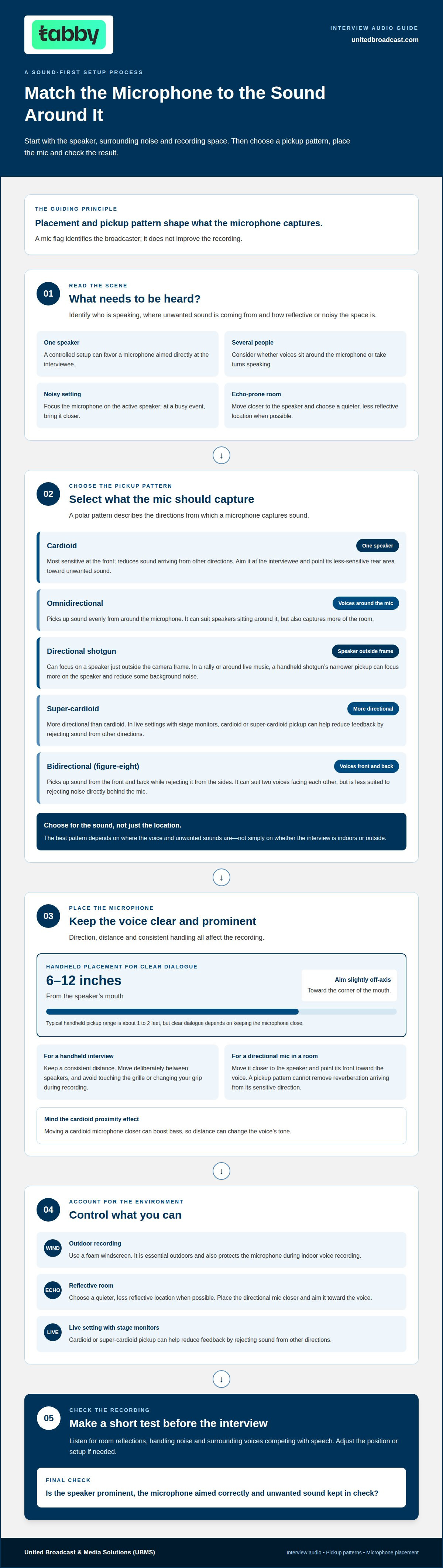
A microphone’s polar pattern describes the directions from which it captures sound. For interviews, match the pickup pattern to the speaker’s position, surrounding noise and recording space. Choosing the right microphone for interviews starts with understanding what the microphone will pick up, not simply its shape or size.
Cardioid and Omnidirectional Patterns
A cardioid pattern is most sensitive to sound from the microphone’s front and reduces sound arriving from other directions. An omnidirectional pattern picks up sound evenly from around the microphone. This difference matters when an interview has one speaker or several people sharing the recording space.
For a single speaker in a controlled setup, aim a cardioid microphone at the interviewee and point its less-sensitive rear area toward unwanted sound. An omnidirectional microphone can suit a conversation with speakers sitting around it, but it also captures more of the room. A cardioid microphone’s proximity effect boosts bass as it moves closer to the speaker, so distance can change the voice’s tone. That is why choosing the right microphone for interviews depends on both the subject and the room.
Polar Pattern Selection by Recording Environment
For an indoor interview, choose a cardioid pattern when you need to emphasize one speaker and reduce sound from other directions. Outdoors, a directional shotgun microphone can focus on a speaker just outside the camera frame. The best choice depends on where the voice and unwanted sounds are, not simply on whether the interview is indoors or outside.
In an echo-prone room, position a directional microphone closer to the speaker and point its front toward the voice. Choose a quieter, less reflective location when possible. A pickup pattern cannot remove reverberation that reaches the microphone from its sensitive direction. A short test recording can reveal whether room reflections remain prominent.
Outdoor recording makes wind protection an important consideration. Use a foam windscreen, which is essential outdoors and also protects the microphone during indoor voice recording. In noisy situations, such as a rally or an event with live music, a handheld shotgun’s narrower pickup can focus more on the speaker and reduce some background noise.
A super-cardioid pattern is more directional than a cardioid pattern. A bidirectional, or figure-eight, pattern picks up sound from the front and back while rejecting it from the sides. Figure-eight pickup can suit two voices facing each other, such as a duet, but is less suited to rejecting noise directly behind the microphone. In live settings with stage monitors, cardioid or super-cardioid pickup can help reduce feedback by rejecting sound from other directions.
Handheld microphones for fast-paced interviews
A handheld microphone suits quick interviews because the reporter can bring it into position without setting up a stand. In street interviews, the host can pass it between speakers while keeping it close to whoever is talking. This flexibility helps when the subject, camera or interview location changes during recording.
Typical handheld pickup range is about 1 to 2 feet, but clear dialogue depends on keeping the microphone close. For a clean recording, position it 6 to 12 inches from the speaker’s mouth, slightly off-axis and aimed toward the corner of the mouth. A cardioid handheld should be held very close to the speaker, since greater distance can make surrounding voices and noise more prominent.
For an impromptu interview with two or more people speaking to camera, a portable handheld microphone can work well. Pass it to the person speaking, then move it to the next speaker. An omnidirectional handheld positioned between two subjects can capture both voices and make transitions smoother. A directional pattern focuses more on the person the microphone faces, so the interviewer needs to point it accurately during each answer.
Good microphone technique matters as much as pickup type. Keep a consistent distance as the speaker talks, and move the microphone deliberately rather than swinging it between answers. Avoid touching the grille or changing your grip during recording, since handling noise can distract from speech. At a busy event or public gathering, bring the microphone closer to give the speaker priority over nearby sound.
How much should you spend on a good interview microphone? There is no single suitable budget for every interview. Base your decision on the recording device’s input, the microphone’s intended use and whether you need a wired connection or wireless freedom, rather than choosing by price alone.
How do you connect an interview microphone to a camera, smartphone or computer? Match the microphone’s output connector to the device’s microphone input; if they differ, a compatible adapter or audio interface may be needed. XLR is a practical recording connection when the recorder supports it, while a 1/8-inch mini-jack is associated with portable setups and lower-end recorder preamps.
For camera-based interviews, confirm the recording chain supports the chosen microphone connection and keeps the operator free to frame the exchange. A short test recording can reveal whether speech is clear and whether handling noise or surrounding voices compete with it. To discuss a camera-based interview setup, get in touch about your recording requirements.
Lavalier microphone placement
A lavalier microphone clips to clothing, placing its capsule near the interviewee’s mouth while remaining discreet on camera. Its small size suits sit-down interviews and presentations, but placement affects clarity. A microphone hidden under fabric or positioned too far away can capture muffled speech and more room sound.
For a standard setup, clip the lavalier about 6 to 8 inches below the interviewee’s chin, centered on the chest. A shirt or jacket collar can also provide a close position. Check the camera frame and the clothing before recording, then make sure fabric does not cover the capsule or rub against it as the subject moves. Keep the microphone no farther than 18 inches from the speaker’s mouth unless using a shotgun microphone.
Account for the subject’s movement when positioning a lavalier. A seated guest may turn their head or lean back while answering, so place the microphone where it stays near the voice through those movements. If the subject wears a jacket, test the clip and cable as they move naturally. A loose cable can brush against fabric and create distracting noise. For an on-camera presentation, make sure the microphone remains discreet without being covered by a lapel or collar.
Wired vs wireless lavalier microphones for interviews: which is better? For a stationary sit-down interview lasting ten minutes or longer, a hardwired lavalier is a practical choice. It can draw phantom power from a camera or mixer, avoiding reliance on battery power and wireless interference. A wireless lavalier is better suited to a moving subject who needs freedom from a cable.
A lavalier takes time to attach and needs either a cable to a digital recorder or a wireless system, so plan the setup before the interview begins. A wired connection may restrict movement, while a wireless system lets the subject move without a cable. Choose according to the interview format and recording chain.
A lavalier and a shotgun microphone solve different placement problems. The lavalier moves with the subject, making it useful when the person moves or the microphone needs to stay out of view. A shotgun can remain outside the frame and capture a stationary speaker from above, but a moving subject may require a boom operator to keep it close. For a seated guest who turns frequently, a properly secured lavalier can maintain a consistent position on the clothing.
What common microphone placement and recording mistakes should interviewers avoid? Avoid clipping the capsule too low, covering it with clothing or leaving the cable loose against fabric. Before recording, check the lavalier position on camera and make a short test recording while the subject speaks and moves. Listen for muffled dialogue, clothing noise and changes in level, then adjust the clip or cable before the full interview.
Dynamic and condenser microphone characteristics
Dynamic and condenser microphones convert sound into an electrical signal differently, affecting their power needs and recording behavior. A dynamic microphone needs no external power and can handle high sound-pressure levels. Its durable design suits handheld interviews, live applications and noisy locations. A condenser microphone is more sensitive and offers a wider frequency response, which can capture more detail in a controlled interview room.
For a fast-moving interview in a busy venue, a dynamic handheld microphone is a practical choice. It can handle loud sound and needs no external power, simplifying the recording setup. In a quiet sit-down interview, a condenser can capture subtle vocal detail, provided the room and equipment support it. Its sensitivity can also pick up more unwanted sounds, so the environment matters.
Condenser microphones and phantom power: Large-diaphragm condenser microphones require 48 V phantom power from a microphone preamp to work properly. Before recording, confirm the audio chain can supply phantom power to the microphone. Without the required power, the condenser won’t operate as intended. Dynamic handheld microphones don’t require 48-volt phantom power, so they can be a simpler match for equipment without that capability.
Some shotgun microphones also require 48-volt phantom power from the camera or audio recording device. Don’t assume that every shotgun shares the same power requirement as a dynamic handheld. Match the microphone’s power needs to the recording device, then test the signal before an interview. For a sit-down setup using a condenser, this check can prevent discovering a power mismatch after the conversation begins.
Compare microphone specifications with the voice and recording conditions. A typical frequency-response specification may be written as 40Hz-20kHz, but a wide range alone doesn’t determine whether a microphone suits an interview. Condensers have a wider frequency response than dynamic microphones and can sound more sensitive to detail. Consider whether the room is controlled, whether background noise is present, and how much detail the recording needs.
Condensers can cause feedback in some live applications, particularly noisy performances. Microphone choice matters when interviews take place near speakers or other amplified sound. A dynamic microphone’s durability and ability to handle high sound-pressure levels can suit these demanding situations. For a quieter, carefully controlled conversation, a condenser’s sensitivity may be useful. Choose according to the environment, available power and sound you need to capture.
Choosing a microphone for a sit-down interview
For a stationary interview, choose between a hardwired lavalier and a shotgun microphone based on framing, movement and crew needs. A lavalier stays attached to the speaker, while a shotgun can sit overhead, just outside the frame. Either can capture clear dialogue when it stays close to the voice and suits the room and recording setup.
A shotgun microphone for a sit-down interview should generally remain about 8 to 16 inches from the speaker. A common position is overhead or just out of frame, within a foot or two. For a stationary talking-head shot, place it several inches in front of the subject and above, angled toward the mouth. This keeps the microphone out of view while directing its pickup toward the sound source.
Consider the crew and camera framing before choosing a boom-mounted shotgun. If the speaker shifts during a take, a boom operator may need to follow while keeping the microphone close and outside the frame. This requires an additional crew member and can limit camera angles because the shot must accommodate the boom. A lavalier avoids overhead positioning, although attaching it takes setup time.
A full-size microphone on a table stand may not stay within the recommended 6 to 18 inches of the interviewee’s mouth. The speaker may also turn away from a fixed microphone while answering. A hardwired lavalier or overhead shotgun can keep the microphone nearer the voice without placing a stand between the subject and camera. The reason to choose a table microphone is strongest when its position remains consistent throughout the conversation.
Match the connection to the recorder before the interview. When possible, use an XLR microphone if the recorder supports it. A ¼-inch microphone jack is rare on portable recorders and may require an adapter. Some shotgun microphones need 48-volt phantom power, so confirm the recording chain can supply it. A short test lets the crew assess dialogue level, room reflections and handling noise before the guest begins.
A mic flag can identify a broadcaster, but it doesn’t change the microphone’s polar pattern or improve the recorded sound. For a sit-down shot, decide whether the flag belongs in the composition. Keep the sound source, microphone position and camera view as the primary considerations.
United Broadcast & Media Solutions (UBMS)
United Broadcast & Media Solutions (UBMS) helps production teams plan camera choices around the practical demands of an interview. Once you’ve selected a microphone type and placement, consider how the camera position, framing and lighting will work together in the room. The right camera setup supports a stable composition for a seated guest, while lens choice affects how tightly the shot frames the speaker.
For interview productions in the UAE, UBMS offers professional video cameras, digital cinema cameras, cinema lenses and professional lighting equipment. These options are relevant when your microphone decision is part of a wider recording setup, rather than a standalone audio purchase.
Contact United Broadcast & Media Solutions (UBMS) to discuss your interview production requirements.
Build a repeatable interview workflow
Treat sound planning as part of pre-production, not a last-minute equipment decision. As you move from choosing the right microphone for interviews to building a repeatable setup, document how the microphone, subject, camera frame and room interact. This record helps the crew maintain consistency across pickups, interview days and changes in framing. It also gives camera and audio operators a shared reference when production conditions change.
Include an audio rehearsal before recording. Listen through the camera or recorder monitoring path, then consider whether the speaker’s position or camera framing changes the recorded perspective. If blocking changes, reassess the setup before recording. A clear workflow helps coordinate sound and picture decisions without treating the microphone as an isolated purchase. UBMS supports broader interview setup planning with professional camera, lens and lighting equipment, as well as system integration services for broadcast and studio environments.
With a considered plan, your crew can approach the next interview with greater clarity and control.
Frequently Asked Questions
So Which Microphone is the Best?
A shotgun microphone can serve interviews and other recording situations, making it a versatile option for filmmakers. For a sit-down conversation, its usefulness depends on having a way to position it close to the speaker while keeping it outside the frame. If the interview format is fixed, a lavalier or handheld may suit the setup better. Choose for the production’s movement, framing and sound environment rather than seeking one universal best microphone.
What microphone types are best for interviews: lavalier, handheld, shotgun, or USB?
Choose a lavalier when the subject needs to move or the microphone should remain discreet. A handheld suits quick exchanges where an interviewer can direct it between speakers. A shotgun works for controlled camera interviews when it can be positioned near the subject, just outside the frame. A USB microphone can be convenient for direct computer recording, such as a remote interview, but it must suit the recording software and available placement.
What microphone polar pattern is best for recording one person or two-person interviews?
For one speaker, cardioid pickup is a useful starting point because it emphasizes sound from the front. For two people facing each other, a bidirectional figure-eight microphone can capture voices from the front and back while rejecting sound from the sides. An omnidirectional microphone placed between two seated speakers is another option when both need to be heard evenly. Let room noise and speaker arrangement guide the choice.
What are the best interview microphones by budget and recording setup?
Start with setup requirements, then set a budget. For a simple computer interview, a USB microphone avoids the need for a separate audio interface. For a camera or recorder, match the microphone connection to its input. A solo operator may value a lavalier that keeps the subject mic’d without a boom operator, while a staffed shoot can accommodate a boom-mounted shotgun. Reserve budget for the connection and support accessories the setup actually needs.
What accessories are needed for interview microphones, such as wind protection and stands?
Outdoor recording calls for a foam windscreen to reduce wind reaching the microphone. It also provides protection during indoor voice recording. A stand or boom support can hold a microphone in position for a seated interview, while a clip secures a lavalier to clothing. Cable management helps prevent fabric or cable movement from creating handling noise. Choose accessories to suit the microphone, recording location and camera framing.


