

Benefits of a Professional Equipment Service Contract
What is the value of equipment support beyond getting a fault repaired? For teams working with professional cameras, lighting, and broadcast systems, the benefits of a professional equipment service contract can include clearer maintenance responsibilities and a more planned approach to equipment care. The details matter: an agreement is useful when its written scope fits the equipment and workflow it is meant to support.
An ongoing service commitment is easier to evaluate when the coverage, responsibilities, and operational value are clear. A reactive repair approach may seem straightforward, but it can leave teams responding to faults without a defined maintenance plan. Compare the actual work covered, exclusions, fault-reporting process, and fit with production priorities, rather than relying on the contract label.
This article explains how planned equipment care can support operational continuity, what to review when assessing contract scope, and how to compare an agreement with reactive repairs. United Broadcast & Media Solutions provides professional equipment repairs and technical support through a dedicated service centre, alongside system integration capabilities. These services offer a practical reference when you identify support needs for your equipment and day-to-day workflow.
Key Takeaways
- Assess the benefits of a professional equipment service contract by matching its written scope to the equipment and production workflow it needs to support.
- Distinguish preventive inspection, maintenance, fault diagnosis, repairs, and system-level support when reviewing what an agreement covers.
- Compare scheduled service with reactive repairs by considering responsibilities, exclusions, fault support, and planning needs, not just the service model.
- Use clear maintenance responsibilities to assess service commitments against operational priorities.
- Consider how professional equipment repairs and system integration, from planning and design to testing and post-project support, relate to production continuity.
Why a Professional Equipment Service Contract Matters for Production Continuity
A production depends on more than whether each piece of equipment powers on. Cameras, lenses, lighting, and studio systems need to work together when a shoot or broadcast is scheduled. A fault can disrupt that plan, even if the affected device seems like only one part of the setup. A professional equipment service contract sets out agreed support for specified equipment, helping teams plan maintenance responsibilities instead of relying only on repairs after problems arise.
A professional equipment service contract defines agreed care and support for specified equipment, helping teams plan maintenance and fault response without guaranteeing uninterrupted operation. Its potential benefits begin with clarity: which equipment is covered, what work is planned, and how reported faults are handled. Those boundaries can make equipment care more deliberate, but they cannot eliminate unexpected failures.
How reactive repairs affect media operations
With a reactive approach, a technical issue often becomes urgent only after it interrupts work. A camera fault may delay a scheduled shoot; a lens problem can limit the planned setup; or a lighting issue may require the crew to adjust the scene or workflow. In a studio, a fault affecting one component can also require checks across connected equipment before operators can confirm technical readiness.
Interdependence matters. A camera may feed a monitoring or switching workflow, while studio equipment relies on functioning connections and correctly configured systems. A fault at one point can prompt troubleshooting elsewhere, taking engineering time away from preparation or live operations. The practical impact may be disruption, rescheduling, or a slower setup. Any financial effect depends on the production and circumstances, so it should not be assumed or presented as a guaranteed loss.
What planned equipment care is designed to do
Planned care gives teams a process for considering equipment condition before a fault dictates the schedule. The Maintenance concept includes work intended to keep equipment functional as well as actions taken to restore it after failure. In a service agreement, scheduled checks and defined support responsibilities can help coordinate that work with operational requirements and the equipment in scope.
Preventive service and repair after failure are related, but they are different tasks. A scheduled inspection or maintenance activity is planned in advance; fault diagnosis begins when a problem needs investigation, and repair addresses the identified failure. The written scope determines which activities apply. This distinction helps production teams understand what is planned and what may be needed if equipment stops performing as expected.
- Camera and lens workflows: Consider planned care alongside the readiness checks for camera bodies and lenses used on a shoot. Teams working with professional video cameras can assess how equipment support fits their preparation routine.
- Lighting and studio systems: Include lighting equipment and connected studio components in maintenance planning rather than treating each device as an isolated asset.
Defined care can reduce uncertainty about responsibilities and make maintenance easier to schedule around production. It cannot prevent every fault or promise continuous operation. Its value is a clearer, more considered approach to equipment support.
What a Professional Equipment Service Contract Can Cover
A service agreement is useful only when its boundaries are clear. The written scope should identify eligible equipment, covered activities, and where support responsibilities begin and end. Two agreements described as “maintenance” may address very different needs, so assess the details rather than relying on the label. Westlaw’s Equipment Maintenance Agreement (B2B) is a reference for the kinds of terms an equipment agreement may address; it is not a substitute for advice on UAE-specific legal requirements.
Start with an asset list. Record each item’s equipment type, manufacturer and model, serial number where available, location, and current condition. For professional video cameras, distinguish camera bodies from lenses and related accessories. A current inventory helps everyone understand which assets are in scope and makes it easier to identify gaps or changes when equipment moves between production areas.
Maintenance, diagnostics, and repair are different service activities
These terms describe separate stages of equipment care. Scheduled maintenance is planned work intended to assess or maintain equipment condition. Fault diagnosis investigates a reported problem to identify its likely cause. Repair is corrective work addressing an identified fault. The written scope should distinguish these activities: an inspection does not automatically mean repair work or required parts are included.
Equipment condition also matters. Note known faults or limitations in the asset list before a service plan begins. If a camera has an existing issue, documenting it creates a clearer baseline and helps distinguish that condition from a fault discovered later. This is practical record-keeping, not a prediction that a fault will occur.
Support for individual equipment and integrated systems
Support for an individual camera or lens differs from support for an integrated studio environment. A system-level issue may involve signal paths, connections, configuration, or dependencies between broadcast equipment. A scope focused on one device may not define responsibility for the surrounding workflow. Documenting how components relate helps clarify what system-level support means in practice.
For a studio, an asset register can identify connected equipment and show which operational chain each component serves. This context helps distinguish a device fault from a wider integration issue. It makes service boundaries more meaningful for the facility’s actual workflow, rather than treating every item as an isolated asset.
- Eligible assets: Identify equipment by type, model, serial number, and location.
- Defined tasks: Separate scheduled maintenance, diagnosis, repair, and system support.
- Known condition: Record existing issues and relevant equipment history.
- System context: Document connections and dependencies that affect studio workflows.
Clear scope makes it easier to evaluate support against production needs. United Broadcast & Media Solutions (UBMS) provides professional equipment repairs and technical support, as well as system integration services. Teams mapping support needs across equipment and workflows can discuss their technical requirements with the team.
The Benefits and Limits of a Professional Equipment Service Contract
A service contract can offer practical value when its commitments match how production equipment is used. The benefits of a professional equipment service contract may include a more organized maintenance schedule, clearer responsibility for defined tasks, and access to relevant technical expertise. These are potential operational advantages, not guaranteed results. Their value depends on the agreement’s scope, equipment condition and usage, and how well the planned work fits production needs.
Operational value: planning, expertise, and clearer responsibilities
A defined service process gives operations and engineering teams a basis for arranging maintenance around equipment use, production calendars, and available technical resources. Clear responsibilities also make it easier to know who coordinates an inspection or reports a fault. For professional cameras, lighting, and broadcast systems, relevant technical familiarity can help technicians assess symptoms in the context of the equipment and workflow, rather than treating every issue as a generic repair.
A service contract can organize maintenance and support responsibilities, but it cannot promise that equipment will remain fault-free.
That distinction matters for decision-makers. Planned work can support a clearer view of equipment condition and help teams address identified concerns through an agreed process. It does not mean every developing issue will be found or that maintenance will extend an asset’s useful life. A camera used frequently in demanding production conditions may experience different wear from equipment used occasionally. Usage, handling, environment, and prior condition all affect what service can reasonably achieve.
- Planning: Coordinate scheduled work with production requirements.
- Accountability: Make responsibility for agreed service tasks easier to identify.
- Technical context: Give fault assessment and maintenance a clearer equipment and workflow context.
United Broadcast provides professional equipment repairs and technical support through a dedicated service centre, including authorized ARRI and Sony service centres. These capabilities are relevant when evaluating the technical expertise a production operation needs. They do not determine the terms of a separate service agreement.
What a service contract cannot promise
Preventive service may identify concerns during planned checks, but it cannot eliminate every failure risk. Equipment can develop a fault between visits, and a problem may need investigation before its cause or corrective work is clear. A contract supports a process for care and response, not uninterrupted production or zero downtime.
The written terms determine the practical boundaries. Response times, parts, repair work, exclusions, and the process for handling faults depend on the agreement. Usage, accidental damage, consumables, third-party equipment, or system-level issues may be treated differently, so do not assume they are included. A service agreement also does not automatically extend, replace, or preserve manufacturer warranty rights. Review its wording alongside the relevant warranty terms.
Weigh the planned work and defined responsibilities against what remains outside the scope. If exclusions cover equipment or tasks central to a production workflow, the agreement may provide less operational value than its broad description suggests. Clear limits are useful because they show teams what the service arrangement can and cannot support.
How to Compare Service Contracts with Reactive Repairs
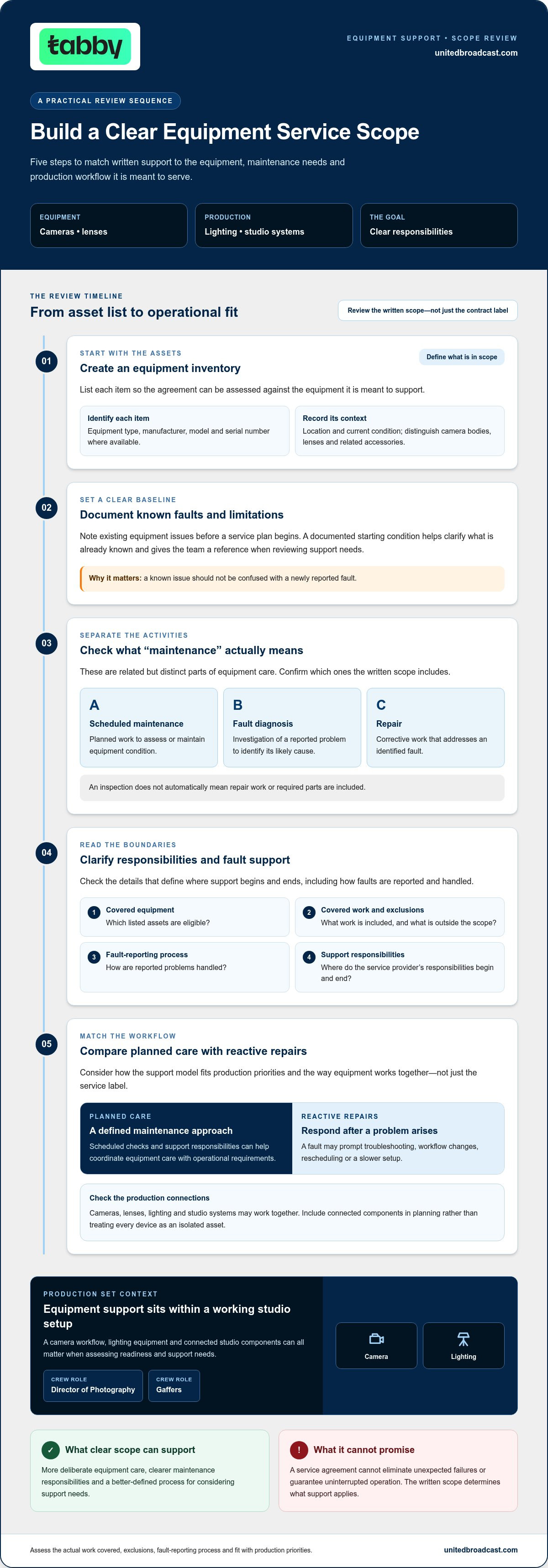
Compare the work each approach covers, not just its label. A service agreement may organize scheduled tasks and define how faults are handled, while reactive repairs focus on problems as they arise. Neither model is universally cheaper: the practical comparison depends on equipment condition, service scope, repair needs, and the effort required to coordinate support. The benefits of a professional equipment service contract are most relevant when its planned work and responsibilities fit the production workflow.
Use these categories to structure the comparison:
- Service model: An agreement defines planned activities and support boundaries; reactive repairs address reported faults as they occur.
- Scheduled work: Check whether inspections or maintenance are specified, or whether work begins only after a fault.
- Fault support: Compare how diagnosis and corrective repairs are described, including the process for arranging them.
- Exclusions: Identify assets, parts, damage, or tasks outside the written scope.
- Planning needs: Consider the internal time needed to schedule care, report faults, coordinate access, and track equipment history.
Assess equipment criticality, age, usage, and system dependencies alongside these categories. A frequently used camera central to a scheduled shoot may need closer planning than a secondary asset. A specialist cinema lens may require a distinct diagnostic and repair assessment, so include lens-specific service needs rather than assuming general camera coverage applies. For interconnected studio equipment, consider whether an issue in one component could affect other parts of the workflow.
Questions to resolve in the written scope
Make the agreement specific enough to compare against your asset register. Identify covered equipment and service activities, then note how call-outs, diagnostics, repairs, parts, exclusions, scheduling, and communication are addressed. Clear terms show where responsibility sits, what work is planned, and which requirements may remain outside the arrangement.
For example, a scope that includes inspection but says little about fault diagnosis may not explain how a reported issue will be assessed. A repair process may also have different conditions from scheduled maintenance. Record unclear boundaries for comparison, without assuming that a service label guarantees a particular response or repair.
Match the service model to your equipment and workflow
Use a simple decision matrix. High criticality, recurring maintenance needs, or limited internal technical capacity may make defined external support more valuable to assess. Lower criticality, straightforward upkeep, and strong in-house capacity may make a reactive model workable. These are decision prompts, not automatic recommendations.
- High criticality, complex dependencies: Examine whether system-level support and connected assets are addressed.
- High criticality, individual asset: Focus on equipment-specific maintenance and the fault process.
- Lower criticality, capable in-house team: Compare internal maintenance capacity with the agreement’s defined tasks.
- Unclear condition or usage: Improve equipment records before judging which model fits.
For camera-only coverage, define the cameras and related equipment precisely. If the workflow depends on integrated studio systems, assess those dependencies separately rather than assuming they are covered by an individual asset’s service scope.
How UBMS Supports Professional Equipment Service and System Continuity
Production support can involve individual equipment repairs or the wider technical environment in which cameras, lighting, and studio systems operate. United Broadcast & Media Solutions provides professional equipment repairs and technical support through a dedicated service centre, including authorized ARRI and Sony service centres. Its system integration services support broadcast environments and studio setups.
For decision-makers weighing the benefits of a professional equipment service contract, it helps to distinguish equipment repair from system integration. A camera or lighting fault may need specialist attention to that asset. A system issue can require a broader view of how equipment is planned, connected, commissioned, and used in the production workflow.
Repair and technical support for professional media equipment
UBMS’s dedicated service centre provides professional equipment repairs and technical support. Its authorized ARRI and Sony service centres are part of this repair capability. For a production team, specialist repair and support can form part of a practical equipment-care plan.
Keep repair and support needs distinct from the terms of any ongoing agreement. Set out eligible equipment, activities, and responsibilities in writing so the service scope can be compared with operational needs.
Discuss service needs for a project or equipment environment
Useful discussions start with the operational picture. Outline equipment types, known service needs, production priorities, and dependencies between devices. Consider camera equipment separately from lighting, then describe how those assets connect to broadcast studio workflows. This context helps clarify whether the requirement is focused on individual repairs, technical support, or a broader system integration project.
UBMS’s system integration capability spans planning, consultancy, design, engineering, commissioning, testing, training, and post-project support. These stages address system requirements across a project lifecycle: planning and design establish the intended solution, engineering and commissioning bring it into operation, and testing and training support its use. Post-project support continues the technical relationship after implementation.
Before discussing requirements, prepare a concise overview:
- Equipment: List the cameras, lighting, and broadcast systems relevant to the discussion.
- Operational priorities: Identify the workflows where readiness matters most.
- System dependencies: Note how equipment connects or relies on other components.
- Support needs: Separate repair requirements from integration or project support.
This information gives the conversation a practical starting point, whether the need concerns a specific piece of equipment or a connected system environment.
Set a Clear Path for Equipment Support
Turn production priorities into a practical support plan. Identify the equipment and workflows that matter most, then define the responsibilities and service activities that would make support useful. This gives decision-makers a stronger basis for assessing the benefits of a professional equipment service contract without assuming that any agreement can prevent every fault or suit every operation.
United Broadcast & Media Solutions supports professional equipment repairs through a dedicated service centre, including authorized ARRI and Sony service centres. For broader technical environments, its system integration work spans planning, design, engineering, commissioning, testing, training, and post-project support. These capabilities support planning for individual equipment and connected systems.
Bring your equipment types, operational priorities, and system dependencies into the conversation. A clear starting point helps shape a considered approach to service and system continuity.
Contact UBMS to discuss professional equipment repairs, technical support, or system integration for your production environment.
Frequently Asked Questions
What is included in a professional equipment service contract?
It includes only the equipment and work identified in its written terms. The scope may describe scheduled inspections, maintenance tasks, fault assessment, repairs, parts, or support for connected systems, but do not assume these are included unless stated. For example, a camera body and its lens may need to be listed separately. Review the asset schedule, exclusions, service process, and responsibility for arranging work before relying on the agreement.
Is a professional equipment service contract worth it?
It may be worthwhile if the defined services address equipment that is critical to your workflow and fit your team’s technical capacity. The benefits of a professional equipment service contract can include more predictable maintenance planning and clearer responsibilities, but value depends on the actual scope and your equipment needs. Compare the agreement with your repair history, equipment use, and internal resources. Do not assume it will always cost less than arranging repairs as needed.
Can a service contract prevent equipment breakdowns?
No service contract can ensure that equipment will not fail. Planned checks may help identify some concerns, but faults can develop between inspections or arise unexpectedly. A camera that passes a scheduled check could still develop a problem during later use. Treat maintenance as one part of equipment readiness, alongside operator checks, accurate fault reporting, and practical contingency planning for important productions.
How much maintenance should professional camera equipment receive?
There is no single maintenance interval that suits every professional camera. Follow the manufacturer’s guidance and consider factors such as frequency of use, operating conditions, transport, and any symptoms or changes in performance. Keep a service log with dates, reported issues, and work completed; this helps reveal recurring concerns and supports informed planning. Avoid opening or adjusting equipment beyond the procedures permitted by the manufacturer or your organisation’s technical practice.
What happens if equipment fails while a service contract is active?
The agreement’s fault-reporting process and scope determine what happens next. Record the affected asset, symptoms, when the issue appeared, and relevant operating conditions, then follow the stated notification and assessment procedure. A technician may need to diagnose the fault before determining corrective work. Active coverage alone does not establish that every failure, repair, or part is included, so refer to the written terms for the applicable process.
Does a service contract cover repairs and replacement parts?
Only if its terms say so. Some agreements may define maintenance separately from corrective repairs, and parts may have their own conditions or exclusions. Check how the document treats labour, components, consumables, damage, and equipment outside the listed assets. If a cinema camera fault requires a replacement component, do not assume that component is covered simply because the camera appears on an asset list.
How is a service contract different from a manufacturer warranty?
A manufacturer warranty is provided by the manufacturer and applies according to its own terms. A service contract is a separate agreement whose maintenance or support scope is defined by its written conditions; it does not automatically extend or replace warranty protection. UBMS acts as a retailer, while warranty obligations rest with the manufacturer. Review the applicable warranty documentation and service agreement separately, especially before arranging work that could affect warranty conditions.


