

Cinema Camera Repair Service: A Professional Guide to Maintaining High-End Gear
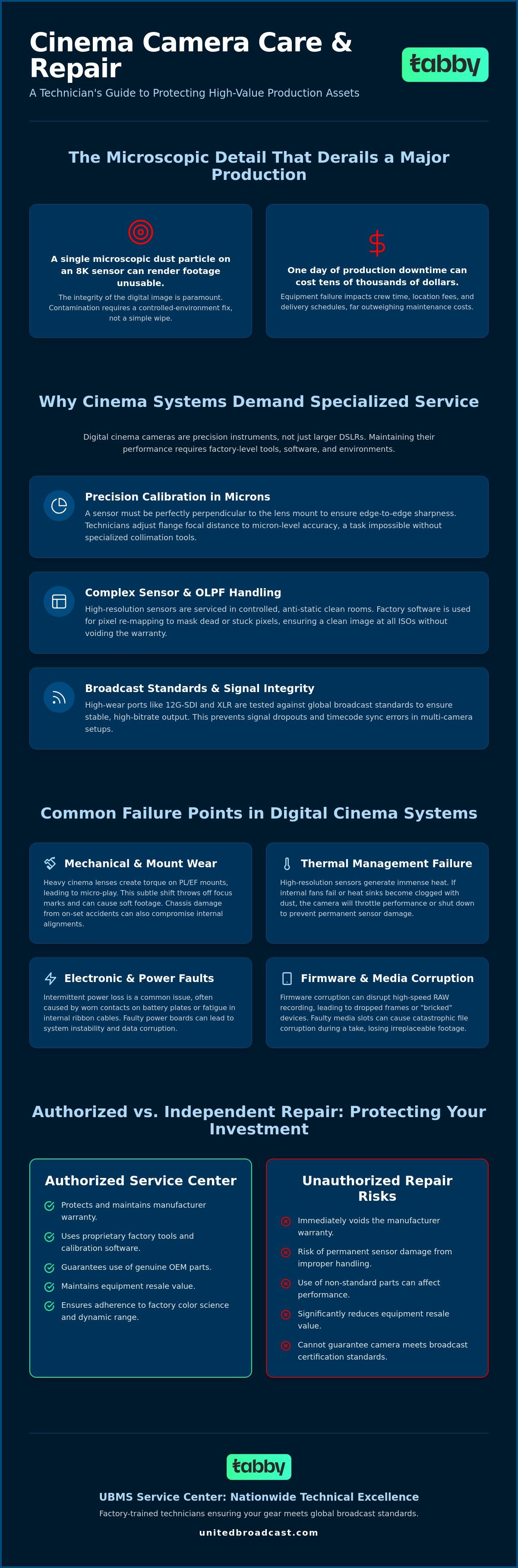
A single microscopic particle on an 8K sensor can render a high-budget production unusable. For professional cinematographers, the stakes of equipment failure go beyond simple repair costs; they involve the integrity of the digital image and the reliability of the entire production workflow. When your gear malfunctions, finding a qualified cinema camera repair service becomes a race against tight delivery schedules. You need more than just a quick fix. You require a technical partner that understands the precision required for high-end digital cinema cameras and the risks of improper sensor handling.
It's natural to worry about long turnaround times or the danger of voiding manufacturer warranties with unauthorized work. This guide details the rigorous technical standards and factory-calibration protocols necessary to maintain professional gear. You'll discover the most common failure points in modern cameras and learn preventive strategies to extend your equipment's lifespan in harsh climates. We'll examine how specialized technical support ensures your cameras return to the field with restored precision and guaranteed reliability.
Key Takeaways
- Understand why digital cinema systems require specialized calibration to maintain factory-level color science and dynamic range.
- Identify common mechanical and thermal failure points, including lens mount wear and internal heat dissipation issues.
- Learn why choosing an authorized cinema camera repair service is critical for protecting your manufacturer warranty and equipment resale value.
- Gain practical strategies for protecting internal circuitry and sensors from the extreme heat and fine particulate ingress common in harsh production environments.
- Explore how professional diagnostic facilities and factory-trained technicians ensure your gear meets global broadcast standards.
Why Professional Cinema Camera Repair Service Requires Specialized Expertise
Digital cinema cameras are not merely larger versions of consumer mirrorless systems. They are sophisticated workstations designed to handle the rigorous demands of digital cinema technology, which involves massive data throughput and precise optical alignments. While a standard photography shop might handle basic mechanical issues, a dedicated cinema camera repair service is essential for maintaining the delicate balance of color science and dynamic range that defines high-end production. These systems utilize specialized hardware, such as global shutters and active cooling arrays, that require specific diagnostic tools and factory-level software to service correctly.
Precision calibration is the foundation of professional imaging. If a sensor isn't perfectly perpendicular to the lens mount, the resulting footage will suffer from uneven sharpness across the frame. This level of accuracy is measured in microns. For owners of professional video cameras, the financial impact of equipment failure during a shoot far outweighs the cost of routine maintenance. A single day of production downtime can cost tens of thousands of dollars in lost crew time and location fees. Professional service ensures that every component, from the PL-mount's flange focal distance to the internal thermal management system, operates within factory specifications.
The Complexity of Modern Cinema Sensors
Modern 8K sensors are incredibly sensitive to environmental contaminants and physical shifts. Professional cleaning and repair don't happen on a standard workbench; they require controlled environments to prevent dust from becoming trapped behind the optical low-pass filter. Beyond physical cleanliness, technicians must use authorized software for sensor re-mapping. This process identifies and masks dead or stuck pixels that naturally occur over time, ensuring the image remains clean across all ISO ratings. Improper handling during this stage can lead to permanent sensor damage or a voided warranty.
Broadcast Standards and Signal Integrity
Cinema cameras rely on high-speed data interfaces like 12G-SDI and XLR for critical signal routing. These ports are high-wear items that frequently require component-level expertise to repair. Maintaining signal integrity is vital for multi-camera environments where timecode sync accuracy is non-negotiable. Our technicians test these interfaces against global broadcast standards to ensure that high-bitrate outputs remain stable. We also verify the integrity of internal recording media slots, as any fluctuation in power or data transfer can lead to catastrophic file corruption during a take. Reliability is the only acceptable outcome for professional gear.
Common Failure Points in Digital Cinema Systems
Professional cinema cameras operate under extreme conditions, from high-speed data processing to heavy physical loads. Identifying these issues early allows a cinema camera repair service to intervene before a minor glitch becomes a total system failure. Most failures stem from the constant stress of the production environment, where mechanical wear and thermal limitations eventually collide. Even the most robust systems from global broadcast brands aren't immune to the cumulative effects of heat, dust, and physical torque.
Mechanical wear is most evident on PL and EF lens mounts. These components support heavy cinema glass, and over time, the constant torque and frequent lens changes can cause the mount to shift. Thermal management is another critical area. High-resolution sensors generate immense heat, requiring active cooling systems. If an internal fan fails or a heat sink becomes clogged with dust, the camera will throttle performance or shut down entirely to prevent permanent sensor damage. Electronic faults often manifest in power boards or battery plate connectivity. Intermittent power loss is a frequent complaint, often caused by worn contacts or internal ribbon cable fatigue. Additionally, firmware corruption can disrupt high-speed RAW recording, leading to dropped frames. Establishing good can help you identify these issues before they ruin a shoot.
Mechanical and Physical Damage
Micro-play in a lens mount is a subtle but destructive issue. Even a fraction of a millimeter of movement can throw off a focus puller’s marks, resulting in soft footage. While magnesium alloy chassis components are rugged, they aren't invincible. On-set accidents can lead to structural compromises that aren't always visible. Ignoring minor cracks in weather sealing is a common mistake. These openings allow moisture and fine dust to reach internal circuitry, leading to corrosion that is much more expensive to fix than a simple body repair.
Internal Electronic and Software Stability
Diagnosing intermittent power cycles or "ghost" errors requires specialized diagnostic software. These problems are often linked to the synergy between firmware and hardware. While updates provide new features, they can also expose underlying hardware weaknesses. Write-speed failures in CFexpress or SSD slots are another major concern. If the interface can't maintain the data rates required for 8K RAW, the recording will fail. If your system exhibits these symptoms, it’s best to consult our technical team for a full diagnostic review.
Authorized vs. Independent Repair: Making the Right Choice
When a high-value asset like a digital cinema camera requires service, the choice of facility determines its future performance and market value. Opting for an authorized cinema camera repair service ensures that your equipment remains within the manufacturer's ecosystem. This decision isn't just about technical skill; it's about protecting a significant financial investment. Using a certified cinema camera repair service provides a verified paper trail that is essential for insurance compliance and future equipment sales.
Authorized centers use genuine manufacturer parts, which is critical for maintaining resale value. In the used market, buyers often demand service records from certified facilities to ensure no "grey market" components were used. Using third-party components can lead to unexpected failures and significantly lower the asset's worth. Furthermore, authorized service centers have access to proprietary diagnostic software that independent shops simply don't possess. This software allows for deeper system interrogation and precise calibration that meets factory standards. Crucially, authorized repairs protect your existing manufacturer warranty. An unauthorized repair attempt usually voids this protection immediately, leaving you liable for all future costs.
The Risks of Non-Genuine Components
Third-party circuit boards often lack the precise thermal management profiles required by high-end sensors. They may draw more power than the system is designed to handle, leading to overheating or intermittent shutdowns. Even non-standard glass filters can alter the specific color science of your Professional Video Cameras, ruining the consistency of your footage. Factory-spec internal wiring is equally vital for maintaining the high-speed data transfer rates needed for modern RAW recording. Using anything less than genuine parts risks the stability of the entire system.
Technical Accountability and Certification
A reputable service center should proudly display its brand certifications. These aren't just plaques; they represent ongoing training and direct lines of support to the manufacturers. Always insist on receiving a detailed technical report post-repair. This document should outline the diagnostics performed, parts replaced, and the final calibration results. This level of transparency provides the technical accountability required by production insurance providers, who often necessitate that high-value cinema assets be maintained only by certified experts. It ensures that your gear is not just fixed, but restored to its original factory state.
Preventive Maintenance for Harsh Environmental Conditions
Professional productions in the Middle East face environmental challenges that can quickly degrade high-end imaging systems. High ambient temperatures don't just make the crew uncomfortable; they directly impact sensor performance. When internal temperatures rise, thermal noise increases, muddying the shadows of your 8K footage and reducing overall dynamic range. Maintaining the efficiency of internal cooling arrays is the first line of defense. If your fans are struggling or the heat sinks are coated in fine dust, the camera's processor may throttle performance, leading to unexpected recording failures during critical takes.
Fine sand and particulate ingress are constant threats in desert environments. These microscopic grains act as abrasives on moving parts and can eventually find their way onto internal circuit boards. Humidity is equally dangerous. In coastal regions, high moisture levels lead to the oxidation of SDI and XLR ports, causing intermittent signal loss that is difficult to diagnose in the field. Establishing a daily post-shoot routine is vital. Crews should use compressed air to clear external vents and wipe down all contact points with approved cleaning agents to prevent salt and mineral buildup. Engaging a professional cinema camera repair service for seasonal deep cleans ensures these particulates haven't bypassed internal gaskets.
Sensor Care and Cleaning Protocols
There's a significant difference between a field clean and a professional wet clean. While a blower bulb can remove loose dust on set, oily residue or persistent spots require specialized solvents and a controlled environment. You can learn more about why this matters in our guide on The Importance of Regular Camera Sensor Cleaning. In humid climates, keep an eye out for fungal growth in the optical path. These microscopic filaments can etch into the coating of your sensor's glass or internal lens elements, causing permanent damage that requires expensive component replacement.
Environmental Protection Strategies
Acclimatising your gear is a critical step often overlooked by busy crews. Moving a cold camera from an air-conditioned vehicle directly into 40-degree heat causes immediate condensation on internal electronics. This "thermal shock" can short-circuit delicate boards. Always allow the equipment to reach ambient temperature inside its case before powering on. Use specialized weather covers and keep internal desiccants in your flight cases to manage moisture. Regularly check fan filters and cooling vents for blockages. If you notice your camera's fan running louder than usual or frequent overheating warnings, it's time to book a preventive maintenance session with our technical team to avoid a total system failure on your next shoot.
UBMS Service Center: Nationwide Technical Excellence
Since 1997, United Broadcast & Media Solutions has served as a foundational technical pillar for the regional media landscape. Our facility isn't just a workshop; it's a state-of-the-art diagnostic hub designed to meet the rigorous requirements of global broadcast brands. Choosing a professional cinema camera repair service means trusting technicians who understand the high stakes of your production. We've invested in the specialized infrastructure necessary to handle everything from sensor recalibration to complex electronic board repairs. Our team consists of factory-trained experts who possess a deep understanding of the internal architectures of modern digital cinema cameras.
Our expertise isn't limited to the camera body alone. We provide comprehensive support for Cinema Lenses, ensuring that your entire optical path meets factory standards for sharpness and alignment. This holistic approach to equipment health allows us to offer integrated solutions. We understand how your camera interacts with Professional Lighting systems and external recorders. By maintaining the entire capture chain, we ensure that every piece of gear in your kit performs with the reliability required for high-end cinematography and broadcast environments.
Our Technical Workflow
Precision begins with a detailed initial diagnostic. We use a transparent estimation process that outlines exactly what your equipment needs before any work commences. Our technicians utilize calibrated optical charts and electronic diagnostic tools to interrogate system logs and hardware performance. Every repair concludes with a rigorous quality assurance phase. We test the camera against original factory specifications to confirm that dynamic range, color accuracy, and data throughput are fully restored. This methodical approach eliminates the guesswork and ensures your gear is ready for the field.
Long-term Support and Integration
We extend our technical services beyond individual repairs to support entire facilities. This includes maintaining advanced Broadcast Studio Gear for major networks and production houses. For rental companies and large studios, we offer custom maintenance contracts that provide scheduled inspections to prevent equipment failure before it happens. Our expertise also includes on-site technical support for complex system integrations. Whether you're building a new studio or upgrading an existing cinema workflow, we provide the technical infrastructure to keep your operations running at peak capacity.
Secure Your Production Workflow with Expert Maintenance
Maintaining professional cinema gear requires a proactive approach that balances daily field care with factory-spec technical intervention. By identifying common failure points early and implementing rigorous environmental protection strategies, you protect both your digital image and your equipment's resale value. Relying on an authorized cinema camera repair service ensures that every calibration meets global broadcast standards while keeping your manufacturer warranties intact. It's the most effective way to guarantee that your workstation performs exactly as the manufacturer intended.
As an authorized distributor for leading global brands, UBMS maintains a comprehensive inventory of genuine spare parts and proprietary diagnostic tools. Our in-house technical experts bring decades of experience to every service, ensuring your gear is restored to peak capacity. Don't let technical glitches or environmental wear delay your production schedule. Contact the UBMS Service Center for Professional Technical Support to schedule your next diagnostic session and ensure your gear is ready for the field's highest demands.
Frequently Asked Questions
How long does a professional cinema camera repair usually take?
Turnaround times typically range between 7 and 14 business days, depending on part availability and the complexity of the technical issue. If specialized components must be imported from global manufacturers, the timeline might extend. We recommend requesting an initial diagnostic to receive an accurate estimate based on your specific equipment needs and production schedule.
Will a third-party repair void my cinema camera’s manufacturer warranty?
Most manufacturers will void your warranty if an unauthorized third party opens the camera chassis or attempts a technical repair. Using an authorized cinema camera repair service ensures that your equipment remains within the manufacturer’s support ecosystem. This protection is vital for maintaining the long-term value and reliability of high-end digital cinema systems.
What are the signs that my camera sensor needs professional cleaning?
Persistent dark spots that appear in the same position across different lenses, especially when shooting at higher f-stops, indicate that your sensor requires professional cleaning. You might also notice smearing or reduced contrast in high-key areas of the frame. Because 8K sensors are extremely sensitive, you should avoid aggressive field cleaning and seek a controlled environment to prevent permanent scratching.
Is it possible to repair damaged SDI or HDMI ports on a cinema body?
Damaged SDI and HDMI ports are common failure points that can typically be repaired through component-level soldering or full interface board replacement. These ports endure significant physical stress from heavy-duty cabling on set. Professional technicians will test the signal integrity after the repair to ensure the output meets high-bitrate broadcast standards without signal dropouts.
How often should a cinema camera undergo preventive maintenance?
High-end gear should undergo a comprehensive preventive maintenance check every six to twelve months, depending on the intensity of your production schedule. If you've recently completed a shoot in a desert or coastal environment, an immediate service is recommended. Regular checks help identify fan blockages and internal particulate buildup before they cause a catastrophic thermal failure.
Do you provide a warranty on the parts and labor for camera repairs?
We provide a standard warranty on both the genuine spare parts installed and the technical labor performed during the repair process. This ensures that your equipment is returned to service with the same confidence you'd expect from a factory-new unit. Specific warranty durations may vary based on the manufacturer’s policies and the nature of the component replaced.
Can firmware issues be fixed through a service center if the camera won’t boot?
Service centers can resolve firmware corruption and "bricked" states even if the camera fails to boot through the standard user interface. Technicians use proprietary hardware interfaces to bypass the primary operating system and re-flash the internal memory. This process is often necessary after a failed update or a sudden power loss during a high-speed RAW recording session.
Is it worth repairing an older digital cinema camera model?
A repair is generally considered viable if the total cost is less than 50% to 60% of the camera's current market value. For older digital cinema cameras, you must also consider if the model still meets the technical requirements for modern workflows. If the hardware is functionally obsolete, investing in a newer system might be more economical in the long term.


