

The Professional Guide to Prime Lenses for Cinema in Dubai (2026)
With leading media production facilities across the United Arab Emirates hitting high utilization rates in the first quarter of 2026, the pressure to deliver world-class visuals in the nation has reached an all-time high. You're likely aware that selecting the right prime lenses for the UAE's cinema industry isn't just about the aperture or the mount. It's a high-stakes investment where environmental factors like extreme heat and fine dust can compromise even the most expensive optics. Managing the 5% VAT on imports and the subtle character differences between legendary brands requires more than just a basic spec sheet, a challenge United Broadcast & Media Solutions (UBMS) is uniquely positioned to help you navigate.
This guide provides the technical clarity you need to master these nuances, helping you elevate your cinematography while ensuring your gear survives the local landscape. We'll explore how to identify a lens set that matches your specific artistic vision, evaluate the long-term ROI of primes versus zooms, and address the critical technical support required to protect your glass. By the end of this article, you'll have a clear roadmap for building a kit that meets the high-quality expectations of the nation's rapidly expanding media market.
Key Takeaways
- Understand why fixed focal length optics provide the superior image quality and creative depth required for high-end UAE productions.
- Master technical specifications like T-stops and lens breathing to select the most reliable prime lenses cinema Dubai professionals use for exposure accuracy.
- Learn how to safeguard your glass against regional environmental risks, including fine desert dust and high humidity that can lead to internal fungus.
- Distinguish between the clinical precision of the "ZEISS look" and the organic warmth of the "Cooke look" to match your lens choice with your project's aesthetic.
- Discover a strategic framework for evaluating lens sets based on sensor size and budget, emphasizing the necessity of technical consultations before finalizing your investment.
The Role of Prime Lenses in Modern Cinema Production
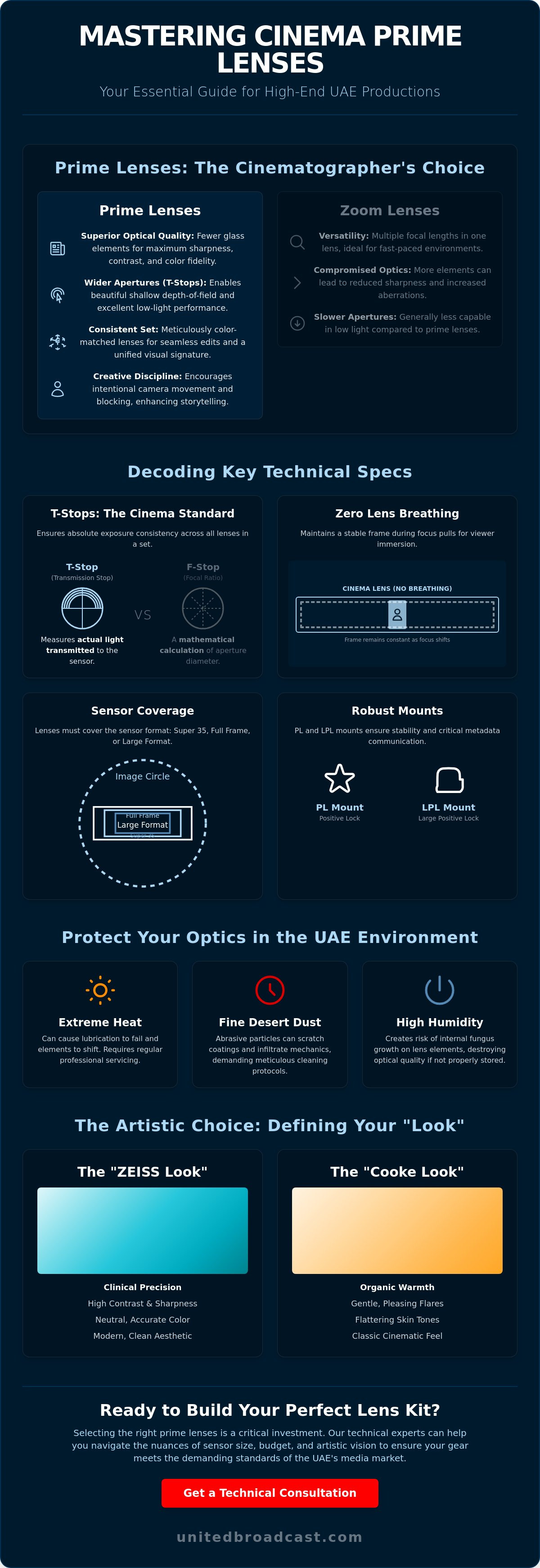
Prime lenses are the foundational tools of high-end acquisition. In the competitive media environment of the UAE, achieving a truly cinematic aesthetic starts with these fixed focal length optics. Unlike zoom lenses, which prioritize versatility and speed, cinema lenses with a fixed focal length are engineered for maximum optical performance. They offer a level of clarity, character, and specialized texture that variable lenses struggle to replicate. For directors of photography, the choice to use primes is often a commitment to a specific visual signature that defines the entire production.
Exposure accuracy is a non-negotiable requirement for professional sets. Prime lenses utilize T-stops (Transmission stops) rather than the F-stops found on photography glass. This measurement accounts for the light lost as it passes through the lens elements, ensuring that a T2.0 on a 35mm lens delivers the exact same amount of light to the sensor as a T2.0 on an 85mm. This consistency is vital when shooting in the high-contrast environments of Dubai, where lighting conditions can shift rapidly. Furthermore, the wide apertures typical of primes provide the shallow depth-of-field necessary to isolate subjects against the complex architectural backgrounds of the city.
The UAE professional market has largely standardized on PL (Positive Lock) and LPL (Large Positive Lock) mounts. These robust interfaces provide the mechanical stability required for heavy cinema glass and ensure precise metadata communication between the lens and digital cinema cameras. This technical synergy is essential for modern workflows, especially when integrating visual effects or complex camera tracking.
Optical Superiority and Image Consistency
Prime lenses generally contain fewer internal glass elements than their zoom counterparts. This simplified optical path reduces light scattering and internal reflections, resulting in higher contrast and biting sharpness. When you invest in a full set of prime lenses cinema Dubai projects benefit from meticulous color matching. Every lens in a high-end series is tuned to produce identical skin tones and color temperatures. This uniformity saves significant time in the color grading suite. You'll also notice a marked reduction in chromatic aberration and spherical distortion, even when shooting at the widest apertures under intense studio lighting or the midday sun.
The Creative Discipline of Fixed Focal Lengths
Working with fixed focal lengths encourages a specific creative discipline on set. Because the focal length is locked, the camera must be physically moved to adjust the frame. This engagement with the physical space leads to more intentional blocking and dynamic camera movement. Specific focal lengths also carry distinct psychological weight. A 24mm wide-angle can create a sense of vastness or environmental immersion, while an 85mm telephoto compresses space for intimate, emotional close-ups. Using a consistent set of primes ensures that your visual storytelling remains cohesive, as the audience becomes accustomed to the specific perspective and "feel" of the chosen glass throughout the narrative.
Key Technical Specifications for High-End Cinema Optics
Precision defines the professional workflow. When selecting prime lenses cinema Dubai specialists prioritize technical consistency to ensure that every shot in a sequence matches perfectly. The most critical distinction in this field is the move from F-stops to T-stops. While an F-stop is a mathematical ratio of the focal length to the aperture diameter, a T-stop measures the actual light transmission reaching the sensor. This accounts for light lost through the glass elements. For a cinematographer, this means a T2.0 setting will provide identical exposure across every lens in a set, a necessity for the high-contrast lighting often found in UAE desert exteriors.
Lens breathing is another technical hurdle that cinema primes are designed to solve. In standard photography glass, the frame slightly zooms in or out when the focus is adjusted. Cinema-grade optics minimize this "breathing," keeping the background stable during a focus rack. This stability is vital for maintaining the audience's immersion. Additionally, modern sensors require specific coverage. While Super 35 remains a workhorse format, the trend in 2026 has shifted heavily toward Full Frame and Large Format sensors. Ensuring your lens set covers these larger imaging circles prevents vignetting and maintains corner-to-corner sharpness on cameras like the ARRI Alexa 65 or Sony VENICE 2.
Workflow efficiency on set depends on mechanical uniformity. High-end prime sets feature consistent gear positioning for the focus and iris rings. This allows an assistant camera (AC) to swap lenses without repositioning follow-focus motors or matte boxes. It's a small detail that saves hours over a multi-day shoot. Professionals seeking to build a future-proof kit can explore the latest cinema lenses at our Dubai showroom to experience these mechanical advantages firsthand.
Understanding Mounts and Metadata
The choice of mount dictates the physical and electronic connection to the camera. The PL mount remains the global standard for its rugged, positive-lock mechanism. However, the LPL mount is increasingly common for Large Format systems due to its wider diameter and shorter flange focal distance. Beyond the physical connection, electronic metadata plays a massive role in post-production. Systems like Cooke /i Technology or ARRI LDS-2 record focal length, T-stop, and focus distance directly into the RAW files. This data is indispensable for visual effects teams in Dubai who need to match CG elements with the physical lens characteristics used during principal photography.
Prime Lenses vs. Cinema Zooms: A Technical Comparison
Choosing between a prime set and a high-end zoom involves balancing speed against optical perfection. While a zoom lens offers convenience, a prime lens almost always delivers a wider maximum aperture and a lighter physical profile. This makes primes non-negotiable for gimbal work or tight interior shots where space and weight are restricted. The Dubai Film and TV Commission often facilitates shoots in diverse locations where a compact, fast prime set allows for more agile movement than a heavy zoom setup.
| Feature | Cinema Prime Lenses | Cinema Zoom Lenses |
|---|---|---|
| Average Weight | 0.8kg - 1.6kg | 2.5kg - 5.5kg |
| Maximum Aperture | Fast (T1.3 - T2.1) | Moderate (T2.8 - T4.5) |
| Lens Breathing | Highly Corrected | Variable by Model |
| Optical Complexity | Fewer Elements (Higher Contrast) | Multiple Elements (Lower Contrast) |
Overcoming Environmental Challenges for Optics in the UAE
Operating high-end cinema glass in the Middle East requires a specialized approach to equipment care. While the aesthetic results of using prime lenses cinema Dubai are unparalleled, the regional climate presents two primary threats: fine particulate dust and extreme humidity. Desert sand is composed largely of silica, which is highly abrasive. If these particles find their way into the helical threads of a lens or between moving elements, they can cause permanent mechanical damage. Similarly, the rapid transition from air-conditioned interiors to the humid outdoor air of a coastal set can cause condensation to form inside the lens barrel.
This moisture is particularly dangerous as it can lead to the growth of lens fungus, which eventually eats through internal optical coatings. Optical precision maintenance is a mandatory practice for UAE owners who wish to protect the resale value and functional integrity of their cinema kit. Unlike standard photography lenses, cinema primes are complex mechanical instruments that require a sterile environment for deep cleaning. Relying on a dedicated service center for precision lens calibration ensures that your optics perform to manufacturer specifications despite the environmental stress.
Field Protection and Handling Procedures
Maintaining the "prime look" begins with rigorous on-set protocols. You shouldn't change lenses in an open, windy environment where dust can enter the camera mount. Instead, perform swaps inside a vehicle or under a dedicated changing bag. When shooting near the dunes, use high-quality optical flats or clear protection filters to shield the front element from pitting caused by wind-blown sand. For storage, avoid leaving lens cases in hot vehicles. Use climate-controlled dry cabinets or heavy-duty cases with fresh desiccant packs to keep internal humidity levels below 40%. These simple steps prevent the most common causes of optical degradation in the region.
Professional Calibration and Maintenance Services
Regular technical check-ups are essential for professional reliability. Extreme temperature fluctuations in the UAE can cause the metal components of a lens to expand and contract, potentially shifting the flange focal distance. If this back focus is off by even a fraction of a millimeter, your focus marks will no longer be accurate. A local authorized service center can perform these critical adjustments using specialized projectors and collimators. This level of professional care is also necessary to maintain manufacturer warranties. By integrating a post-production maintenance check into your standard workflow, you ensure that your investment remains a dependable asset for years to come.
Evaluating the Best Prime Lenses for Cinema in Dubai
Choosing a lens set is a decision that shapes the emotional resonance of your film. While technical specs like T-stops are foundational, the subjective "look" of a lens brand is what truly defines the image. In the UAE's high-end commercial and narrative sectors, the choice often comes down to the distinct optical philosophies of legendary manufacturers. When you invest in prime lenses cinema Dubai, you're choosing a specific color science and texture that will persist through your entire body of work.
The "ZEISS Look" is synonymous with clinical precision and modern contrast. These lenses are engineered to be incredibly sharp from corner to corner with minimal distortion. This makes them a preferred choice for the sleek, architectural cinematography often required for Dubai's corporate and real estate sectors. Conversely, the "Cooke Look" is prized for its organic warmth and smooth skin tones. Cooke lenses feature a gentle "fall-off" in sharpness toward the edges, providing a more painterly, human feel that's highly sought after for character-driven narratives.
The market is also seeing a surge in high-performance glass from emerging brands. Optics from NiSi and Sirui offer a compelling entry point for independent filmmakers, delivering impressive resolution and housing quality. For those aiming for a truly epic scale, anamorphic primes provide the classic widescreen aesthetic, characterized by oval bokeh and horizontal blue flares. These specialized tools are becoming increasingly popular for national-scale productions seeking a "Hollywood" feel.
Top-Tier Industry Standards: ARRI, ZEISS, and Cooke
ARRI Signature Primes represent the pinnacle of large-format cinematography. They offer a natural, immersive look with incredibly soft bokeh and skin tones that feel authentic. For mid-to-high level productions, the ZEISS CP.3 series provides exceptional versatility. These lenses are compact enough for drone or gimbal work while maintaining the professional metadata capabilities discussed in previous sections. For narrative projects, the Cooke S7/i and Panchro/i Classic remain staples. They provide that legendary "Cooke Look" across modern full-frame sensors, ensuring your production has a timeless, high-production-value aesthetic.
Emerging Optics and Specialty Glass
The rise of Chinese cinema glass has changed the ROI calculation for many local studios. Brands like NiSi Athena offer a performance-to-price ratio that was previously unavailable, making high-quality prime sets more accessible. Another growing trend in the UAE is vintage glass rehousing. By placing older, character-rich optics into modern cinema housings, cinematographers can achieve a unique, textured look that stands out from the "perfect" digital image. Whether you choose the horizontal compression of anamorphic glass or the clarity of spherical primes, your choice should align with the project's visual goals. You can view our extensive collection of professional cinema lenses to find the perfect match for your next project.
Selecting the Right Optics for Your Next National Production
Finalizing your lens kit for a major UAE production requires balancing technical requirements with fiscal responsibility. Whether you're shooting a high-budget commercial in Downtown Dubai or a narrative feature in the Northern Emirates, the selection process must prioritize your camera's sensor size and the project's specific visual language. While a Super 35 sensor might pair perfectly with vintage-inspired glass, a modern Large Format sensor requires optics with a wider imaging circle to avoid vignetting. Because the cost of professional glass is significant, we always recommend a "test before you invest" approach. Technical consultations allow you to see how specific prime lenses cinema Dubai professionals favor actually perform on your specific camera body.
United Broadcast & Media Solutions (UBMS) serves as the national hub for this critical decision-making process. We provide more than just equipment; we offer a comprehensive ecosystem that includes procurement, system integration, and dedicated after-sales support. Our team understands that a lens isn't a standalone purchase. It's part of a complex rig that includes follow-focus motors, matte boxes, and wireless transmitters. We invite you to visit our Dubai showroom for a hands-on technical demo, where you can evaluate different lens sets side-by-side under controlled conditions.
Procurement and System Integration
Successful integration means ensuring your optics communicate perfectly with your camera's brain. Our engineers help you match lenses to specific camera bodies from ARRI, Sony, or RED, ensuring that metadata systems like Cooke /i Technology or ARRI LDS function seamlessly. Buying from a national distributor with a physical service presence in the UAE provides a layer of security that international vendors can't match. If a lens requires calibration or a firmware update, our local service center handles the repairs, minimizing downtime for your production. We value long-term technical partnerships over one-off transactions, supporting your gear through every stage of its operational life.
Conclusion: Investing in Future-Proof Glass
Camera bodies are frequently updated, but high-quality prime lenses often outlast multiple sensor cycles. They're a stable asset that retains value, provided they're maintained correctly in our regional climate. Before finalizing your purchase, use a checklist to confirm compatibility: verify the mount (PL vs LPL), check the gear pitch for follow-focus compatibility, and ensure the front diameter matches your existing matte box rings. This diligence ensures your kit remains functional for years to come. To see the latest industry-standard optics in person, you can explore our full range of professional cinema lenses and speak with our technical specialists today.
Mastering Your Cinematic Vision in the UAE
Selecting the right optics is a definitive step in establishing your production's visual signature. Whether you prioritize the clinical sharpness of ZEISS or the organic warmth of Cooke, your choice of prime lenses cinema Dubai remains a long-term investment that frequently outlives multiple camera sensor cycles. Protecting this investment requires a proactive approach to maintenance, especially when managing the regional challenges of fine desert dust and high humidity. Since 1997, United Broadcast & Media Solutions has supported the local media landscape as a trusted technical partner. As an authorized distributor for industry leaders like ARRI, ZEISS, Cooke, and Sony, we ensure your gear meets global standards. Our dedicated in-house Service Center provides the precision calibration and repairs necessary to keep your optics performing flawlessly in the field. We're here to help you move forward with the tools and support your creative vision demands.
Browse the Latest Cinema Prime Lens Collections at UBMS
Frequently Asked Questions
What is the difference between a prime lens and a zoom lens for cinema?
A prime lens has a fixed focal length, while a zoom lens allows for variable focal lengths within a single housing. For cinema, primes are typically optimized for higher optical performance, offering wider apertures and more consistent image quality. While zooms offer speed and convenience for documentary work, primes are the preferred choice for achieving the specific "prime look" and artistic character required for high-end narrative cinematography.
Why are cinema prime lenses significantly more expensive than photo lenses?
Cinema prime lenses are engineered with extreme mechanical precision to meet the demands of professional sets. Unlike still photography lenses, they feature calibrated T-stop scales for exposure accuracy and consistent gear positioning for follow-focus systems. The manufacturing process involves higher-quality glass elements and robust housings designed to withstand rigorous daily use. This complexity ensures that every lens in a set matches perfectly in color, contrast, and performance.
Do I need Full Frame or Super 35 prime lenses for my cinema camera?
You should choose lenses that cover your camera's specific sensor area to avoid vignetting. Full Frame prime lenses cinema Dubai professionals use will cover both Full Frame and Super 35 sensors, making them a more future-proof investment. However, dedicated Super 35 lenses are often smaller and lighter, which can be an advantage for specific handheld or drone rigs. Always check the imaging circle against your sensor's diagonal measurements before investing.
What is lens breathing and why does it matter in cinematography?
Lens breathing is the slight change in focal length that occurs when you adjust the focus. In cinematography, this creates a distracting "zooming" effect during a focus rack, which can pull the audience out of the story. High-end cinema primes are specifically designed to minimize this phenomenon, keeping the frame stable so the focus remains on the subject. This correction is a primary reason why professionals invest in dedicated cinema glass over photography optics.
How do I protect my cinema lenses from the humidity and dust in the UAE?
Protecting optics in the UAE climate requires a combination of physical barriers and climate-controlled storage. Use high-quality optical flats to shield front elements from abrasive desert sand during outdoor shoots. For storage, invest in a dry cabinet to keep humidity levels below 40%, preventing the growth of internal fungus. Regular professional maintenance is also necessary to remove fine particulates that may have bypassed external seals during lens changes in the field.
What is a PL mount and why is it the industry standard for cinema?
The PL (Positive Lock) mount is the industry standard because of its exceptional mechanical strength and stability. It uses a flanged locking ring to secure the lens, ensuring there is no play or movement between the lens and the camera body. This precision is vital for maintaining an accurate flange focal distance and reliable focus marks. It also provides a robust interface for electronic metadata communication between the lens and the camera system.
Can I use anamorphic prime lenses on a standard 16:9 sensor?
Yes, you can use anamorphic prime lenses on a 16:9 sensor, but it requires specific considerations. Anamorphic glass "squeezes" a wider image onto the sensor, which must be "de-squeezed" in post-production. While this works on 16:9, a 4:3 or "Open Gate" sensor mode is ideal to utilize more of the anamorphic character. On a standard 16:9 sensor, you'll likely end up with a very wide aspect ratio that may require some vertical cropping.
Where can I get professional cinema lens calibration and repair in the UAE?
Professional cinema lens calibration and repair are available at the United Broadcast & Media Solutions Service Center in Dubai. Our facility, established in 1997, is equipped with specialized collimators and projectors required for precise back-focus adjustments and internal cleaning. As an authorized partner for major brands, we provide manufacturer-standard support to ensure your optics remain in peak condition. Regular servicing at a local facility is the most effective way to maintain your equipment longevity.


