

Choosing the Right Lens for a Cinematic Look: The Professional 2026 Guide
What if the most cinematic lens for your next project isn't the one with the highest resolution, but the one with the most intentional flaws? When you are choosing the right lens for cinematic look in 2026, the decision requires a strategic balance between mechanical precision and optical texture. You likely understand that a high-end image is about more than just pixel count. It is about how the glass handles light, flare, and depth.
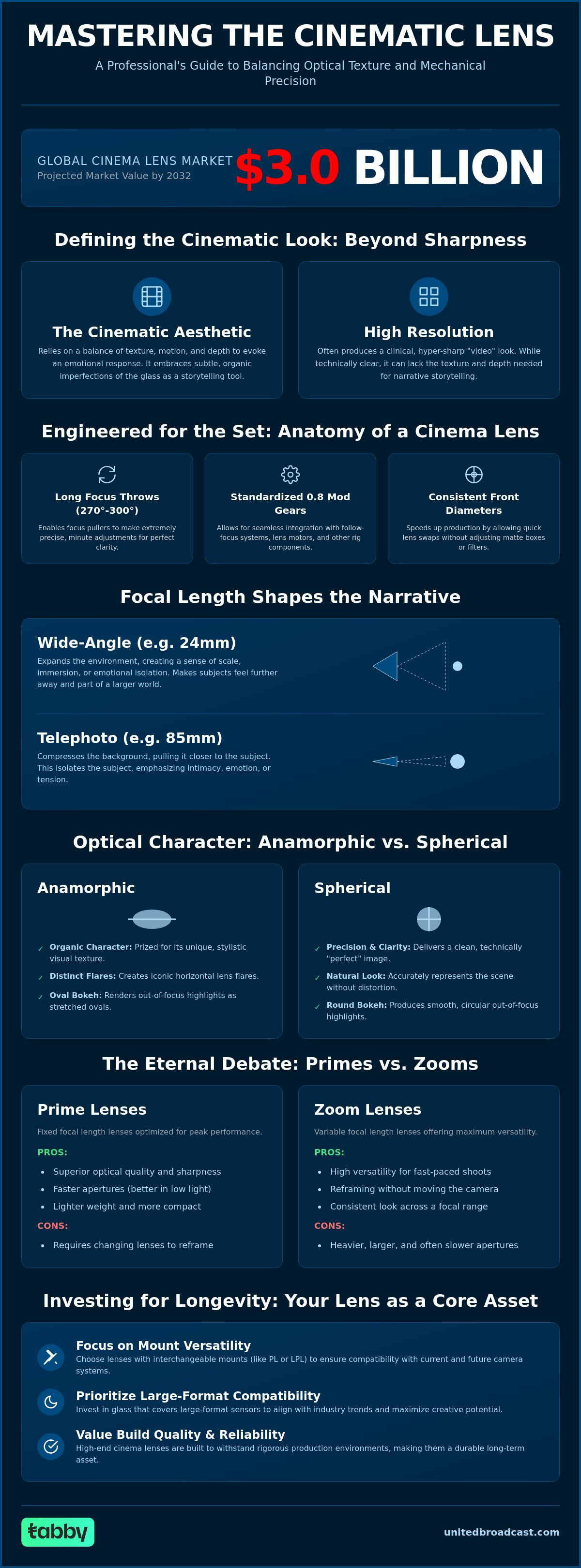
Many professionals feel the pressure of technical uncertainty when upgrading their kit. You might struggle with the practical differences between T-stops and F-stops or question the long-term ROI of investing in a prime set versus a versatile zoom. With the global cinema lens market projected to reach 3.0 billion dollars by 2032, the options are expanding rapidly. This guide will help you master these nuances to elevate your storytelling and make informed equipment choices. We will explore how to match lenses with large-format sensors and evaluate the latest innovations, such as the internal motors found in the new ZEISS Horizon anamorphic series, to ensure your kit remains a professional asset for years to come.
Key Takeaways
- Learn why a cinematic aesthetic relies on a combination of texture and motion rather than high resolution, which can often appear too clinical for narrative storytelling.
- Develop a technical framework for choosing the right lens for cinematic look by understanding how T-stops and specific focal lengths manipulate the viewer's emotional connection to the scene.
- Evaluate the operational benefits of cinema-grade housing, such as the elimination of lens breathing and the strategic trade-offs between prime sets and high-performance zoom optics.
- Distinguish between the organic character of anamorphic glass and the precision of spherical lenses to select the appropriate visual texture for your project's sensor format.
- Protect your production capital by investing in lenses as long-term assets, focusing on mount versatility and compatibility with modern large-format digital cinema cameras.
Defining the Cinematic Look: Beyond Resolution and Sharpness
Defining the cinematic look requires moving past the industry obsession with resolution. For most professionals, "cinematic" describes a specific marriage of depth, texture, and motion that evokes an emotional response rather than just a clear image. High resolution alone often produces a clinical, "video-like" aesthetic that captures every pore and digital artifact with harsh clarity. In contrast, filmic images rely on the subtle imperfections of glass to create a sense of reality. Choosing the right lens for cinematic look involves selecting a tool that prioritizes these organic qualities over raw sharpness.
Lens character serves as a deliberate storytelling device. A lens isn't just a window to the sensor; it is a filter that determines how light is shaped and how shadows are rendered. Professional cinema lenses are engineered to provide consistent results across a range of environments, offering a distinct "look" that remains stable regardless of lighting conditions. While a standard photography lens might prioritize compact size and autofocus speed, a cinema lens focuses on mechanical repeatability and aesthetic consistency across an entire set of glass.
The Role of Micro-Contrast and Texture
Micro-contrast refers to the ability of a lens to resolve fine detail within the midtones and shadows without increasing overall global contrast. This is why professional glass renders skin tones with a natural, healthy appearance while consumer lenses might make them look muddy or artificially sharp. Lens texture is the delicate balance between high-frequency sharpness and the smoothness of the highlight roll-off. This texture gives the image its perceived depth, making subjects pop from the background without looking like they were digitally sharpened in post-production.
Mechanical Reliability and Ergonomics
Precision on a professional set depends on the mechanical build of the equipment. Investing in high-grade housing is a fundamental part of choosing the right lens for cinematic look because it guarantees that the aesthetic remains consistent throughout a long production day. Cinema lenses feature standardized 0.8 mod gears on the focus, iris, and zoom rings, allowing for seamless integration with follow-focus systems and wireless motors.
- Consistent Front Diameters: Most professional sets share a common front diameter, such as 95mm or 114mm. This ensures that matte boxes and filters don't need to be swapped or adjusted between lens changes.
- Long Focus Throws: A focus throw of 270 to 300 degrees allows a focus puller to make minute adjustments with extreme accuracy.
- Repeatable Accuracy: Unlike photo lenses that use "fly-by-wire" focusing, cinema optics use physical linkages to ensure that a focus mark on the barrel always corresponds to the same distance.
Technical Specifications: How Focal Length and Aperture Shape the Narrative
Focal length is more than a measurement of field of view. It's a fundamental storytelling tool that dictates the psychological distance between the audience and the subject. When choosing the right lens for cinematic look, you must consider how different focal lengths manipulate space. Wide-angle lenses, such as a 14mm or 24mm, expand the environment and can create a sense of immersion or isolation. Conversely, telephoto lenses like an 85mm or 135mm compress the background, pulling it closer to the subject to emphasize emotional intimacy or tension. This spatial relationship is further influenced by your choice of professional video cameras and their sensor formats.
Sensor size fundamentally changes how you utilize focal length. A 50mm lens on a Super 35 sensor provides a tighter field of view compared to its performance on a large-format or full-frame sensor. With the industry move toward larger sensors, many cinematographers are reaching for wider glass to maintain traditional framing while benefiting from the shallower depth of field that large-format cinematography offers. Lens speed also plays a critical role here. A fast lens with a wide maximum aperture allows for superior performance in low-light environments and gives you precise control over the "bokeh" or the aesthetic quality of the out-of-focus areas.
Focal Length and Spatial Compression
Wide-angle lenses are excellent for establishing shots, but they can introduce unflattering distortion in close-up portraits. Telephoto glass is often preferred for character-driven scenes because it flattens features and separates the subject from the background. Understanding these optical properties is essential for maintaining visual consistency. For a deeper dive into these mechanics, resources like this guide on Camera Lenses Explained offer excellent visual breakdowns of how different optics affect the frame. Matching your focal length to the genre is key; for example, gritty dramas often favor the intimacy of long lenses, while epic adventures rely on the scale provided by wider glass.
Understanding T-Stops for Consistent Exposure
While photographers use F-stops to describe the physical opening of the iris, cinematographers rely on T-stops. An F-stop is a mathematical ratio of the focal length to the diameter of the entrance pupil, but it doesn't account for light lost as it travels through the glass elements. Cinema lenses are calibrated in T-stops to represent actual light transmission. T-stops ensure exposure remains identical when swapping lenses, which is vital for maintaining a consistent look across a multi-camera production. This technical precision prevents exposure shifts that can complicate the color grading process. If you need assistance selecting a matched set for your next production, our team can help you find the right technical solution for your specific workflow.
Prime vs. Zoom Lenses: Evaluating Versatility against Optical Excellence
The debate between prime and zoom optics is no longer just about image quality. Modern manufacturing has closed the gap significantly. Choosing the right lens for cinematic look now depends on your production environment and the specific "texture" you wish to achieve. Prime lenses are celebrated for their optical excellence and wider maximum apertures, which offer a shallower depth of field. However, zoom lenses have become increasingly sophisticated. Industry data suggests that zoom lenses will account for over 40% of the total cinema lens market share by late 2026, reflecting their growing role in high-end production.
One of the most critical distinctions between cinema glass and photography glass is "lens breathing." This phenomenon occurs when the field of view shifts slightly as you adjust focus. It's distracting for an audience and breaks the cinematic illusion. High-end cinema lenses are engineered to minimize breathing, ensuring that the frame remains stable during complex focus pulls. While a single high-end zoom can replace three or four primes, it often comes with a larger footprint and increased weight. For handheld or gimbal work, a compact prime kit remains the professional standard for maintaining a low-profile rig.
The Case for Cinema Primes
Primes offer a level of visual discipline that helps maintain a consistent aesthetic throughout a project. Because they have fewer glass elements than zooms, they generally provide superior micro-contrast and flare control. These lenses are often the first choice for narrative work where "speed"—the ability to shoot at a low T-stop—is required for low-light scenes. For those transitioning into high-end production, exploring Sony Alpha cameras and lenses provides an accessible gateway into a world of professional-grade optics that balance performance with modern sensor requirements.
Modern Cinema Zooms in Professional Workflows
In fast-paced environments like documentaries or live broadcasts, the versatility of a zoom lens is indispensable. A true cinema zoom must be parfocal, meaning it maintains perfect focus throughout the entire zoom range. This allows for dynamic "snap zooms" or subtle framing adjustments without the need to refocus. Modern coatings and optical designs now allow high-end zooms to match the color and contrast of prime sets, making them easier to cut together in post-production. These versatile tools are particularly effective when paired with professional video cameras, as they allow operators to adapt to unfolding action without the downtime of frequent lens swaps.
- Optical Purity: Primes typically offer less distortion and higher light transmission.
- Production Speed: Zooms reduce the time spent on lens changes and matte box re-configurations.
- Weight Distribution: A prime set allows for better balance on smaller gimbal systems.
- Consistent Image: Cinema zooms are designed to match the "look" of their prime counterparts within the same lens family.
Aesthetic Character: Navigating the Nuances of Anamorphic and Spherical Glass
The visual soul of a project is often determined by the fundamental geometry of the glass. Choosing the right lens for cinematic look requires a clear understanding of the trade-off between the precision of spherical optics and the stylized character of anamorphic lenses. Spherical lenses are the baseline of the industry. They produce a "clean" image with minimal distortion, circular bokeh, and consistent sharpness across the frame. While spherical glass is technically superior in terms of geometric accuracy, many cinematographers prefer the "organic" flaws inherent in anamorphic designs to create a more immersive, filmic atmosphere.
Anamorphic lenses utilize a squeeze factor, typically 2x, 1.5x, or 1.33x, to compress a wider field of view onto the sensor. This allows filmmakers to use more of the sensor's vertical resolution while achieving a widescreen aspect ratio. On modern digital sensors, this transition is technical. A 2x squeeze was ideal for 4:3 film gates, but for 16:9 or 3:2 digital sensors, a 1.33x or 1.5x squeeze often provides a better balance of character without requiring extreme cropping in post-production. This squeeze creates the iconic oval bokeh and horizontal lens flares that have defined big-budget cinema for decades.
Character is also shaped by lens coatings. Modern optics often feature advanced multi-coatings to eliminate flare and maximize contrast. However, the 2026 trend toward "vintage" aesthetics has seen a resurgence in lenses with simpler coatings. These lenses allow for controlled veiling glare and unique highlight roll-offs, adding a layer of texture that digital sensors often lack. While these "imperfections" are desirable, they require a skilled operator to manage, as anamorphic lenses are generally heavier and have more restrictive minimum focus distances than their spherical counterparts.
Anamorphic Lenses and the Widescreen Tradition
The anamorphic look is inseparable from the history of epic storytelling. Beyond the oval bokeh, these lenses offer a shallower perceived depth of field for a given field of view, which helps separate characters from their environments. Brands like Cooke are famous for the "Cooke Look," characterized by a warm, "creamy" rendering of skin tones, while ARRI anamorphic sets often lean toward a more controlled, modern aesthetic. Using these tools requires dedicated de-squeezing hardware in your monitors to ensure the crew sees the corrected image in real-time.
Spherical Lenses: The Modern Industry Standard
Spherical lenses remain the standard for high-speed photography and VFX-heavy productions because they lack the complex distortions of anamorphic glass. The ARRI Master series, for example, represents the pinnacle of optical perfection, offering near-zero chromatic aberration. To prevent these lenses from looking too clinical, cinematographers often use ARRI lighting to introduce high-contrast ratios and shape the "texture" of the scene in-camera. This combination provides a versatile foundation that can be easily manipulated in color grading.
Selecting the right aesthetic for your narrative is a complex decision that impacts every stage of production. If you are ready to compare these optical styles in person, you can speak with our technical consultants to find the perfect match for your sensor and story.
Strategic Acquisition: Investing in High-End Cinema Lenses for Long-Term Production
Choosing the right lens for cinematic look is a capital investment that often outlasts the camera body it is mounted on. While digital cinema cameras see major technological shifts every few years, high-quality optics remain relevant for decades. Sensors age. Glass endures. A well-maintained set of primes can retain a significant portion of its value over ten years, whereas camera bodies often depreciate rapidly as newer sensor technologies emerge. This makes the acquisition of cinema glass one of the most stable financial decisions a production house can make.
Mount versatility is essential for future-proofing your investment. Standardizing on PL or LPL mounts ensures compatibility with high-end professional systems, while interchangeable mount systems allow for adaptation to EF or E-mount cameras when needed. In regions with extreme climates, environmental factors play a critical role in lens longevity. Fine dust and high humidity can penetrate internal housings, leading to haze or mechanical friction. Choosing lenses with robust environmental sealing is a strategic necessity for maintaining optical clarity in harsh conditions. Professional calibration is also required to ensure that a lens set matches perfectly in color and contrast, preventing costly mismatches during post-production.
Building a Balanced Lens Kit
For those starting a professional kit, a "holy trinity" of focal lengths—typically a 25mm, 50mm, and 85mm—provides enough range to cover the majority of narrative needs. Purchasing a matched set is superior to buying individual lenses from different manufacturers because it ensures consistent color rendering and iris performance. Consistency is the hallmark of a professional workflow. To keep these assets in peak condition, especially when shooting in sandy or humid environments, refer to our comprehensive guide on cinema lens repair Dubai for essential maintenance protocols.
Professional Support and Maintenance
Precision optics require factory-authorized service centers for any internal adjustments. Even a slight misalignment in the lens flange can cause focus marks to be inaccurate, which is unacceptable on a professional set. Regular sensor cleaning and flange depth checks ensure that your equipment performs at its theoretical limit. Beyond technical specs, the best way to finalize your decision in choosing the right lens for cinematic look is through physical testing. We invite you to visit the UBMS showroom for hands-on evaluation of the latest cinema lenses to see how different glass handles light and texture before you commit to an investment.
Elevating Your Visual Narrative with Professional Optics
Mastering the art of choosing the right lens for cinematic look is a continuous process of balancing technical precision with creative intent. You now understand that a filmic image is built on more than just resolution. It relies on the deliberate use of lens character, spatial compression, and the unique geometry of anamorphic or spherical glass. These tools allow you to shape light and texture in ways that digital sensors can't replicate on their own. Since high-end glass serves as a primary production asset for decades, your choice of equipment represents a significant long-term investment in your craft.
With over 25 years of expertise in Middle Eastern broadcast solutions, United Broadcast & Media Solutions is your dedicated technical partner. As an authorized distributor for industry leaders like Sony, ARRI, and ZEISS, we provide the tools and the logistical support necessary for high-stakes production. Our in-house service center ensures your optics remain perfectly calibrated for peak performance. If you're ready to refine your kit or require technical guidance on specific cinema lens sets, please contact our expert team today. We look forward to supporting your next cinematic vision.
Frequently Asked Questions
What is the difference between a cinema lens and a photography lens?
Cinema lenses prioritize mechanical repeatability and optical consistency, whereas photography lenses focus on autofocus speed and portability. Cinema glass features standardized 0.8 mod gears for follow-focus systems and de-clicked iris rings for smooth exposure transitions. These features are essential when choosing the right lens for cinematic look because they allow for precise, repeatable control during a take. Photo lenses often use "fly-by-wire" focus, which lacks the tactile accuracy required for professional cinematography.
Why are cinema lenses so much more expensive than standard lenses?
The high cost reflects specialized manufacturing, premium glass elements, and robust mechanical housings designed to last decades. Cinema lenses are produced in much lower volumes than consumer photo lenses, requiring higher margins to cover research and development. Each lens undergoes rigorous calibration to ensure it matches the color and contrast of other lenses in the set. This precision prevents exposure shifts and color mismatches that would otherwise complicate the post-production workflow.
What does 'lens breathing' mean and why does it matter in cinematography?
Lens breathing is an optical phenomenon where the field of view shifts slightly as the focus is adjusted. It matters because it creates a distracting "pulsing" effect that can draw the audience's attention away from the story. Professional cinema lenses are engineered with complex internal linkages to minimize this effect. This ensures that the frame remains stable during a focus pull, maintaining the professional polish expected in high-end narrative productions.
Can I use a Full Frame cinema lens on a Super 35 sensor camera?
You can absolutely use a Full Frame cinema lens on a Super 35 sensor camera. The larger image circle of the Full Frame lens will more than cover the smaller sensor, often utilizing the sharpest "sweet spot" at the center of the glass. While the effective field of view will be narrower due to the crop factor, this is a common practice that allows filmmakers to future-proof their lens investments as they transition between different camera systems.
What is a PL mount and why is it the industry standard for cinema?
The PL (Positive Lock) mount is the industry standard because it provides a secure, flange-based connection that eliminates any rotational play. Unlike consumer bayonet mounts, the PL mount uses a locking ring to press the lens firmly against the camera body. This stability is critical when using heavy cinema glass or wireless focus motors that exert significant torque. It ensures that the flange focal distance remains perfectly consistent for accurate focus marks.
Do I need an anamorphic lens to get a 2.39:1 aspect ratio?
You don't strictly need an anamorphic lens to achieve a 2.39:1 aspect ratio, as you can crop spherical footage in post-production. However, choosing the right lens for cinematic look often involves anamorphic glass for its unique aesthetic qualities rather than just the frame shape. Anamorphic optics provide oval bokeh and horizontal flares that cropping cannot replicate. They also utilize more of the sensor's vertical surface area, resulting in a more detailed widescreen image.
How often should professional cinema lenses be serviced or calibrated?
Professional cinema lenses should undergo a full technical evaluation at an authorized service center at least once a year. If you're working in harsh environments like the desert, more frequent cleaning and flange depth checks are necessary. Regular maintenance prevents the buildup of internal dust and ensures that the mechanical gears remain smooth. Precision calibration is vital to keep focus scales accurate and ensure the glass elements haven't shifted during transport.
What is the benefit of a parfocal lens for video production?
A parfocal lens stays in focus throughout its entire zoom range, which is a critical requirement for professional video production. This allows an operator to zoom in to check focus and then zoom out to the desired focal length without losing sharpness. In live broadcast or documentary settings, parfocal designs enable dynamic framing changes during a take. This mechanical reliability prevents the need for constant refocusing, ensuring that the action is always captured with clinical precision.


