

Calculating ROI on Professional Camera Equipment: A Practical Guide
Could a professional camera that looks costly on paper deliver a better return than a cheaper option? The answer depends on more than purchase price. When calculating ROI on professional camera equipment, projected use, attributable project contribution, operating costs, maintenance, and useful life all affect the result. A technically impressive system can still be a poor investment if it doesn’t meet production needs or spend enough time in use.
It’s reasonable to want a clear financial case before committing to equipment. This guide sets out a repeatable ROI formula and explains how to estimate its inputs without treating uncertain bookings or revenue as guaranteed. You’ll compare ownership with using existing equipment or renting for selected productions, applying consistent assumptions to each scenario. You’ll also consider how cameras, lenses, lighting, and other parts of a production system work together, so the decision reflects both business goals and practical requirements. The aim is a grounded assessment of the value an investment may deliver over its working life.
Key Takeaways
- Calculating ROI on professional camera equipment starts with a defined evaluation period and a full list of investment costs and expected benefits.
- Separate direct project contribution from productivity, reliability, production capability, and client-service gains.
- Compare existing gear, a new purchase, and rental for selected productions using consistent assumptions for cost, utilization, and time period.
- Test estimates with input from production, finance, and technical teams, and account for uncertainty rather than treating projections as guarantees.
- Use ROI alongside production requirements to plan camera capabilities, workflow integration, maintenance, and technical support.
Why calculate ROI on professional camera equipment before investing?
A camera’s purchase cost is only one part of its business impact. A system that sits idle or cannot meet a production’s requirements may offer less value than a lower-cost setup used consistently across suitable projects. Calculating ROI on professional camera equipment helps you assess whether its expected benefits justify the total investment over a defined period.
That return may include direct project contribution from work the equipment enables, but financial contribution isn’t the only relevant outcome. A camera system can also support a faster workflow, reliable delivery, new production capabilities, or stronger client service. These operational benefits matter, but describe them clearly rather than assigning a monetary value without evidence. The Return on Investment (ROI) concept offers a useful foundation: compare an investment’s benefits with its costs, then interpret the result in context.
Utilization and project fit shape that context. A system suited to recurring work may contribute value across many productions. Equipment for occasional specialist requirements may be used less often but still be important to delivery. Neither purchase cost nor technical specifications alone can settle the decision. Consider what the equipment enables, how often the team expects to use it, and how well it fits the broader workflow.
- Direct project contribution: Track the contribution from projects the equipment enables or supports, after relevant production costs.
- Productivity: Record specific workflow changes, such as fewer setup steps or fewer compatibility issues.
- Capability and reliability: Identify production requirements the system can meet and operational risks it may address.
- Client service: Note how the equipment supports delivery requirements and consistent production quality.
What does camera equipment ROI measure?
Camera equipment ROI compares the net financial benefit generated by a defined camera system over a chosen period with the total cost of that investment. Set the evaluation period first, then specify what the system includes, such as the camera body, lenses, and support equipment being assessed. Separate documented cash benefits from operational gains you can describe but cannot reliably price.
Which production goals can an ROI calculation support?
Start with the planned project types, expected workload, and delivery requirements. For example, a team producing recurring studio interviews may value a consistent camera setup that fits its established workflow, while a team taking on varied productions may prioritize adaptable capability. These goals can guide equipment selection and capacity planning. Treat time savings or service improvements as qualitative benefits unless internal records support a defensible financial estimate.
ROI remains an estimate, not a promise. Project volume, utilization, maintenance needs, and future production requirements can differ from forecasts. Make assumptions explicit, use realistic evidence where available, and review the calculation as workload changes. The result is a more useful basis for investment decisions, not a guarantee of financial performance.
How to calculate ROI on professional camera equipment
Choose one evaluation period and define the system scope before entering figures. The period might match your budgeting cycle or the equipment’s planned working life, but use the same timeframe for every cost and benefit. Include only benefits and expenses attributable to the camera investment. This makes the calculation useful for comparing options without mixing short-term project income with long-term ownership costs.
Camera equipment ROI is the percentage return over a stated period, calculated by subtracting total investment from attributable net benefits, then dividing by total investment and multiplying by 100.
ROI = (net benefit − total investment) ÷ total investment × 100
Here, net benefit means the cumulative financial contribution attributable to the system after relevant operating expenses, but before subtracting the initial investment in the formula. Use project contribution rather than gross revenue: deduct costs such as crew, transport, or other production expenses when they’re part of earning that revenue. Include productivity gains only when records support a defensible financial estimate. Don’t count the same saving as both a reduced cost and added income.
Which costs belong in total investment?
Set the system boundary first. Include the camera body and components required for the intended workflow, such as compatible lenses, support equipment, storage, or monitoring where applicable. Add attributable onboarding or training, maintenance, repairs, and other ownership expenses expected during the evaluation period. Keep the treatment consistent across scenarios, and don’t include equipment outside the defined scope simply because it’s used on the same productions.
Choose one approach for residual value. You can include a supportable end-of-period resale estimate as a final benefit, or subtract it from total investment to calculate a net cost. Don’t do both. If the value is uncertain, show the result without it or test it separately as an assumption.
How should you estimate benefits and payback?
Estimate income from projects the system enables or supports, then use attributable project contribution rather than booking value alone. Tie each estimate to a stated utilization assumption, such as expected project days or workload over the chosen period. For non-cash benefits, record the operational improvement separately unless business records support a credible monetary value.
Payback is a separate measure: it’s the time required for cumulative attributable benefits to recover the investment. Map benefits by month, quarter, or project, and identify when the running total reaches the initial outlay. ROI summarizes return across the full period; payback shows how soon recovery may occur. Both depend on estimates, so test a conservative utilization case alongside your central forecast.
For a workflow-specific equipment-planning discussion, visit the UBMS contact page.
Compare camera investment scenarios without overlooking hidden trade-offs
Assess a camera purchase against practical alternatives, not in isolation. Compare keeping and using existing equipment, acquiring a new system, and renting equipment for selected productions. Use the same evaluation period, cost categories, utilization assumptions, and method for estimating attributable benefits in each case. For a fair comparison, measure each option against the same production need, such as delivering a planned workload that current equipment cannot support.
The table below is a framework, not a forecast. Populate it with your own project records, ownership estimates, and rental quotes. For each scenario, calculate ROI using the method already defined, based on benefits and costs attributable to that option. Don’t treat all project revenue as a camera benefit if the work could have been completed another way.
| Scenario | Assumptions and benefits | Ownership or use costs | Risks to assess | Estimated ROI |
|---|---|---|---|---|
| Use existing equipment | Expected workload the current system can handle; note any documented efficiency or capability limits. | Incremental maintenance, repairs, and workflow costs during the period. | Downtime, compatibility gaps, or work the setup cannot support. | Calculate from incremental benefits and costs versus the current baseline. |
| Acquire new equipment | Realistic project use and attributable contribution; separate confirmed work from potential demand. | Acquisition, required components, onboarding, maintenance, repairs, and other scoped ownership costs. | Underuse, integration needs, downtime, and uncertain residual value. | Calculate from attributable benefits and total investment over the shared period. |
| Rent for selected productions | Specific production dates and requirements the existing system cannot meet. | Rental charges and directly related logistics or preparation costs. | Schedule constraints, repeated use, and coordination requirements. | Compare the incremental project contribution with rental-related costs. |
How does utilization change the investment case?
Run low, expected, and high utilization cases using the same calculation method. Base the expected case on confirmed bookings and documented production patterns. Use the low case to account for idle periods or seasonal slowdowns, and keep speculative projects in the high case rather than treating them as secured demand. This makes the effect of usage visible without presenting an optimistic forecast as a certainty.
How do lifecycle and workflow factors affect the result?
Check whether the camera works with existing lenses, media, power, monitoring, and crew workflows. A new body may require additional components or retraining, while a compatible system may fit more readily into established production. Include maintenance, repairs, downtime, and any planned replacement consistently across scenarios. Treat resale value as an estimate, not guaranteed income, and show how ROI changes if that estimate is excluded.
Consistent assumptions make calculating ROI on professional camera equipment a more useful decision tool. They reveal whether an apparent advantage comes from genuine production value, higher utilization, or costs left out of the comparison.
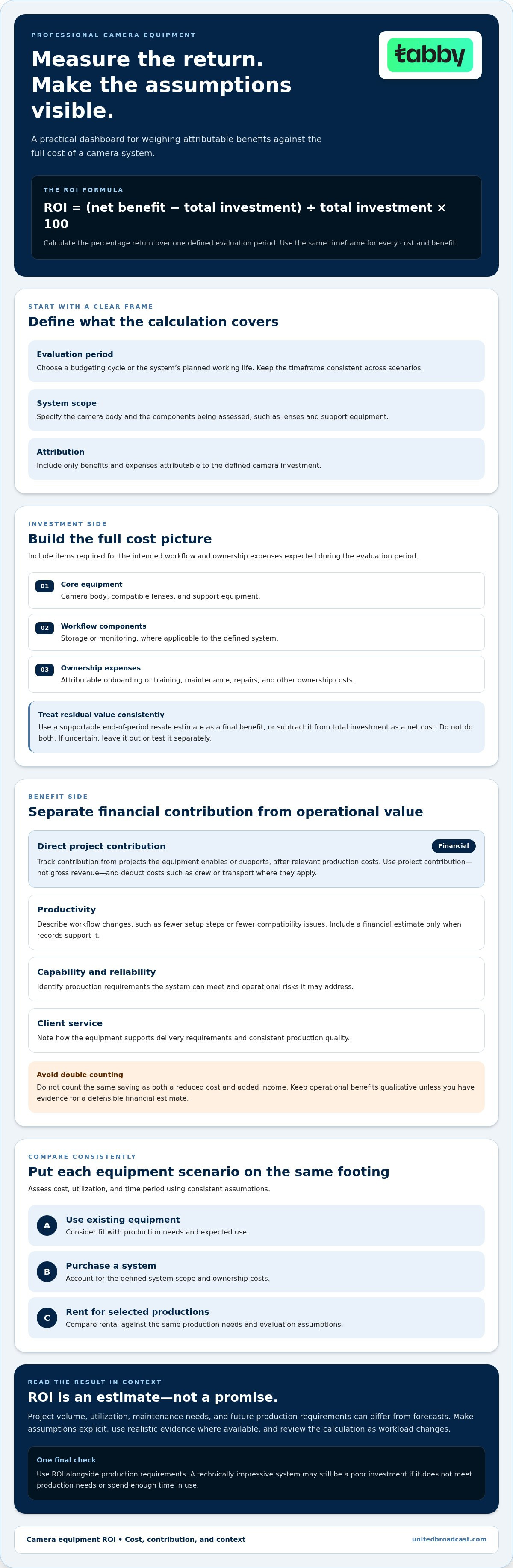
A practical checklist for testing your camera ROI assumptions
A repeatable review makes calculating ROI on professional camera equipment more useful than relying on a single optimistic forecast. Gather the inputs, label their sources, and have the relevant teams challenge the assumptions before treating the result as a basis for investment.
What information should you collect before calculating?
Define the equipment scope and assessment period, then connect the proposed system to the productions it is expected to support. Use internal records where possible, and mark each benefit as documented, estimated, or speculative. That distinction helps prevent uncertain demand from carrying the same weight as booked work.
- Scope: List the camera body and required lenses, media, monitoring, power, or other components included in the analysis.
- Production plan: Identify intended project types, delivery requirements, expected usage, and known idle or seasonal periods.
- Costs: Gather acquisition and attributable lifecycle expenses from organizational records, including maintenance, repairs, training, and workflow changes.
- Benefits: Note project contribution, capacity changes, or operational improvements, with the evidence source and confidence level for each.
- Baseline: Record what existing equipment can already deliver, so the analysis focuses on incremental value rather than assigning all project income to the new system.
Production teams can validate project fit, workload, and delivery assumptions. Finance can review cost definitions and confirm that revenue is treated as contribution rather than gross billing. Technical staff can assess compatibility, integration needs, maintenance expectations, and potential downtime. Reviewing the professional video camera range can help frame the equipment scope against production requirements.
How can you reduce uncertainty in the final decision?
Recalculate with lower utilization and higher operating costs before relying on the expected case. For example, reduce projected project use to reflect quieter periods, then test whether additional service or repair needs materially change the result. Keep the same assessment period and cost definitions across each version.
Identify the assumptions that move ROI most. If the result depends heavily on future bookings, utilization deserves closer review. If lifecycle costs drive the change, revisit maintenance and downtime estimates. Record why each assumption was chosen and who validated it. A conservative scenario won’t predict the future, but it shows whether the investment still supports production goals when conditions are less favorable.
Turn camera ROI analysis into a supported equipment plan
An ROI result can guide a purchase, but it doesn’t specify the right camera system on its own. Translate the analysis into a plan that connects project requirements with camera capabilities, compatible components, workflow integration, and lifecycle support. A strong plan explains not only why equipment may be a sound investment, but how it will function across the production environment.
What should an equipment plan include beyond the ROI percentage?
Document the work the system needs to support, the expected utilization, and the assumptions behind the calculation. Then map those needs to the complete workflow, including lenses, media, power, monitoring, crew practices, and any connections with existing broadcast or studio systems. Identify integration, training, maintenance, and repair requirements that may affect operational readiness. Explore professional video cameras as part of this requirements-led equipment review.
Use the ROI percentage as one decision input, not a substitute for technical assessment. A camera that appears financially attractive may still require workflow changes or additional components. Conversely, support, maintenance, and system integration can clarify how an investment fits into a broader production system and its ongoing operating needs. United Broadcast & Media Solutions supplies professional cameras and provides system integration, service-center repairs, and technical support for professional media equipment.
When should you revisit the ROI calculation?
Review the model when project mix, workload, utilization, or delivery requirements change. Compare the original assumptions with actual equipment use, attributable project benefits, maintenance, repairs, and downtime. If the camera supports different work than expected, update the scope and benefit assumptions rather than relying on the original forecast. This keeps the calculation relevant to real operating conditions and can inform future equipment decisions.
Use the review to decide whether the system still meets production needs, whether integration or maintenance planning should change, and which assumptions need refinement. Calculating ROI on professional camera equipment is most useful when it informs both the initial decision and ongoing equipment planning, without treating projected returns as guaranteed.
Make your next camera investment with a clear plan
Calculating ROI on professional camera equipment helps turn an equipment decision into a practical business case. Set a consistent evaluation period, include the costs of the complete system, and compare realistic usage scenarios. Then weigh the result alongside production requirements, workflow compatibility, and lifecycle support. ROI is a planning tool, not a promise of future returns.
United Broadcast & Media Solutions supports professional media businesses through equipment sales, broadcast system integration, and service-center repairs and technical support. Bring those operational considerations into your equipment plan, not just the camera’s headline capabilities.
A well-grounded plan can help you choose equipment that fits both your productions and your business goals. Move forward with clear assumptions and a decision process that accounts for costs, usage, and technical fit.
Frequently Asked Questions
How do you calculate ROI on professional camera equipment?
Calculate ROI by comparing attributable financial benefits with the full investment over a defined assessment period. Include relevant acquisition and lifecycle costs, then apply: ROI = (net benefit − total investment) ÷ total investment × 100. State how you estimated each input and avoid counting a single saving or benefit more than once. Calculate payback separately, since it measures how long cumulative benefits take to recover the investment.
What costs should be included in a camera equipment ROI calculation?
Include the equipment within your defined investment scope, plus directly required accessories and relevant ownership costs. Depending on the system and period, these may include servicing, repairs, training, and attributable operational expenses. Use documented figures from your organization and keep the timeframe consistent. If you include an estimated resale value, label it clearly and test the result without it. Exclude unrelated production expenses unless they’re directly attributable to the camera investment.
How do you estimate the revenue a professional camera will generate?
Start with projects or production work the equipment enables or supports, then estimate the financial contribution reasonably attributable to it. Use historical workload, confirmed plans, and internal records where available. Don’t assign the camera the full revenue from a project that also depends on staff, other equipment, and production costs. Document your method and assumptions so finance, production, and technical decision-makers can understand and review the estimate.
Is rental income the only way to measure camera equipment ROI?
No. Rental income can be one direct return for equipment owners who rent gear, but production teams can assess attributable project contribution and operational value instead. Workflow efficiency, reliability, or expanded capability may also matter. Keep these qualitative benefits separate from financial returns unless internal evidence supports a defensible monetary estimate. Avoid counting the same improvement more than once, such as recording a time saving as both reduced cost and added project income.
How does equipment utilization affect camera ROI?
Utilization affects how often the camera system supports valuable or revenue-generating work during the assessment period. Low use can extend payback, while consistent productive use can improve the projected result. Base estimates on realistic workload and project schedules, not best-case expectations. Test conservative, expected, and higher-use scenarios, and state how idle periods or seasonal changes affect each one. Separate confirmed projects from speculative future demand.
How often should a business recalculate camera equipment ROI?
Revisit the calculation when workload, equipment use, maintenance needs, or production requirements change materially. Compare actual utilization, costs, and attributable benefits with the assumptions in the original model. A periodic review can show whether the system is meeting its intended role or whether the investment case has shifted. Keep earlier versions of the calculation so decision-makers can track which assumptions changed and understand how those changes affected the result.
Should resale value be included when calculating camera ROI?
Resale value can be included if the analysis covers a defined ownership period and uses a clearly identified estimate. Treat it as uncertain, not guaranteed future income. Explain the basis for the estimate and include relevant selling or transition costs when reliable figures are available. Then recalculate without resale value. Comparing both results shows how much the investment case depends on an uncertain end-of-life assumption.
What is the difference between camera ROI and payback period?
ROI describes the relationship between an investment’s net benefit and total cost over a defined period, often as a percentage. Payback period estimates how long cumulative benefits take to recover the investment. They answer different questions: ROI indicates the overall return across the assessment period, while payback focuses on recovery timing. Present both when useful, and state the period, cost scope, utilization, and benefit assumptions behind each measure.


