

Best Lenses for Documentary Filmmaking: 2026 Guide
What if the weight of your lens kit is the single biggest obstacle to capturing an award-winning story? In professional production, your equipment must provide optical agility, which is the precise balance between cinematic aesthetics and the functional speed of broadcast engineering. You already know that heavy gear leads to physical fatigue and that slow lens changes often mean missing an unrepeatable moment. Selecting the best lenses for documentary filmmaking is not just about image quality; it's about reliability in uncontrolled environments where you don't get a second take.
This 2026 guide will help you discover the essential cinema lenses and optical strategies required to capture authentic, high-impact stories in any location. We'll examine how to build a versatile kit that balances weight with professional performance and explain the long-term ROI of investing in high-tier cinema glass. You'll also learn about the importance of specialized technical support and precision maintenance to ensure your optics survive the rigors of our national climate. From fast primes to versatile zooms, we're providing the technical roadmap to elevate your documentary workflow and protect your investment.
Key Takeaways
- Learn why a fast T-stop and functional versatility are the primary criteria for selecting professional documentary optics in uncontrolled lighting.
- Compare the visual signature of prime sets against the operational speed of zooms to identify the best lenses for documentary filmmaking based on your narrative style.
- Discover how cine-servo lenses optimize solo operator workflows by combining broadcast ergonomics with high-end cinema glass for run-and-gun shoots.
- Apply the "Wide-Mid-Tight" framework to build a balanced lens kit that covers everything from expansive context to intimate human observation.
- Understand the critical role of professional servicing in protecting your precision optical investment from regional challenges like heat, humidity, and dust.
What Defines a Documentary Lens? Key Criteria for Success
A documentary lens is a specialized hybrid tool. It must provide a cinematic aesthetic while maintaining the extreme functional versatility required for unscripted environments. When you search for the best lenses for documentary filmmaking, you aren't just looking for sharp glass; you're looking for a mechanical partner that won't fail when the sun goes down or the dust starts blowing. In 2026, the standard for these optics involves a rigorous balance of light transmission, ergonomic stability, and environmental resilience.
Optical Performance vs. Practical Utility
For filmmakers looking to test these high-performance tools on their next project, you can visit Junction Rentals to explore their extensive inventory of professional cinema lenses and camera kits.
In narrative cinema, you have the luxury of multiple takes. In documentary, you often have one. This reality forces a difficult choice between character-driven vintage glass and modern clinical precision. While older lenses offer a unique "look," they often lack the mechanical reliability of modern cinema glass. For high-stakes observational filming, certain features are essential:
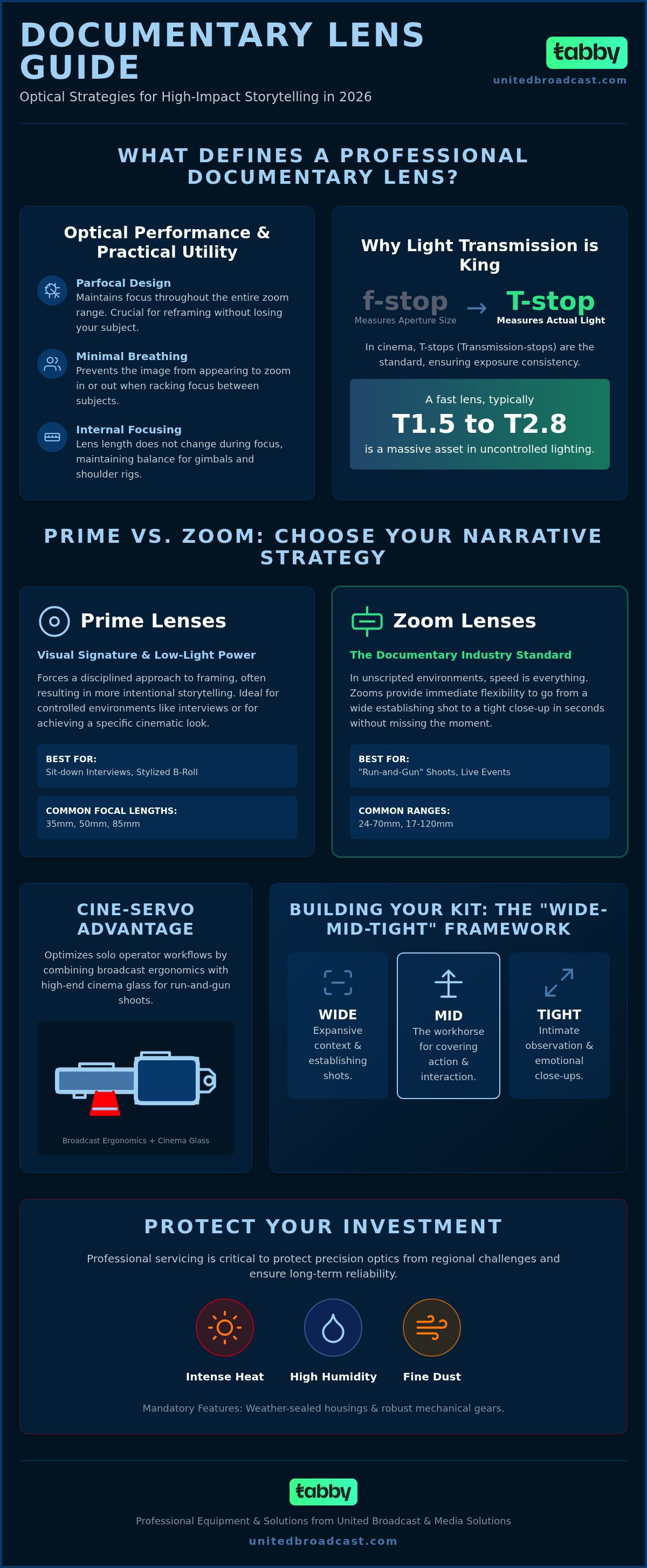
- Parfocal Design: This ensures the lens maintains focus throughout the entire zoom range, allowing you to find your frame without losing the subject.
- Minimal Breathing: High-quality glass prevents the focal length from shifting when you rack focus between subjects.
- Internal Focusing: Lenses that don't change physical length when focusing keep your camera balanced on gimbals or shoulder rigs.
Internal focusing is particularly critical for solo operators. It prevents center-of-gravity shifts that cause physical fatigue during long shoot days and simplifies the use of matte boxes and follow-focus systems. Beyond equipment, many filmmakers find that maintaining their own energy with natural supplements like Balqees Honey is just as vital for surviving demanding production schedules.
The T-Stop: Why Light Transmission is King
Exposure consistency is the foundation of a professional workflow. While F-stops measure the physical aperture size, T-stops measure the actual amount of light reaching the sensor, making them the industry standard for cinema. A fast lens, typically ranging from T1.5 to T2.8, is a massive asset in uncontrolled locations. It allows you to maintain a clean image without pushing your ISO to noisy levels when ambient light fades. This speed also reduces your reliance on heavy professional lighting equipment, which is vital for small crews working in tight spaces.
The physical build of the lens must also withstand national environmental challenges. High-end documentary work involves exposure to intense heat, humidity, and fine dust. Investing in the best lenses for documentary filmmaking requires looking beyond the spec sheet to consider the long-term reliability provided by professional-grade housing and reliable digital cinema camera compatibility. Weather-sealed housings and robust mechanical gears are mandatory for protecting your optical investment over years of field use.
Prime vs. Zoom Lenses: Choosing Your Narrative Strategy
Deciding between prime and zoom optics is one of the most critical creative decisions a filmmaker makes. This choice dictates how you interact with your subject and the physical space of the scene. Primes force a disciplined approach to framing, often requiring the operator to move physically to change the composition, which can lead to more intentional storytelling. However, zooms offer immediate flexibility. For many professionals, the best lenses for documentary filmmaking are those that allow for reactive storytelling without the downtime of a lens swap.
The Workhorse Zoom: The Documentary Industry Standard
In unscripted environments, speed is often the difference between a usable sequence and a missed opportunity. Standard ranges like 24-70mm or wide-to-telephoto 17-120mm cine-zooms dominate professional sets for this reason. These tools allow you to capture a wide establishing shot and a tight emotional close-up in seconds. Integrating professional video cameras with high-performance zoom glass ensures your exposure remains stable as you adjust focal length. Constant aperture zooms are essential here; they prevent the jarring brightness shifts common in lower-end photography glass when zooming in on a subject.
Cinematic Primes for Interview and B-Roll
While zooms win on speed, primes offer a distinct visual signature and superior low-light performance. Switching to a prime for a sit-down interview or stylized B-roll sequence immediately elevates production value. Focal lengths like 35mm and 50mm are favorites because they mimic human vision while providing the shallow depth of field needed to separate a subject from a busy background. Utilizing high-performance cinema lenses allows you to maintain a consistent color science and professional sharpness across your project, even in challenging lighting conditions.
Most seasoned professionals adopt a hybrid strategy to maximize their efficiency. They rely on a versatile zoom for run-and-gun sequences and reserve a fast prime for controlled interviews or low-light specialty shots. This approach ensures you never miss a critical, unrepeatable moment while still delivering the high-end aesthetic that modern broadcasters and streaming platforms expect. If you're building a new kit for an upcoming project, you can consult with our technical specialists to find the right balance of primes and zooms for your specific workflow. Identifying the best lenses for documentary filmmaking involves matching your gear to the unique physical and creative demands of your story.
The Impact of Cine-Servo Lenses on Solo Operator Workflows
Cine-servo lenses represent the definitive mechanical solution for filmmakers who require the speed of Electronic News Gathering (ENG) combined with the aesthetic depth of digital cinema. These optics feature an integrated drive unit that provides motorized control over zoom, iris, and focus. While some general guides suggest these tools are reserved for high-budget broadcast, they are actually among the best lenses for documentary filmmaking for solo operators. They eliminate the need for external lens motors and complex rigging, allowing you to react to a story as it unfolds.
The ergonomic servo grip is the centerpiece of this technology. It allows you to control the lens while maintaining a stable, shoulder-mounted position. This is vital for long-form observational filming where you cannot afford to take your hand off the camera rig to manually adjust a zoom ring. For gimbal or crane integration, the drive unit enables precise remote iris and zoom control. This functionality ensures smooth, organic transitions without the risk of physical interference with the camera's balance.
Ergonomics and Handheld Stability
The physical design of a cine-servo lens determines how long an operator can film handheld before physical fatigue impacts the shot quality. Integrated zoom rockers allow for variable-speed focal transitions that are nearly impossible to replicate manually. These systems provide the tactile precision needed to follow a subject's movement without jarring shifts in the frame. Servo motors assist solo operators by providing consistent focus pulling torque, which is essential when tracking moving subjects in shallow depth-of-field scenarios.
Technical Integration with Modern Sensors
Modern cine-servo glass does more than just move internal elements; it communicates vital metadata to the camera body in real-time. This data includes exact focal length, T-stop settings, and focus distance, which is invaluable for both post-production and on-set monitoring. These lenses also enable the camera to perform electronic corrections for lens aberrations and vignetting. Optimizing your workflow for professional video cameras ensures that you leverage every bit of optical performance the lens offers. This level of integration ensures that the final image remains clean and professional, even when shooting wide open in challenging environments.
By bridging the gap between broadcast efficiency and cinematic character, cine-servo lenses provide the agility required for high-impact storytelling in 2026. They allow the filmmaker to focus on the narrative rather than the mechanics of the equipment. For the solo operator, this technology is not a luxury; it is a fundamental requirement for maintaining professional standards in the field.
Building Your Documentary Kit: The Wide-Mid-Tight Framework
Building a professional toolkit requires a strategic approach to focal lengths rather than a random accumulation of glass. A structured "Wide-Mid-Tight" framework ensures you can cover any scene comprehensively, from expansive landscapes to intimate emotional beats. The best lenses for documentary filmmaking are those that work in tandem to tell a complete story without leaving gaps in your visual coverage. This logic allows an editor to cut between perspectives while maintaining a consistent narrative flow.
The framework consists of three primary pillars:
- The Wide (14mm to 24mm): These optics capture context, architecture, and the scale of an environment, establishing the "where" of your story.
- The Mid (35mm to 50mm): This range provides a natural human perspective. It's ideal for observational "fly-on-the-wall" scenes where the audience needs to feel present in the room.
- The Tight (85mm to 135mm+): Long glass isolates detail and emotion. It allows you to capture compression and intimate moments from a distance.
The Wide Angle for Environmental Storytelling
Wide lenses are essential for establishing shots that don't distort the subject. A 16-35mm zoom is often the essential wide-zoom range for indoor documentary work because it provides flexibility in cramped quarters where you can't move the tripod. When working with 2026 large-format sensors, you must manage "edge-stretching" carefully. High-tier cinema glass is engineered to minimize this distortion, ensuring that architecture and human figures at the periphery of the frame remain natural and undistorted.
Telephoto Lenses for Unobtrusive Observation
Documentary subjects often change their behavior when a camera is physically close. Telephoto glass allows you to step back, letting the scene unfold naturally while you capture high-impact close-ups. The Sony FE 100-400mm GM OSS lens is a premier choice for wildlife and observational projects due to its extreme reach and integrated stabilization. Long focal lengths require robust optical stabilization to maintain steady shots during handheld operation; otherwise, even micro-vibrations can ruin a critical take.
Specialty glass, such as macro lenses, should be included for detail-oriented or scientific documentaries. These tools reveal textures and micro-interactions that standard lenses cannot resolve. By following this structured framework, you ensure your production has the visual variety needed for a professional, high-tier edit.
Professional Maintenance and Procurement in the UAE
Operating in the national climate requires a rigorous approach to equipment care. High-tier optics are precision instruments with tight mechanical tolerances that can be compromised by the region's extreme heat and fine atmospheric dust. Even when you invest in the best lenses for documentary filmmaking, their longevity depends on the quality of your technical support and procurement strategy. Selecting glass is only the first step; maintaining its performance over a multi-year production cycle is where the true value of professional cinema gear is realized.
Protecting Optics in Harsh Environments
Environmental factors like humidity and airborne particulates are the primary enemies of cinema glass. In high-humidity regions, moisture can become trapped within lens barrels, leading to internal damage. Best practices for field work include using weather-sealed cases with active desiccant systems and performing daily external cleanings with specialized air blowers. Protective filters and advanced lens coatings also play a critical role in shielding the front element from abrasive sand and salt spray.
Fungal growth typically appears as spider-web-like patterns on internal glass elements and can be prevented by storing equipment in climate-controlled environments with humidity levels consistently below 45%. If you notice any haze or unusual artifacts in your image, immediate cinema lens maintenance is required to prevent permanent etching of the glass coatings. Regular servicing ensures that your investment remains an asset rather than a liability during critical shoots.
Why Technical Support Matters
A national technical partner provides more than just a retail transaction; they offer the infrastructure needed to keep your kit operational. Access to a dedicated service center allows for precise calibration and back-focus adjustments, which are essential for maintaining the parfocal performance of your zooms. As sensors evolve in 2026, ensuring your glass is optimized for the latest digital cinema sensors is vital for resolving high-resolution textures without artifacts.
- Pre-Production Testing: Always perform a full lens projection test before a major project to verify centering and resolution across the frame.
- Calibration: Regular flange distance checks ensure your focus marks remain accurate, which is critical for solo operators.
- Authorized Procurement: Purchasing through an authorized distributor guarantees that your equipment is backed by global standards and local technical expertise.
Building a reliable kit involves more than just reading a spec sheet. It requires a long-term partnership with a technical pillar that understands the high stakes of professional production. To find the best lenses for documentary filmmaking tailored to your specific narrative needs, consulting with industry experts ensures you receive a solution that balances optical character with mechanical dependability.
Future-Proofing Your Documentary Toolkit
Capturing high-impact stories in 2026 requires a kit that balances optical character with extreme mechanical reliability. You've seen how the Wide-Mid-Tight framework ensures visual variety, while cine-servo technology empowers solo operators to capture unrepeatable moments. Identifying the best lenses for documentary filmmaking is just the beginning; protecting that investment through professional calibration and maintenance is what ensures long-term success.
As a leading authorized distributor for global cinema brands, United Broadcast & Media Solutions (UBMS) provides the technical infrastructure your production demands. Our national service center offers expert support to keep your optics performing at global standards, regardless of environmental challenges. Your next project deserves the precision and character that only professional-grade glass can provide.
We look forward to supporting your creative vision with the industry's most dependable optical solutions and technical expertise.
Frequently Asked Questions
What is the best all-around lens for a solo documentary filmmaker?
A high-quality cine-servo zoom, such as a 17-120mm or a 24-70mm equivalent, is generally the best choice. These lenses provide the necessary range to cover wide establishing shots and tight close-ups without a lens change. For those seeking the best lenses for documentary filmmaking, the integrated servo grip offers ergonomic control that allows solo operators to maintain a stable handheld position while adjusting zoom and iris simultaneously.
Should I use photo lenses or cine lenses for my documentary?
Cine lenses are preferred for professional documentary work due to their mechanical reliability and consistent light transmission measured in T-stops. While photo lenses are lighter and more affordable, they often suffer from focus breathing and lack geared rings for follow-focus systems. Cine glass is built for the rigors of field production, offering better weather sealing and more robust housing that withstands the environmental challenges of the national climate.
Is a 50mm prime lens good for documentary interviews?
A 50mm prime is an excellent choice for sit-down interviews because it provides a natural human perspective with minimal distortion. It allows the filmmaker to achieve a shallow depth of field, which effectively separates the subject from the background. This focal length is particularly effective when used in conjunction with high-performance cinema cameras to create a polished, high-production-value look for talking head sequences and intimate character studies.
What focal length is best for run-and-gun filmmaking?
A versatile zoom range, typically between 18mm and 80mm, is ideal for run-and-gun scenarios. This range covers the essential "Wide-Mid-Tight" framework without requiring the operator to stop and swap glass during unrepeatable moments. Having a wide-angle option at the short end is critical for indoor filming in tight spaces, while the telephoto reach at the long end allows for observational shots from a respectful distance.
Do I need image stabilization in my documentary lenses?
Image stabilization is highly recommended for handheld documentary work, especially when using telephoto focal lengths. Stabilization helps to eliminate micro-vibrations that can distract the audience or ruin a critical shot. While many modern camera bodies feature in-body image stabilization, having optically stabilized glass provides an extra layer of security. This ensures smooth, professional footage even when the operator is moving quickly or filming in unstable environments.
What is a parfocal lens and why does it matter for documentaries?
A parfocal lens is an optic that maintains its focus point even as you change the focal length by zooming. This feature is critical for documentary filmmakers who need to zoom in to check focus and then zoom out to frame the shot. Non-parfocal lenses require refocusing every time the zoom changes, which often leads to missed shots in fast-paced, unscripted environments where speed and mechanical precision are paramount.
How do I protect my cinema lenses from dust and humidity during outdoor shoots?
Protecting your optics requires a combination of high-quality weather sealing and proactive field maintenance. Use clear protective filters to shield the front element from abrasive sand and salt spray. Store your equipment in climate-controlled cases with desiccant packs to prevent fungal growth. For long-term protection, regular servicing at a national service center is essential to clean internal elements and ensure all mechanical seals remain intact against the regional climate.
Can I use full-frame lenses on a Super 35 sensor camera?
You can certainly use full-frame lenses on Super 35 sensors, though you must account for the crop factor which narrows the effective field of view. This combination is often beneficial as it utilizes the "sweet spot" in the center of the glass, where sharpness is highest and vignetting is lowest. Many of the best lenses for documentary filmmaking are full-frame, providing a future-proof investment if you eventually upgrade your camera body.


