


4K SxS Memory Cards: Professional Production Guide 2026
Is your media strategy robust enough to handle a 600 Mbps data stream without dropping a single frame? Professional cinematographers know that high-end 4K acquisition is only as reliable as the PCIe interface sitting inside the camera slot. When you're recording critical footage on a high-stakes set, the distinction between a successful wrap and a catastrophic data loss often comes down to your choice of 4k sxs media. We understand the pressure of maintaining zero-failure recording environments where every second of downtime impacts the production budget.
This guide helps you master the technical nuances of professional storage by showing you how to choose and maintain high-performance SxS media for peak data integrity. You'll learn how to distinguish between SxS PRO+ and SxS-1 tiers to avoid bottlenecking your high-bitrate 4K workflows. We also provide actionable insights into optimizing DIT offload speeds and implementing maintenance protocols that protect your long-term ROI. From technical benchmarks to field-tested reliability, this is your roadmap to mastering professional media management in 2026.
Key Takeaways
- Understand why the PCIe interface of 4k sxs media provides the sustained throughput required for high-bitrate XAVC Intra recording compared to standard SD protocols.
- Learn to calculate the critical difference between burst speeds and sustained write requirements for flawless 4K 60p and 120p capture.
- Identify the reliability and lifespan differences between SxS PRO+ and SxS-1 tiers to align your media choice with specific production demands.
- Implement fail-safe offloading protocols using checksum verification to ensure total data integrity from the camera slot to the post-production suite.
- Discover the technical advantages of sourcing professional media through authorized channels for guaranteed authenticity and long-term support.
Understanding SxS Technology for 4K Workflows
The SxS memory card standard represents a fundamental shift from consumer flash storage to enterprise-level data engines designed for the rigors of digital cinema. Originally developed as an extension of the ExpressCard interface, SxS was built from the ground up to handle the massive data throughput required for professional broadcast. It isn't just a storage device; it's a specialized PCIe-based platform that facilitates direct communication between the camera's image processor and the flash memory cells. This architecture is what makes 4k sxs media the industry benchmark for reliability in high-bitrate environments.
A critical component of this ecosystem is Sony’s proprietary EB Stream (Efficient Bulk) technology. This protocol manages the constant, high-speed data flow required for 4K XAVC Intra recording. It ensures that the camera and the card remain in a state of constant synchronization, preventing the buffer overflows or "media busy" errors that often plague lower-tier storage formats. By prioritizing sustained write speeds over theoretical burst peaks, SxS provides the stability needed for critical acquisition.
The PCIe Advantage in Digital Cinema
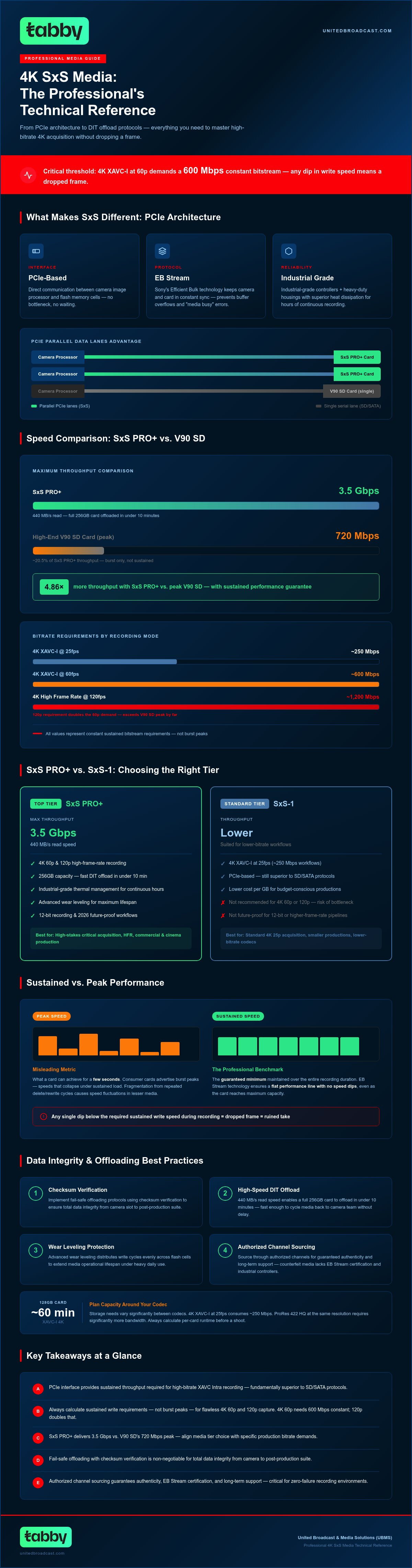
The PCIe interface serves as a high-speed highway that connects storage media directly to the camera’s processing engine, virtually eliminating the data bottlenecks that cause latency during 4K acquisition. Unlike SD cards or CFast 2.0 media that often rely on SATA or serial protocols, PCIe allows for parallel data lanes. This direct CPU communication means the camera doesn't have to wait for the card to "catch up" during high-frame-rate recording. While a high-end V90 SD card might peak at 720 Mbps, a modern SxS PRO+ card handles up to 3.5 Gbps. This massive overhead is essential when you're shooting 4K at 60p or 120p, where data integrity is non-negotiable.
Reliability in High-Resolution Acquisition
Capturing 4K footage generates immense thermal loads and places significant stress on NAND flash memory. Standard cards often throttle their performance as they heat up, leading to dropped frames. In contrast, 4k sxs cards utilize industrial-grade controllers and heavy-duty housings designed for superior heat dissipation. This thermal management allows for hours of continuous recording without performance degradation. For cinematographers using advanced professional video cameras, this reliability translates to peace of mind on set. The cards also feature advanced wear leveling, which distributes data write cycles evenly across the flash cells to extend the media's operational lifespan even under heavy daily use.
Decoding Specs: Read and Write Speeds for 4K Intra
Selecting the right media requires a clear understanding of the data math behind high-resolution acquisition. When you record in 4K XAVC-I at 60p, the camera generates a constant bitstream of approximately 600 Mbps. If you move into high-frame-rate territory, such as 120p, that requirement doubles. While consumer-grade cards often highlight their maximum "burst" speeds, professional 4k sxs media is rated for sustained performance. This distinction is vital because any dip in write speed during a high-bitrate recording will result in a dropped frame, potentially ruining a critical take.
Read speeds are equally important for the production lifecycle, specifically at the DIT station. A card with a 440 MB/s (3.5 Gbps) read speed allows you to offload a full 256GB card in under ten minutes, provided your bus speed supports it. This efficiency is what enables a fast-paced crew to cycle media back to the camera team without delay. As we move toward 12-bit recording and even higher frame rates in 2026, having this overhead ensures your storage won't become the bottleneck in your pipeline.
Sustained vs. Peak Performance
In the world of digital cinema, peak performance is a misleading metric. Peak speeds represent what a card can achieve for a few seconds, whereas sustained write speed is the guaranteed minimum the card maintains over the entire recording duration. Fragmentation can occur when files are deleted and rewritten, which often causes speed fluctuations in lesser media. The EB Stream technology integrated into 4k sxs cards prevents these fluctuations by managing how data is allocated to the flash cells. This ensures a flat performance line with no speed dips, even as the card reaches its maximum capacity.
Codecs and Capacity Requirements
Storage needs vary significantly between codecs. For instance, 4K XAVC-I at 25fps consumes roughly 250 Mbps, while ProRes 422 HQ at the same resolution requires significantly more bandwidth. A 128GB card might provide around 60 minutes of XAVC-I 4K footage, but that time drops sharply when shooting ProRes or high-speed 120p bursts. We recommend choosing 256GB or higher capacities for full-day productions to minimize card swaps. A vital technical tip for longevity: always leave a 10% buffer on your media. Filling a card to 100% forces the controller to work harder for wear leveling, which can eventually impact performance. If you need assistance mapping out your storage requirements, our team can provide expert technical guidance for your specific workflow.
SxS PRO+ vs. SxS-1: Choosing the Right Tier
Distinguishing between the two primary SxS tiers is essential for production planning and budget allocation. While both share the same physical form factor, their internal architecture is tailored for different operational stresses. SxS PRO+ utilizes high-end professional NAND flash, specifically optimized for the high-frequency write operations of digital cinema. In contrast, SxS-1 is designed for reliability in standard broadcast environments where bitrates are generally lower and the recording pace is less intense. Choosing the wrong tier for a high-bitrate 4k sxs workflow can lead to buffer errors or even recording stops at critical moments.
The lifespan of these cards is a major differentiator for long-term ROI. The PRO+ series employs higher-grade cells that can handle significantly more write cycles before the risk of cell exhaustion increases. While SxS-1 is rated for approximately five years of daily use under standard broadcast conditions, the PRO+ series is built for the extreme endurance required in high-intensity cinema shoots. For 2026 media generations, look for the "E" or "G" designations in model numbers, such as SBP-256E, to ensure you're using the latest controller technology.
The PRO+ Series: Engineered for 4K Cinema
The PRO+ series is a non-negotiable requirement for flagship cameras like the Sony Venice when recording at the highest quality settings. These cards are specifically certified for XAVC 4K Intra recording at high frame rates where data stability is paramount. Beyond raw speed, the PRO+ tier offers exclusive data salvage capabilities. If a power failure occurs during recording, the specialized controller in a PRO+ card works with the camera firmware to reconstruct the file. This safety net is invaluable on high-budget sets. You can pair this high-end capture reliability with our ARRI lighting solutions to ensure every frame of your cinema package is technically perfect.
SxS-1: The Broadcast Workhorse
SxS-1 cards provide a cost-effective solution for news production and documentary work where ultra-high bitrates aren't always necessary. They're perfect for MPEG HD422 or XAVC Long GOP workflows. A key feature of this tier is the Life Indicator. When inserted into a compatible camcorder, the viewfinder displays the remaining lifespan of the card as a percentage. This transparency allows operators to manage their media pool effectively. Professionals should retire an SxS-1 card once the indicator drops below 10% to avoid potential field failure. For mixed-resolution shoots, having a few 4k sxs PRO+ cards for A-roll and SxS-1 for B-roll can be a smart way to optimize your equipment spend.
Best Practices for Data Integrity and Offloading
Data integrity doesn't end when you stop recording. Establishing a rigorous offloading protocol is the only way to ensure your 4k sxs footage survives the journey from the field to the edit suite. Every transfer carries a microscopic risk of bit-rot or packet loss. To mitigate this, professionals use bit-for-bit checksum verification. Protocols like MD5 or the faster XXH64 compare the source file on the card with the copy on the RAID. If the strings don't match exactly, the software flags the error immediately. This prevents the nightmare scenario of discovering a corrupted 4K file weeks later during the color grade.
The DIT Workflow: From Camera to Raid
Speed is a safety feature in a DIT workflow. Utilizing Thunderbolt 3 or Thunderbolt 4 readers is essential for 4k sxs media because it allows the bus to handle the full 3.5 Gbps read speeds without bottlenecking. Always wait for the OS to confirm the volume is unmounted before physically removing the card. Heat is another factor. During high-speed transfers, SxS cards can become quite warm. Ensure your card reader is placed in a well-ventilated area rather than stacked under other drives. This prevents thermal throttling and protects the internal controller from heat-related stress.
Environmental Protection for Media
The national climate presents unique challenges for sensitive electronics. Fine dust and high humidity can settle on the ExpressCard interface, leading to connectivity issues or data transfer errors. It's vital to keep your media in weather-sealed cases when not in use. For more comprehensive advice, read our guide on protecting cinema cameras from humidity and dust. If you notice residue on the gold contacts, use a lint-free swab with a small amount of 99% isopropyl alcohol. Never use compressed air directly into the card slot, as this can push debris deeper into the camera's internal pins.
Proper media management starts with physical labels and the write-protect switch. Once a card is full, slide the lock tab immediately. This simple physical habit prevents accidental formatting. Always format your cards in the camera they'll be used in, rather than on a computer. This ensures the file system and directory structure are perfectly aligned with the camera's firmware requirements. Protect your media from electrostatic discharge by using anti-static pouches during transport.
Investing in Professional Media Solutions
Investing in professional storage is a strategic decision that extends beyond simple capacity and speed. For high-value productions, your media is the most critical link in the chain. Sourcing 4k sxs cards through an authorized distributor ensures that every unit is genuine and backed by the manufacturer's full technical ecosystem. This approach protects your investment from the risks associated with unverified supply chains, where performance inconsistencies can lead to catastrophic data loss on set. When your reputation depends on the integrity of the footage, the provenance of your media matters as much as the camera itself.
Ensuring Media Authenticity
Grey market media often bypasses the rigorous quality control standards required for professional broadcast. These cards may lack the specialized controllers needed to sustain the high bitrates we've discussed in previous sections. At UBMS, we verify that all equipment meets the specific technical standards for the regional market. Authenticated media comes with valid serial numbers that qualify for official data recovery services and warranty claims. Keeping your card readers updated with the latest firmware is equally vital to ensure seamless communication between the media and modern operating systems, especially as new 4K codecs evolve and demand more from the hardware interface.
Professional Support and System Integration
Professional media management is more efficient when integrated into a well-planned studio environment. Our system integration services help you design workflows that maximize the throughput of your storage media from capture to archive. We don't just sell cards; we provide a technical foundation that supports your entire camera package. This includes expert advice on matching media tiers to specific project requirements to ensure the best possible ROI. Beyond hardware sales, our authorized service center provides specialized repairs for camera card slots and readers, ensuring your equipment remains in peak condition throughout its lifecycle. This technical infrastructure is what distinguishes a professional vendor from a simple retail outlet.
Choosing the right partner means gaining access to nearly 30 years of industry expertise and a dedicated support infrastructure. We understand that the cost of a failed card far exceeds the price of the media itself. By prioritizing authenticated solutions and professional maintenance, you ensure that your 4k sxs workflow remains a dependable asset for your business. Our team is ready to help you plan your next high-resolution project with the reliability that only a technical partner can provide. Whether you are upgrading a single camera or building a multi-cam broadcast facility, the right media strategy is the bedrock of your success.
Securing Your Production Pipeline for 2026 and Beyond
Mastering the technical landscape of high-performance media is no longer optional for digital cinema professionals. We've explored how the PCIe architecture of SxS cards provides the essential throughput for high-bitrate capture, ensuring that your most demanding 4K workflows remain stable. From selecting the high-endurance PRO+ series for flagship cinema cameras to implementing checksum-verified offloading, every step in your media management chain impacts the final image quality. It's about more than just storage; it's about the security of your creative data.
As an Authorized Sony Service Center and national broadcast system integrator, we provide more than just hardware. We offer the technical support for professional cinema that ensures your 4k sxs media remains a reliable asset throughout its lifecycle. Authenticated sourcing and expert maintenance are your best defenses against data corruption and field failure. Our seasoned veterans understand the high stakes of professional production and the logistical excellence required to succeed.
Our team is ready to help you optimize your storage strategy and protect your creative vision with industry-leading expertise. Let's build a workflow that stands up to the rigors of modern acquisition.
Frequently Asked Questions
Can I record 4K on an older SxS-1 card?
Recording 4K on SxS-1 cards is possible depending on the specific codec and card generation. Modern SxS-1 "G" series cards support XAVC Intra 4K up to 60p, but older generations may be restricted to HD or lower bitrate 4K Long GOP formats. It's vital to check for the EB Stream designation on the label. Using underpowered media for a high-bitrate 4k sxs workflow can lead to buffer errors or stopped recordings during critical takes.
What is the difference between SxS and XQD cards?
The primary differences lie in the physical form factor and the target application. While both utilize the PCIe interface for high speed, SxS cards use the larger ExpressCard standard and are engineered for the sustained throughput required by broadcast camcorders. XQD is a smaller format often found in mirrorless or entry-level professional cameras. SxS media offers superior thermal management and industrial-grade controllers designed for years of continuous daily use in demanding digital cinema environments.
How do I recover footage from a corrupted SxS card?
If a card becomes unreadable, stop using it immediately to prevent data overwriting. You should first attempt recovery using the Sony Memory Media Utility software. For more severe corruption, our authorized service center provides specialized technical support for professional cinema equipment. We can assess the hardware integrity of the card and guide you through professional data salvage options. Don't rely on generic consumer-grade recovery tools, as they can sometimes worsen the file structure damage.
Are SxS cards waterproof or shockproof?
SxS cards are built to withstand the rigors of professional field production. They are tested for resistance to shock, vibration, and X-ray exposure. While they aren't rated for full submersion, the heavy-duty housing protects internal components from the high humidity and dust common in regional climates. The gold-plated ExpressCard pins are more durable than those on consumer SD cards, which reduces the risk of connectivity failure after hundreds of insertion cycles in the camera.
Why is SxS media more expensive than CFexpress?
The higher cost of SxS media reflects its industrial-grade architecture and specialized controllers. Unlike many CFexpress cards that prioritize burst speeds for photography, SxS is engineered for sustained, zero-failure video recording. Technologies like EB Stream ensure consistent data flow without the speed dips that cause dropped frames. This reliability is essential for high-stakes 4k sxs productions where the cost of losing a single day of shooting far outweighs the initial investment in premium storage.
How many hours of 4K footage fit on a 256GB SxS card?
Capacity depends entirely on your chosen resolution and frame rate. A 256GB card provides approximately 120 minutes of 4K footage when recording in XAVC-I at 25fps (250 Mbps). If you increase the frame rate to 50p or 60p, the bitrate doubles to 500 or 600 Mbps, reducing your recording time to about 50 to 60 minutes. High-speed 120p bursts will consume space even faster. We recommend mapping out your daily storage needs based on your specific codec requirements.
Does the camera brand affect SxS card performance?
Camera hardware and firmware play a significant role in how SxS media performs. While the card's internal speed is fixed, the camera's controller determines the maximum bitrate it can push to the media. Sony and ARRI cameras are specifically optimized for the SxS protocol, allowing them to unlock advanced features like data salvage and life-cycle monitoring. Using these cards in non-optimized readers or through third-party adapters can occasionally bottleneck the transfer speeds or limit metadata communication.
How often should I format my SxS cards?
You should format your cards before every new shoot day once the previous data has been verified and backed up. It's a best practice to always format the media in-camera rather than using a computer. This ensures the file system and directory structure are perfectly aligned with the camera's firmware. Regular in-camera formatting helps maintain the health of the file allocation table and prevents the file fragmentation that can lead to recording errors over time.


