

Broadcast Monitor UAE: The 2026 Professional Roundup & Selection Guide
Imagine spending twelve hours on a high-stakes shoot in the Dubai desert, only to find that a subtle color shift caused by equipment heat has compromised your entire post-production workflow. For specialists in the Middle East, where the media market is projected to reach USD 48.92 billion by 2026, there's no room for technical guesswork. You understand that a professional broadcast monitor UAE crews can rely on must do more than just display an image; it has to guarantee absolute color fidelity and survive the rigors of the regional climate.
This guide offers the technical criteria and top-tier monitoring solutions essential for high-end broadcast and cinema production across the Emirates. We'll explore the critical shift toward 4K and 8K workflows and the latest regulatory compliance standards set by the UAE Media Council. From field-ready high-brightness panels to color-critical studio reference displays, you'll discover how to achieve seamless integration with your existing camera chains and broadcast gear.
Key Takeaways
- Learn why consumer-grade screens lack the precision signal analysis required for high-end production and how to identify true broadcast-grade instruments.
- Master the technical differences between OLED and high-brightness LCD panels to ensure your gear performs under intense studio or field lighting.
- Select the ideal broadcast monitor UAE sets require by distinguishing between portable on-camera field monitors and large-scale director displays.
- Understand the mandatory role of regular color calibration and the specific tools needed to maintain visual consistency across your entire camera chain.
- Access professional insights on integrating 2026 monitoring technology into comprehensive studio environments for seamless operational flow.
What Defines a Professional Broadcast Monitor?
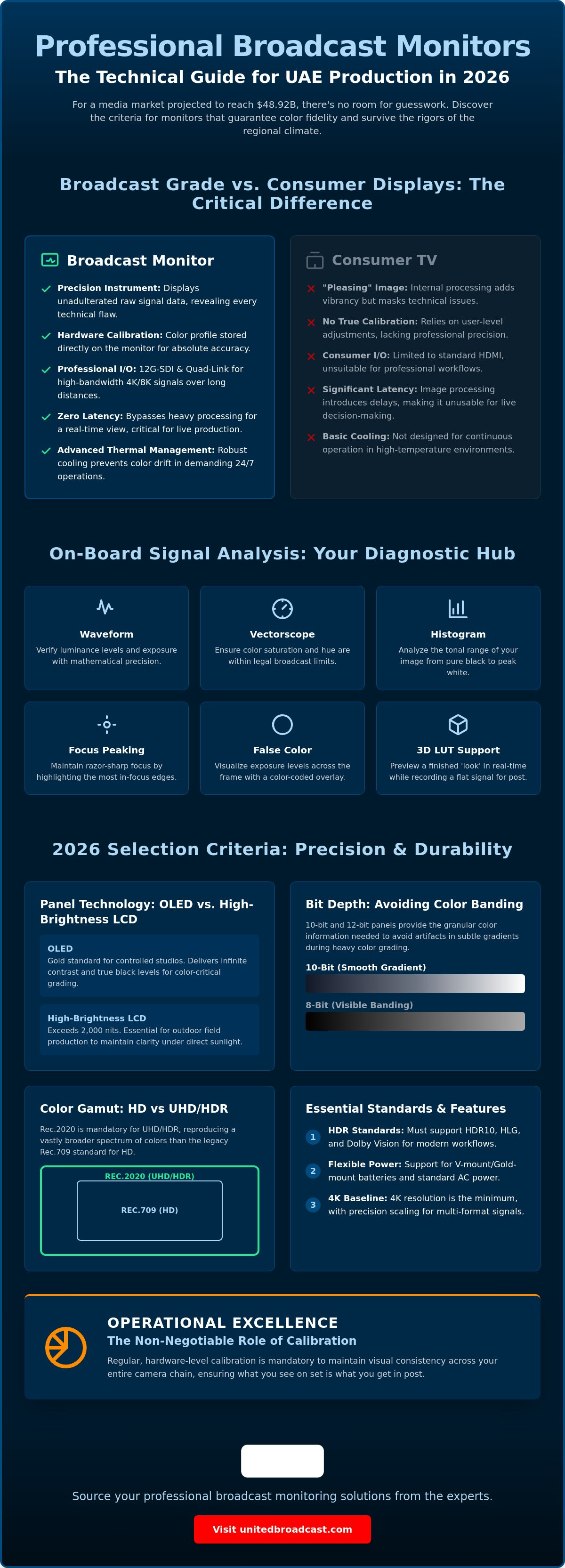
A Broadcast reference monitor is far more than just a high-resolution screen. It's a precision instrument designed for technical signal analysis and visual consistency. In a professional broadcast monitor UAE environment, these devices serve as the final authority on color, exposure, and signal health. While consumer displays use internal processing to make images look "vibrant" or "pleasing," a professional monitor provides an unadulterated view of the raw data. It reveals every technical flaw, from sensor noise to compression artifacts, ensuring that production teams catch errors before they reach the master file.
Maintaining signal integrity across the entire production chain is impossible without a reliable reference point. If your monitor doesn't display accurate blacks or highlights, your colorist will make incorrect adjustments that cascade through the post-production process. For live environments, latency-free monitoring is non-negotiable. Consumer TVs often introduce significant lag due to heavy image processing; professional monitors bypass these delays to provide a real-time window into the camera's output. This speed is critical for directors who need to make split-second decisions during a live event or broadcast.
Broadcast vs. Consumer Displays
The primary difference lies in the color processing engine. Professional monitors allow for hardware-level calibration, where the color profile is stored directly on the monitor's internal chips. Connectivity is another major factor. While consumer screens rely on standard HDMI, professional gear utilizes 12G-SDI and Quad-Link interfaces to handle high-bandwidth 4K and 8K signals over long distances. This connectivity is essential when integrating professional video cameras into a studio or OB van. Additionally, these units feature advanced thermal management systems. In the UAE's demanding climate, robust cooling is necessary to prevent hardware failure or color drifting during 24/7 operations.
The Necessity of Signal Analysis Tools
A professional monitor acts as a diagnostic hub. Built-in tools like Waveform monitors, Vectorscopes, and Histograms allow engineers to verify luminance and color saturation with mathematical precision. Focus peaking and false color are standard features that help operators maintain razor-sharp focus and perfect exposure in challenging lighting. Most modern units also support 3D LUTs. This functionality allows the crew to preview a finished "look" in real-time while the camera records a flat, high-dynamic-range signal for later grading. This level of control is a cornerstone of any high-end broadcast monitor UAE workflow, providing confidence that the captured image matches the creative vision.
Key Selection Criteria for Broadcast Monitors in 2026
Selecting a broadcast monitor UAE professionals can trust involves balancing technical precision with environmental durability. OLED technology remains the gold standard for color-critical grading in controlled studio environments due to its infinite contrast and deep black levels. However, for outdoor field production in the high-ambient light of the Middle East, high-brightness LCD panels are often the more practical choice. These panels frequently exceed 2,000 nits, ensuring the image remains visible and clear even under direct sunlight.
Color gamut requirements have also evolved. While Rec.709 is the legacy standard for HD, Rec.2020 is now mandatory for UHD and HDR content. This wider gamut allows the display to reproduce a broader spectrum of colors, which is essential for meeting international delivery standards in 2026. Reliable power options are a cornerstone of operational success. Professional monitors must offer flexibility, supporting V-mount or Gold-mount battery plates for field use, alongside standard AC power for studio integration.
Understanding Resolution and Bit Depth
As 4K resolution becomes the baseline for UAE media houses, the focus has shifted toward bit depth and processing. An 8-bit panel is prone to color banding in subtle gradients. In contrast, 10-bit and 12-bit panels provide the granular color information needed to avoid artifacts during heavy color grading. Precision scaling is equally important, as it ensures that multi-format signals from various camera chains remain sharp and artifact-free when upscaled to the monitor's native resolution.
HDR Standards and Monitoring
Modern workflows require monitoring solutions that support HDR10, HLG, and Dolby Vision. For HDR accuracy, a monitor must achieve high peak brightness (Nits) while maintaining low black levels. This contrast ratio is what allows for the increased detail in highlights and shadows that HDR provides. In dark studio suites, superior black level performance prevents light leakage, ensuring that what you see on the screen is exactly what the viewer will experience.
If you need assistance matching these criteria to your specific project needs, our specialists can provide a technical consultation on the latest monitoring technology.
Top Broadcast Monitor Categories for UAE Professionals
The broadcast monitor UAE market offers a diverse range of hardware tailored to specific roles within the production pipeline. Selecting the right category depends entirely on where the monitor sits in your workflow. A monitor used by a focus puller on a bright exterior set requires different specifications than a reference display used by a colorist in a controlled grading suite. Understanding these distinctions is the first step toward building a reliable and efficient monitoring ecosystem.
Beyond the primary displays, production environments also rely on large-scale director monitors and specialized rack-mount units. Director monitors, often 17 to 24 inches, serve as the central hub for "video village" setups. These allow the creative team to review performances and framing on a large screen with calibrated color. Rack-mount monitors are the backbone of control rooms and OB vans. These space-efficient solutions often pack dual or triple screens into a standard 19-inch rack, allowing engineers to monitor multiple camera feeds and signal paths simultaneously without taking up valuable desk space. For larger mission-critical environments, Activu Corporation provides specialized video wall systems that expand these monitoring capabilities into a unified operational platform.
On-Camera and Field Solutions
For cinematographers and camera operators, portability and visibility are the top priorities. Most modern professional video cameras and cinema rigs utilize 5-inch or 7-inch on-camera monitors. These compact units provide essential tools like focus peaking and false color right at the operator's eye level. Many of these models now serve as integrated recording monitors. They can capture high-bitrate backup files in formats like ProRes or DNxHR directly to SSD media, providing an immediate safety copy of your footage. This redundancy is particularly valuable for high-pressure shoots in remote UAE locations where data security is paramount.
Studio and Post-Production Reference
When it's time for final QC and color grading, studio reference monitors are the only acceptable authority. These panels, typically ranging from 24 to 31 inches, are designed for absolute color accuracy and consistency. They must integrate seamlessly with the existing broadcast studio gear UAE facilities use to meet international delivery standards. Key features in this category include:
- Hardware Calibration: Compatibility with professional probes and software to maintain color accuracy over time.
- Advanced Connectivity: 12G-SDI and Quad-Link inputs for uncompressed 4K and 8K signal monitoring.
- Wide Color Gamut: Full support for Rec.709 and Rec.2020 color spaces to ensure HDR compliance.
These monitors provide the granular detail necessary to spot subtle noise, compression artifacts, or color shifts that smaller field monitors might miss. Investing in a high-tier reference display ensures that your final output looks exactly as intended across all broadcast and cinema platforms.
Operational Excellence: Calibration and Maintenance
Investing in a high-end broadcast monitor UAE professionals rely on is only the first step toward visual precision. Over time, all display panels experience "drift," a phenomenon where color temperature and luminance levels shift due to the aging of internal components. Without a rigorous calibration schedule, the accuracy you paid for will slowly erode, leading to discrepancies between your field monitors, studio displays, and the final delivery. Maintaining consistency across the production chain requires a proactive approach to both software alignment and hardware care.
Operational excellence also extends to how gear is handled in the unique environment of the Middle East. High ambient temperatures and fine desert dust pose constant threats to sensitive electronics. A monitor that isn't properly maintained won't just lose color accuracy; it may suffer from premature hardware failure. Establishing a routine for technical upkeep ensures your equipment remains a dependable reference point for years, rather than a liability during critical shoots.
The Calibration Workflow
Professional display profiling requires specialized tools like colorimeters and spectrophotometers. While colorimeters are excellent for daily checks and speed, spectrophotometers offer the absolute precision needed to measure the spectral power distribution of a light source. For the best results, prioritize hardware-based calibration. This method stores the calibration data directly in the monitor's internal Look-Up Table (LUT), bypassing the limitations of the computer's graphics card. Most industry standards suggest calibrating studio monitors every 200 to 500 hours of use, or at least once a month for color-critical suites.
Maintenance for UAE Conditions
The regional climate demands extra vigilance. Fine dust can accumulate in the intake vents of high-brightness field monitors, causing internal fans to work harder and eventually fail. Regularly clearing these vents with filtered compressed air is essential. Humidity can also affect panel performance, particularly when moving gear from air-conditioned studios to humid outdoor sets. Allow your equipment time to acclimate to prevent internal condensation. For broader equipment care, you can find useful cinema lens repair Dubai insights that apply to general optical and electronic maintenance.
Transporting sensitive OLED panels requires specific precautions. Unlike traditional LCDs, OLEDs are more susceptible to pressure damage and physical shock. Always use custom-fit flight cases with high-density foam. Ensure the panel is never stored face-down, even inside a case, as prolonged pressure can lead to permanent artifacts or "bruising" on the display surface. If you are experiencing technical issues or need help establishing a calibration routine, you can contact our service center for professional support.
Why Source Your Broadcast Monitoring from UBMS?
Established in 1997, United Broadcast & Media Solutions (UBMS) has grown into a cornerstone of the regional media landscape. We provide more than just a retail transaction; we offer a technical partnership built on decades of experience. Sourcing a broadcast monitor UAE professionals can rely on means choosing a supplier that understands the complexities of the local production environment. Our inventory includes the latest 2026 technology from global leaders, ensuring your facility remains at the cutting edge of industry standards. This long-standing presence allows us to anticipate market shifts and provide hardware that isn't just current, but future-proofed for evolving delivery requirements.
Our role as a trusted advisor is backed by deep technical infrastructure. We don't just supply individual units; we design and implement comprehensive workflows that solve real-world production challenges. Whether you're outfitting a new OB van or upgrading a flagship studio, our team ensures every component functions as a cohesive unit. This end-to-end approach minimizes compatibility issues and maximizes your return on investment. We focus on the functional utility of the equipment, ensuring that your monitoring solutions integrate perfectly with your cameras, switchers, and signal distribution networks.
System Integration and Technical Support
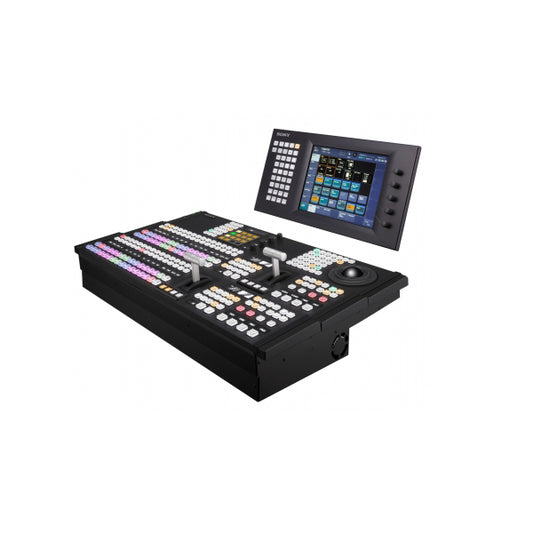
Modern broadcast environments require precise interoperability between different hardware layers. We specialize in customized monitoring solutions that integrate perfectly with your broader TV studio equipment Dubai setups. Our engineers provide expert advice on finding the right video switcher Dubai options to match your monitor's specific signal requirements and latency standards. Our dedicated service center provides post-sales assistance, warranty support, and technical repairs, ensuring your downtime is kept to an absolute minimum during critical production cycles.
The UBMS Experience
We believe in a hands-on approach to equipment selection. Our facilities allow you to test the latest panel technologies in person, comparing contrast ratios and color fidelity before making a final decision. You can see how different broadcast monitor UAE models handle HDR highlights or off-axis viewing in real-time. Beyond monitoring, we offer comprehensive solutions that include professional lighting equipment Dubai specialists need to create broadcast-ready environments. As a trusted partner for major UAE media entities, United Broadcast & Media Solutions (UBMS) is committed to the long-term success of your production capabilities through logistical excellence and technical expertise.
Elevate Your Production Standards for 2026
Selecting the ideal broadcast monitor UAE professionals require is a strategic investment in image integrity and long-term operational reliability. As the industry moves toward UHD and HDR delivery, the necessity for absolute color fidelity and robust thermal management becomes non-negotiable. By prioritizing regular hardware calibration and choosing panel technologies tailored to your specific environment, you ensure that your creative vision remains consistent from the initial capture to the final broadcast master.
United Broadcast & Media Solutions (UBMS) has been providing comprehensive broadcast solutions since 1997. As an authorized distributor for top global brands, we combine industry-leading technology with the dedicated support of our expert technical service center right here in the UAE. Our team possesses the specialized expertise to help you integrate the latest 2026 monitoring standards into your existing studio or field infrastructure with precision.
Explore the Full Range of Professional Broadcast Monitors at UBMS
We look forward to supporting your next high-end production with monitoring tools that deliver the absolute precision your work deserves.
Frequently Asked Questions
What is the difference between a field monitor and a studio monitor?
A field monitor is designed for portability and high-brightness visibility on set. These units are typically compact, ranging from 5 to 7 inches, and feature high nit ratings to combat direct sunlight. In contrast, a studio monitor is a larger, color-critical display used for grading and quality control. It prioritizes absolute color accuracy and reference standards over portability, serving as the final authority on image quality in controlled lighting environments.
Do I need a 4K monitor if I am only broadcasting in HD?
Investing in a 4K broadcast monitor UAE professionals use provides significant benefits even for HD delivery. A 4K panel offers higher pixel density, which makes it much easier to judge critical focus and identify fine sensor noise. Since most modern cameras record in 4K or higher, having a matching display allows you to monitor the native resolution before it's downsampled for the final HD broadcast feed.
What is 12G-SDI and why is it important for 4K monitoring?
12G-SDI is a high-bandwidth digital interface that supports 4K resolution at 60 frames per second over a single BNC cable. It's essential for 4K monitoring because it eliminates the need for complex Quad-Link SDI setups, which require four separate cables. Using 12G-SDI simplifies your signal path, reduces potential points of failure, and ensures a stable, uncompressed data stream for high-resolution production workflows in the studio or field.
How often should a professional broadcast monitor be calibrated?
Most industry professionals recommend calibrating a monitor every 200 to 500 hours of active use. If you're working in a color-critical post-production suite, a monthly calibration check is the safest standard. Regular profiling is necessary because all display panels experience component aging, which leads to shifts in color temperature and luminance. Consistent calibration ensures your output remains within international broadcast specifications and matches other displays in your chain.
Can I use a high-end consumer OLED TV as a broadcast reference monitor?
Consumer OLED TVs aren't suitable for professional reference because they lack critical hardware-level calibration and professional 12G-SDI inputs. While they look impressive, they often use internal enhancement algorithms that hide technical errors like noise or compression artifacts. A true broadcast monitor UAE specialists trust provides a completely raw, unprocessed image and includes essential diagnostic tools like waveforms and vectorscopes that are absent on consumer-grade television sets.
What are the best monitor brands for professional use in the UAE?
Top-tier brands for the Middle East market include Sony, SmallHD, Atomos, and TVLogic. These manufacturers are favored because they offer the durability required for regional production and are supported by local technical service centers. When selecting a brand, prioritize those that offer robust thermal management and a wide range of sizes, from compact on-camera monitors to large-scale 31-inch reference displays for grading suites.
How does high ambient temperature in the UAE affect field monitors?
Extreme heat can cause internal components to expand, leading to color drifting or complete thermal shutdown. In the UAE's summer climate, field monitors must have efficient active cooling systems and heat sinks to dissipate heat during long outdoor shoots. Professional-grade monitors are specifically engineered to maintain color consistency even when ambient temperatures exceed 40°C, a feat that consumer-grade electronics simply cannot achieve without failing.
What features should I look for in a director’s monitor?
A director's monitor should feature a screen size of at least 17 to 24 inches to allow for detailed review by multiple crew members. It must include high-brightness capabilities for outdoor use and support for wireless video receivers to maintain a tidy video village setup. Additionally, look for quad-split viewing modes, which allow the director to monitor up to four camera feeds simultaneously on a single calibrated display.


