

V-Mount vs Gold Mount Battery Differences: The 2026 Professional Power Guide
Imagine you are halfway through a critical high-speed sequence when your camera rig suddenly loses power because a battery shifted just a millimeter out of place. For professional cinematographers, a minor mechanical failure like this can lead to thousands of dirhams in lost production time. While both systems provide the necessary juice, the V-mount vs Gold mount battery differences often come down to how they handle the physical rigors of a professional set.
You likely already know that your choice of mount dictates your entire accessory ecosystem, from chargers to plates. This guide will clarify the critical mechanical, electrical, and regional ecosystem factors you need to consider to ensure a stable power solution for your 4K or 8K workflow. We will examine the security of the three-stud Gold mount, the global accessibility of V-mount, and how the emergence of 24V B-mount systems is future-proofing high-draw cinema cameras like the ARRI Alexa 35. By the end, you'll have the technical knowledge to select a power standard that won't fail when the pressure is on.
Key Takeaways
- Understand the fundamental mechanical split between the V-mount wedge design and the Gold mount three-stud locking system to prevent unexpected power drops on set.
- Evaluate how V-mount vs Gold mount battery differences impact your global production workflow, especially when matching owned gear with international infrastructure.
- Discover how high-voltage demands from modern cinema cameras are reshaping traditional power standards and introducing alternative options.
- Learn how professional system integration and custom power distribution safeguard your investment in high-end digital cinema cameras.
The Architecture of Professional Power: V-Mount vs Gold Mount
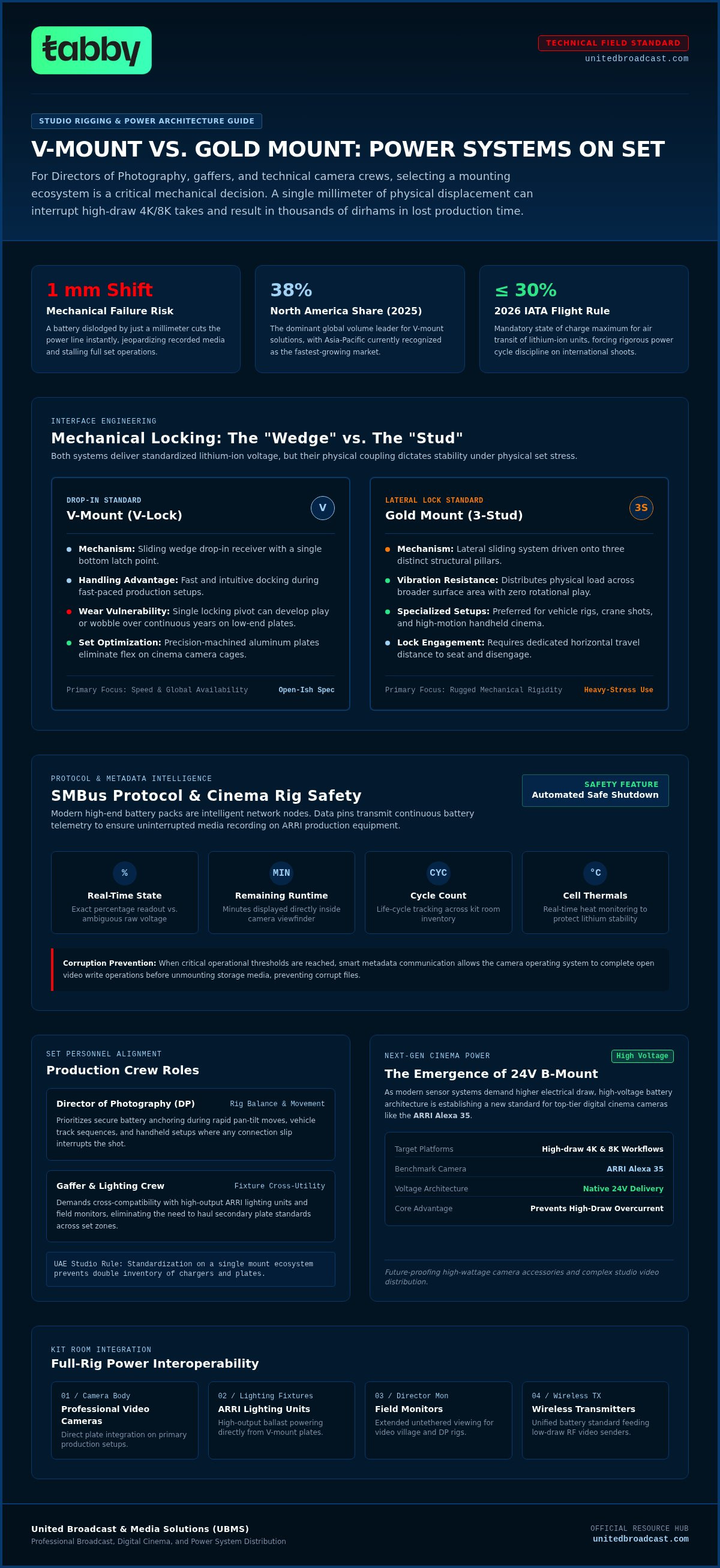
Professional camera mounts serve a purpose far beyond simple electrical conduction. In a high-stakes production environment, the mount acts as a structural anchor that must withstand rapid camera movements, extreme temperatures, and constant physical stress. Understanding V-mount vs Gold mount battery differences starts with their mechanical philosophy: the "wedge" versus the "stud." While both systems utilize The Architecture of Professional Power found in modern lithium-ion cells, their physical interfaces dictate how securely that power is delivered during a shoot.
Production houses in the UAE typically standardize on a single mount ecosystem to ensure logistical efficiency. Mixing mounts on a single set leads to confusion, requiring a double inventory of chargers and plates. By committing to one standard, teams guarantee that every battery in the kit is compatible with every camera, monitor, and light on the rig. This consistency is vital when managing high-draw professional video cameras that require uninterrupted metadata flow to maintain operational status.
Mechanical Locking Mechanisms
The V-lock system utilizes a sliding wedge design. It's a global standard where the battery drops into a V-shaped receiver and clicks into place. It's fast and intuitive; however, because it relies on a single locking point at the bottom, it can develop "play" or wobbling over years of heavy use. In contrast, the Gold Mount, or three-stud system, uses a lateral locking mechanism. The battery is pushed onto three distinct pillars and slid sideways to lock. This creates a more rigid connection across a larger surface area, which is why many cinematographers prefer it for high-vibration environments, such as vehicle-mounted shots or handheld documentary work.
Data Communication Standards
Modern power solutions are "smart" devices that do more than just provide voltage. They communicate vital metadata to the camera viewfinder using standardized protocols like SMBus. This allows the operator to see the exact percentage of charge or the remaining runtime in minutes, rather than a vague voltage reading. The pin layouts differ between the two mounts, but both typically include data pins that transmit battery health, cycle counts, and temperature. For users of high-end systems like the ARRI production kits, this communication is essential for preventing sudden shutdowns during a take. High-quality smart batteries ensure that the camera can trigger a safe shutdown sequence if the power level hits a critical threshold, protecting your recorded media from corruption.
V-Mount Batteries: The Global Standard for Versatility
Sony's decision to open the V-mount specification decades ago transformed the professional media landscape. Unlike proprietary systems, this "open-ish" standard invited a massive wave of third-party manufacturing, making it the most accessible power solution globally. When analyzing V-mount vs Gold mount battery differences, the primary advantage of the V-lock is its sheer ubiquity. Whether you are shooting in the UAE or on an international co-production, you'll find V-mount chargers and batteries in almost every professional kit room.
Market data reflects this dominance. North America held the largest market share for V-mount batteries in 2025 at 38%, but the Asia-Pacific region is currently the fastest-growing market. Critics often point to a "wobble" in the wedge design as a drawback. While low-end plastic plates may flex, high-end professional plates utilize precision-machined aluminum to ensure a rock-solid lock. This stability is crucial, especially as 2026 IATA regulations now mandate that lithium-ion batteries shipped by air must maintain a state of charge not exceeding 30%, requiring crews to manage their power cycles more precisely than ever before.
Ecosystem Compatibility
Most professional video cameras ship with V-mount options by default because the interface is so easily integrated into various accessories. Beyond the camera body, V-mount plates are the standard for high-output ARRI lighting fixtures and field monitors. This cross-compatibility allows a single battery type to power your entire rig, from the wireless transmitter to the director's monitor. If you're unsure which plate configuration suits your specific equipment list, consulting with a technical specialist can help streamline your inventory.
Form Factor and Compactness
A significant trend in 2026 is the shift toward "mini" or "micro" V-mount designs. These compact batteries provide the same 14.4V output as their full-sized counterparts but in a footprint small enough for gimbal and drone work. Many modern V-mount batteries also feature bi-directional USB-C Power Delivery (PD) ports, allowing them to charge laptops or mobile devices directly. Some advanced models even offer stacking capabilities, where one battery attaches to the back of another to provide pass-through power, effectively doubling your runtime without requiring a camera shutdown. This versatility in weight distribution makes V-mount an excellent choice for shoulder-mounted rigs where balance is a priority.
Gold Mount (3-Stud): The Choice for Rugged Reliability
The Anton Bauer legacy began with a focus on eliminating power failure in the field. This engineering philosophy birthed the three-stud Gold mount, a standard that remains the benchmark for rugged reliability. When analyzing V-mount vs Gold mount battery differences, the most striking contrast is the mechanical connection. While the V-mount wedge is intuitive, the Gold mount lateral slide creates a connection that is physically impossible to dislodge without deliberate intent. This rigidity is why the standard dominates Electronic News Gathering (ENG) and high-stakes field reporting across the UAE media landscape.
Maintenance is another area where the V-mount vs Gold mount battery differences become apparent to technical crews. The interface features large, gold-plated pins that are easy to inspect and service. Unlike the recessed pins in V-lock systems, which can hide debris, Gold mount pins are self-cleaning. Every time the battery is slid onto the plate, the studs wipe across the contacts, ensuring a fresh electrical connection. This simple mechanical action prevents the micro-arcing and carbon buildup that often lead to connection failure during critical takes.
The Security of the Lateral Lock
The lateral locking mechanism is designed for environments where failure isn't an option. By utilizing three distinct points of contact, the mount distributes physical stress evenly across the camera plate. This design makes it the preferred choice for high-G force scenarios, such as vehicle-mounted chase cams or aerial rigs. It's a system built for vibration. Even if the camera is subjected to sudden shocks, the battery stays locked in place, maintaining a constant flow of power to your professional video cameras.
Professional Cinema Adoption
High-end cinema sets often choose the Gold mount for its ability to support heavier, high-capacity rigs. When establishing a Comparative Framework for power management, DPs look for mounts that can handle the weight of a 270Wh battery without flexing. The three-stud design provides a stable base for complex power distribution boxes that feed monitors, wireless follow-focus systems, and video transmitters simultaneously. In UAE broadcast environments, standardizing on Gold mount ensures that gear remains interchangeable between studio setups and field units, providing a seamless workflow for technical teams.
Comparative Framework: Choosing the Right Mount for Your Rig
Deciding between these standards requires a balance of mechanical security and operational speed. While Gold mount offers superior rigidity, the V-mount system is often faster for one-handed operation, allowing operators to swap power sources without looking at the back of the camera. When analyzing V-mount vs Gold mount battery differences, you must consider the specific amperage requirements of your equipment. High-draw cameras, such as the ARRI Alexa 35, pull significant power and require batteries capable of sustained high-current discharge to avoid thermal shutdowns or voltage drops during recording.
Environmental factors in the UAE also play a major role in mount selection. Fine dust and high ambient temperatures can affect electrical contact integrity. The open, easy-to-clean studs of a Gold mount plate are often simpler to maintain in sandy environments than the recessed V-lock channel. For a large production house, switching ecosystems involves a significant capital investment. You aren't just buying batteries; you are committing to a specific inventory of chargers, plates, and distribution boxes. Standardizing on one mount simplifies logistics and reduces the risk of accidental gear mismatch on set.
Camera-Specific Recommendations
Your choice of camera body often dictates the most efficient mount. For creators using Sony Alpha cameras and lenses, compact V-mount batteries provide a balanced power-to-weight ratio for handheld setups. Conversely, high-end cinema configurations like ARRI Omnibar production kits often utilize Gold mount for added security on heavy, accessorized rigs. Large-format cinema sensors demand consistent voltage, making the rigid three-stud connection a safer bet for long shooting days where battery failure is not an option.
The Hybrid Approach: Adapters and Plates
If you manage a diverse inventory, conversion plates can offer flexibility. V-to-Gold or Gold-to-V adapters allow you to use your existing battery stock on rented or new camera bodies. However, these adapters add physical bulk and create an additional point of failure. Each interface introduces a small amount of electrical resistance, which can be problematic for high-draw cameras. Multi-mount plates are a popular solution for facilities that need to support various client preferences without maintaining two entirely separate inventories. Always ensure your conversion plates support full metadata pass-through to maintain accurate "time remaining" data in the viewfinder.
Optimizing Your Production Workflow with UBMS
Selecting the right power standard is only the first step in building a reliable broadcast or cinema infrastructure. As a leading UAE-based provider of professional video gear, United Broadcast & Media Solutions (UBMS) delivers tailored power solutions that address the specific environmental and operational challenges of the region. Understanding the practical implications of V-mount vs Gold mount battery differences allows our engineering teams to design robust distribution frameworks that minimize down time during critical shoots.
Protecting high-end camera sensors requires clean, regulated power. Counterfeit or uncertified batteries can cause voltage spikes that damage internal circuitry, leading to expensive repairs. UBMS acts as an authorized distributor for global cinema brands, ensuring that every battery and plate we supply meets strict manufacturing standards. Our team provides comprehensive technical support, helping production houses evaluate their current power draw and select the most efficient ecosystem for their long-term investment.
Technical Integration Services
Our expertise extends to full-scale engineering projects, including custom power solutions for complex broadcast studio gear and multi-camera OB vans. We configure advanced power distribution networks that balance the load for high-end lighting setups, ensuring that heavy-draw fixtures do not cause voltage drops on the camera line. If your facility is planning a transition to a standardized power ecosystem, our engineers provide detailed consultations to map out the most efficient fleet-wide implementation strategy.
Professional Maintenance and Repair
Physical wear on battery plates can compromise connection stability over time. The dedicated UBMS service center specializes in equipment maintenance, including servicing worn battery pins, replacing damaged locking brackets, and executing mount conversions. Our technicians utilize advanced diagnostic tools to test battery health, analyze cell degradation, and verify cycle counts. This rigorous testing ensures your power fleet remains reliable in the field, preventing unexpected failures on set. For specialized assistance with your fleet, you can reach our team directly to schedule a professional power consultation.
Powering Your Next Production with Confidence
Selecting between these two standards involves balancing mechanical rigidity with logistical flexibility. While the global ubiquity of the V-lock is undeniable, the lateral security of a three-stud system remains the benchmark for high-vibration broadcast environments. Understanding the V-mount vs Gold mount battery differences ensures you select a system that supports your camera’s specific amperage needs and metadata requirements without compromise. This decision impacts everything from your charger inventory to the physical balance of your shoulder rig.
As an authorized distributor for major global brands, UBMS provides the technical expertise needed to optimize your power distribution for studio and field use. Our full-service center offers ongoing maintenance for battery plates and mounting hardware, ensuring your equipment remains reliable under the most demanding UAE field conditions. We prioritize precision and dependability to help you avoid connection failures during critical takes.
Investing in a standardized, high-quality power ecosystem is the best way to future-proof your professional camera rig and maintain high-tier production standards. Our specialists are ready to help you navigate these technical choices. We look forward to supporting your technical journey.
Frequently Asked Questions
Which is better for travel, V-mount or Gold mount?
Neither mount is inherently superior for travel, as airline regulations focus on capacity rather than the physical interface. IATA mandates that lithium-ion batteries must stay under 100Wh for carry-on luggage, though some carriers allow up to 160Wh with prior approval. V-mount batteries are often easier to replace locally if you need to purchase additional stock while traveling, as they are the dominant standard in most international markets outside of North America.
Can I use a V-mount battery on a Gold mount camera?
Yes, you can bridge the gap using a battery adapter plate. These conversion plates mount onto the camera's existing Gold mount studs and provide a V-lock receiver on the back. While this solves immediate compatibility issues, it adds physical depth to your rig and can introduce a secondary point of mechanical failure. For high-draw digital cinema cameras, native mounting is always preferred to ensure maximum electrical contact integrity and metadata accuracy.
Why do cinema cameras use V-mount and Gold mount instead of standard batteries?
Professional cinema cameras require significantly more power than consumer models to run large-format sensors, high-speed processors, and multiple accessories. These mounts provide a standardized, high-capacity interface that supports advanced metadata communication. They allow the camera to display exact runtimes in the viewfinder, which consumer batteries cannot do. Additionally, the mechanical locking systems are designed to withstand the vibration and physical stress found on professional production sets.
Is V-mount more common than Gold mount?
V-mount is currently the most widely used standard globally. Its open-specification nature led to massive third-party adoption, meaning you'll find V-lock plates on everything from LED lights to field monitors. While Gold mount remains a staple in North American broadcast environments due to its rugged three-stud design, the V-mount ecosystem offers a broader range of "mini" and "micro" options that are popular for modern gimbal and drone workflows.
How do I know if my camera is high-draw and which battery I need?
You should check the technical specifications in your camera manual for the total wattage consumption. High-draw cameras, like the ARRI Alexa 35, require batteries with a high continuous discharge rate, often 15 amps or more. When evaluating V-mount vs Gold mount battery differences, you must ensure the battery’s internal management system can handle the camera’s peak amperage without triggering a safety shutdown. Our technical specialists can help you calculate these requirements.
What is a D-Tap connector and do both mounts have it?
A D-Tap, also known as a P-Tap, is a standardized two-pin port used to power accessories like wireless transmitters and follow-focus motors. Most modern V-mount and Gold mount batteries include at least one integrated D-Tap port on the side of the battery housing. This allows you to draw power directly from the battery rather than relying solely on the camera body's output ports, which helps manage the overall electrical load on your rig.
How long do professional V-mount and Gold mount batteries typically last?
A professional lithium-ion battery typically maintains its peak performance for 300 to 500 full charge cycles. After this point, you may notice a gradual decline in total capacity. The actual runtime per charge depends on your total power draw; for instance, a 98Wh battery might power a mid-range cinema camera for approximately two hours. Regular health checks at a dedicated service center can help you track cycle counts and maintain fleet reliability.


