

Cinema Lens Repair Dubai: The Professional’s Guide to Optical Maintenance
In the high-stakes world of UAE cinematography, a single grain of desert sand or a subtle shift in coastal humidity can turn a premium production into a blurry liability. Professional filmmakers know that high-end glass isn't just an asset; it's a precision instrument that demands rigorous upkeep to survive the region's unique environmental challenges. When your focus pulls feel gritty or your back-focus shifts mid-shoot, the anxiety of handing over your investment to an unqualified technician is real.
We understand that maintaining optical integrity is a matter of technical survival for active productions. This guide explores the specialized standards of cinema lens repair Dubai, focusing on the scientific restoration of optical paths to 2026 industry benchmarks. You'll discover how factory-level calibration and detailed performance reports can eliminate mechanical inconsistencies and restore your lenses to their original specifications. We will preview the essential maintenance protocols designed to combat humidity ingress and ensure your equipment remains reliable under the most demanding shooting conditions in the Middle East.
Key Takeaways
- Understand why professional cinema lens repair Dubai requires specialized recalibration of mechanical and optical components far beyond standard photography lens maintenance.
- Learn how to identify and mitigate the specific risks of sand ingress and humidity-induced fungus that are prevalent in the UAE's demanding climate.
- Explore the professional repair workflow, including Modulation Transfer Function (MTF) testing and disassembly within controlled, dust-free clean room environments.
- Discover how to evaluate service centers based on manufacturer authorizations and the availability of genuine spare parts for brands like Sony, ARRI, and ZEISS.
- Leverage over 25 years of regional expertise to ensure your high-end cinema glass is restored to factory specifications for active production use.
The Critical Role of Cinema Lens Repair Dubai in Professional Production
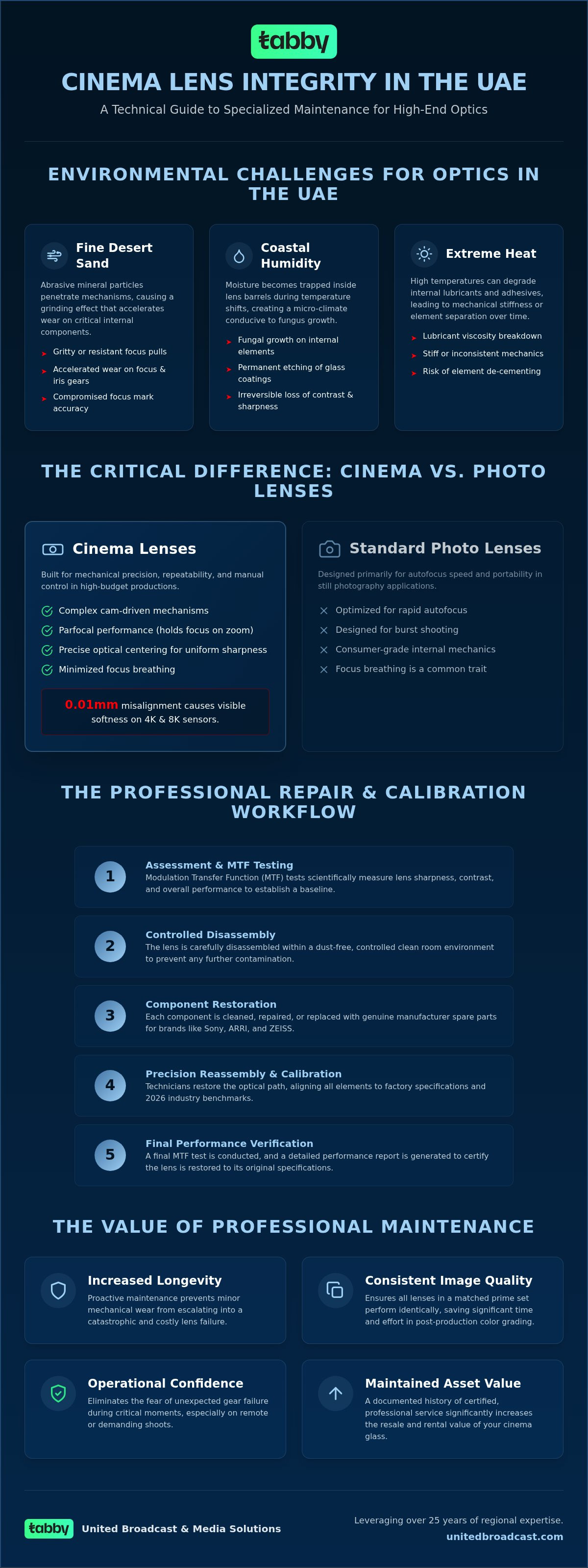
Professional cinema lens repair Dubai is more than a simple cleaning service; it's a rigorous process of technical recalibration. While photography lenses are designed for burst shooting and autofocus speed, cinema lenses are built for repeatability, mechanical precision, and manual control. These optics feature complex cam-driven mechanisms and de-clicked apertures that require a level of maintenance far beyond consumer-grade glass. In a high-resolution environment, even a minor mechanical shift can compromise a high-budget production.
Precision is the baseline in modern cinematography. When paired with high-resolution Professional Video Cameras, a misalignment as small as 0.01mm can cause noticeable softness or chromatic aberration on 4K and 8K sensors. For UAE-based production houses, preventative maintenance isn't a luxury. It's a logistical necessity to ensure that equipment remains reliable despite the harsh local climate. Waiting for a lens to fail mid-shoot is a risk that most professionals simply can't afford.
Why High-End Glass Requires Specialized Care
The internal architecture of a cinema lens is a marvel of engineering. Modern lenses often utilize cam-driven focus mechanisms to eliminate "lens breathing" and provide smooth, tactile focus pulls. Maintaining parfocal performance, where the lens stays in sharp focus while zooming, requires exact spacing of internal elements. Optical centering refers to the precise alignment of individual lens elements along a shared central axis to ensure uniform sharpness and image symmetry across the entire frame. Without this symmetry, one side of your image may appear softer than the other, a flaw that becomes glaringly obvious on large cinema screens.
Maintaining Asset Value for Rental Houses and DPs
For Directors of Photography (DPs) and rental houses, cinema glass represents a significant capital investment. Documenting regular service through professional logs directly increases the resale value of these assets. Buyers look for a history of certified maintenance as proof of optical health. Regular servicing also ensures consistency across a matched set of prime lenses. If the 35mm and 85mm lenses in your kit don't share the same color rendition and sharpness profiles, your post-production workflow becomes a color-grading nightmare. Professional cinema lens repair Dubai keeps your inventory standardized and ready for the next call sheet.
- Increased Longevity: Prevents minor mechanical wear from becoming a total lens failure.
- Consistent Image Quality: Ensures all lenses in a kit perform identically.
- Operational Confidence: Eliminates the fear of gear failure during remote desert shoots.
Common Optical Challenges for Filmmakers in the UAE
The UAE presents an environment that's uniquely hostile to high-end optics. Filmmakers operating in this region must contend with an intersection of extreme heat, fine desert particulate, and high coastal humidity. These factors don't just affect the exterior of the lens; they penetrate deep into the internal mechanical and optical arrays. For those managing high-value assets, specialized cinema lens repair Dubai becomes the only way to restore factory-level performance after exposure to these elements. If left unaddressed, these issues can necessitate a total overhaul to prevent permanent damage to the internal glass elements.
One of the most persistent issues is the ingress of fine desert sand into the focus and iris gears. Unlike standard dust, UAE sand is incredibly fine and contains abrasive minerals. When these particles enter the cam-driven mechanisms, they create a grinding effect that accelerates the wear of critical components. You'll often feel this as a "grittiness" or resistance during a focus pull. This isn't just a tactile annoyance; it's the sound of your lens gears losing their precision and potentially throwing off your focus marks.
Humidity poses an equally severe threat to optical health. In coastal areas, moisture often becomes trapped inside the sealed lens barrels during rapid temperature shifts, such as moving from a chilled studio to a humid outdoor set. This creates a micro-climate conducive to fungus growth. Once fungus begins to feed on the organic components of lens coatings or internal lubricants, it can etch the glass permanently, leading to a loss of contrast and sharpness that cannot be fixed by simple cleaning.
Environmental Hazards: Dust, Sand, and Humidity
The danger of micro-abrasions on front elements is frequently underestimated. Attempting to wipe away fine sand with a dry cloth on-set is akin to using sandpaper on your optics. These tiny scratches scatter light and reduce the overall contrast and MTF performance of the lens. Beyond the glass, humidity traps moisture that can lead to internal haze. For a broader look at protecting your kit, read our guide on Protecting Cinema Cameras from Humidity and Dust.
Mechanical Wear and Impact Damage
High temperatures also affect internal lubrication. When ambient heat exceeds 45°C, lubricants can thin and migrate onto the iris blades, causing them to stick or move sluggishly. This heat also causes thermal expansion in the lens body, which can trigger back-focus shifts. If your lens is no longer hitting infinity focus after being in the sun, the flange focal distance has likely been compromised. While it's tempting to apply on-set quick fixes, these often mask deeper mechanical issues like "gear slip" in follow-focus systems. If you suspect your optical axis has been knocked out of alignment due to a minor impact, it's safer to consult our technical team for a professional diagnostic before your next shoot.
The Professional Repair and Calibration Workflow
Restoring a high-end lens to its factory state is a scientific process that leaves no room for guesswork. A professional cinema lens repair Dubai begins with a rigorous diagnostic phase to establish a performance baseline. Technicians utilize Modulation Transfer Function (MTF) testing to measure how well the lens transfers contrast and detail from the subject to the sensor. This data identifies specific areas of resolution loss or edge softness that might be invisible during a standard visual inspection. Only after this analytical mapping does the physical intervention begin.
The repair sequence follows a methodical path to ensure total optical and mechanical restoration:
- Initial Diagnostic: Comprehensive MTF testing and mechanical stress checks.
- Controlled Disassembly: Stripping the lens down to its base components within a sterile environment.
- Ultrasonic Cleaning: Using high-frequency sound waves to remove microscopic debris from focus gears and iris assemblies.
- Optical Centering: Realigning internal elements using a collimator to ensure the optical axis is perfectly straight.
- Final Certification: Adjusting the flange focal distance (back-focus) and issuing a calibration report.
The Importance of the Clean Room Environment
Opening a cinema lens in a standard workshop is a recipe for long-term failure. Professional facilities utilize ISO-standard clean rooms where air filtration systems remove airborne particulates. Even a single dust particle invisible to the human eye can settle on an internal element during assembly, creating a permanent shadow or flare that ruins a $50,000 lens. A collimator is a specialized optical instrument that projects a parallel beam of light to simulate an infinite distance, allowing technicians to verify that a lens achieves true infinity focus before it leaves the bench. Without these controlled conditions, the mechanical integrity of the lens is compromised from the moment it's reassembled.
Advanced Calibration Tools and Software
Modern cinematography relies heavily on metadata and electronic integration. Calibration involves more than just glass; it includes testing electronic lens data systems, such as Cooke /i Technology, to ensure focal length and aperture data accurately reach the camera. We use advanced projection systems to check for chromatic aberration and flare patterns across the entire frame. This level of precision is essential when pairing lenses with the latest sensors found in The Ultimate Guide to Professional Video Cameras in 2026. Once the mechanical friction is optimized and the back-focus is shimmed to perfection, the lens is certified for active production, providing the DP with total confidence in their focus marks.
Choosing the Right Service Center for Cinema Lens Repair
Selecting a partner for cinema lens repair Dubai is a decision that impacts the long-term viability of your optical kit. While many shops claim to handle high-end glass, true proficiency requires manufacturer-certified infrastructure. You should prioritize centers that hold official authorizations from industry leaders like Sony, ARRI, and ZEISS. These certifications aren't just badges; they guarantee that the facility has access to proprietary calibration software and factory-trained technicians who understand the specific tolerances of each brand's optical designs. Without this direct manufacturer link, a technician is essentially guessing at the internal specifications.
Authorized vs. Independent Repair Centers
Authorized centers have a direct line to the manufacturer for genuine spare parts. Using generic or third-party replacements in a cinema lens can alter the color rendition or cause mechanical failures under the stress of a motorized follow-focus. Additionally, authorized repairs maintain your original manufacturer warranty, which is vital for the resale value of the lens. Independent shops might offer lower upfront costs, but the risk of using non-standard tools on delicate cam-followers often leads to more expensive corrections later. Factory-trained technicians follow standardized protocols that ensure your lens returns to its "day one" performance levels.
It's also essential to evaluate a technician's experience with different lens types. Anamorphic glass involves far more complexity than spherical optics due to the cylindrical elements and alignment required for consistent "squeeze" ratios. If a center doesn't have a dedicated projection room or an optical bench, they can't accurately verify the performance of an anamorphic set. For active film sets, you should also inquire about turnaround times and emergency support. Production schedules don't wait for gear, so a service partner who understands the urgency of professional workflows is indispensable.
Questions to Ask Your Repair Partner
Before committing your gear, ask specific questions about their process. Do they provide a detailed calibration report showing MTF data or projection results? What specific optical testing equipment is used on-site? Transparency in these areas is the hallmark of a professional operation. You need to know that your glass is being tested against objective standards, not just a technician's subjective eye. For a deeper understanding of these technical requirements, review our comprehensive Cinema Lens Repair Dubai: The Professional’s Guide to Optical Maintenance.
The UBMS Advantage: Precision Optical Support in the UAE
United Broadcast & Media Solutions (UBMS) has served as a primary pillar of the regional media ecosystem since 1997. With over 25 years of experience, we provide more than just equipment sales; we offer a technical infrastructure designed to support the long-term health of professional optical assets. Our state-of-the-art service center is a specialized hub for cinema lens repair Dubai, where precision engineering meets decades of regional expertise. We don't just fix gear. We act as a trusted advisor to ensure your equipment survives the transition from the studio to the harshest desert environments.
Our facility is equipped with the same high-tier diagnostic tools used by global manufacturers. This includes specialized optical benches, collimators, and clean room environments that prevent contamination during the repair process. By focusing on technical solutions rather than just transactions, we help our partners maintain the mechanical integrity and resale value of their most expensive glass assets.
Expertise Across Leading Cinema Brands
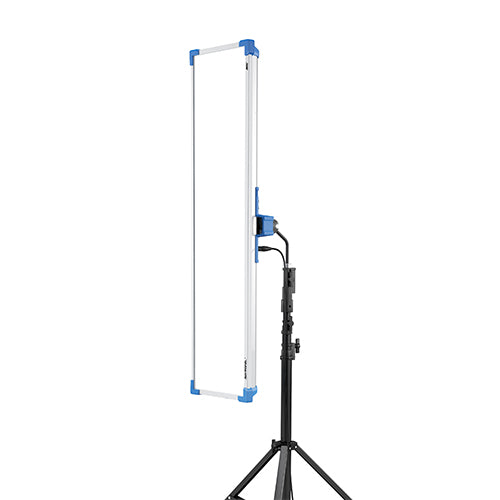
Our technical team possesses deep-rooted knowledge across a vast spectrum of cinema glass and accessories. We provide authorized support for Sony Alpha and Lenses, including the high-end G-Master series, ensuring that your sensor-lens pairing remains sharp and calibrated to factory standards. Beyond glass, our ecosystem extends to ARRI lighting and advanced production tools. We are equipped to handle the maintenance of complex mechanical kits like the ARRI Omnibar Production Kit, providing a comprehensive solution for production houses that require absolute reliability from their entire gear package. This breadth of authorization means we can maintain consistency across your entire inventory, regardless of the brand.
A Trusted Partner for National Production Hubs
We serve the entire UAE, acting as a vital logistical partner for national production hubs and independent filmmakers alike. We understand that downtime isn't just an inconvenience; it's a financial drain on active film sets. Our commitment to logistical excellence means we prioritize efficient workflows without ever compromising on the scientific rigor of our calibration process. We provide detailed service logs and calibration reports that offer total transparency into the health of your optics. By minimizing technical delays and providing expert system integration support, we ensure your production remains on schedule and your images remain sharp.
Maintaining high-end cinema glass requires a proactive approach to optical health. Whether you're dealing with sand ingress after a desert shoot or need a routine back-focus calibration, our team is ready to assist. Contact us today to book a technical consultation and ensure your lenses are performing at their absolute peak.
Securing the Future of Your Optical Investments
Maintaining high-end glass is a commitment to technical excellence that ensures your creative vision remains sharp on every frame. We've explored how the UAE's unique environmental factors, from fine desert sand to coastal humidity, can compromise your kit and why scientific calibration is the only reliable path to restoring factory specifications. By choosing a partner with factory-trained optical technicians, you protect both your immediate image quality and the long-term resale value of your professional assets.
United Broadcast & Media Solutions has been a dependable industry pillar since 1997. As an authorized service center for global brands, we provide the specialized technical infrastructure required for complex cinema lens repair Dubai. Our team understands the high stakes of active production and is dedicated to providing the precise support you need to keep your equipment reliable under the most demanding conditions.
Your lenses are the most critical link between your subject and the sensor. Let's ensure your equipment is ready for the next production cycle with the scientific precision and care it deserves. We're here to support your journey as a trusted technical partner in the Middle Eastern film community.
Frequently Asked Questions
How often should I have my cinema lenses professionally serviced?
Cinema lenses should undergo professional inspection at least once every twelve months. In the UAE's demanding environment, more frequent checks are necessary after shoots involving heavy desert dust or high coastal humidity. Regular maintenance prevents internal mechanical wear and ensures that focus and iris gears remain smooth. For active production houses, a bi-annual schedule helps maintain the reliability required for high-stakes projects and prevents minor issues from becoming total failures.
Can you repair fungus inside a cinema lens element?
Fungus can be removed if the infestation is caught before it etches the internal glass coatings. Our technicians perform a complete disassembly and ultrasonic cleaning of the affected elements within a sterile environment. If the fungus has already caused permanent physical damage to the glass, the specific element must be replaced with a genuine manufacturer part. Early detection is critical to saving high-value optics from irreversible contrast and sharpness loss.
What is the typical turnaround time for lens calibration in the UAE?
Turnaround times vary based on the lens complexity and parts availability, but a standard diagnostic and calibration usually takes three to five business days. We prioritize minimizing downtime for active film sets across the UAE. For extensive cinema lens repair Dubai projects involving element replacement or complex anamorphic alignment, the timeline may extend. We recommend providing a detailed equipment log to help our technical team expedite your specific service request.
Does professional lens repair void my manufacturer's warranty?
Utilizing an authorized service center ensures your manufacturer's warranty remains intact. UBMS is an authorized partner for global leaders like Sony and ARRI, meaning our technicians follow factory-prescribed protocols and use genuine spare parts. Independent, non-authorized shops often lack access to proprietary calibration software, which can lead to improper reassembly that voids your protection. Choosing a certified facility preserves both your warranty and the long-term resale value of your glass.
What is the difference between back-focus adjustment and full optical calibration?
Back-focus adjustment is the precise setting of the flange focal distance to ensure focus marks remain accurate. Full optical calibration is a more comprehensive process that includes optical centering, element degreasing, and MTF testing. While back-focus ensures your lens hits infinity, full calibration restores image symmetry and contrast across the entire frame. Most professionals opt for full calibration during their annual service to ensure the lens meets original factory specifications.
Can anamorphic lenses be repaired and aligned locally in the UAE?
Specialized facilities in the UAE are equipped to handle the complex alignment required for anamorphic glass. These lenses feature cylindrical elements that must be perfectly synchronized to maintain consistent squeeze ratios and horizontal flare characteristics. Our service center utilizes dedicated projection rooms and optical benches to verify anamorphic performance. Local repair saves production houses the high cost and logistical risk of shipping delicate anamorphic sets to international factory hubs.
How do I know if my cinema lens needs a collimation check?
You should seek a collimation check if your focus marks no longer align with physical distances or if you cannot achieve sharp infinity focus. Other symptoms include inconsistent sharpness across the frame or "soft" edges that were previously crisp. A collimator simulates an infinite distance to verify that the lens is correctly projecting the image onto the sensor plane. Regular checks are essential after any minor impact or extreme temperature transition.
Is it possible to repair scratches on the front element of a lens?
Light surface scratches on lens coatings can sometimes be mitigated, but deep scratches on the glass require a front element replacement. Polishing out deep scratches often changes the optical properties and curvature of the element, which compromises image quality. We recommend using high-quality clear filters to protect your front glass from micro-abrasions caused by sand. If damage occurs, our technicians can source and install genuine replacement elements to restore factory performance.


