

2026 Film & Broadcast Battery Power Station Buying Guide
Imagine you're deep into a high-stakes sunset shot. Your cinema camera is rolling, the lighting is perfect, and suddenly, the monitor flickers and dies because your power source couldn't handle the peak wattage. It's a nightmare scenario that every professional filmmaker and broadcast specialist has faced. Relying on inconsistent power or noisy diesel generators can compromise the technical integrity of your production and the silence required for clean audio recording on set.
We understand that in a high-pressure environment, gear failure isn't an option. Choosing the ideal battery power station is no longer just about convenience; it's a critical investment in your production's uptime and reliability. Discover how to choose the right unit to keep your cinema cameras, lighting, and monitors running flawlessly on any professional set. This guide will help you navigate technical specs like Wh vs. W, explore desert-resilient technology, and review the top-tier solutions available in the UAE for 2026. We will examine how to ensure 100% uptime for your critical broadcast equipment while maintaining a portable and silent workflow.
Key Takeaways
- Learn why high-capacity lithium-ion storage is replacing traditional generators to maintain silent sets for critical audio recording.
- Identify the essential professional ports and recharge specifications needed to choose the right battery power station for high-end cinema gear.
- Master the technical calculations for power draw to ensure 100% uptime for demanding rigs like the ARRI Alexa 35 and heavy lighting setups.
- Discover specialized maintenance and thermal management protocols to protect your investment from the extreme temperatures of the UAE climate.
- Gain insights into selecting the most reliable workhorses for basecamp and broadcast studio integration from authorized industry experts.
Why Battery Power Stations are Essential for Modern Film Sets
A professional battery power station serves as a portable, silent, and high-capacity alternative to traditional combustion generators. These units utilize advanced battery energy storage systems to provide consistent electricity for high-end cinema gear. Unlike industrial generators that produce noise and exhaust fumes, a dedicated battery power station allows for a "Silent Set." This is a significant advantage for audio departments that require pristine sound recording without the interference of background hums. It also removes the need for long, cumbersome cable runs from a distant power source.
Modern production workflows demand extreme mobility. Whether you're shooting in remote desert landscapes or tight urban interiors, having a reliable power hub is vital. These stations enable crews to deploy professional video cameras and high-output professional lighting equipment in locations where grid access is non-existent. Beyond logistical flexibility, switching to battery power supports eco-friendly production goals by reducing the carbon footprint of broadcast and cinema projects.
Capacity vs. Output: Understanding the Specs
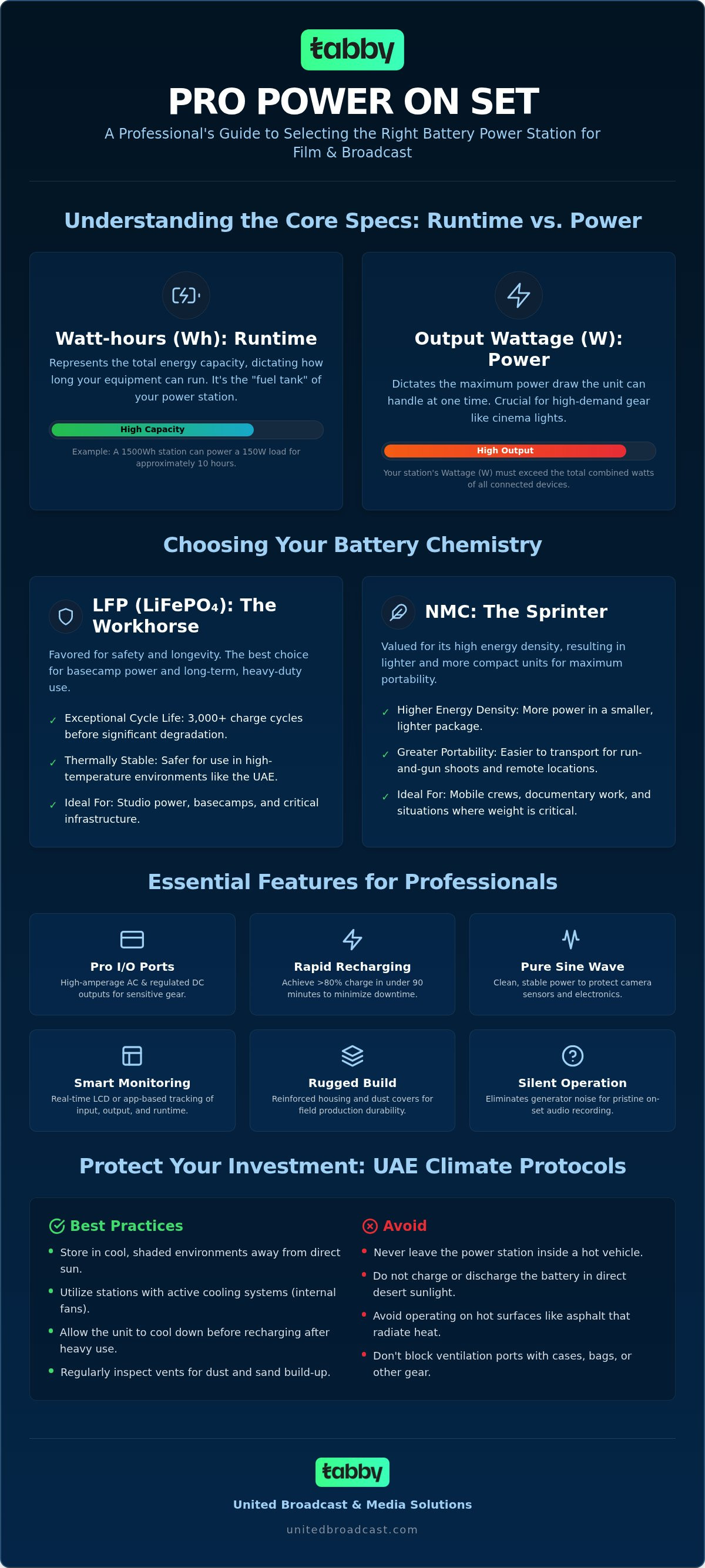
Technical precision is required when evaluating power solutions. Watt-hours (Wh) represent the total energy capacity, essentially determining your shoot's duration. If your rig draws 100W and your station has 1000Wh, you'll theoretically have ten hours of runtime. Output Wattage (W), however, dictates the peak draw the unit can handle. High-power LED lights often require a high continuous output to prevent the station from tripping. Professionals must also look for pure sine wave inverters. These ensure the current is clean and stable, which is critical for protecting sensitive camera sensors and digital processors from electrical interference.
Battery Chemistry: LFP vs. NMC for Professionals
The choice of battery chemistry impacts both safety and portability. Lithium Iron Phosphate (LiFePO4 or LFP) is favored for its exceptional cycle life, often lasting over 3,000 cycles before significant capacity loss. It's also thermally stable, making it a safer option for heavy use in demanding environments. Conversely, Nickel Manganese Cobalt (NMC) batteries offer higher energy density. This results in a lighter, more compact unit, which is ideal for run-and-gun shoots where every kilogram counts. Choosing between them depends on your specific workflow priorities:
- LFP: Best for basecamp power, long-term investments, and high-safety environments.
- NMC: Best for handheld setups, frequent travel, and situations where weight is the primary constraint.
Key Features to Compare Before Investing in a Power Station
Selecting a professional battery power station requires looking beyond basic capacity numbers. Professional sets demand hardware that can withstand environmental stressors while providing precise electrical delivery. As the industry continues transitioning to sustainable battery technology, the focus has shifted toward units that offer comprehensive connectivity and rapid turnaround times. A station that works for a camping trip will rarely suffice for the rigors of a multi-camera broadcast environment.
Input and output versatility is the first metric of a professional unit. While consumer units prioritize USB ports, a dedicated battery power station for media must feature high-amperage AC outlets and industry-standard DC connections. Recharge speeds are equally critical for fast-paced productions. Look for units capable of reaching 80% charge in under 90 minutes via AC input. In the UAE, solar charging has become a viable secondary option for remote desert shoots, providing a renewable method to top up internal cells between setups.
Field production is notoriously hard on gear. Ruggedized housing with reinforced corners and dust-resistant port covers is essential for equipment longevity. Additionally, smart monitoring systems via integrated LCD displays or mobile apps allow technicians to track real-time power consumption and remaining runtime. This visibility ensures that a camera never shuts down mid-take due to an unforeseen battery drain.
The Importance of Regulated DC Outputs
Standard DC ports on budget power stations often suffer from voltage drop as the battery depletes. This instability can be dangerous for sensitive digital cinema cameras, potentially causing data corruption or hardware damage. Professional units provide regulated 12V and 24V outputs, maintaining a constant voltage regardless of the remaining charge level. Integration with D-Tap and 4-pin XLR ports allows for a seamless connection to high-end broadcast accessories without the need for unreliable external adapters.
Expansion and Scalability
Many modern stations utilize modular designs that allow you to add extra battery packs. This scalability is vital for multi-day shoots where grid access is non-existent. Furthermore, parallel capabilities allow two stations to be linked, effectively doubling the peak wattage and capacity. This is particularly useful when powering high-draw professional lighting equipment that might otherwise exceed the limits of a single unit. For tailored advice on matching a station to your specific production requirements, you can consult with our technical specialists.
Matching Power Stations to Your Professional Production Rig
Building a dependable workflow requires more than just high-capacity hardware; it demands a precise understanding of your rig's total energy consumption. To avoid mid-take failures, you must sum the wattage of every component, including the camera body, wireless transmitters, and external monitors. For example, a modern digital cinema camera might draw 80W, while a wireless video system adds another 15W. Failing to account for these "hidden" draws is a common mistake that leads to unexpected shutdowns.
Powering "heavy hitters" like the ARRI Alexa 35 requires even more diligence. These cameras have higher baseline power requirements compared to older models, often exceeding 65W before you even attach a lens motor or a viewfinder. When using a battery power station, always factor in a 20% buffer zone. This safety margin accounts for efficiency losses in the inverter and the increased power consumption caused by thermal management systems in high-ambient-temperature environments.
Lighting presents its own set of challenges. A 300W LED light doesn't just pull 300W; it often experiences a surge or "inrush current" when first powered on. If your station's peak output isn't rated significantly higher than the light's continuous draw, the unit's protection circuit may trip. For complex setups, we recommend reviewing our collection of professional lighting equipment to verify exact wattage requirements before finalizing your power strategy.
Powering Cinema Cameras and Monitors
For most 4K and 8K professional video cameras, a 1000Wh station provides approximately 8 to 10 hours of continuous operation. However, this runtime drops significantly when using high-brightness director's monitors. Outdoor shoots in the UAE often require monitors to run at 2500 or 3000 nits to remain visible in direct sunlight, which can double the monitor's power draw. It's essential to monitor these high-draw accessories closely to ensure they don't drain your primary basecamp station prematurely.
Field Lighting and DIT Stations
DIT (Digital Imaging Technician) stations are often the most sensitive part of a production's power grid. Keeping laptops and RAID storage arrays powered is critical for secure data offloading. A sudden power loss during a transfer can lead to catastrophic data corruption. Additionally, audio recording equipment requires exceptionally clean power. High-quality battery power station models provide the pure sine wave output necessary to prevent unwanted electrical hums or interference from entering your audio tracks, ensuring that your sound remains as professional as your visuals.
Top Professional Battery Power Stations in the UAE
Professional production requires equipment that meets specific regional standards and technical demands. While general marketplaces offer consumer-grade units, a professional battery power station sourced from an authorized distributor like UBMS ensures you receive hardware designed for the rigors of a broadcast environment. Our curated selection focuses on units with high-cycle life, robust thermal management, and full compliance with UAE electronics regulations. Investing in professional-grade power also provides access to our dedicated service center for long-term technical support and repairs, a critical advantage for maintaining high-end gear.
Choosing a local professional supplier means you're not just buying a battery; you're securing a technical partnership. We understand the high stakes of professional production in the UAE, where equipment must perform under intense heat and demanding schedules. Our team ensures that every unit we sell provides the reliability required for high-stakes cinema sets, backed by regional expertise and immediate after-sales care.
The Ultimate High-Capacity Solution
For basecamp operations and multi-camera setups, high-capacity workhorses with 2000Wh or more are the industry standard. These flagship units often feature an Uninterruptible Power Supply (UPS) mode, which is vital for broadcast studios to prevent equipment resets during power fluctuations. Key features include rapid AC charging, often reaching 80% in approximately 90 minutes, and professional output ports that include high-wattage AC and regulated DC. These units are ideal for powering large-scale ARRI lighting setups and DIT stations simultaneously, ensuring that your data offloading and lighting remain consistent throughout the shoot.
Portable Power for Run-and-Gun Crews
Independent filmmakers and documentary crews often prioritize mobility over raw capacity. Compact units in the 500Wh to 700Wh range offer a balance of power and portability. These solutions are frequently designed to be lightweight and easy to transport to remote locations, providing enough energy to run a mirrorless camera rig and several small LED panels for an entire afternoon. They don't have the weight of a basecamp station, making them perfect for fast-paced environments. You can browse our full range of battery power stations to find the unit that matches your specific travel and mobility requirements.
Battery Maintenance and Safety in the UAE Climate
Maintaining a battery power station in the UAE requires a proactive approach to thermal management. The intense heat of the region is the primary factor in premature cell degradation. High ambient temperatures, often exceeding 45°C during summer months, can lead to thermal throttling. This is a safety feature where the station reduces its output to prevent overheating, which can cause unexpected power drops for your cinema gear. Proactive maintenance ensures that your investment remains reliable for years rather than failing after a single demanding season.
Storage practices are equally vital during production hiatuses. Don't leave your units fully charged or completely depleted for extended periods. Storing lithium-ion or LFP cells at approximately 50% to 60% capacity in a climate-controlled environment is the industry standard for preserving battery health. Additionally, you must stay informed about IATA transport regulations if your project moves internationally. Most professional-grade stations exceed the 100Wh limit for passenger aircraft carry-on, meaning they must be shipped as Class 9 dangerous goods via specialized cargo channels.
Identifying the signs of battery fatigue can prevent on-set disasters. If you notice the casing beginning to swell, or if the unit becomes excessively hot during a standard charging cycle, it's time for a professional audit. These symptoms suggest internal cell stress that could lead to a critical failure if ignored.
Managing Heat on Location
Never leave your power station in direct sunlight on a set. Even "desert-resilient" models can reach critical internal temperatures if exposed to the UAE's solar radiation for several hours. Utilize pop-up tents, flags, or reflective covers to create a shaded "power hub." Ensure that the intake and exhaust vents are clear of sand and equipment cases to allow internal fans to function at maximum efficiency. Exposure to extreme heat significantly accelerates the chemical aging process, reducing the total number of usable charge cycles over the battery's lifespan.
Safety Protocols and Technical Support
Safety is non-negotiable when handling high-capacity energy storage. If a unit suffers a physical impact or liquid ingress, it must be isolated from other gear immediately and decommissioned until a specialist can verify its integrity. Don't attempt to open the housing yourself, as this voids warranties and poses a significant electrical hazard. Our dedicated service center provides expert diagnostic and repair services to ensure your broadcast studio gear and power solutions meet global safety standards. Regular technical check-ups are a small price to pay for the peace of mind that your equipment won't fail during a high-stakes production.
Powering Your Next Professional Production
Selecting the right battery power station is a strategic decision that directly impacts the technical reliability and acoustic environment of your set. By accurately calculating your rig's total wattage and accounting for the unique thermal challenges of the UAE climate, you ensure that your equipment remains operational throughout the most demanding shoot days. Reliability on a professional cinema set isn't just about raw capacity; it's about having a technical partner that understands the high stakes of modern media production.
As an authorized distributor for industry-leading global brands, United Broadcast & Media Solutions maintains a comprehensive stock of professional-grade power solutions. Our dedicated Dubai-based service center provides the expert technical support and repairs necessary to protect your long-term equipment investments. We're committed to ensuring your transition to silent, sustainable power is both seamless and efficient.
We look forward to supporting your next project with the precision and dependability your production deserves.
Frequently Asked Questions
Can I use a battery power station while it is charging?
Yes, most professional units support pass-through charging. This allows you to power your cinema rig while the station is connected to an AC outlet or solar panel. However, this may increase heat generation. It's vital to monitor internal temperatures, especially in the UAE, to ensure the unit doesn't throttle output. Always check the manufacturer's specific guidelines to confirm support for your model before attempting simultaneous charging and discharging during a shoot.
How long will a 1000Wh battery power station run a professional cinema camera?
A 1000Wh battery power station typically runs a professional cinema camera for 8 to 12 hours. This estimate assumes a standard camera draw of 80W to 100W. If you add high-brightness monitors, wireless transmitters, or lens motors, the runtime decreases significantly. For example, a rig drawing 200W total will last approximately 5 hours. Always calculate the total wattage of all accessories to determine the exact duration for your specific production setup.
Are battery power stations allowed on airplanes in the UAE?
Most high-capacity power stations are not allowed in passenger cabins due to IATA regulations. Batteries exceeding 160Wh are generally prohibited from carry-on and checked luggage on commercial flights. Because professional units often exceed 500Wh, you must ship them as Class 9 Dangerous Goods via specialized cargo services. Always consult with your airline and UAE transport authorities well in advance to arrange the necessary documentation and safety packaging for international equipment transport.
What is the difference between a portable power station and a UPS for a broadcast studio?
A battery power station is designed for mobility and high-capacity storage, whereas a UPS focuses on instantaneous power switching during a grid failure. While many modern power stations include a UPS mode with a fast switchover time, dedicated broadcast UPS systems often provide more sophisticated surge protection for sensitive studio infrastructure. For field work, the power station's versatility and multiple DC outputs make it the superior choice for powering mobile production rigs.
Can a battery power station run high-wattage LED studio lights?
Yes, provided the station's peak output wattage exceeds the light's inrush current. A 300W LED light often requires a station rated for 600W or higher to handle the initial surge when powered on. High-capacity workhorses with 2000W output can easily handle multiple LED panels. Always verify the continuous and peak wattage ratings of both the light and the station to prevent the unit's internal circuit breaker from tripping during a take.
How many years does a professional battery power station typically last?
Lifespan depends on the battery chemistry and usage frequency. LiFePO4 (LFP) models often last 5 to 10 years, offering over 3,000 cycles before capacity drops to 80%. NMC models typically offer 500 to 1,000 cycles, lasting 3 to 5 years under heavy professional use. In the UAE's high-heat environment, regular maintenance and proper storage are essential to maximize this lifespan. Our service center can provide health checks to monitor cell degradation and performance.
What happens if a battery power station gets too hot on a desert shoot?
The unit will likely engage thermal throttling or a safety shutdown to protect the internal cells. You'll notice a decrease in output wattage or the cooling fans running at maximum speed. If temperatures continue to rise, the station will cut power entirely to prevent permanent damage or fire risks. Always keep your equipment in the shade and ensure clear airflow around the intake vents to maintain operational stability during extreme desert conditions.
Do I need a pure sine wave inverter for my professional video equipment?
A pure sine wave inverter is essential for protecting sensitive broadcast and cinema electronics. Budget stations often use modified sine waves, which can cause electrical noise, overheating, or even damage to camera sensors and audio recorders. Pure sine wave output mimics the clean electricity provided by a wall outlet, ensuring that your digital processors and wireless systems operate without interference. All professional power solutions we distribute feature this critical specification to ensure equipment longevity.


