

The Professional Guide to Anamorphic Lenses Dubai: 2026 Industry Reference
The most iconic cinematic moments aren't defined by the resolution of the sensor, but by the distinctive character of the glass in front of it. When sourcing anamorphic lenses Dubai filmmakers often struggle to balance aesthetic desires with the technical realities of modern large-format cameras. You've likely felt the frustration of trying to match squeeze factors or worrying if your delicate optics can survive the region's intense heat and dust. It's a common challenge for those aiming to bridge the gap between local projects and international standards.
We understand that precision is paramount in professional production. This guide will help you master the technical nuances and visual characteristics of anamorphic glass to elevate your cinematography. You'll gain a clear understanding of anamorphic visual signatures, learn the specific criteria for selecting professional-grade cinema lenses, and discover how to identify a reliable national supplier. By the end of this reference, you'll have the technical confidence to choose the right tools for your next high-end production.
Key Takeaways
- Understand the fundamental physics of the horizontal squeeze and how it produces the iconic vertical elongation in out-of-focus highlights.
- Learn the essential criteria for selecting professional-grade anamorphic lenses Dubai filmmakers rely on for global-standard productions.
- Distinguish between blue, gold, and neutral streak effects to select the specific visual signature that fits your narrative tone.
- Master the maintenance techniques required to protect complex internal elements from the specific challenges of regional dust and high humidity.
- Discover how authorized technical support and expert consultation can help you pair professional glass with the latest digital cinema systems.
Understanding Anamorphic Lenses: The Science of the Squeeze
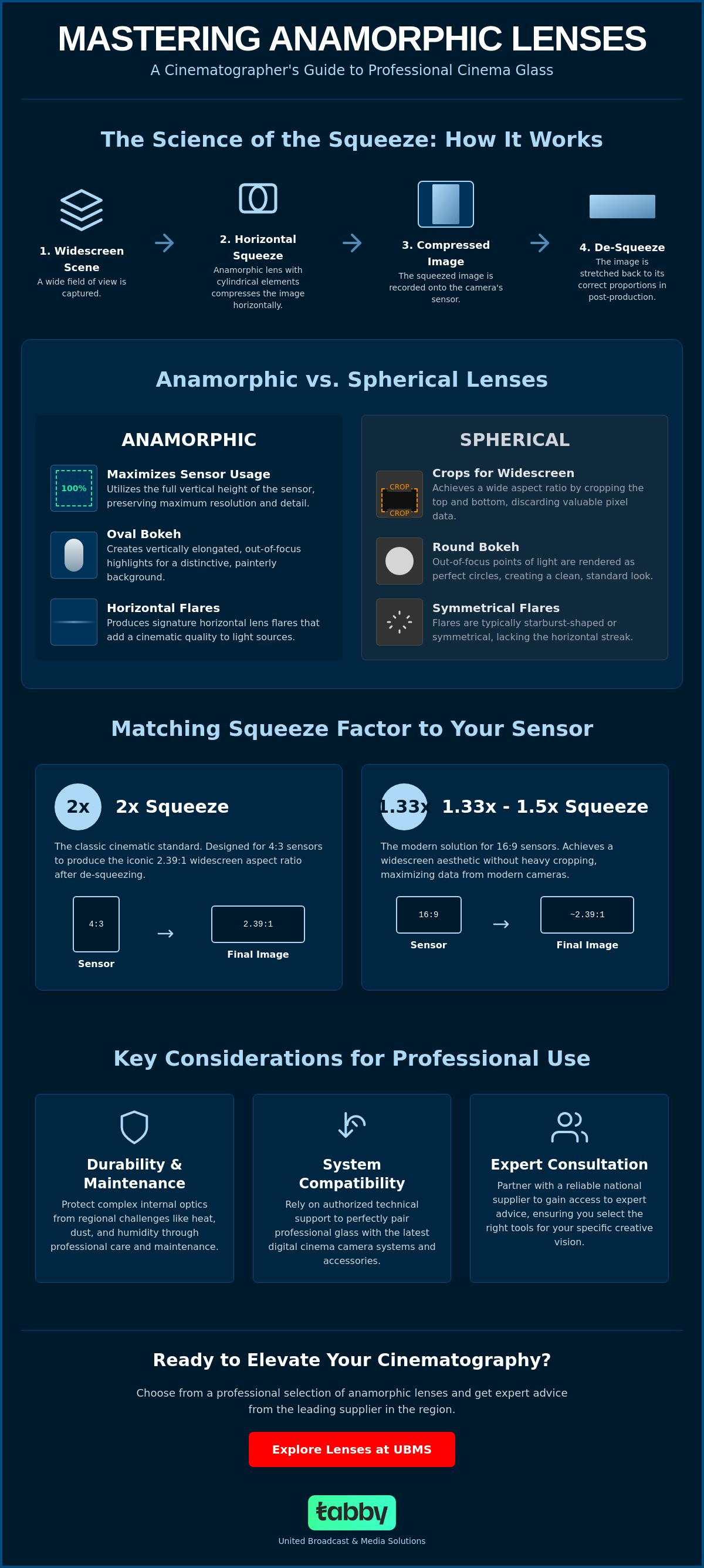
The anamorphic process is an optical solution to a physical limitation. In the mid-20th century, filmmakers needed a way to capture widescreen images on standard 35mm film without wasting precious resolution. By utilizing specialized optics, cinematographers could capture a vast field of view on a standard 35mm frame, maximizing the available surface area of the film stock. This Anamorphic format revolutionized cinema, establishing the 2.39:1 aspect ratio as the global standard for high-end feature films. When you use anamorphic lenses Dubai, you aren't just changing the frame shape; you're employing a sophisticated system of cylindrical glass elements to compress the image horizontally onto the sensor.
This horizontal compression is defined by the squeeze factor. A lens with a 2x squeeze, for example, captures twice as much horizontal information as a standard lens, which is then "de-squeezed" during the monitoring or post-production phase. This mathematical restoration stretches the pixels back to their natural proportions. The result is a wider perspective that maintains the full vertical height and detail of the camera sensor.
Anamorphic vs. Spherical Lenses
Spherical lenses project a circular image onto the sensor without distortion. To achieve a widescreen look with spherical glass, you must crop the top and bottom of the frame. This process effectively discards millions of pixels, which significantly reduces vertical resolution and image clarity. Anamorphic lenses take the opposite approach by using the full sensor height. This provides a shallower depth of field for a given field of view and creates the unique optical aberrations that filmmakers crave. The internal construction relies on cylindrical elements rather than purely spherical ones, which is the primary reason for the distinctive visual character of the footage.
Squeeze Factors and Sensor Compatibility
The squeeze factor must be carefully matched to the camera's sensor dimensions to avoid inefficient workflows or strange aspect ratios. Traditional 2x squeeze lenses were designed for 4:3 sensors, a combination that yields a final de-squeezed ratio of 2.66:1, which is typically cropped slightly to 2.39:1. However, many modern professional video cameras utilize 16:9 sensors. For these systems, 1.33x or 1.5x lenses are often more practical. These lower squeeze factors allow for a widescreen aesthetic without the extreme data loss associated with heavy cropping. Squeeze factors directly dictate the final resolution by determining the ratio at which horizontal pixels are expanded to fill the viewing screen.
The Visual Signature of Cinematic Anamorphic Glass
The visual soul of a motion picture is often defined by the specific optical flaws and characteristics of the glass used. When professionals invest in anamorphic lenses Dubai, they're looking for more than just a wider aspect ratio; they're seeking a specific texture that spherical lenses cannot replicate. Selecting anamorphic lenses Dubai requires a keen eye for these subtle variations in glass character. One of the most immediate identifiers is oval bokeh. Because the lens compresses the horizontal plane, out-of-focus light sources appear as vertically elongated ovals once the image is de-squeezed in post-production. This creates a dreamy, painterly background that separates the subject from the environment in a way that feels inherently cinematic.
The cinematic application of anamorphic lenses also introduces unique depth of field characteristics. For any given field of view, an anamorphic lens uses a longer focal length than its spherical counterpart. This results in a shallower depth of field, providing that high-end separation effect where the subject pops against a soft, textured background. You'll also notice lens breathing during focus pulls. Unlike spherical lenses that often zoom slightly, anamorphic glass tends to shift horizontally, adding a subtle sense of movement that audiences subconsciously associate with big-budget filmmaking.
The Aesthetic of Distortion and "Mumps"
Modern optics have largely solved the historical issue known as "anamorphic mumps," where subjects' faces appeared wider when focused at close distances. However, a degree of barrel distortion remains a desired trait. This slight curvature at the edges of the frame naturally draws the viewer's eye toward the center, creating an immersive, intimate experience. This emotional impact is why these lenses remain the primary choice for narrative storytelling where the relationship between the character and their surroundings is vital.
Choosing Your Flare Character
The choice of horizontal lens flare is a critical creative decision. While classic blue streaks are the hallmark of the genre, many cinematographers now opt for gold or neutral flares to better suit specific color palettes. Your choice of professional lighting equipment plays a significant role here. High-intensity point sources will trigger more dramatic streaks, whereas diffused lighting maintains a cleaner look. If you're unsure which optical character suits your next project, our team can provide a technical consultation to help you find the perfect match.
Selecting the Right Anamorphic Lens for Your Production
Selecting the correct glass requires a thorough understanding of both mechanical compatibility and creative intent. When browsing anamorphic lenses Dubai, the first hurdle is often matching the lens mount to your camera body. While PL mount remains the industry standard for high-end cinema, the rise of mirrorless systems has increased the demand for E-mount and EF-mount options. You must consider the physical weight of these optics; anamorphic lenses are significantly heavier than their spherical counterparts. A 35mm anamorphic prime can weigh twice as much as a standard prime, which directly impacts your choice of support systems, gimbals, and handheld configurations.
Optical consistency across a prime set is another vital consideration. If your 40mm lens produces a distinct blue flare but your 75mm remains neutral, your post-production color grade will be inconsistent. This is why professionals prioritize matched sets that offer uniform color, contrast, and flare characteristics. As detailed in The Science of the Squeeze, the way these lenses interact with the sensor dictates your final image quality. Investing in a high-quality set provides better long-term value than piecing together disparate lenses that may not match in a professional workflow.
Top Brands in the Anamorphic Space
ARRI and ZEISS represent the gold standard for optical precision, offering lenses with minimal distortion and high contrast. For those seeking a warmer, more organic aesthetic, Cooke Anamorphic/i lenses provide the legendary "Cooke Look" in a widescreen format. For filmmakers utilizing compact professional video cameras, Sony FE anamorphic options provide a lightweight solution without sacrificing the essential widescreen character required for modern productions.
Technical Evaluation Checklist
Before finalizing your selection, evaluate the following technical parameters:
- Sharpness vs. Softness: Determine if you need clinical sharpness at wide apertures or a more artistic, vintage softness.
- Close-Focus Capabilities: Anamorphic lenses typically have poor close-focus performance; you may need to budget for high-quality diopters.
- Electronic Metadata: Systems like Cooke /i Technology are essential for modern VFX workflows, as they record lens settings for every frame.
Matching the right anamorphic lenses Dubai to your specific project needs ensures that your technical choices support your narrative goals. This balance between ergonomics and optical performance is what separates a standard shoot from a global-tier production.
Maintaining Optical Precision in National Climates
Dubai's climate presents unique challenges for high-end cinema glass. The combination of fine desert dust and coastal humidity can quickly degrade the mechanical and optical performance of your gear. When working with anamorphic lenses Dubai cinematographers must be vigilant about particulates entering the lens barrel during lens changes. Even the smallest grains of sand can cause micro-scratches on the front element or interfere with the focus and iris rings. Particulates often find their way into the helicoid grease, leading to a gritty feel during focus pulls that can eventually seize the mechanism entirely.
On-location maintenance is your first line of defense. Always use a high-velocity air blower to remove loose dust before applying any liquid cleaner or microfiber cloth. This prevents you from grinding abrasive sand into the delicate lens coatings. For the sensor, regular inspections are required, especially when shooting in high-humidity environments where condensation can trap dust against the glass. Regular professional calibration is essential to ensure that the complex cylindrical elements remain perfectly aligned, as even a slight shift can ruin the de-squeezed image quality and introduce unwanted asymmetry in your bokeh.
Professional Service and Repair
Anamorphic optics are significantly more complex than spherical lenses. They require specialized collimation tools and laser alignment systems to ensure the squeeze factor remains consistent across the entire frame. If you notice a loss of contrast or a milky appearance in your footage, you may be dealing with internal haze or fungus growth. Identifying these issues early is critical to preventing permanent etching of the glass. For comprehensive technical support, you can rely on our dedicated center for cinema lens repair Dubai to restore your equipment to factory specifications.
Protecting Your Investment
Using high-quality clear or UV filters can provide a physical barrier against the elements. However, you must ensure these filters don't introduce unwanted reflections that compete with your natural anamorphic flares. Transporting your gear in airtight, hard-shell cases with desiccants is standard practice for regional productions to manage moisture levels. It is absolutely vital to keep professional cinema lenses in a climate-controlled storage environment with consistent humidity levels to prevent the long-term development of glass fungus. Contact our technical team today to schedule a professional inspection or maintenance session for your cinema optics.
Professional Solutions for Anamorphic Lenses Dubai at UBMS
United Broadcast & Media Solutions (UBMS) serves as the definitive hub for anamorphic lenses Dubai. We provide authorized distribution for world-leading cinema brands, ensuring that cinematographers have access to genuine, high-performance glass backed by full manufacturer support. Choosing the right optics involves more than just selecting a focal length; it requires a technical understanding of how specific glass interacts with the digital cinema cameras UAE professionals use for high-end commercials and feature films. Our team provides expert consultation to help you navigate squeeze factors and sensor coverage, ensuring your optical choices are technically sound and creatively impactful.
We believe that hands-on experience is vital when selecting cinema glass. Our national showroom allows you to test the specific visual signatures of different lens sets, from flare character to edge distortion. This practical approach ensures that the tools you select match your narrative vision. Beyond the initial acquisition, we provide comprehensive after-sales support to keep your equipment performing at its peak throughout its operational life.
Why Industry Professionals Choose UBMS
With over 25 years of expertise in the broadcast and media sector, we've built a reputation based on technical proficiency and service-oriented reliability. We don't just sell individual components; we provide complete production solutions. This includes access to comprehensive kits featuring ARRI lighting and advanced grip equipment. Our specialized system integration services ensure that your anamorphic workflow is seamless, whether you're working in a controlled studio or a demanding field environment. We understand the high stakes of professional production and offer the technical infrastructure to support your most ambitious projects.
Visit Our National Service Center
Our commitment to your production doesn't end at the point of sale. We understand that downtime is not an option in the professional media landscape. Our national service center is staffed by expert technicians specifically trained in the maintenance and repair of high-end cinema optics. We offer fast turnaround times for critical gear, ensuring your lenses are calibrated and ready for the next shoot. Whether you need a routine check-up for your anamorphic lenses Dubai or a complex mechanical adjustment, our facility is equipped with the necessary precision tools to restore your glass to factory specifications. Contact us for a personalized consultation to discuss your specific lens requirements and explore our full range of cinematic solutions.
Advancing Your Cinematic Vision with Professional Optics
Mastering the use of anamorphic glass is a transformative step for any filmmaker aiming to reach global production standards. By understanding the technical mechanics of the squeeze factor and the specific visual character of oval bokeh, you can make informed decisions that serve your narrative. Proper maintenance remains critical, as the regional climate requires a proactive approach to protecting complex internal elements from humidity and dust. Accessing the right anamorphic lenses Dubai through a trusted partner ensures that your equipment is always calibrated for peak performance.
Since 1997, United Broadcast & Media Solutions has supported the regional film community with industry-leading expertise. As an authorized dealer for premier brands like ARRI, Sony, and Cooke, we provide the technical infrastructure and authorized service center support necessary for high-stakes productions. Whether you're configuring a new camera package or require expert repairs, our team is ready to assist you. Explore our full range of professional cinema lenses to find the perfect optical signature for your next project. We look forward to helping you achieve your creative objectives with precision and reliability.
Frequently Asked Questions
What is the main difference between anamorphic and spherical lenses?
Spherical lenses capture images without horizontal distortion, whereas anamorphic optics use cylindrical elements to squeeze a wider field of view onto a narrower sensor. This process creates unique optical traits like oval bokeh and horizontal flares. While spherical lenses require cropping to achieve a widescreen look, anamorphic glass utilizes the full sensor height. This results in superior resolution and a distinct cinematic texture that cropping cannot replicate.
Can I use anamorphic lenses on a mirrorless camera like the Sony Alpha?
Yes, many modern anamorphic lenses are available in native E-mount or can be used via PL to E-mount adapters. Compact mirrorless systems are increasingly popular for anamorphic cinematography due to their advanced stabilization and high resolution sensors. However, you must ensure your camera supports an anamorphic de-squeeze display mode. This allows you to monitor your framing accurately in real time during the shoot.
Why do anamorphic lenses produce blue flares?
Blue flares are caused by internal reflections off the cylindrical lens elements, often enhanced by specific anti-reflective coatings. While the classic blue streak is the most famous visual signature, modern lens coatings also allow for gold or neutral flares. The intensity and color of these streaks depend on the light source's angle and the specific optical design. This characteristic is a primary reason filmmakers choose these specialized optics.
Is a 2x squeeze better than a 1.33x squeeze for professional film?
Neither is inherently better, as the choice depends on your sensor's aspect ratio. A 2x squeeze is the traditional standard for 4:3 sensors, providing the most dramatic oval bokeh and flares. A 1.33x or 1.5x squeeze is often preferred for 16:9 sensors to achieve a 2.39:1 widescreen ratio. This allows for a cinematic aesthetic without the extreme horizontal stretching or excessive data loss in post-production.
How do I de-squeeze anamorphic footage in my editing software?
Most professional editing platforms like DaVinci Resolve or Adobe Premiere Pro allow you to set the Pixel Aspect Ratio in the clip attributes. By selecting the correct multiplier, such as 1.33x or 2.0x, the software mathematically stretches the pixels back to their natural proportions. This ensures your final export maintains the correct widescreen aspect ratio without distortion. It's a standard step in the professional anamorphic workflow.
Are anamorphic lenses compatible with all digital cinema cameras?
Compatibility depends on the lens mount and the sensor size. While most digital cinema cameras feature PL mounts, you must verify if the lens covers the specific sensor area, such as Super 35 or Full Frame. Some high-end anamorphic lenses Dubai professionals use require a 4:3 sensor mode to fully utilize the 2x squeeze factor. Without this compatibility, you may experience vignetting or resolution issues in your final image.
What maintenance is required for high-end cinema lenses in the UAE?
Regional maintenance focuses on protecting the glass from high humidity and abrasive desert dust. Technicians must regularly inspect internal elements for haze or fungus, which can thrive in the Middle East's climate. Mechanical components like focus gears also require periodic cleaning and re-greasing. This prevents sand from causing friction or seizing the delicate internal helicoids, ensuring the lens remains smooth and reliable on location.
Does UBMS offer technical support for anamorphic lens calibration?
UBMS provides specialized technical support through our national service center, where expert technicians handle precise lens calibration and collimation. We utilize advanced optical testing tools to ensure your anamorphic lenses Dubai remain perfectly aligned for consistent squeeze factors and sharpness. Our team understands the high stakes of professional production. We offer fast turnaround times to ensure your critical equipment is ready for the next shoot.


