

Live Production Equipment and Workflow Solutions: The 2026 Professional Guide
What if the infrastructure you rely on today becomes the very bottleneck that prevents your broadcast from scaling tomorrow? As the industry firmly moves toward 2026, the demand for high-capacity, low-latency workflows has never been more critical. Selecting the right live production equipment professionals across the UAE trust is no longer just about purchasing a camera; it's about engineering a deterministic environment where hardware and software exist in perfect sync. You likely recognize the frustration of managing high latency in remote setups or the technical friction that occurs when transitioning from legacy SDI to modern IP-based systems.
We understand that interoperability issues between competing brands can stall a project before it even begins. This guide provides a comprehensive technical roadmap to mastering the shift toward SMPTE ST 2110 and NDI 6 standards. You'll learn how to build a scalable production ecosystem that reduces operational costs through intelligent hybrid models. We'll explore the essential hardware and system integration strategies needed to ensure your workflow remains resilient, efficient, and ready for the high stakes of professional media.
Key Takeaways
- Master the transition from legacy SDI hardware to deterministic, IP-based infrastructures that offer greater scalability for 2026 workflows.
- Learn to select the professional live production equipment Dubai broadcasters require to maintain superior dynamic range and optical excellence in the acquisition layer.
- Compare the technical advantages of NDI 6 and SMPTE ST 2110 to identify the most efficient signal transport protocol for your facility’s specific requirements.
- Discover a technical roadmap for implementing remote production (REMI) models that prioritize low-latency signal backhaul and bandwidth efficiency.
- Understand why professional system integration and dedicated technical maintenance are essential for preventing interoperability issues and maximizing long-term ROI.
The Evolution of Live Production Workflow Solutions
Live production workflow solutions have evolved from a collection of isolated hardware units into highly integrated ecosystems. These systems now manage the entire lifecycle of a signal, from the initial capture and routing to final delivery. In 2026, the industry has reached a pivotal stage where deterministic networks provide the reliability once reserved for specialized cabling. This shift means that hardware is no longer a standalone tool; it's a critical node within a software-defined environment. For professionals sourcing live production equipment Dubai broadcasters depend on, understanding this infrastructure is the first step toward building a future-proof facility. High-tier live production equipment Dubai specialists utilize must be compatible with both current standards and emerging IP protocols to remain competitive.
From SDI to IP: A Necessary Transition
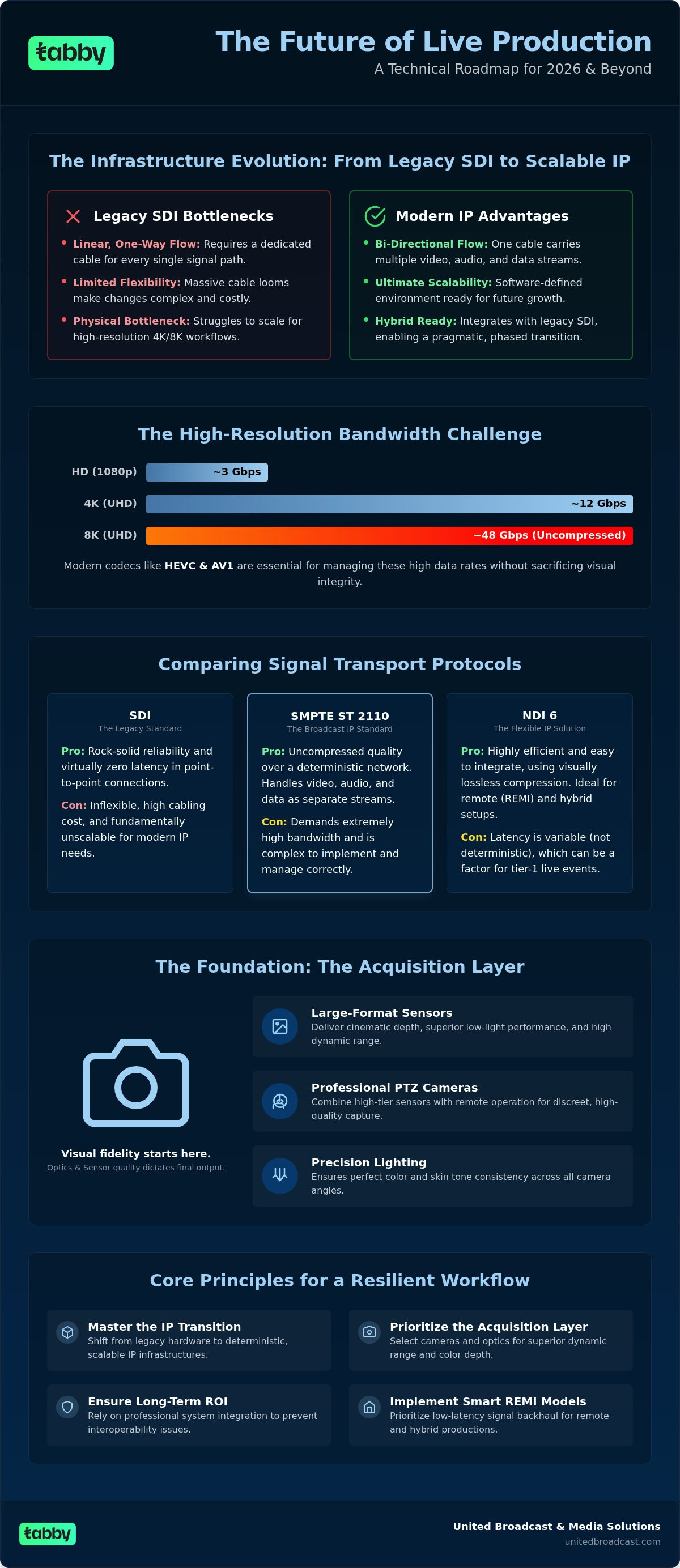
Traditional serial digital interface (SDI) cabling served the industry well for decades, but its linear, one-way nature creates significant bottlenecks in modern environments. SDI requires dedicated cables for every signal path, which often leads to massive cable looms and limited flexibility. IP-based infrastructures utilize bi-directional signal flow, allowing a single network cable to carry multiple video, audio, and metadata streams simultaneously. Most national broadcasters currently operate in hybrid environments. These setups bridge the gap by maintaining legacy SDI reliability while integrating the scalability of IP. It's a pragmatic approach that ensures stability during the transition to fully networked operations.
The Impact of 4K and 8K on Workflow Architecture
The push for 4K and 8K resolution has fundamentally changed how we calculate bandwidth and storage. A single uncompressed 4K stream demands roughly 12Gbps, which pushes the limits of standard infrastructure. Modern codecs such as HEVC and AV1 are now essential for optimizing these signals without sacrificing visual integrity. Even with advanced compression, the acquisition stage remains the most critical point of the chain. Utilizing high-performance professional video cameras ensures that the raw data captured has the dynamic range and color depth needed for high-resolution delivery. In 2026, the synergy between elite optical hardware and robust network protocols defines the success of any live production.
Core Hardware Foundation: The Acquisition Layer
While the previous section highlighted the shift toward IP-based backends, the acquisition layer remains the most critical factor in visual fidelity. In 2026, the quality of your output is still dictated by the physical properties of your sensor and optics. High-end live production equipment Dubai specialists utilize must prioritize sensor size and dynamic range to ensure signals remain robust through the distribution chain. Capturing a high-bitrate signal with deep color information allows for more flexibility in the vision mixer, especially when matching multiple sources in a complex live environment. Ensuring color accuracy at this stage prevents technical debt during the delivery phase.
Professional Cameras and Optical Systems
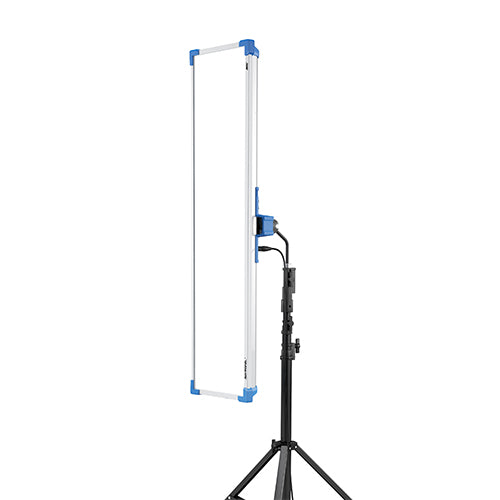
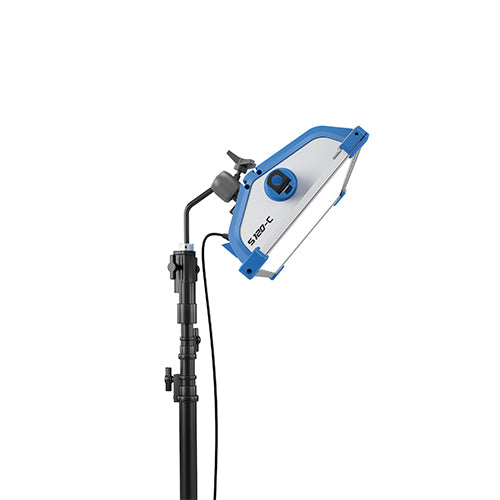
Integrating large-format sensors into live multi-camera setups has become a standard practice for achieving a cinematic aesthetic. These sensors provide superior low-light performance and a shallow depth of field that smaller broadcast sensors simply can't replicate. Alongside these, we've seen the rise of professional-grade PTZ cameras. These units now feature the same high-tier sensors found in standalone studio cameras, making them ideal for discreet placement without sacrificing image quality. To ensure these cameras perform at their peak, you must integrate precise lighting solutions that offer consistent color temperatures. Many professionals rely on ARRI lighting to maintain perfect skin tone consistency across various camera angles. This consistency is vital for maintaining a professional look throughout a long-form broadcast. Monitoring also demands high-accuracy reference displays to verify that what you capture is exactly what the viewer sees.
Support Systems and On-Set Infrastructure
The physical stability of your acquisition layer is just as important as the electronics inside the camera. Specialized kits, such as the ARRI Omnibar Production Kit, provide the versatility needed to mount complex camera rigs and accessories in tight spaces. Beyond mounting, professional grip hardware ensures that heavy cinema-grade lenses remain stable during rapid pans or tilts. Power management also requires a redundant approach. In 2026, mission-critical events utilize decentralized power blocks and hot-swappable battery systems to prevent any single point of failure from taking a camera offline. When sourcing the live production equipment Dubai professionals require, infrastructure reliability isn't an afterthought. If you're looking to upgrade your acquisition chain, reach out to our technical team for a detailed system analysis.
Signal Transport Standards: Comparing NDI 6, SDI, and ST 2110
Once the acquisition layer captures high-fidelity data, the focus shifts to how that signal moves through the facility. In 2026, the choice of transport protocol defines the flexibility and latency of the entire workflow. For high-end live production equipment Dubai facilities utilize, the debate usually centers on the trade-off between uncompressed reliability and networked efficiency. While SDI remains a legacy fallback for its simplicity, modern IP-based protocols offer the bi-directional communication required for complex, multi-site productions. Selecting the right standard depends heavily on your bandwidth availability and the specific requirements of the broadcast.
The ST 2110 Ecosystem: Uncompressed Professionalism
SMPTE ST 2110 has solidified its position as the gold standard for professional-grade IP broadcast. Unlike older standards that wrap everything into one stream, ST 2110 breaks the signal into essence flows. ST 2110-20 handles the video, -30 manages the audio, and -40 carries the ancillary metadata. This separation allows operators to route audio or metadata independently without processing the heavy video essence. However, this precision requires a robust Precision Time Protocol (PTP) implementation. Synchronization is the heartbeat of an ST 2110 network. If the PTP clocking isn't perfectly tuned, the deterministic nature of the network fails. Investing in a full ST 2110 backbone is a significant commitment, but it's the only way to achieve zero-compromise, uncompressed signal transport in a high-stakes environment.
NDI 6 and Beyond: Efficient Workflows
NDI 6 has fundamentally changed the perception of compressed IP workflows. By improving bit-depth and color support to 10-bit HDR, it now meets the technical requirements of many high-end productions that previously required uncompressed paths. One of its greatest strengths is its ease of discovery. Devices on an NDI network register themselves automatically, which drastically reduces setup time. This makes it a primary choice for broadcast studio gear UAE professionals use in corporate and fast-turnaround environments. While NDI introduces a small amount of compression latency, it's often negligible for everything except the most demanding real-time sports applications. For remote links over the public internet, Secure Reliable Transport (SRT) remains the essential partner to these protocols. SRT ensures that even when packet loss occurs on a volatile network, the feed remains stable and secure. Balancing these protocols within your live production equipment Dubai setup ensures you have the right tool for every delivery challenge.
Implementing Remote Production (REMI) and Hybrid Models
Remote production, or REMI, has transitioned from an emergency alternative to a standard operating procedure for broadcasters in 2026. This model centralizes the technical crew at a master control room while only the acquisition team remains on-site. When sourcing the live production equipment Dubai engineers trust for these setups, the priority is creating a deterministic path over non-deterministic networks. Success depends on a methodical approach to infrastructure and a clear understanding of the signal chain's requirements.
- Step 1: Assess bandwidth at both the remote site and the master control room. You need a consistent uplink speed that exceeds your total bitrate by at least 20 percent to account for network jitter.
- Step 2: Select low-latency hardware encoders and decoders. In 2026, HEVC remains the standard for maintaining visual quality at lower bitrates during signal backhaul.
- Step 3: Establish a robust intercom and tally system. Remote teams can't function without real-time communication that operates with the same low latency as the video feed.
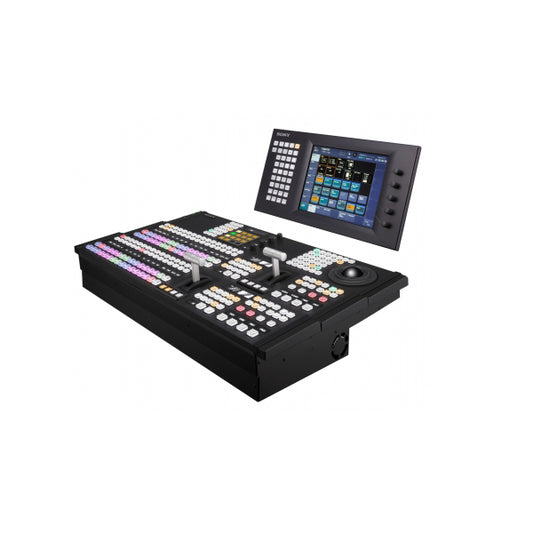
- Step 4: Implement your switcher. Whether using cloud-based instances or on-premise hardware, the switcher must handle incoming streams with varying arrival times.
- Step 5: Test synchronization. Ensure that multi-camera feeds are aligned perfectly to prevent jarring cuts or audio-sync issues.
The Rise of the Virtual Control Room
The virtual control room relies on software-based switchers to manage global production teams from a single interface. Monitoring is vital here; operators need high-performance displays to maintain quality control from afar. For compact remote setups, many teams are integrating Sony Alpha cameras and lenses. These systems provide full-frame cinematic quality in a form factor that's easy to deploy in temporary locations, making them a cornerstone of modern live production equipment Dubai inventories for agile teams.
Managing Latency and Jitter
Managing latency and jitter is the greatest technical hurdle in remote production. While software encoding is flexible, hardware-based encoding still wins in high-stakes environments due to its dedicated processing power and stability. For mobile hubs, OB van system integration provides a localized infrastructure that can process signals before they hit the long-haul network. This reduces the primary point of failure and ensures a cleaner feed for the master control room, regardless of the distance between the event and the studio.
System Integration and Technical Maintenance: Ensuring ROI
Investing in a high-end signal chain is only the first half of the equation. The true return on investment (ROI) comes from how those components interact under the pressure of a live broadcast. Professional system integration is the difference between a collection of individual parts and a cohesive technical solution. For those acquiring live production equipment Dubai specialists provide, the integration phase ensures that every encoder, switcher, and camera communicates without friction. To explore professional AV integration and support options, learn more about JVG Sound Lighting & Visual Pty Ltd. DIY setups often suffer from hidden costs, specifically the high price of downtime and the technical friction caused by brand incompatibility. A single misconfigured network switch or an outdated firmware version can take an entire production offline, negating any initial savings.
A successful workflow begins with a detailed consultation and design phase. This involves mapping the technical infrastructure to specific production goals, ensuring that the bandwidth and routing capabilities match the intended output. Once the design is finalized, professional installation and team training follow. Training is often overlooked, yet it's essential for ensuring the crew can maximize the capabilities of the new infrastructure. Proximity to a dedicated service center is equally vital for after-sales support. In the high-stakes environment of 2026, having a local technical partner who understands the specific nuances of your system integration is the key to maintaining 99.9 percent uptime.
Hardware Longevity and Upgrades
Maintaining high-tier live production equipment Dubai facilities rely on requires a proactive approach to both software and hardware. In an IP-connected world, firmware management is a continuous task. Keeping devices updated ensures compatibility with the latest SMPTE and NDI standards while patching security vulnerabilities. Physical maintenance is just as critical for the acquisition layer. Professional sensor maintenance prevents artifacts that can ruin high-resolution 4K and 8K feeds, while cinema lenses require regular calibration to ensure focus mechanics remain precise over years of use.
- Regular calibration: Extends the life of optics and ensures color consistency across multi-camera setups.
- Strategic component swapping: A well-integrated system allows you to upgrade specific nodes, like a primary camera, without rebuilding the entire workflow from scratch.
- Service center support: Access to a dedicated repair facility reduces the turnaround time for mission-critical hardware failures.
Relying on a dedicated service center for these tasks protects your capital expenditure. By focusing on technical resilience and regular maintenance, broadcasters can transition from reactive troubleshooting to a state of operational excellence.
Future-Proofing Your Broadcast Ecosystem
The shift toward IP-based workflows represents a fundamental change in how we approach broadcast architecture. By integrating deterministic standards like SMPTE ST 2110 and NDI 6, your facility gains the flexibility to scale without the physical limitations of legacy cabling. Success in 2026 requires more than just high-end hardware; it demands a synergy between elite acquisition tools and a robust, well-maintained network. We bring decades of experience in broadcast and cinema technology to every project, backed by an expert system integration team with national coverage and an authorized service center for major global brands. Finding the right live production equipment Dubai professionals trust is easier when you've got a technical partner dedicated to your long-term ROI.
Your transition to a modern, low-latency environment starts with a clear technical roadmap. We're here to ensure your workflow remains resilient and ready for the future of professional media. Let's build a solution that keeps your production ahead of the curve.
Frequently Asked Questions
What is the primary difference between SDI and IP live production workflows?
The primary difference lies in signal routing and scalability. SDI uses one-way, point-to-point connections requiring dedicated cables for every signal. IP workflows utilize a bi-directional network where multiple video, audio, and data streams share a single high-bandwidth cable. This allows for massive scalability and remote access. When upgrading live production equipment Dubai facilities often choose IP for its ability to handle 4K and 8K signals without the physical bulk of traditional cabling.
Can I use my existing cinema cameras in an IP-based live production workflow?
You can absolutely integrate digital cinema cameras into IP workflows by using specialized encoders or IP-native camera backs. This approach allows you to leverage large-format sensors and superior dynamic range within a live broadcast environment. Encoders convert the SDI or HDMI output into NDI or ST 2110 streams. It's a popular choice for high-end productions that want a cinematic look while maintaining the efficiency of a networked infrastructure.
What bandwidth is required for a 4K REMI production?
A compressed 4K REMI feed using HEVC or AV1 typically requires between 25 Mbps and 50 Mbps per camera for high-quality backhaul. However, you must also account for return feeds, intercom, and tally signals. For uncompressed 4K over a local network, bandwidth needs jump to 12 Gbps. Always ensure your uplink has a 20 percent overhead to manage network jitter and prevent packet loss during critical live events in 2026.
Is NDI reliable enough for professional television broadcasting?
NDI 6 is highly reliable for professional television broadcasting, particularly in corporate studios and fast-paced news environments. With its support for 10-bit color and HDR, it meets the technical benchmarks required for modern delivery. While it uses compression, the latency is minimal enough for most live applications. Many broadcasters use it as a primary protocol for internal routing while reserving uncompressed ST 2110 for high-stakes national sports or cinema-grade productions.
How does SMPTE ST 2110 handle audio and video synchronization?
SMPTE ST 2110 handles synchronization through the Precision Time Protocol (PTP), defined in the ST 2110-10 standard. PTP provides a common grandmaster clock that ensures video, audio, and metadata essence flows remain perfectly aligned as they move through the network. This eliminates the need for traditional black burst or tri-level sync cables. It's a deterministic approach that maintains frame-accurate timing across thousands of networked devices in a complex, modern facility.
What are the benefits of a hybrid live production model?
A hybrid model allows you to leverage the reliability of legacy SDI hardware while gradually integrating the scalability of IP. This approach protects your existing investment in live production equipment Dubai while providing a bridge to 4K and remote production capabilities. It reduces the risk of a total system overhaul and allows your team to train on new protocols without compromising current broadcast uptime. It's the most pragmatic path to modernizing a facility.
How often should professional broadcast equipment undergo technical maintenance?
Professional broadcast gear should undergo technical maintenance every six to twelve months to ensure peak performance. This includes sensor cleaning, firmware updates, and lens calibration. Cinema lenses, in particular, require regular mechanical checks to maintain focus precision. IP-connected devices also need routine security audits and firmware management. Using a dedicated service center helps identify potential component failures before they cause expensive on-air downtime during a mission-critical live production.
What role does a system integrator play in setting up a new TV studio?
A system integrator designs the technical blueprint of a studio to ensure all hardware and software work in harmony. They manage everything from bandwidth calculations to physical installation and staff training. Their role is to prevent interoperability issues between different equipment brands and to optimize the signal chain for maximum efficiency. By partnering with an integrator, you ensure your facility is engineered for long-term ROI and operational stability from the very first broadcast.


