

Anamorphic Lenses: The Professional’s Guide to Achieving the Cinematic Look
Choosing the wrong squeeze factor for your sensor doesn't just distort your image; it fundamentally breaks the professional workflow that defines high-end cinema. You likely recognize the iconic horizontal flares and oval bokeh that define the Hollywood aesthetic, but achieving that look consistently requires more than just mounting anamorphic lenses. While these optics offer a distinct visual character that spherical glass cannot match, they also introduce unique technical challenges. From managing the physical weight of heavy cinema glass to resolving the confusion between 1.33x and 2x compression ratios, the learning curve is often steep for professional cinematographers.
We understand that the transition to anamorphic production can feel daunting when you're balancing gear compatibility and desqueezing workflows in DaVinci Resolve 21 or Adobe Premiere 26.2. This guide provides the technical clarity you need to master these nuances and elevate your production with a true widescreen aesthetic. You'll learn how to select the right support gear for heavy optics, understand lens-to-sensor compatibility, and ensure your final output meets professional standards. This article offers a definitive roadmap for integrating anamorphic technology into your next project in the UAE with absolute confidence.
Key Takeaways
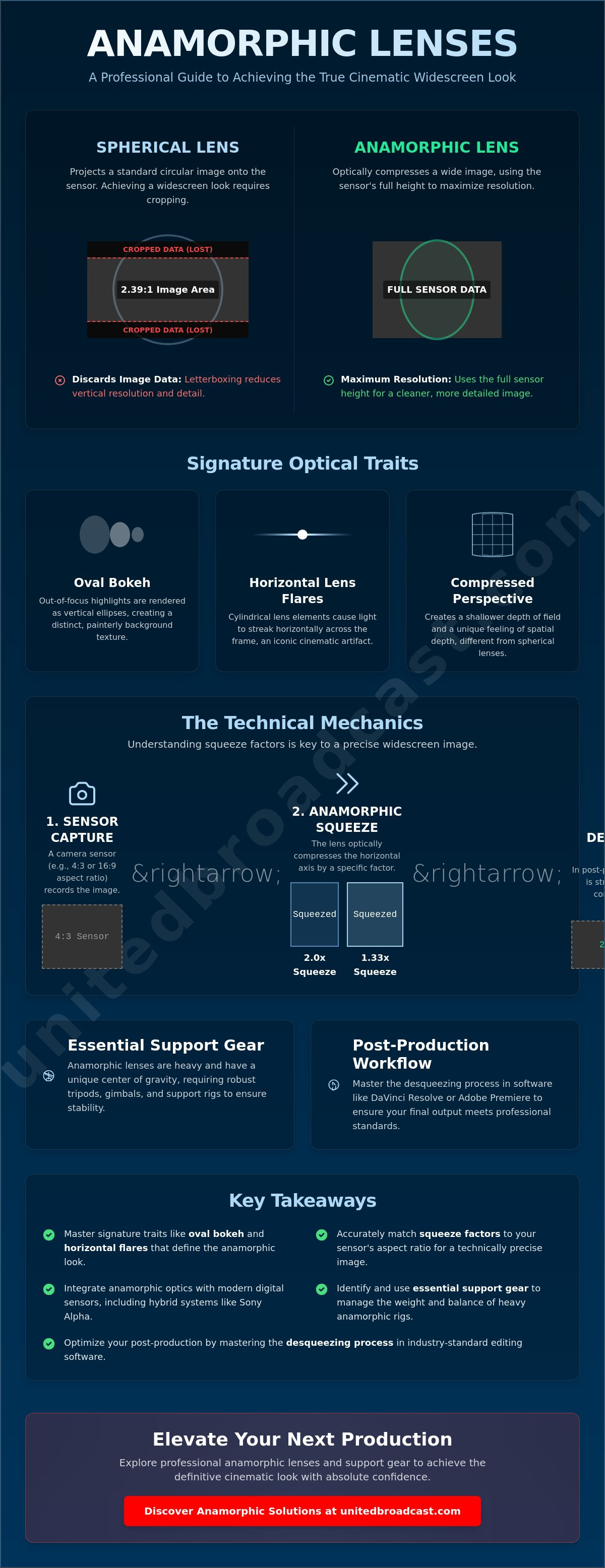
- Understand the mechanical shift from spherical to cylindrical optics to master signature traits like oval bokeh and horizontal flares.
- Learn how to accurately match specific squeeze factors to your sensor's aspect ratio for a technically precise widescreen image.
- Explore the integration of anamorphic glass with modern digital sensors, including specific considerations for hybrid systems like Sony Alpha cameras.
- Identify the essential support gear required to manage the physical weight and unique center of gravity inherent to professional anamorphic lenses.
- Optimize your post-production workflow by mastering the desqueezing process within the latest versions of industry-standard editing software.
What are Anamorphic Lenses? Defining the Widescreen Standard
The visual identity of modern cinema is often defined by the widescreen format. While spherical lenses remain the industry standard for general capture, anamorphic lenses provide a specialized optical solution designed to maximize field of view without sacrificing vertical resolution. Unlike spherical lenses that project a circular image onto the sensor, anamorphic glass utilizes cylindrical elements to compress a wider horizontal perspective into a standard frame. This mechanical shift allows for a much broader field of view than traditional optics, creating the expansive vistas and intimate, wide-angle close-ups that characterize big-budget filmmaking.
Historically, this technique emerged in the 1950s with the introduction of the Anamorphic format, specifically CinemaScope, to compete with the growing popularity of television. By squeezing a 2.39:1 aspect ratio onto a 4:3 film strip, filmmakers achieved a grander scale that home television could not match. Today, this tradition continues in digital cinema. Professional filmmakers prioritize these lenses not just for the aspect ratio, but for the unique emotional texture and legendary optical artifacts they introduce to the frame.
The Concept of Optical Compression
The technical foundation of this look is the squeeze factor. Anamorphic compression is the optical squeezing of a wide image onto a narrower sensor area. By utilizing cylindrical elements, the lens captures a field of view significantly wider than a spherical lens of the same focal length. This process requires the image to be "desqueezed" during monitoring or post-production to restore the correct proportions. This relationship allows cinematographers to use more of the sensor's real estate, particularly on professional video cameras equipped with 4:3 or Open Gate sensor modes.
Anamorphic vs. Cropped Spherical
It's a common misconception that simply adding black bars to a spherical image creates a cinematic look. This "letterboxing" approach actually discards valuable image data, reducing your vertical resolution and overall detail. In contrast, anamorphic lenses use the full height of the sensor, providing a significant resolution advantage. This results in a cleaner, more detailed image even when projected on massive screens.
Perspective and depth also change fundamentally with anamorphic optics. Because an anamorphic lens has a longer focal length vertically than it does horizontally, it creates a shallower depth of field and a more compressed perspective. This creates a distinct feeling of space that feels more immersive and three-dimensional than a simple crop. For professionals, choosing these optics is a deliberate decision to favor character and texture over clinical perfection.
Signature Optical Traits: Flares, Bokeh, and Distortion
The appeal of anamorphic lenses extends far beyond the widescreen aspect ratio. For many cinematographers, the primary motivation for choosing these optics lies in their unique "imperfections" which add a layer of organic texture to the digital image. These visual cues are the result of how light interacts with cylindrical glass elements, creating a look that is impossible to replicate perfectly in post-production. Identifying these traits is essential for any professional looking to define their visual style.
Oval bokeh is perhaps the most recognizable characteristic. In a standard spherical lens, out-of-focus highlights appear circular. However, because anamorphic glass squeezes the image horizontally, those circular highlights are compressed into an elliptical or oval shape. This effect is most pronounced with a 2x squeeze factor, providing a background texture that feels more vertical and painterly. While some budget options attempt to simulate this, true anamorphic bokeh offers a depth and dimensionality that distinguishes high-tier productions.
Lens flares also behave differently within these optics. While some entry-level brands focus exclusively on vivid blue horizontal streaks, professional cinema lenses from manufacturers like Cooke or ZEISS offer a broader palette. Depending on the lens coating, these flares can range from neutral silver to warm amber, providing a more sophisticated and less distracting aesthetic. Additionally, focus breathing in anamorphic glass often manifests as a subtle horizontal stretching of the frame during a focus pull, a signature trait that adds a sense of movement and energy to a scene.
Depth of Field and Dimensionality
Anamorphic optics create a "large format" feel even on Super 35 sensors. Because you are using a longer focal length to achieve a wider horizontal field of view, the depth of field is shallower than a spherical lens with an equivalent horizontal perspective. This results in superior subject separation. The background appears more compressed, pulling distant elements closer to the subject and creating a sense of intimacy within an expansive frame.
Edge Distortion and Character
Vintage anamorphic glass often exhibits the "Waterfall" effect, where vertical lines near the edges of the frame appear to stretch or curve. This barrel distortion adds a sense of character that many filmmakers prefer for narrative storytelling. Modern designs, such as those from ZEISS, prioritize optical precision and minimize these distortions while maintaining the essential anamorphic feel. Choosing between vintage character and modern clarity depends on the specific requirements of your project. To manage the physical demands of these complex optical builds, it's vital to pair your rig with professional support systems that can handle the increased weight and shifting center of gravity.
Technical Mechanics: Squeeze Factors and Desqueezing
Mastering anamorphic lenses requires a shift from purely creative thinking to precise technical calculation. The squeeze factor is the numerical value representing how much the lens horizontally compresses the image. While legacy cinema often defaulted to a 2x squeeze, the diversity of modern digital sensors has introduced a range of factors that operators must understand to ensure their footage is usable for broadcast or theatrical delivery. In the UAE, where broadcast and commercial production standards are exceptionally high, selecting the right squeeze factor is a foundational decision that impacts every stage of the workflow.
Choosing a squeeze factor that doesn't align with your sensor's native dimensions can lead to wasted resolution or awkward cropping in post-production. For example, using a 2x lens on a standard 16:9 sensor results in an ultra-wide 3.55:1 aspect ratio, which is often too wide for most delivery requirements and requires significant side-cropping. Conversely, using the correct pairing ensures you're utilizing the maximum available sensor area, resulting in the high-fidelity, "clean" widescreen look that clients expect from professional productions.
Choosing the Right Squeeze for Your Project
- 1.33x: This factor is designed primarily for 16:9 sensors, common in many Sony Alpha cameras and lenses used for hybrid work. It stretches the image to approximately 2.35:1 without losing significant vertical resolution.
- 1.5x and 1.8x: These factors serve as a modern middle ground. They are often paired with 3:2 full-frame sensors to achieve a 2.39:1 delivery ratio with more pronounced anamorphic character than 1.33x glass.
- 2x: Known as the industry gold standard, this factor is intended for 4:3 "Open Gate" sensor modes found on high-end digital cinema cameras. It provides the most dramatic version of the oval bokeh and flares discussed in previous sections.
Monitoring and Focus Pulling
Focusing with anamorphic glass is notoriously difficult. Because the out-of-focus areas are distorted into ellipses, judging the exact point of critical sharpness is harder than with spherical glass. A high-resolution monitor with a built-in desqueeze tool is mandatory for the crew. Without real-time desqueezing, the "skinny" squeezed image makes it nearly impossible for a 1st AC to pull focus accurately during complex camera movements. Essential accessories like wireless follow-focus systems and laser rangefinders become even more vital when working with these heavy, complex optics. Ensuring your pixel aspect ratio is correctly set in your camera's metadata will also save hours of troubleshooting during the desqueeze process in post-production.
Integrating Anamorphic Optics into Modern Digital Workflows
Modern digital sensors have fundamentally changed how cinematographers deploy anamorphic glass. While Super 35 was the industry standard for decades, the rapid adoption of large-format sensors has expanded the utility of anamorphic lenses. You must verify that a lens's image circle fully covers your specific sensor dimensions to prevent aggressive vignetting or soft edges. While PL mount remains the definitive professional standard for high-end cinema, many operators in the UAE now utilize E-mount or EF mount adaptations for versatile hybrid systems.
Sony Alpha cameras and lenses are frequently used by local production houses to balance high-end aesthetics with logistical efficiency. These systems are particularly effective when paired with 1.33x or 1.5x squeeze factors, allowing for a cinematic widescreen ratio while maintaining a manageable file size. However, the camera's ability to handle high bitrates is a critical factor when choosing your recording format. Ensuring your camera can record in 10-bit or higher is vital for maintaining the subtle gradients and flares unique to these optics.
Sensor Modes and Data Rates
Shooting anamorphic isn't just an optical choice; it's a data management challenge. High-resolution capture at 6K or 8K is necessary because the desqueeze process stretches pixels horizontally, which can expose compression noise in lower-bitrate files. Open Gate sensor modes are required to utilize the full vertical height of 2x anamorphic lenses. By capturing the sensor's entire vertical area, you maximize the available resolution and maintain the highest possible image fidelity after the horizontal stretch is applied in post-production. This approach prevents the loss of detail that occurs when you crop a standard 16:9 frame to fit a widescreen aspect ratio.
Lens Calibration and Metadata
Precise lens calibration is the difference between a professional delivery and a technical failure. High-end optics often feature metadata systems like Cooke’s /i Technology or ARRI’s LDS, which communicate real-time lens data to the camera. This information allows software like DaVinci Resolve 21 or Adobe Premiere 26.2 to automate the desqueeze process and apply accurate distortion corrections based on the lens's specific profile. To maintain this precision on set, we recommend using professional camera support to prevent any flex in the lens mount. Heavy anamorphic builds can put significant strain on a camera body, making rigid support systems essential for maintaining optical alignment throughout the shoot.
Essential Support: Stability for Heavy Anamorphic Rigs
While spherical glass often allows for a compact setup, anamorphic lenses are inherently larger and heavier due to the complex cylindrical elements required for horizontal compression. This physical reality creates a significant challenge for camera operators. It isn't just about the total weight of the glass; it's about the distribution of that weight. Most anamorphic optics are front-heavy, which shifts the center of gravity far forward of the camera's mounting point. This imbalance puts immense torsional stress on the lens mount and the tripod head, making smooth operation impossible without the right support infrastructure.
Standard photo tripods and lightweight video heads typically fail under the demands of a professional cinema rig. They lack the structural rigidity to handle the torque generated when tilting a front-heavy system. When you use anamorphic lenses, every vibration is magnified by the widescreen perspective. Ensuring your camera remains perfectly level and your movements stay fluid requires a move toward dedicated cinema support systems that can handle high-payload capacities without flexing or slipping under pressure.
The Need for High-Payload Fluid Heads
Calculating the exact counterbalance for your fully rigged camera is a non-negotiable step in your workflow. Your fluid head must support the combined weight of the camera body, anamorphic glass, matte box, and wireless follow focus motors. Brands like Sachtler and OConnor are industry standards for a reason; they offer stepped drag systems that provide consistent resistance. This precision is essential when working with wide optics where even a minor stutter in a pan can ruin a take. A high-quality fluid head ensures that once you find the balance point, the camera stays exactly where you leave it, regardless of the tilt angle.
Precision Support Systems
To protect your equipment, you must use lens supports and bridge plates to distribute weight across the entire rig. A dedicated lens support attaches to 15mm or 19mm studio rods, taking the physical strain off the lens mount. This prevents optical misalignment and potential damage to the camera's internal electronics. For professionals operating across the UAE, carbon fiber tripod legs offer the best balance between payload capacity and portability for national transport. These systems provide the necessary dampening to eliminate micro-vibrations during high-resolution capture.
Achieve rock-solid stability for your cinema rig. Explore our professional Tripods & Support collection to find the right pairing for your anamorphic workflow.
Master Your Cinematic Widescreen Production
Successfully integrating anamorphic lenses into your workflow requires a balance between creative intent and technical precision. You've explored how signature optical traits like oval bokeh and horizontal flares define the widescreen aesthetic, provided you correctly match squeeze factors to your sensor's geometry. Transitioning to these professional optics also demands a focus on rig stability to manage the unique physical characteristics of cylindrical glass. By mastering both the optical mechanics and the necessary support infrastructure, you position your work at the highest tier of modern digital cinema.
United Broadcast & Media Solutions (UBMS) serves as your dedicated technical partner in the UAE. We are an authorized distributor for industry-leading cinema brands and offer expert technical support for even the most complex camera configurations. Our comprehensive national service center ensures your equipment remains in peak condition for every shoot. Upgrade Your Rig with Professional Tripods & Support to achieve the stability your production deserves. Your journey toward a truly cinematic aesthetic starts with the right tools and the expertise to back them up.
Frequently Asked Questions
What is the difference between an anamorphic lens and a spherical lens?
Spherical lenses project a standard circular image onto the sensor, while anamorphic lenses utilize cylindrical glass elements to compress a wider horizontal field of view. This optical "squeeze" allows you to capture a much broader perspective without losing vertical resolution through cropping. Beyond the aspect ratio, anamorphic optics introduce unique visual traits like elliptical bokeh and horizontal flares that spherical lenses cannot replicate.
Can I use anamorphic lenses on a mirrorless camera like the Sony A7S III?
You can use these optics on mirrorless systems via native E-mount versions or PL-to-E adapters. While the Sony A7S III doesn't feature a native 4:3 anamorphic recording mode, it's highly effective when paired with 1.33x or 1.5x squeeze factors. Operators should use an external monitor with built-in desqueeze tools, as the camera's internal display doesn't always provide a corrected preview for all compression ratios.
What does '2x squeeze' mean in anamorphic cinematography?
A 2x squeeze factor indicates that the lens captures a horizontal field of view that is twice as wide as the sensor's physical width. When the footage is desqueezed in post-production, a 4:3 sensor image is transformed into a 2.66:1 widescreen frame. This is the classic cinema standard. It produces the most dramatic optical effects, including the highly recognizable vertical oval shapes in out-of-focus highlights.
Why do anamorphic lenses produce blue flares?
The distinctive blue flare is typically a result of specific anti-reflective coatings applied to the cylindrical glass elements. While some budget-friendly anamorphic lenses prioritize this vivid blue aesthetic, high-end cinema glass from manufacturers like Cooke or ZEISS offers neutral or warm coatings. These professional options provide a more sophisticated flare that integrates naturally into different lighting environments without dominating the scene's color palette.
Do I need a special sensor to shoot anamorphic?
You don't strictly need a specialized sensor, but your camera's sensor aspect ratio determines which squeeze factor will be most effective. A standard 16:9 sensor is best paired with 1.33x glass to reach a 2.39:1 delivery ratio. For the traditional 2x anamorphic look, a camera with a 4:3 or "Open Gate" sensor mode is ideal. This setup utilizes the full sensor height for maximum image fidelity.
How do I desqueeze anamorphic footage in post-production?
Desqueezing is achieved by adjusting the Pixel Aspect Ratio (PAR) within your editing software. In the latest versions of DaVinci Resolve or Adobe Premiere, you modify the clip attributes to match your lens's squeeze factor, such as 1.33, 1.5, or 2.0. The software then stretches the image horizontally to its intended proportions, ensuring that the final output displays the correct geometry for widescreen delivery.
Why are anamorphic lenses more expensive than standard lenses?
These optics are more costly due to the extreme precision required to manufacture and align cylindrical glass elements. Maintaining sharpness across a squeezed frame is a significant engineering challenge compared to standard spherical designs. Additionally, the mechanical builds must be exceptionally robust to support heavy glass while providing precise focus control. The lower production volumes for such specialized equipment also contribute to the higher market price.
What tripod should I use for a heavy anamorphic cinema camera setup?
You should utilize a high-payload fluid head with a sophisticated counterbalance system, such as those from Sachtler or OConnor. Standard tripods often fail to manage the front-heavy nature of large cinema optics, which shifts the center of gravity forward. In the UAE, where production environments can vary from studios to desert locations, a rigid carbon fiber tripod with a 100mm or 150mm bowl is essential for stability.


