

Prime vs Zoom Lenses: A Filmmaker's Guide
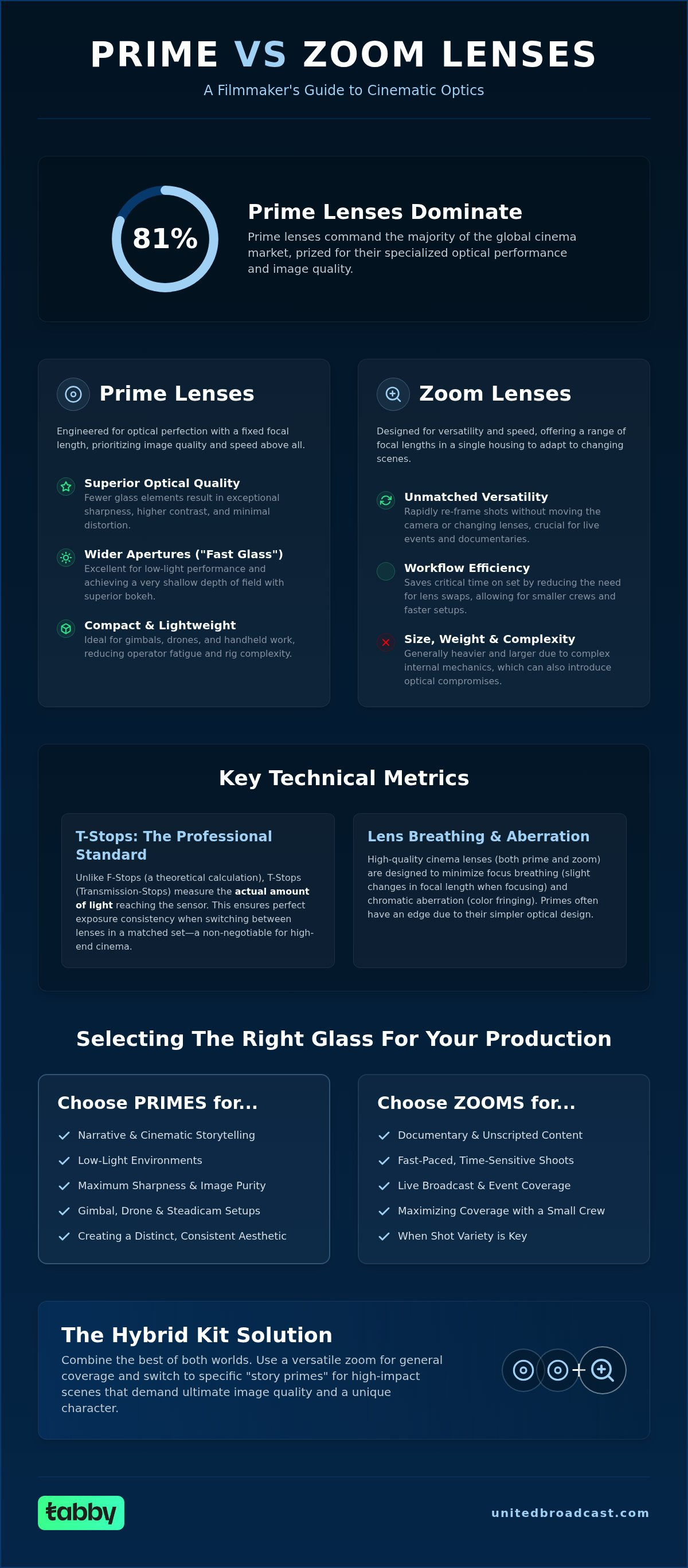
Did you know that prime lenses currently command up to 81% of the global cinema market share? While high-end zooms are rapidly closing the optical gap, the choice between prime vs zoom lenses for filmmaking remains a fundamental decision that shapes both your visual language and your daily workflow. It's common to feel a sense of uncertainty regarding the ROI of expensive lens sets, especially when balancing the need for wide apertures against the physical weight requirements of gimbal or handheld setups.
We understand that your equipment must be as reliable as your creative vision. You likely want to avoid the technical pitfalls of lens breathing while maintaining the agility needed for fast-paced productions. This guide explores the critical differences between these optical systems to help you optimize your cinematic narrative and production efficiency. We'll provide a clear decision framework for kit building, reviewing the latest industry trends and technical trade-offs to ensure your next investment delivers the precision your projects demand.
Key Takeaways
- Understand how the fixed focal length precision of primes contrasts with the variable flexibility of cinema zooms to better align with your project's visual goals.
- Leverage the superior speed and wide apertures of prime lenses to achieve a distinct cinematic aesthetic and enhanced performance in low-light environments.
- Maximize production efficiency in unscripted or time-sensitive scenarios by utilizing professional zoom lenses to minimize frequent equipment changes.
- Evaluate critical technical metrics like lens breathing and chromatic aberration when comparing prime vs zoom lenses for filmmaking to maintain optical consistency.
- Learn to build a strategic hybrid kit that combines versatile zoom coverage with dedicated story primes for high-impact narrative sequences.
Understanding the Fundamental Differences in Cinema Optics
The technical foundation of any high-tier production lies in the glass. Selecting prime vs zoom lenses for filmmaking is a decision that impacts every stage of the creative process, from technical blocking to the final color grade. A prime lens features a fixed focal length, meaning its optical design is meticulously optimized for a single field of view. This specialization allows manufacturers to prioritize image quality and light transmission. Conversely, a zoom lens utilizes variable focal length optics, allowing operators to shift between various perspectives within a single housing. This eliminates the need to physically move the camera or swap lenses to change the frame.
Professional cinematographers often prioritize optical perfection over convenience. Primes are generally engineered with fewer internal elements, which typically results in superior sharpness and reduced distortion. However, the operational flexibility of a zoom lens is indispensable in environments where time is the most valuable resource. This trade-off defines the workflow for those utilizing professional video cameras in the field. While a zoom offers speed, a set of primes offers a disciplined, consistent look that many narrative directors prefer.
One critical distinction in professional cinema optics is the use of T-stops rather than F-stops. While an F-stop is a mathematical calculation of the aperture size relative to the focal length, it doesn't account for light lost as it passes through the glass. A T-stop is the measurement of actual light reaching the sensor. This distinction is vital for exposure consistency. It ensures that if you swap from a 35mm to an 85mm at T2.8, your exposure remains identical. This level of precision is a requirement for high-end broadcast and cinema work where matching shots is essential.
The Physics of Fixed vs. Variable Focal Lengths
Prime lenses benefit from a simpler optical path. This reduction in internal glass elements minimizes internal reflections and flare, providing a cleaner image with higher contrast. In contrast, zoom lenses require complex mechanical groups to move internal elements for focal length adjustment. This complexity can lead to increased light absorption and potential "ramping," where the aperture narrows as you zoom in. A T-stop is the measurement of actual light reaching the sensor.
Aperture and Low-Light Performance
Speed is a primary motivator for selecting primes. These lenses often offer wider apertures, such as f/1.4 or f/1.8, which are rarely found in professional zooms. This "fast glass" is essential for achieving specific creative and technical goals. Fast lenses are particularly useful for:
- Isolating subjects through an extremely shallow depth of field.
- Superior bokeh characterized by smooth, circular highlights.
- Exposure management in high-contrast regional environments where maintaining low ISO is crucial for image cleanlines.
In regions with harsh sunlight and deep shadows, the ability to control exposure through high-quality glass rather than digital gain is a hallmark of professional work. While modern zooms are improving, the aperture advantage of prime vs zoom lenses for filmmaking still leans heavily toward fixed focal lengths for low-light and shallow-focus applications.
The Narrative Power of Prime Lenses: Speed, Sharpness, and Aesthetic
Narrative cinema often relies on the distinctive properties of fixed focal lengths to establish a specific visual language. When discussing prime vs zoom lenses for filmmaking, the primary argument for primes centers on their uncompromising optical sharpness. Because these lenses are engineered for peak performance at a single focal length, they typically exhibit minimal edge distortion and high contrast. This precision allows for a level of clarity that variable optics, which must compromise across a range, often struggle to replicate.
Weight and portability also play a significant role in modern production. Primes are generally more compact than their zoom counterparts. This makes them the preferred choice for gimbal and drone-based cinematography. A lighter payload reduces motor strain on stabilizing systems and allows for more agile camera movements during complex handheld sequences. This physical advantage translates directly to production efficiency on set.
Visual Consistency and Lens Sets
Professional productions rarely use a single lens; they utilize matched sets. Using a matched set of primes ensures that color rendition, contrast, and flare characteristics remain uniform throughout a project. Brands like ZEISS and Cooke are renowned for maintaining a consistent "character" across their entire focal range. This consistency is vital when pairing glass with high-end professional video cameras, as it prevents jarring visual shifts during the editing process.
The Psychological Impact of Fixed Focal Lengths
Primes introduce a level of discipline to the filmmaking process. They force a more intentional approach to camera placement and blocking. Since the focal length is fixed, the cinematographer must physically move the camera to change the frame. This movement often leads to more dynamic perspectives and a stronger emotional connection with the subject. High-end narrative productions favor primes because they allow the director to control the "emotional distance" from a character with absolute precision.
Choosing the right glass involves balancing these aesthetic benefits with your specific technical requirements. If you're building a narrative kit for an upcoming project, speak with our technical team to discuss which matched set best suits your production's needs.
Beyond the look, the technical performance of a lens impacts how it handles light and movement. While primes offer a specific aesthetic, modern professional zooms have evolved to provide a level of versatility that is essential for many contemporary workflows, particularly in unscripted environments.
The Versatility of Professional Zoom Lenses: Workflow Efficiency
While the previous section highlighted the aesthetic discipline of primes, the operational reality of many productions demands a different approach. Professional zoom lenses provide a level of versatility that is essential for unscripted environments. In documentary filmmaking or live event coverage, the ability to adjust focal lengths instantly allows operators to capture unpredictable moments that would otherwise be lost during a lens swap. This speed of workflow is a primary factor when evaluating prime vs zoom lenses for filmmaking for high-stakes productions.
Beyond speed, utilizing a single high-quality zoom lens offers logistical advantages. Frequent lens changes expose the camera's sensor to environmental contaminants such as dust and moisture. By minimizing swaps, you preserve the integrity of your equipment and reduce the need for sensor cleaning during a shoot. Modern optical engineering has also narrowed the performance gap. High-end cinema zooms now rival the sharpness and contrast of many prime sets. For example, the Laowa Ultima Zoom series, which includes focal ranges like 12-120mm and 25-600mm, provides a massive range in a single unit, making them viable for both narrative and broadcast work.
Broadcast and Live Production Requirements
Live broadcast environments leave no room for error. Operators must react to action as it happens, making the variable focal range of a zoom lens a technical necessity. These lenses are frequently paired with Sony Alpha cameras and lenses to create flexible, high-performance kits. It's vital to distinguish between parfocal and varifocal designs. Professional filmmakers require parfocal zooms, which maintain focus throughout the entire zoom range. Cheaper varifocal alternatives require refocusing after every focal adjustment, which is unacceptable in a professional workflow.
Dynamic Framing and In-Shot Zooms
Zooms also enable creative techniques that are physically impossible with primes. The "dolly zoom" or Vertigo effect relies on simultaneous camera movement and focal length adjustment to create a sense of psychological unease. Executing these moves requires precision. This often involves external zoom motors and controllers integrated into the camera rig. While these lenses are heavier, modern digital cinema bodies are designed to distribute this weight effectively. Proper balance is achieved through the use of support rails and bridge plates, ensuring the mount isn't stressed by the heavier glass.
Technical Performance Metrics: Beyond Focal Length
Selecting the right glass involves more than just picking a focal range. For professional operators, the technical behavior of the lens during a shot is just as important as the image it produces. When comparing prime vs zoom lenses for filmmaking, technical metrics like lens breathing, chromatic aberration, and physical ergonomics determine how well the equipment integrates into a high-stakes production environment. These factors are particularly critical as sensor resolutions climb toward 8K, where every optical imperfection is magnified.
Optical Artifacts and Image Quality
Lens breathing is a primary concern for narrative cinematographers who perform frequent focus pulls. Lens breathing is the shift in focal length during focusing. While high-end cinema primes are often engineered to eliminate this effect entirely, many zoom lenses exhibit a noticeable "zoom" sensation when racking focus between subjects. This can distract the audience and break the immersion of a narrative scene. Additionally, chromatic aberration, seen as color fringing around high-contrast edges, can degrade the perceived sharpness of your footage. While primes generally offer a cleaner optical path, modern high-tier zooms utilize low-dispersion glass to minimize these artifacts, ensuring edge-to-edge clarity on large-format sensors.
Regional Environmental Protection and Maintenance
Operating in the UAE presents unique challenges for precision optics. High temperatures and fine desert dust can compromise internal mechanisms over time. Zoom lenses, with their complex internal moving groups and multiple seals, are often more susceptible to dust ingress than the simpler, more robust construction of primes. Maintaining the longevity of your investment requires a disciplined care regimen. Dust that penetrates the lens barrel can lead to friction in the focus or zoom rings, eventually requiring professional intervention. For those operating in these demanding conditions, our Cinema Lens Repair guide provides essential protocols for optical maintenance.
Physical ergonomics also dictate how a lens is used on set. A heavy cinema zoom may require a dedicated lens support system and can limit the duration of handheld takes. In contrast, the lighter profile of primes allows for more flexible camera configurations. Balancing these physical demands against your creative needs is a core part of the kit-building process. It's vital to choose equipment that doesn't just look good on paper but performs reliably under pressure.
Strategic Kit Building: Selecting the Right Glass for Your Production
Building a lens kit is a strategic business decision that must align with your specific production model. Narrative filmmakers often prioritize a set of primes to maintain a specific visual language, while corporate and documentary shooters require the speed of a high-end zoom. The choice between prime vs zoom lenses for filmmaking isn't always binary. Many professional operators now utilize a hybrid approach, using a versatile zoom for the majority of the day and switching to specific story primes for high-impact sequences or low-light requirements. This strategy ensures you have the necessary tools for both technical efficiency and creative depth.
Future-proofing your investment is equally critical when selecting professional glass. Opting for industry-standard mounts, such as PL or E-mount, ensures your lenses remain compatible as you upgrade your digital cinema cameras. High-quality optics generally retain their value much longer than camera sensors. While a camera body might be superseded in three years, professional-grade cinema lenses can serve a production house for a decade or more if maintained correctly. This makes glass the most stable asset in your technical inventory, providing a reliable return on investment over multiple project cycles.
Budget Allocation and ROI
When allocating a production budget, it's often more effective to prioritize lens quality over the latest camera body upgrades. A superior lens on a mid-range sensor will typically produce a more professional image than a budget lens on a flagship sensor. If you're building a kit from scratch, decide whether your workflow benefits more from a single, high-performance zoom or a three-lens prime kit. For specialized telephoto requirements, such as wildlife or sports broadcast, the Sony FE 100-400mm offers the precision and reach necessary for professional results without the need for multiple lens swaps.
The UBMS Advantage: Sales and Technical Support
Selecting the right optics requires more than just reading a spec sheet; it involves understanding how those lenses integrate into your entire system. At United Broadcast & Media Solutions (UBMS), we provide access to an extensive inventory of cinema lenses and professional lighting equipment to ensure your production is fully supported. We don't just act as a vendor; we serve as a technical partner for the regional media community, providing the expertise needed to navigate complex equipment choices.
Our authorized service center plays a vital role in the longevity of your equipment. Professional lenses require periodic calibration and cleaning to ensure mechanical rings remain smooth and optical elements stay aligned, especially when operating in the demanding environments of the UAE. By choosing a partner with a deep technical infrastructure, you ensure that your investment is protected against dust and heat. Whether you're a solo operator or a large-scale broadcast facility, United Broadcast & Media Solutions (UBMS) provides the support needed to build a kit that balances performance with operational efficiency.
Optimizing Your Optical Strategy
Choosing between prime vs zoom lenses for filmmaking is ultimately about aligning your optical tools with your production's specific demands. While primes offer fixed precision and a disciplined aesthetic, professional zooms provide the agility required for unscripted environments and time-sensitive broadcast workflows. The most effective kit usually prioritizes the lenses that best serve your primary project type while maintaining a clear path for future expansion.
United Broadcast & Media Solutions (UBMS) has supported the regional media landscape since 1997, offering the expertise required to navigate these technical decisions. As an authorized distributor for global leaders like Sony, ARRI, and ZEISS, we provide more than just equipment sales. Our in-house service center ensures your lenses receive the professional maintenance necessary for longevity, backed by over 25 years of industry leadership in the UAE.
We look forward to helping you select the glass that transforms your creative vision into high-tier cinematic reality.
Frequently Asked Questions
Are prime lenses better than zoom lenses for 4K filmmaking?
Prime lenses typically provide higher resolving power and contrast, which is beneficial for 4K and 8K workflows. However, modern cinema zooms from manufacturers like ZEISS and ARRI are specifically engineered to match the sharpness of primes on high-resolution sensors. The choice often depends on whether your production requires the absolute peak optical performance of a fixed focal length or the operational speed of a variable one.
What is lens breathing and why is it worse in zoom lenses?
Lens breathing is an optical artifact where the field of view shifts slightly as you adjust focus. This effect is often more pronounced in zoom lenses because their complex internal construction involves multiple moving glass groups. In narrative filmmaking, excessive breathing can be distracting during focus pulls. High-end cinema primes are designed to minimize or eliminate this shift, ensuring the frame remains stable throughout the move.
Can I use a zoom lens for professional narrative cinema?
Yes, high-end zoom lenses are frequently used in professional narrative cinema for their efficiency and unique creative capabilities. While primes were once the exclusive choice for achieving a cinematic look, modern optics have closed the quality gap significantly. Many directors of photography use zooms for wide-angle coverage or to execute precise in-shot focal adjustments, provided the lens maintains consistent color and contrast with the rest of the kit.
Why are cinema prime lenses so much more expensive than photo lenses?
Cinema primes are engineered for the rigorous demands of professional sets, featuring robust all-metal housings and standardized geared rings for follow-focus systems. Unlike photo lenses, they prioritize consistent T-stops, minimal breathing, and expanded focus scales with precise markings. These lenses also cover larger image circles for digital cinema sensors. This specialized engineering and low-volume production result in a higher price point that reflects their long-term reliability.
Is it better to have one high-quality zoom or three average primes?
Choosing one high-quality cinema zoom often provides better long-term value for commercial and broadcast work than a set of average primes. A single premium zoom reduces lens changes and maintains optical consistency across your project. However, if your work is purely narrative and requires wide apertures for low-light performance, a small set of high-quality glass might be the more appropriate investment when evaluating prime vs zoom lenses for filmmaking.
How do I protect my cinema lenses from dust and humidity in the UAE?
Protecting your glass in the UAE requires climate-controlled storage and a disciplined maintenance routine to combat fine dust and high humidity. Use high-quality UV filters to shield front elements and keep lenses in airtight cases with silica gel when they aren't in use. Regular inspections at an authorized service center are essential. This ensures that internal mechanisms remain lubricated and free from contaminants that could cause friction or optical degradation.
What is the difference between a parfocal and a varifocal lens?
A parfocal lens maintains its focus point even as you change the focal length, which is a requirement for professional filmmaking. Varifocal lenses, common in photography, lose focus when you zoom and require refocusing for every new frame. For unscripted or live broadcast environments, parfocal zooms are indispensable. They allow the operator to zoom in to check focus and then zoom out to frame the shot without losing sharpness.
Which lens type is better for gimbal and handheld shooting?
Prime lenses are generally better for gimbal and handheld shooting due to their compact size and lighter weight. Using a heavy zoom on a gimbal can strain the motors and make balancing the rig more difficult. Primes allow for a more agile camera setup, which is vital for long shooting days. If you must use a zoom, ensure your rig includes proper lens support to protect the camera mount from unnecessary stress.


