

Professional Corporate Video Studio Setup: The 2026 Comprehensive Guide
A professional corporate video studio setup is no longer a luxury for the modern enterprise; it's a critical infrastructure requirement that defines your brand's authority. You likely understand that high-quality content drives engagement, yet the technical complexity of building a broadcast-ready environment often feels daunting. It's common to feel overwhelmed by compatibility issues or worry that expensive gear will become obsolete within months. We recognize these challenges and the need for a system that delivers consistent, professional-grade reliability.
This comprehensive 2026 guide provides the technical roadmap you need to build a high-performance in-house broadcast environment. You'll gain a deep understanding of essential equipment, from professional cameras to advanced lighting, and learn how system integration ensures everything works together seamlessly. We'll explore the standards required for broadcast-ready visual and audio quality, helping you make informed decisions that protect your investment. By the end of this guide, you'll have the clarity to move from a collection of gadgets to a sophisticated, integrated media hub.
Key Takeaways
- Transition from basic video conferencing to high-end broadcast environments to elevate your brand's communication authority.
- Learn how sensor size and lens selection directly impact the visual depth of your corporate productions.
- Master the technical essentials of a professional corporate video studio setup, focusing on high CRI lighting and reliable audio foundations.
- Identify the critical role of video switchers and routing infrastructure in managing complex live workflows.
- Understand why professional system integration is the key to creating a user-friendly environment that maximizes equipment longevity.
Defining the Modern Corporate Video Studio Environment
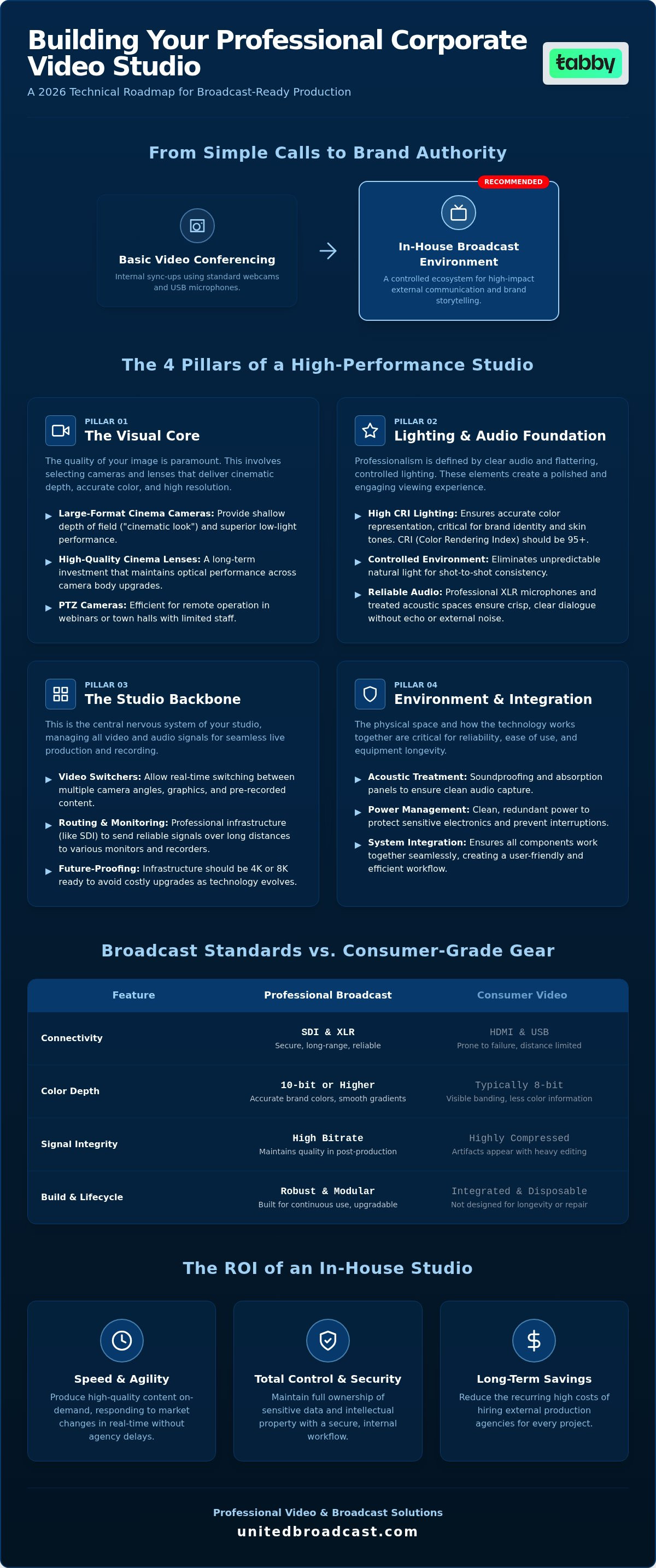
The shift from basic video conferencing to a professional corporate video studio setup marks a significant evolution in organizational communication. While standard webcams might handle internal sync-ups, they lack the technical capability to represent a brand's authority to external stakeholders. A dedicated studio provides a controlled ecosystem where every variable, from the light temperature to the audio floor, is managed for maximum impact. This transition requires a fundamental understanding of Television studio design principles, ensuring the space is acoustically isolated and electrically stable.
A professional studio is more than just a room with cameras; it's a technical ecosystem designed for consistency. Effective professional lighting equipment needs a space that allows for precise control, free from the unpredictability of natural light. This control extends to the physical environment itself. A professional studio must be built with specific infrastructure to support high-performance gear. While a podcast booth focuses on audio and a webinar room on interaction, a full broadcast studio integrates these elements into a high-output production hub.
- Acoustics: Soundproofing prevents external noise intrusion while acoustic treatment manages internal reflections to ensure crisp dialogue.
- Power Management: Clean, redundant power sources are necessary to protect sensitive broadcast electronics from surges and ensure uninterrupted filming.
- Climate Control: Specialized HVAC systems must operate silently while managing the significant heat output generated by high-intensity lighting and server racks.
Broadcast Standards vs. Consumer Video
Professional standards prioritize signal integrity and color accuracy. Consumer-grade HDMI cables and USB interfaces are prone to failure and distance limitations. In contrast, professional SDI and XLR connections provide secure, long-range transmission. High-end professional video cameras offer 10-bit color science and high bitrates that consumer devices cannot match. This ensures your corporate identity is rendered accurately across all platforms. Designing for 4K or 8K ready infrastructure now prevents costly technical debt as display technology evolves.
The ROI of In-House Production
Investing in an in-house studio reduces the recurring costs of hiring external production agencies. The primary benefit is speed. Your team can produce high-quality announcements or marketing content on-demand without waiting for agency availability. Additionally, keeping production internal ensures total control over sensitive data and intellectual property. You maintain a secure workflow from the moment the camera starts rolling until the final file is archived. This autonomy allows for a more agile content strategy that responds to market changes in real time.
The Visual Core: Selecting Professional Video Cameras and Lenses
Choosing the right imaging tools is the most visible decision in a corporate video studio setup. PTZ (Pan-Tilt-Zoom) cameras offer efficiency and remote operation, making them ideal for webinars or recurring town halls where staff resources are limited. However, large-format cinema cameras remain the standard for high-stakes brand storytelling. These cameras utilize larger sensors that naturally produce a shallower depth of field, creating the "cinematic" look that separates professional content from a standard office video call. The larger sensor also improves low-light performance, which is critical in studio environments where lighting might be stylized or moody.
Integrating professional video cameras into a multi-camera workflow requires careful consideration of color matching and signal consistency. While camera bodies evolve rapidly, high-quality cinema lenses are a superior long-term investment. They maintain their value and optical performance across multiple generations of camera sensors. Investing in high-quality glass ensures that your visual core remains robust even as you upgrade your camera bodies to meet future resolution standards.
Digital Cinema Cameras for Corporate Narrative
The trend in corporate communication has shifted toward narrative-driven content that requires high dynamic range and color depth. Utilizing Sony Alpha camera and lenses provides a hybrid solution that balances portability with professional output. Shooting in Log formats is essential here, as it preserves dynamic range and allows for precise color grading to match corporate brand guidelines. This level of technical control is a core component of modern Broadcast systems integration, where the goal is a unified visual aesthetic across all company assets.
Optical Precision in the Studio
Selecting between prime and zoom lenses depends on your studio's physical footprint and the variety of content you produce. Prime lenses offer superior sharpness and faster apertures, but zooms provide the flexibility needed for fast-paced environments. In larger studio spaces or town hall settings, a Sony FE 100-400mm lens allows for tight framing from a distance without disrupting the presenter. Maintaining a consistent lens kit ensures that visual quality remains uniform across different content segments, from internal training to external product launches.
For assistance in selecting the right optical path for your facility, reach out to our imaging specialists for a technical consultation.
Studio Lighting and Audio: The Foundation of Professionalism
Lighting and audio are the invisible pillars of any successful corporate video studio setup. While high-end cameras capture the data, it's the quality of light and the clarity of sound that establish professional credibility. Relying on natural window light or standard office overheads is a mistake for any enterprise environment. These sources are unpredictable and often have poor color rendering, leading to inconsistent content that looks amateurish. A professional environment requires a fully controllable ecosystem where every light source is intentional and every sound is isolated.
Achieving accurate skin tones is a non-negotiable requirement for corporate branding. This is why selecting professional lighting equipment with a high Color Rendering Index (CRI) is critical. LEDs used in a broadcast setting should ideally have a CRI of 95 or higher. This ensures that the colors of your brand's products and the complex tones of human skin are rendered truthfully, preventing the "greenish" or "washed out" look common in consumer-grade setups.
Preparing the physical space involves two distinct disciplines: soundproofing and acoustic treatment. Soundproofing involves structural changes to block external noise from the office, such as humming HVAC systems or hallway chatter. Acoustic treatment focuses on the interior of the room, using panels and diffusers to manage sound reflections. Without these, even the most expensive microphones will capture a "roomy" echo that distracts the audience. For talent, the choice of microphone depends on the format. Lavalier mics provide a clean, discreet look for interviews, while boom mics offer superior natural sound without being visible on camera.
Professional Lighting Infrastructure
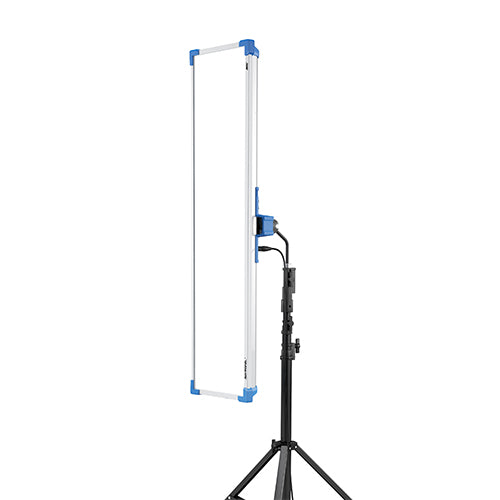
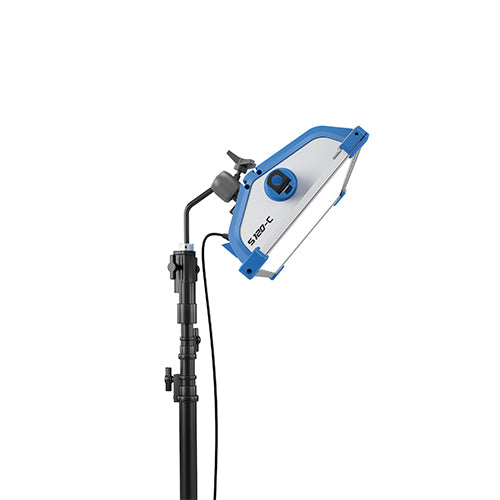
Implementing ARRI lighting solutions provides the industry-standard reliability required for daily corporate operations. For facilities that require flexible set configurations, the ARRI Omnibar Production Kit offers a versatile mounting solution that adapts to different talent placements. Modern studios utilize DMX control systems, allowing non-technical staff to trigger complex lighting presets with a single button. This automation ensures that the lighting is perfect every time, regardless of who is operating the studio.
Audio Engineering for Enterprise
Audio represents 50% of the viewer's experience. In high-density office environments, managing wireless signal interference is a major challenge. Transitioning to digital audio mixers that support Dante or AES67 workflows allows for clean, uncompressed audio transmission over standard IT networks. These networked solutions simplify the infrastructure and make it easier to route audio to multiple destinations, from live stream encoders to internal recording servers. This technical stability is what transforms a simple room into a high-performance broadcast environment.
The Studio Backbone: Switchers, Monitoring, and Routing
The infrastructure connecting your imaging tools to your final output defines the technical resilience of a corporate video studio setup. While cameras capture the performance, the routing and switching systems ensure that the signal remains uncompromised as it travels through the facility. For enterprise environments, the choice between traditional SDI cabling and modern NDI or IP-based workflows is a critical decision. SDI remains the standard for zero-latency, point-to-point reliability. However, NDI offers the flexibility to route video over existing 10GbE network infrastructure, which is often more practical for large corporate campuses.
Managing the high-bitrate assets generated by 4K and 8K workflows requires a dedicated storage strategy. Corporate broadcasts often involve sensitive data, so local high-speed NAS (Network Attached Storage) or SAN (Storage Area Network) solutions are preferred over consumer cloud storage. This ensures that assets are archived securely and remain accessible for future editing or compliance audits. A robust storage backbone prevents the bottlenecking that occurs when standard office hardware attempts to handle professional broadcast data rates.
Live Production Switchers
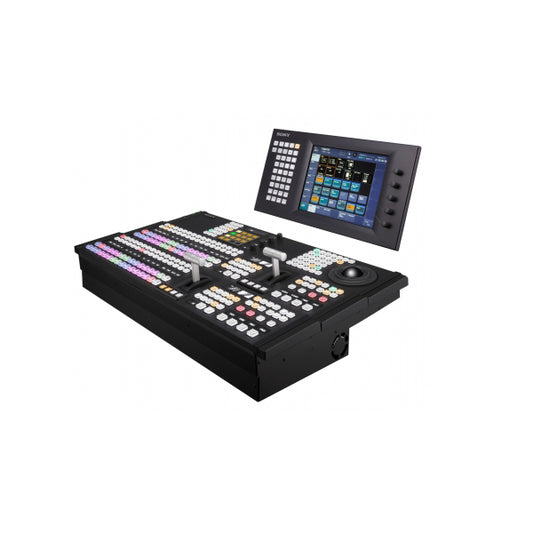
A video switcher serves as the central nervous system of any live broadcast. While software-based switching offers flexibility, dedicated hardware switchers provide the mission-critical reliability needed for high-stakes corporate town halls. Hardware systems don't suffer from the OS-level crashes that can plague software-only solutions. These systems allow operators to seamlessly blend multiple camera angles with digital presentations and remote guests from platforms like Teams or Zoom. Integrating professional graphics and lower-thirds directly within the switcher ensures a polished look that aligns with corporate brand standards.
Professional Monitoring and Quality Control
Accurate monitoring is essential to ensure that what you see in the control room is what the audience receives. Adhering to broadcast monitor UAE standards involves using high-fidelity displays that support precise color calibration. Multi-view monitors allow the operator to see all inputs simultaneously, while technical tools like waveform monitors and vectorscopes provide objective data on signal levels. Reference monitors are the final step in the chain, used for critical color and audio checks before the signal is transmitted. This level of quality control prevents technical errors that could damage corporate reputation during a live event.
System Integration and Technical Lifecycle Management
The final and most critical phase of a corporate video studio setup is professional system integration. While purchasing high-end hardware is a necessary step, the value of that equipment is only realized when it functions as a unified, stable ecosystem. Professional integration bridges the gap between disparate technologies, ensuring that audio, video, and data networks operate without conflict. Many organizations underestimate the complexity of AV/IT convergence, where broadcast signals must live on corporate networks without compromising security or bandwidth. A properly integrated studio doesn't just work; it's designed for high-performance reliability that generic retail solutions cannot provide.
The Integration Process
A successful build begins with a deep consultation to align technical choices with specific corporate goals. This stage involves detailed workflow design, mapping every signal path from the camera sensor to the final stream. The physical installation phase focuses on precision cabling and rack management, which are vital for cooling and long-term maintenance. Once the hardware is in place, the focus shifts to staff training. We provide comprehensive handover documentation that empowers internal teams to operate complex broadcast technology with confidence, ensuring the studio remains an asset rather than a technical burden.
Maintenance and Support
Broadcast equipment requires consistent technical oversight to maintain peak performance. Preventative maintenance for sensors, lenses, and cooling systems prevents minor issues from becoming catastrophic failures during a live event. Our in-house technical service center provides a dedicated resource for repairs and firmware management, significantly minimizing studio downtime. In the fast-moving broadcast sector, staying current with software updates is essential for compatibility with new standards like NDI or evolving security protocols. This proactive approach protects your initial investment and ensures your facility remains broadcast-ready at all times.
Planning for a 3-5 year technology lifecycle is a standard industry practice. While professional lenses and lighting often last much longer, camera sensors and processing hardware evolve rapidly. We help our partners navigate these cycles, identifying when to upgrade and when to maintain existing infrastructure. This strategic planning ensures your corporate video studio setup stays ahead of global broadcast standards without unnecessary capital expenditure. By treating your studio as a living technical environment, you ensure long-term ROI and a consistently professional image for your brand.
Building Your Future-Ready Broadcast Environment
Establishing a professional corporate video studio setup requires more than just high-end hardware; it demands a unified technical ecosystem designed for stability. We've explored how the synergy between large-format sensors, high CRI lighting, and robust signal routing creates a broadcast-ready environment that elevates your brand's authority. By prioritizing professional system integration and planning for a 3-5 year technology lifecycle, you protect your investment from premature obsolescence.
As an authorized dealer for global leaders like Sony, ARRI, and Blackmagic, we provide the specialized tools necessary for enterprise-grade production. Our expert team offers comprehensive UAE-wide technical support and maintains a dedicated professional repair center to ensure your studio remains operational at all times.
Your transition to in-house broadcast excellence starts with a clear roadmap. We're ready to help you navigate every technical requirement to build a facility that meets the highest industry standards.
Frequently Asked Questions
How much space do I need for a professional corporate video studio?
A professional corporate video studio setup typically requires a minimum of 20 to 30 square meters to accommodate talent, cameras, and lighting stands comfortably. You need enough depth to create separation between the subject and the background, which is essential for a high-end look. High ceilings, ideally 3 meters or more, are also vital for mounting overhead lighting grids and managing heat dissipation from professional electronic gear.
Should I choose 4K or 1080p for our internal corporate broadcasts?
We recommend implementing a 4K-ready infrastructure even if your current internal delivery is 1080p. Shooting in 4K provides superior image data and allows for reframing shots during post-production without losing quality. By 2026, 4K has become the baseline for professional branding. Investing in 4K broadcast gear now ensures your facility remains relevant as corporate display standards continue to evolve across the country.
What is the difference between SDI and HDMI in a studio setup?
SDI is the industry standard for professional environments because it uses locking BNC connectors and supports long cable runs without signal degradation. HDMI is a consumer standard prone to accidental disconnection and limited to shorter distances. In a professional studio, SDI provides the reliability needed for mission-critical live broadcasts. Most high-end cameras and switchers utilize SDI to ensure a stable, uncompressed video feed throughout the production chain.
How many people are needed to operate a professional corporate studio?
A streamlined professional corporate video studio setup can be operated by a single skilled technician using PTZ cameras and automated switchers. However, high-stakes productions often benefit from a three-person team: a technical director to manage the switcher, a sound engineer for audio levels, and a floor manager to assist talent. The complexity of your specific workflow will ultimately dictate the necessary headcount to maintain broadcast-quality standards.
Is NDI technology suitable for a corporate network infrastructure?
NDI technology is highly suitable but requires a robust 10GbE network backbone to handle high-bitrate video traffic without latency. It allows you to route video signals over existing IT infrastructure, making it easier to share content across different departments. It's essential to work with a system integration team to ensure your network is configured with the correct VLANs to prevent interference with standard office data traffic.
Can we integrate remote guests into a professional studio setup?
Yes, professional switchers and dedicated broadcast hardware can seamlessly integrate remote guests from platforms like Zoom or Teams into your studio workflow. Using a mix-minus audio setup ensures that remote participants hear the studio feed without an echo of their own voice. This capability is critical for global corporate communications, allowing you to bring in subject matter experts from any location while maintaining a unified, high-end broadcast appearance.
How do I ensure consistent lighting across different video segments?
Consistency is achieved through a fixed lighting grid and the use of high CRI LED fixtures with DMX control. By saving specific lighting scenes or presets, you can recall the exact intensity and color temperature for recurring segments at the touch of a button. This removes the guesswork for non-technical staff and ensures that every video produced in your facility maintains a uniform visual identity that aligns with your brand.
What is the benefit of using cinema cameras for corporate interviews?
Cinema cameras feature larger sensors that provide a shallower depth of field, which helps isolate the subject from the background for a more professional aesthetic. They also offer superior dynamic range and color science, capturing more detail in highlights and shadows. This results in a more flattering image for executive interviews and provides greater flexibility during the color grading process to match your company's specific visual guidelines.


