

Professional Camera Sensor Cleaning in Dubai: The Complete 2026 Maintenance Guide
A single microscopic dust particle can render an entire day of 8K production useless, costing thousands in post-production retouching or mandatory reshoots. When you're working with high-end cinema and broadcast equipment, the margin for error is non-existent. You've probably felt that anxiety when spotting a blur on your monitor, wondering if a DIY cleaning kit will fix the issue or permanently scratch your expensive low-pass filter. It's a common frustration for professionals who demand perfection but fear the risks of improper maintenance.
This guide clarifies why professional camera sensor cleaning Dubai is a critical technical requirement rather than a luxury for serious filmmakers. You'll learn how to accurately identify different types of sensor contamination and why specialized service center protocols are essential for maintaining equipment integrity in the UAE's challenging climate. We'll preview the exact maintenance standards used by industry experts to ensure your sensor remains pristine, helping you avoid inconsistent DIY results and the catastrophic risk of hardware failure during a high-stakes production.
Key Takeaways
- Master the "White Wall Test" to definitively differentiate between external lens debris and internal sensor contamination before you start your shoot.
- Understand how the UAE's combination of fine desert dust and humidity impacts high-end optics, making professional camera sensor cleaning Dubai a technical necessity.
- Recognize the extreme risks of DIY swabbing, such as static discharge and permanent damage to specialized cinema-grade sensor coatings.
- Learn why professional maintenance protocols utilize ISO-rated cleanrooms and HEPA filtration to ensure a truly particulate-free environment.
- Implement expert preventative measures, including proper lens change techniques, to protect your equipment's internal components during outdoor productions.
Why Camera Sensor Cleaning in Dubai is Critical for Professionals
Sensor contamination is a technical reality that every cinematographer must manage. It occurs when microscopic particulates, ranging from organic fibers to inorganic mineral dust, bypass the lens mount and adhere to the camera's image sensor assembly. Unlike a simple smudge on a lens element, these particles sit directly on the optical low-pass filter, casting distinct shadows onto the raw data. In the high-stakes world of UAE production, neglecting regular camera sensor cleaning Dubai leads to more than just aesthetic flaws; it compromises the technical integrity of the entire project.
Professional digital cinema cameras require a higher standard of maintenance than consumer gear. These systems often lack the aggressive internal weather sealing found in hobbyist bodies because they're designed for modularity and frequent lens swaps. When you're operating in the field, every second the sensor is exposed increases the risk of contamination. The financial implications are significant. Retouching 8K footage to remove persistent dust spots is an expensive, frame-by-frame process that can easily exceed the cost of a year's worth of preventative maintenance. Professional servicing ensures your equipment remains field-ready, preventing costly downtime and protecting your reputation for delivering flawless masters.
The Impact of Dust on High-Resolution Sensors
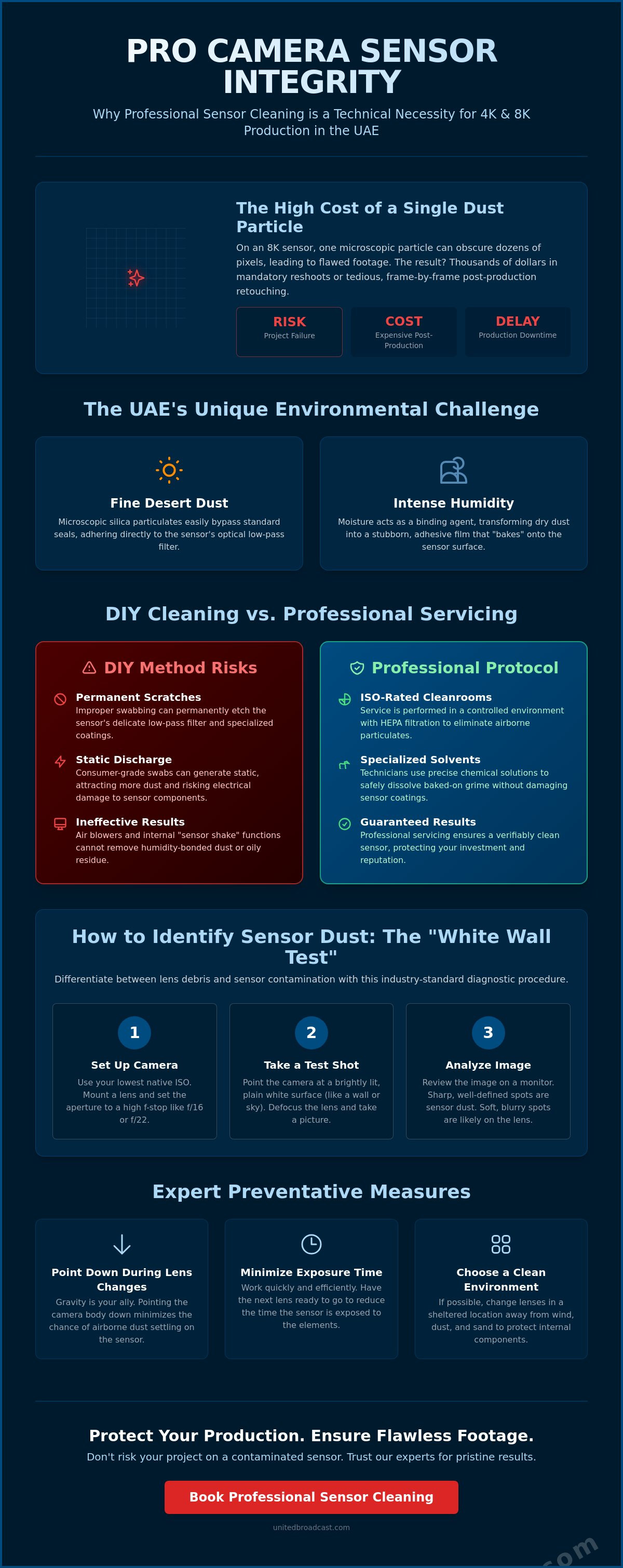
Modern 4K and 8K sensors have incredibly small photosites. Because the pixel pitch is so tight, even a tiny dust particle can obscure dozens of pixels simultaneously. This becomes especially problematic when shooting at higher f-stops. As you stop down the aperture, the light rays become more parallel, which makes the shadows cast by sensor debris sharper and much more visible in the final image. Many operators rely on internal "sensor shaking" functions, but these are designed for loose, dry dust. They're often ineffective against the stubborn particulates found on professional video cameras used in regional environments.
Environmental Challenges in the Middle East
The UAE climate presents unique challenges for sensitive electronics. The atmosphere contains high concentrations of fine silica dust that can penetrate even the tightest tolerances. When you combine this with the region's intense humidity, the situation worsens. Moisture acts as a binding agent, causing dry dust to transform into a thin, adhesive film that effectively "bakes" onto the sensor surface during operation. This type of contamination cannot be removed with a simple air blower. It requires specialized chemical solvents and precise physical swabbing to safely restore the sensor without damaging the delicate coatings.
How to Identify Sensor Dust: A Professional Diagnostic Guide
Identifying the exact source of an image artifact is a foundational skill for any digital imaging technician or camera operator. Before committing to a service appointment, you must confirm that the debris is actually on the sensor and not within the lens elements. Determining the need for camera sensor cleaning Dubai starts with a controlled diagnostic procedure that isolates the sensor from the rest of the optical chain. This systematic approach prevents unnecessary physical contact with sensitive components while ensuring your maintenance records are accurate.
Professional diagnostic tools, such as a high-magnification sensor loupe, allow for direct visual verification. These loupes often feature built-in LEDs that illuminate the sensor surface at an angle, making microscopic particulates and translucent oils visible to the naked eye. If you aren't sure whether an artifact is internal or external, you can refer to a comprehensive sensor cleaning guide to understand the physical characteristics of different contaminants. Documenting these findings by creating a "dust map" helps technicians at a service center target specific areas for intensive cleaning.
Step-by-Step Sensor Inspection
The "White Wall Test" is the industry-standard method for sensor inspection. To perform this test, set your camera to its lowest native ISO to minimize electronic noise. Mount a lens and stop the aperture down to f/16 or f/22. Point the camera at a plain, brightly lit white surface and take a defocused shot while slightly moving the camera. This motion blurs any external textures, leaving only the stationary sensor dust visible. Analyze the resulting image on a calibrated monitor at 100% magnification. If the dark, soft-edged spots remain in the same position across multiple shots and different lenses, the sensor requires attention.
Common Misidentifications
Dead pixels are often confused with dust, but their characteristics are entirely different. A dead or stuck pixel is a sharp, single-colored point that remains visible at every aperture. In contrast, sensor dust appears as a soft, gray, organic shape that becomes more defined as you stop down the lens. If you notice a linear, unmoving mark that doesn't resolve with standard air blowing, it may indicate a physical scratch on the Optical Low Pass Filter (OLPF). This is a critical distinction, as a scratch requires a component replacement rather than a simple cleaning. If you encounter an artifact that doesn't fit these descriptions, consult with a technician for a formal evaluation to avoid misdiagnosing hardware failure as simple contamination.
The Risks of DIY Sensor Cleaning for Cinema Cameras
DIY cleaning kits are widely available, but they often fail to account for the technical complexity of high-end cinema equipment. While a basic kit might suffice for a consumer DSLR, the stakes are significantly higher when dealing with 8K production gear. Seeking professional camera sensor cleaning Dubai is not just about convenience; it's about mitigating the risk of permanent hardware damage. A single error during a home cleaning attempt can result in a repair bill that far exceeds the cost of professional maintenance. Professional technicians understand that a cinema sensor isn't just a piece of glass; it's a multi-layered optical stack with specific tolerances.
One of the most overlooked dangers is static electricity. Using incorrect swabbing materials can generate a charge on the sensor surface, which then acts as a magnet for airborne particulates. Additionally, DIY attempts often lead to the "oil smear" problem. This happens when a swab inadvertently touches the lubricated mechanics of the sensor frame, dragging grease across the optical glass. Instead of removing debris, you're merely redistributing it in a way that's much harder to clean. For a deeper look at the physics involved, you can consult this comprehensive guide to digital camera sensor cleaning. If you aren't working in a controlled environment, every swipe risks introducing more contaminants than you remove.
The Complexity of High-End Sensors
The Optical Low Pass Filter (OLPF) on professional video cameras is a sophisticated component with specialized anti-reflective and infrared-cut coatings. These surfaces require specific solvent formulas that won't degrade the chemical bond of the coating. Using generic "sensor fluid" or compressed air can be catastrophic. Compressed air often contains propellants that leave oily residues or, if used too closely, can cause thermal shock to the sensor assembly, leading to microscopic cracks in the filter glass.
Common DIY Failures
Precision is the difference between a clean sensor and a ruined one. Common failures include:
- Over-saturation: Applying too much fluid allows liquid to seep behind the sensor frame, potentially shorting out internal electronics.
- Excessive pressure: The glass covering the sensor is thin. Applying uneven force can cause micro-scratches that are invisible to the eye but appear as permanent streaks in high-contrast footage.
- Contaminated environments: Opening the camera mount in a standard room immediately exposes the interior to millions of floating particles. Professional labs use filtered air to prevent this.
Finally, consider the warranty implications. Manufacturers can easily detect residue from improper solvents or physical abrasions caused by manual swabbing. If a DIY attempt goes wrong, it often voids the manufacturer's protection, leaving the owner responsible for the full cost of a sensor replacement. Choosing expert camera sensor cleaning Dubai ensures the work is done to factory standards, preserving both your gear and your investment.
Professional Service Center Standards in the UAE
Professional maintenance for cinema-grade sensors requires an environment far more controlled than a standard retail workspace. For high-end camera sensor cleaning Dubai, the industry standard dictates the use of HEPA-filtered, ISO-rated cleanrooms. These facilities maintain positive air pressure to ensure that no airborne particulates enter the camera body while the sensor is exposed. Unlike general electronics repair shops, a professional service center uses high-magnification microscopy to conduct a surface analysis of the sensor before and after the procedure. This allows technicians to identify microscopic residue or coating degradation that would be invisible to the naked eye, ensuring the optical stack is restored to factory specifications.
The process involves manufacturer-approved, laboratory-grade solvents that are chemically balanced for specific sensor coatings. This is particularly vital for large-format cinema sensors found in systems like the ARRI ALEXA or Sony Venice, where the OLPF assembly is a precision-engineered component. A professional service doesn't stop at the sensor glass. It includes a comprehensive cleaning of the internal chamber and the lens mount. Debris often hides in the mirror box or the crevices of the mount, only to migrate to the sensor during the next lens change. By addressing the entire chamber, we eliminate the primary sources of re-contamination.
The UBMS Technical Approach
Our technicians utilize specialized, high-intensity lighting to reveal even the most translucent oil spots. We employ a methodical sequence of wet and dry cleaning cycles using non-abrasive, single-use materials. This protocol is essential for Sony Alpha cameras and high-end cinema lines, where sensor stabilization systems (IBIS) require delicate handling to avoid mechanical misalignment during the cleaning process. Each step is designed to remove contaminants without leaving behind the residue often associated with consumer-grade kits.
Ensuring Production Uptime
In the broadcast industry, equipment downtime translates directly to lost revenue. We prioritize efficient turnaround times for professional gear to keep your projects on schedule. Every service concludes with a post-cleaning verification and a quality assurance report, providing you with a technical record of the sensor's condition. This level of detail is why specialized camera sensor cleaning Dubai is a staple for local production houses. For those managing complex facilities, our guide on Advanced Broadcast Studio Gear UAE offers further insights into maintaining a high-performance production environment. If your equipment requires immediate technical attention, schedule a professional sensor inspection with our specialized team today.
Preventative Care: Protecting Your Gear on National Shoots
Maintaining equipment in the UAE's arid environment requires a proactive strategy. While professional camera sensor cleaning Dubai is essential for corrective maintenance, your daily field habits determine how long your sensor remains pristine between services. Desert shoots expose gear to fine silica that behaves differently than standard indoor dust. It's abrasive and highly mobile. Implementing a strict protocol for lens changes and equipment handling isn't just about cleanliness; it's about preserving the long-term optical performance of your investment.
Field Maintenance Protocols
The moment you remove a lens, the sensor is at its most vulnerable. Always point the camera mount toward the ground during swaps. This uses gravity to prevent airborne particles from settling directly onto the OLPF. If you must use a rocket blower in the field, ensure you're in a relatively shielded area. Never insert the tip of the blower into the camera body. If a few puffs don't clear the debris, stop immediately. Persistent particulates in this region are often "sticky" due to humidity, and continued blowing only risks swirling more dust into the internal chamber.
Cross-contamination is a frequent issue when handling cinema lenses. Ensure that rear lens caps are cleaned regularly. A dusty rear element will transfer debris directly into the camera's throat the moment it's mounted. Using professional-grade, tight-fitting body caps when the camera is "naked" is non-negotiable. Many standard plastic caps shed tiny flakes of material over time; switching to high-quality machined or reinforced caps significantly reduces this internal "self-contamination."
Storage and Transport
Effective protection continues after the wrap. In Dubai, the transition from air-conditioned interiors to high-humidity outdoor sets creates a major risk of internal condensation. Store your gear in sealed cases equipped with fresh desiccant packs. These packs manage the internal micro-climate, preventing moisture from binding dust to the sensor surface. This is a critical step because once moisture binds a particle to the glass, a simple air blower will no longer be effective.
Establish a maintenance schedule based on your production volume. For heavy field use, a quarterly professional inspection is recommended. This ensures that minor issues don't escalate into permanent sensor damage. Before any major production, run through a final prep checklist: inspect all mounts, refresh your desiccant, and verify sensor clarity using the White Wall Test discussed in previous sections. Consistent preventative care, paired with expert camera sensor cleaning Dubai, ensures your equipment remains a reliable asset for years to come.
Ensuring Long-Term Performance for Your Cinema Equipment
Maintaining a pristine image sensor is a technical requirement that directly impacts the success of your 8K productions. As explored in this guide, the unique environmental challenges of the UAE make camera sensor cleaning Dubai a vital part of any professional maintenance schedule. By implementing strict field protocols and recognizing the limitations of DIY kits, you protect your equipment from permanent damage and ensure your footage remains free of costly artifacts. Relying on expert care isn't just about cleaning; it's about preserving the sophisticated optical coatings that define your camera's performance.
United Broadcast & Media Solutions operates an authorized service center for leading global broadcast brands. Our expert technicians bring over 25 years of industry experience to every task, providing precision maintenance for ARRI, RED, Sony, and Panasonic systems. We utilize ISO-rated cleanroom environments and manufacturer-approved methodologies to restore your gear to factory specifications. Don't let microscopic dust compromise your creative vision or your hardware's warranty.
Book Your Professional Sensor Cleaning at the UBMS Service Center today to secure your equipment for your next major shoot. We look forward to supporting your production excellence.
Frequently Asked Questions
How often should a professional cinema camera sensor be cleaned?
Cleaning frequency depends on your specific shooting environment and how often you swap lenses. For professionals operating in the UAE's desert conditions, a technical inspection is recommended every three months or immediately following any major outdoor production. Regular monitoring ensures that your equipment maintains the high-resolution standards required for 8K broadcast and cinema delivery.
Can I use a standard air compressor to blow dust off my sensor?
No, you should never use an industrial air compressor or canned air on a camera sensor. Industrial compressors often discharge microscopic oil droplets and moisture that can permanently contaminate the optical stack. Additionally, the unregulated high pressure can damage the delicate internal mechanics or the sensor stabilization system, leading to catastrophic hardware failure and expensive repairs.
Will a dirty sensor affect the video quality if I shoot at a wide aperture?
While dust is less visible at wide apertures like f/1.4 or f/2.8, it still degrades overall image contrast and can cause localized flare in high-contrast lighting. Even if the spots aren't sharply defined, the cumulative effect of contamination reduces the technical purity of your footage. Maintaining a clean sensor ensures consistent results regardless of your depth-of-field settings or lens choices.
What is the difference between a "dry" and "wet" sensor clean?
A dry clean involves using specialized anti-static brushes or air bulbs to remove loose, non-adherent particulates from the sensor surface. A wet clean utilizes laboratory-grade solvents and precision swabs to dissolve and lift bonded contaminants like oils or salt spray. For comprehensive camera sensor cleaning Dubai, a professional service typically combines both methods within a cleanroom environment to achieve total surface decontamination.
Are sensor cleaning services covered under the manufacturer warranty?
Standard sensor cleaning is generally classified as routine maintenance rather than a warranty repair. Most manufacturers view environmental contamination as a result of normal field use. However, having your equipment serviced at an authorized center ensures that the work adheres to factory standards and doesn't inadvertently void your existing hardware protection through improper handling or the use of unapproved chemicals.
How can I tell if a spot is on my lens or my sensor?
Rotate the lens while looking through the monitor; if the spot rotates with the lens, the debris is on the glass elements. If the spot remains stationary while you zoom or rotate the optics, the contamination is likely on the sensor. If you swap to a different lens and the artifact persists in the exact same coordinate, it's a definitive sign that a sensor service is necessary.
Is it safe to clean a camera sensor in a high-humidity environment?
Cleaning a sensor in high humidity is risky because moisture can cause solvents to streak or trap particulates against the glass. In the UAE, it's essential to perform camera sensor cleaning Dubai in a climate-controlled environment where humidity is strictly regulated. This prevents the formation of residue or "fogging" during the evaporation phase of the cleaning fluid, ensuring a streak-free finish.
What should I do if I see a scratch on my sensor during inspection?
If you identify a physical scratch on the OLPF, you must stop all cleaning attempts immediately and consult a professional technician. Scratches cannot be cleaned away; they require a component replacement of the filter assembly. Continuing to swab a scratched surface can worsen the damage or strip away the surrounding anti-reflective coatings, making the artifact significantly more prominent in your final footage.


