

Professional Camera Gimbal Guide: Cinema & Broadcast 2026
A professional camera gimbal is no longer just a stabilizer; it's a precision component of a wider optical ecosystem that can make or break a high-end production. In the demanding environments of cinema and broadcast, even a slight motor vibration with heavy cinema lenses or a delay in balancing can derail a project's timeline. You understand that high-tier equipment requires more than just raw power. It demands a level of technical synergy that allows for buttery-smooth cinematic movement while maintaining total control through integrated broadcast systems.
This guide helps you master the technical criteria for selecting and integrating a professional camera gimbal into 2026 production workflows. We'll explore how to navigate the challenges of heavy-payload stabilization and complex on-set configurations. You'll learn how to evaluate gear based on long-term reliability and the necessity of local technical support for specialized repairs. We provide a clear roadmap for achieving seamless integration, moving from payload dynamics and wireless protocols to the specialized service infrastructure required to keep your equipment operational in the field.
Key Takeaways
- Learn why motor torque and center of gravity are more critical than manufacturer "maximum payload" ratings when balancing heavy cinema lenses.
- Select the right professional camera gimbal format by balancing the agility of handheld setups with the physical endurance provided by vest-supported systems.
- Discover how to integrate wireless follow-focus and video transmission systems to maintain precise optical control within a high-end production workflow.
- Understand the long-term value of sourcing equipment from authorized distributors that provide specialized calibration and in-house repair services.
What Defines a Professional Camera Gimbal in 2026?
A professional camera gimbal is a specialized 3-axis motorized stabilizer engineered to support substantial payloads while maintaining surgical precision. Unlike basic consumer handhelds, these systems are designed for high-stakes environments where equipment failure isn't an option. They compensate for physical movement across the pitch, roll, and yaw axes, transforming erratic motion into fluid, cinematic sequences. This evolution has shifted the gimbal from a simple shock absorber to an intelligent motion control system capable of repeatable, programmed moves.
While many modern cameras include in-body image stabilization (IBIS), high-end cinema sensors require external support. IBIS is effective for micro-jitters, but it can't handle the sweeping physical translations or the massive weight of cinema glass and matte boxes. A dedicated gimbal provides a much larger range of motion compensation, ensuring that the sensor remains steady even during aggressive operator movement.
The Mechanics of 3-Axis Stabilization
Modern systems rely on high-torque brushless motors that counteract external forces in milliseconds. This Gimbal technology has evolved from simple mechanical balancing to advanced algorithmic motion control. By utilizing carbon fiber construction, manufacturers achieve a high strength-to-weight ratio, allowing operators to handle heavier rigs without excessive physical fatigue. High-resolution magnetic encoders provide the control board with real-time data on the exact orientation of each motor, enabling the system to maintain its level position with microscopic accuracy during high-speed tracking shots.
Cinema vs. Prosumer Gimbals: The Key Differences
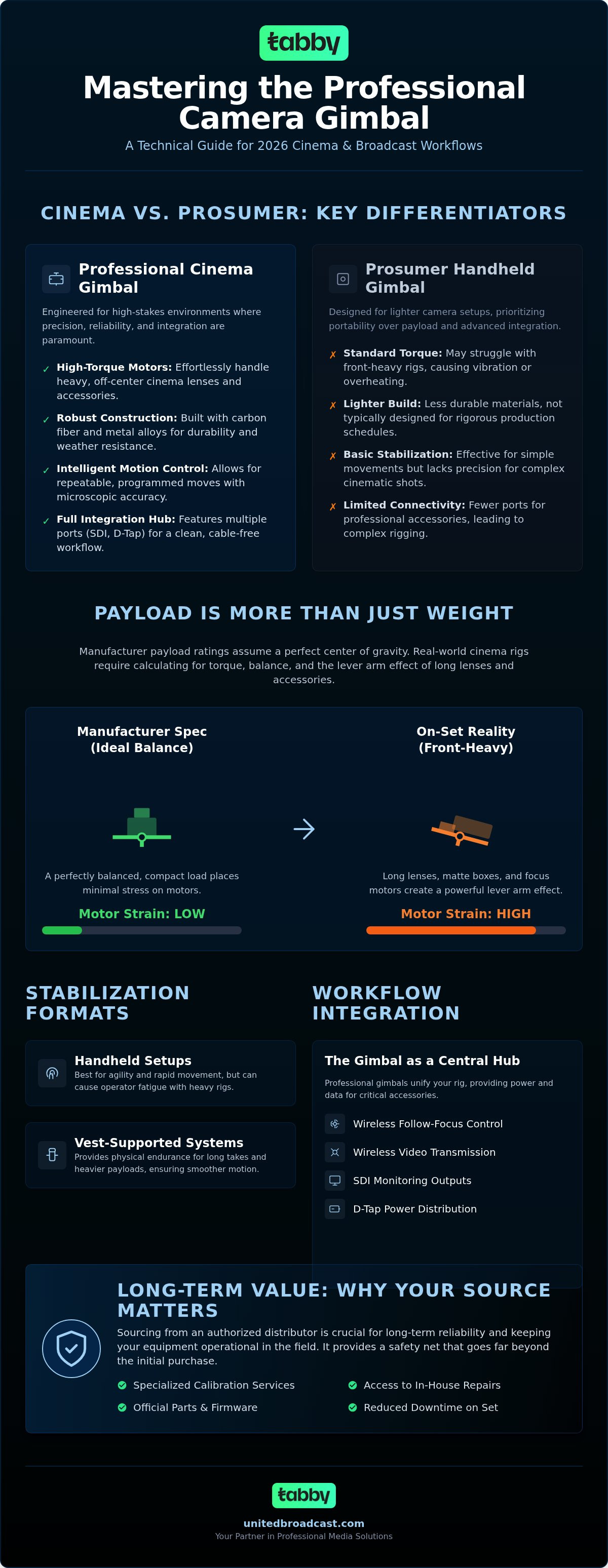
The distinction between tiers lies primarily in payload management and integration. A professional system must accommodate the weight and physical length of professional video cameras equipped with large PL-mount lenses. Prosumer models often struggle with the torque required to move front-heavy configurations, leading to motor vibration or overheating. Professional units are built to withstand the rigorous demands of national production schedules, featuring robust metal alloys and weather-resistant seals.
Integration is another critical differentiator. Professional gimbals act as a centralized hub, offering expansion ports for SDI monitoring, D-Tap power, and wireless transmission systems. These connections ensure that the camera operator, focus puller, and director all receive the data they need without a mess of tangled cables. This level of connectivity is essential for maintaining a clean, efficient workflow on a professional set.
Calculating Real-World Payload and Torque Requirements
Selecting a professional camera gimbal based solely on the manufacturer's maximum payload rating is a common pitfall for cinematographers. While a unit might be rated for 10 kilograms, that figure often represents a perfectly balanced center of gravity. In a cinema environment, the physical length of the rig is just as critical as its weight. A front-heavy configuration creates a longer lever arm, which forces the motors to work significantly harder to maintain stability. This increased demand on motor torque can lead to micro-vibrations, overheating, and ultimately, a shortened operational lifespan for the hardware.
Account for every accessory when calculating your total weight. Professional setups often include matte boxes, heavy-duty follow-focus motors, and top-plates for mounting wireless transmitters. These components don't just add mass; they shift the center of gravity away from the axes of rotation. If the gimbal isn't perfectly balanced, the motors must constantly fight gravity even when the camera is static. This constant strain drains gimbal batteries rapidly and generates internal heat that can trigger safety shutdowns during a shoot.
The Cinema Lens Factor
Balancing prime lenses is relatively straightforward, but cinema zoom lenses present a unique challenge. Many high-end zooms shift their internal glass elements during focal length changes, which can alter the balance of the entire 3-axis rig mid-shot. When using these lenses on professional video cameras, you must adjust the motor stiffness and torque settings to compensate for these shifts. In high-drag environments, such as high-speed vehicle mounts or windy exterior locations, you'll need a gimbal with high-torque motors that can overcome external wind resistance without losing its orientation. Counterweights are often necessary for oversized camera bodies or large-format sensors to ensure the rig sits naturally within the gimbal's cage.
Power Management for High-End Rigs
Powering a complex rig requires a strategic approach to weight and cable management. You can often power the camera directly from the gimbal battery, which keeps the setup compact and agile. However, for long-form national broadcast shoots, many specialists prefer using external V-mount batteries to ensure all-day reliability. You must ensure the voltage output matches the requirements of your professional accessories to avoid equipment damage. Managing cable snags is also vital. During 360-degree rolls or complex pans, a single snagged SDI or power cable can stall a motor and ruin a take. If you're unsure which power configuration suits your specific equipment, you can consult with our technical team for a customized integration plan.
Choosing the Right Stabilization Format
Selecting the ideal professional camera gimbal depends on the specific motion requirements of your project. While a unit might offer high torque, its physical form factor dictates how long an operator can maintain precision. Handheld configurations are the standard for high-speed, run-and-gun environments. These are particularly effective when paired with agile systems like Sony Alpha camera and lenses. However, for long-form documentary work or feature films, a handheld-only approach often leads to operator fatigue and degraded shot quality.
Vest-supported systems solve the endurance problem by distributing the rig's weight across the operator's torso. This allows for smoother, more deliberate movements over several hours of shooting. For added versatility, ring mounts and dual-handle grips provide extra points of contact and multiple mounting locations for monitors and wireless receivers. When the production moves beyond human movement, professional gimbals can be adapted for vehicle or crane mounts. These specialized configurations allow for high-speed tracking or elevated perspectives that would be impossible to achieve manually.
Handheld Agility for Run-and-Gun Production
Modern handheld gimbals have adapted to the rise of vertical content for social media and digital broadcast. Many units now feature native vertical shooting modes that don't require re-balancing the entire rig. Efficiency on set is further improved by standardized quick-release plates, allowing for near-instant transitions between the gimbal and a tripod. Ergonomics play a vital role here. Operators should evaluate the placement of joysticks and the responsiveness of touchscreens, as these interfaces are the primary points of control during complex maneuvers.
Heavy-Duty Rigs for Cinema Production
In large-scale cinema production, the gimbal is a part of a much larger ecosystem that includes professional lighting and grip equipment. The physical footprint of a fully rigged cinema gimbal, complete with a matte box and wireless focus motors, requires careful spatial planning. This complexity often necessitates a dedicated Gimbal Operator or technician. This specialist ensures the system remains calibrated and handles technical logistics, such as signal routing and power distribution, so the Director of Photography can focus entirely on the frame.
Integrating Gimbals into the Professional Workflow
A professional camera gimbal serves as a centralized communication hub on a modern set. It's no longer just about physical balance; it's about data flow. Precise optical control is achieved through seamless wireless follow-focus integration, allowing focus pullers to work independently of the gimbal operator. This synergy is vital when using heavy cinema glass where depth of field is razor-thin. Similarly, connecting to high-brightness monitors and long-range wireless video transmission systems ensures the entire crew has a real-time, high-definition view of the frame.
In specialized broadcast studio gear UAE environments, gimbals must support remote control protocols. This allows for operation from a control room or a remote head setup, integrating the gimbal into a multi-camera live workflow. Beyond motion, the interface often manages critical camera metadata and settings, such as ISO, shutter angle, and record triggers. This level of integration reduces the need for external cables that could impede motor movement or create clutter on the rig.
Wireless Control and Monitoring
Live broadcast and large-scale event coverage demand long-range transmission with near-zero latency. Focus pullers and directors rely on instantaneous feedback to make split-second creative decisions. When working in multi-camera environments, ensuring the gimbal-mounted camera stays in sync with the rest of the production is essential. Modern systems facilitate this by supporting synchronized timecode, which simplifies the post-production alignment of footage from various sources.
Software and Firmware Optimization
Efficiency on set is often dictated by the speed of technical transitions. Modern gimbals feature auto-calibration routines that quickly adapt motor strength to different lens focal lengths and weights. You can also customize motor response curves to match the specific cinematic style of a project, whether you need aggressive tracking or slow, sweeping pans. Regular firmware updates are essential for maintaining compatibility with the latest camera bodies and lens protocols from third-party manufacturers.
Professional Support: Why Your Source Matters
Purchasing a professional camera gimbal from a general retailer carries significant operational risks. High-end stabilization systems aren't just consumer electronics; they're precision tools that require dedicated technical backing. If you source gear from a non-specialized vendor, you'll likely face a lack of technical support when a motor fails or a firmware conflict occurs on set. Specialized distributors provide national warranty support and direct access to authorized service centers, ensuring your production doesn't stall due to avoidable technical hurdles. This infrastructure is essential for maintaining the long-term reliability of your investment.
Beyond the initial sale, professional gimbals require a level of maintenance that general retailers simply cannot provide. System integration services are often necessary to ensure a custom broadcast or cinema rig functions as a single, cohesive unit. This includes everything from signal routing for wireless video to power management for multiple accessories. When your equipment is part of a high-stakes workflow, the security of a national service center becomes a critical asset rather than a luxury.
Technical Maintenance and Calibration
Mechanical gimbals are high-precision instruments. They require periodic motor and sensor calibration to maintain their performance, especially after heavy use with complex cinema rigs. The harsh national climate, characterized by high temperatures and fine dust, can degrade motor bearings and sensor accuracy over time. Regular maintenance at a professional facility includes deep cleaning and recalibration of the internal sensors. This is often handled alongside cinema lens repair to ensure the entire optical path and stabilization system work in perfect harmony. Having expert technical support available for troubleshooting provides peace of mind when operating in the field.
The UBMS Professional Advantage
UBMS brings over 25 years of industry experience to every partnership. We understand that a professional camera gimbal is one component of a broader equipment ecosystem. Our team provides consultative sales for complex system integration projects, ensuring that your stabilization gear works flawlessly with your professional video cameras and broadcast infrastructure. By choosing an authorized national distributor, you gain direct access to a specialized service center equipped with the parts and expertise required for high-tier gear maintenance. This commitment to long-term reliability is what differentiates a technical partner from a simple vendor. We focus on the functional utility and longevity of your equipment, providing the logistical excellence required for high-stakes media production.
Future-Proofing Your Cinematic Movement
Mastering your choice of a professional camera gimbal requires a shift from viewing it as a standalone accessory to seeing it as a core optical component. You've seen how calculating torque for front-heavy cinema lenses and integrating wireless control protocols are essential for maintaining on-set efficiency. High-stakes productions don't just need smooth movement; they require the technical synergy of a fully optimized broadcast or cinema workflow. Success in 2026 is defined by how well your stabilization system communicates with the rest of your rig.
As an authorized distributor for industry-leading brands, UBMS provides more than just hardware. We offer expert system integration for national broadcast projects and maintain a dedicated technical service center for professional repairs. This infrastructure ensures your equipment remains calibrated and operational even in the most demanding environments. Choosing the right partner means securing the long-term reliability and specialized support your high-end gear demands. We're here to help you navigate these technical complexities with confidence.
Frequently Asked Questions
What is the maximum payload for a professional camera gimbal in 2026?
High-end professional camera gimbal systems in 2026 typically support payloads between 10 and 13 kilograms. This capacity allows for a fully rigged digital cinema camera equipped with professional lenses and essential accessories. However, the physical length and weight distribution of your setup are often more critical than the total weight. You should always ensure the center of gravity stays within the gimbal's adjustment range to prevent motor strain and overheating during operation.
Can I use a professional gimbal with cinema lenses and a matte box?
A professional gimbal is specifically designed to handle the physical dimensions and weight of cinema lenses and matte boxes. These setups require precise balancing across all three axes to ensure the brushless motors operate without vibration. Using extended mounting plates and counterweights helps accommodate front-heavy configurations. This ensures that the added weight of filters and lens hoods doesn't compromise the fluid movement or the structural integrity of the stabilization system.
Do professional gimbals support wireless follow-focus systems?
Modern gimbals feature dedicated expansion ports and power outputs to support wireless follow-focus systems. These integrations allow focus pullers to control the lens remotely while the operator handles the camera movement. By using high-torque motors and low-latency transmission, you can maintain sharp focus on complex tracking shots. This setup is a standard requirement for high-end cinema and commercial productions where manual focus pulling isn't feasible due to the rig's motion.
How long does the battery last on a fully rigged cinema gimbal?
The battery life of a fully rigged cinema gimbal typically ranges from 8 to 12 hours. This duration depends heavily on the weight of the camera package and how well the system is balanced. If the motors are fighting an imbalanced load, the battery will drain significantly faster. Many professionals use external V-mount batteries to power both the gimbal and the camera simultaneously, ensuring all-day reliability for long-form broadcast or documentary projects.
Is a vest-support system necessary for professional camera gimbals?
A vest-support system is essential for any production involving heavy cinema cameras or extended shooting schedules. While handheld operation is possible for short bursts, a vest redistributes the weight across your torso to prevent physical fatigue and back strain. This support allows you to maintain steady, precise movements over several hours. It's a vital investment for operators who need to stay mobile without sacrificing shot quality or risking physical injury on set.
Can professional gimbals be controlled remotely in a broadcast studio?
Professional gimbals integrate into broadcast studio environments through various remote control protocols. You can operate the pan, tilt, and roll functions from a control room using specialized joysticks or remote heads. This capability is particularly useful for live events where the camera is mounted on a crane or in a position that's inaccessible to a manual operator. These systems ensure consistent, repeatable movements that can be synchronized across multiple camera angles.
What is the difference between a 3-axis gimbal and a Steadicam?
The primary difference lies in the method of stabilization: gimbals use electronic brushless motors, while Steadicams rely on mechanical weights and an iso-elastic arm. A professional camera gimbal is generally more compact and easier to balance for rapid transitions. In contrast, a Steadicam offers a distinct mechanical "float" that some cinematographers prefer for specific narrative styles. Both systems have their place on a professional set depending on the desired visual aesthetic and movement speed.
How do I protect my gimbal motors from dust and humidity during outdoor shoots?
Protecting your equipment in harsh national climates requires regular maintenance and proper storage. You should use weather-resistant covers during outdoor shoots and clean the motor housings after every use to prevent grit buildup. If you notice any unusual motor noise or resistance, it's essential to visit an authorized service center for professional calibration. Routine servicing at a dedicated facility helps protect the internal electronics from the long-term effects of humidity and fine dust.


