

Cine Lenses Buying Guide: Professional Optics for 2026
Did you know the global market for professional optics is projected to reach 2.79 billion dollars this year? This growth reflects a fundamental truth in the industry: while camera sensors evolve every season, high-quality cine lenses remain the most stable, long-term assets you can own. You likely understand the pressure of choosing between the clinical perfection of a ZEISS or the legendary "Cooke Look," especially when facing the high entry costs and technical hurdles of professional glass.
It's natural to feel overwhelmed by mount compatibility or the demands of 8K+ sensors. This guide helps you master the technical and aesthetic nuances required to make a confident investment for your next production. We'll explore the latest 2026 innovations, including the Zeiss Horizon Anamorphic series and the rise of autofocus in cinema optics, to ensure your kit delivers both a high ROI and a signature visual style for your portfolio.
Key Takeaways
- Understand the fundamental differences between T-stops and F-stops to ensure precise light transmission in professional environments.
- Master the technical criteria for evaluating cine lenses, including sensor coverage and the resolving power required for 8K+ digital sensors.
- Distinguish between anamorphic and spherical aesthetics to select the optical character that best suits your narrative goals.
- Compare the performance and reliability of industry-leading collections from ZEISS and Cooke to maximize your investment’s longevity.
- Learn the importance of local technical support and specialized maintenance for protecting professional glass against the UAE’s environmental challenges.
Cine Lenses vs. Photo Lenses: Why Professionals Make the Switch
Transitioning from high-end photography glass to dedicated cine lenses is a pivotal moment for any cinematographer. While modern photo lenses offer incredible sharpness, they often fail in a high-stakes production environment where consistency and physical control are paramount. A Cine lens overview reveals that these tools are engineered specifically for moving images, prioritizing mechanical reliability and optical repeatability over the automated convenience found in still photography. These lenses aren't just for capturing light; they're designed to handle the rigorous demands of professional video cameras in a collaborative workflow.
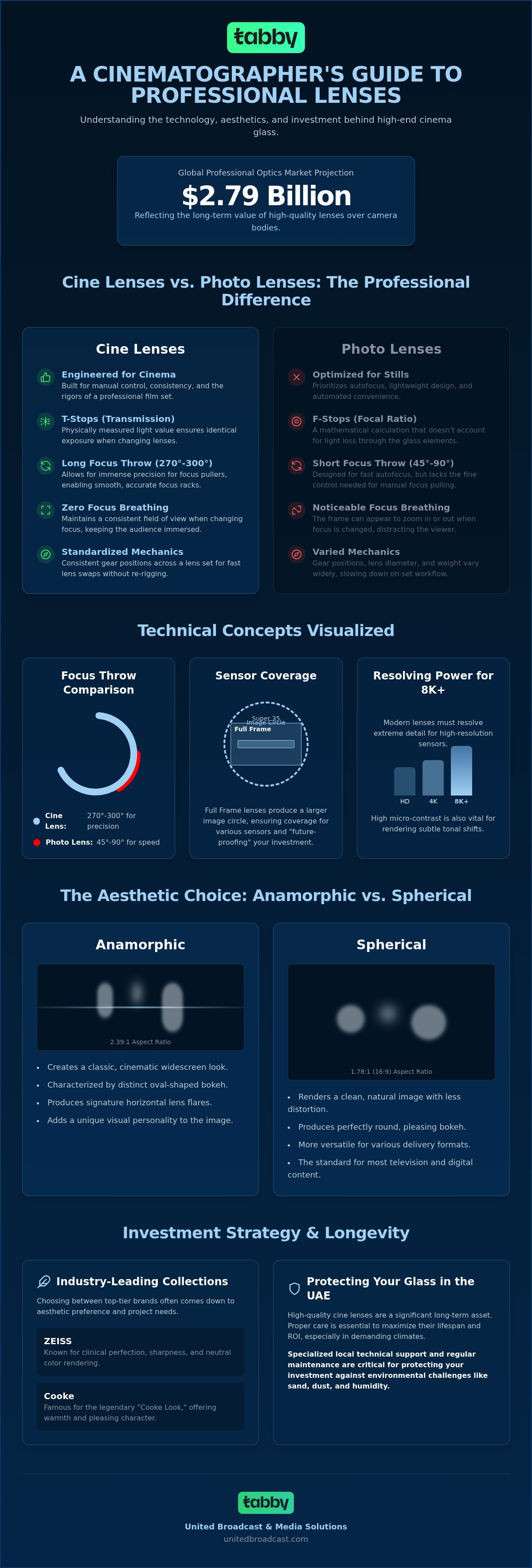
One of the most immediate benefits of this switch is the suppression of "focus breathing." In photo lenses, the frame often appears to zoom in or out as you rack focus between subjects. This shift is incredibly distracting in cinema. Professional cine glass is designed to maintain a consistent field of view throughout the entire focus range, ensuring the audience stays immersed in the story rather than the mechanics of the lens. Additionally, the inclusion of standardized 0.8 pitch geared rings allows for seamless integration with follow-focus systems and lens motors, providing a tactile experience that electronics cannot replicate.
The Superiority of T-Stops in Production
For professional cinematography, F-stops are rarely used. While an F-stop is a mathematical calculation of the aperture's diameter relative to the focal length, it doesn't account for the light actually lost as it travels through the glass elements. Cine lenses use T-stops (Transmission stops), which are physically measured values of how much light actually reaches the sensor. This distinction is vital for multi-camera setups or when swapping lenses mid-scene. If you move from a 24mm to an 85mm within the same set, a T2.1 rating ensures the exposure remains identical. You won't need to tweak your lighting or ISO to compensate for the internal variability common in photo lenses. This level of precision saves hours in the color grade and ensures a cohesive look across your entire production.
Mechanical Precision and Focus Throw
The physical build of a cine lens is designed for a collaborative set. Unlike photo lenses that might have a focus throw of only 45 to 90 degrees, cinema glass typically offers a rotation of 270 to 300 degrees. This expanded focus throw provides the focus puller with immense precision, making it easier to hit marks consistently even when shooting wide open at shallow depths of field. Standardization is another key factor. Most professional sets are designed so that the focus, iris, and zoom gears are in the exact same position across every focal length in the series. This allows your camera assistant to swap glass in seconds without needing to reposition the follow-focus or matte box. Hard physical stops at both ends of the focus scale also ensure that your lens motors don't strain against an infinite electronic ring.
Technical Criteria: How to Evaluate Professional Cinema Glass
Selecting a lens set involves more than just picking a focal length. It requires a rigorous analysis of how the glass renders detail and covers the active sensor area. While the mechanical features discussed previously ensure operational efficiency, the technical specifications of your glass dictate the image's longevity in an era of rapidly advancing sensor technology. Evaluating cine lenses for 2026 means looking beyond the spec sheet to understand how optical performance translates into a professional delivery format.
Sensor Coverage and Future-Proofing
Full Frame (FF) and Large Format sensors have become the benchmark for high-end digital cinematography. Investing in FF glass is the most logical path for kit longevity. These lenses produce a larger image circle, ensuring they can cover everything from Super 35 to the expansive sensors found in the latest professional video cameras. If you use a lens with insufficient coverage, you'll encounter vignetting or a significant drop in corner sharpness. By choosing glass that exceeds the requirements of your current camera, you ensure your investment remains viable even as you upgrade to larger sensor bodies in the future.
Resolving Power and Micro-Contrast
Modern 8K and 12K sensors expose every optical flaw. Resolving power refers to the lens's ability to distinguish fine, high-contrast detail, which is essential for high-resolution delivery. However, sheer sharpness isn't the only metric. Micro-contrast, the ability to render subtle tonal transitions within a small area, is what gives an image its "pop" and perceived depth. High-end optics utilize superior coatings to manage internal reflections and maintain this contrast even in challenging lighting. There's often a trade-off here; while some cinematographers prefer clinical, ultra-sharp modern glass, others seek out "character" lenses that offer a softer, more organic roll-off. Your choice should align with the specific visual language of your portfolio.
Beyond resolution, color matching within a prime set is a non-negotiable requirement for professional work. Every lens in a high-quality series should exhibit identical color reproduction and contrast. If your 35mm has a cool tint while your 85mm leans warm, the post-production color grade becomes a logistical nightmare. Consistency allows you to swap focal lengths mid-scene without altering the visual continuity of the shot. Finally, consider mount versatility. While the PL mount remains the industry standard for its robust, positive-locking mechanism, the rise of mirrorless systems has made E-mount and EF options increasingly popular. Using high-quality adapters can bridge these gaps, but native mounts always offer the most secure connection.
If you're unsure which optical characteristics best suit your upcoming project, you can consult with our technical specialists to compare specific lens sets in person.
The Aesthetic Choice: Anamorphic vs. Spherical Lenses
The choice between anamorphic and spherical glass is the most subjective decision a cinematographer faces. It isn't merely about the technical specifications of cine lenses; it's about the emotional texture and "vibe" of the final image. While spherical lenses provide a clean, naturalistic representation of reality, anamorphic optics introduce a specific set of visual artifacts that have defined the look of big-screen cinema for decades. Deciding which path to take requires balancing your narrative goals with the practical realities of your post-production workflow.
Mastering the Anamorphic Look
Anamorphic lenses use specialized glass elements to squeeze a wider field of view onto a narrower sensor. This process is most famous for creating the 2x squeeze seen in the Zeiss Horizon Anamorphic series released in June 2026. When you de-squeeze this footage, you're left with a grand, wide-screen aspect ratio and several iconic visual signatures. These include oval-shaped bokeh, horizontal lens flares, and a slight "fall-off" in sharpness toward the edges of the frame. These elements can be powerful storytelling tools, adding a sense of scale and dreamlike quality to your project. However, anamorphic shooting in the UAE requires careful planning; the increased complexity of de-squeezing and the generally slower T-stops mean you'll need more light and a more robust monitoring setup on set.
The Versatility of Modern Spherical Primes
Spherical lenses remain the industry workhorse for a reason. They offer superior clarity, lower distortion, and significantly faster apertures than their anamorphic counterparts. If your production demands a naturalistic look or involves high-speed action where corner-to-corner sharpness is critical, spherical glass is the logical choice. These lenses are also much easier to match when using hybrid setups. For instance, many professionals find success matching high-end spherical cine lenses with Sony Alpha camera and lenses for B-roll or gimbal work. This versatility makes spherical primes an excellent investment for those who work across broadcast, commercial, and narrative sectors.
Ultimately, your choice should serve the story. If your narrative is intimate and grounded, the honesty of spherical glass often works best. If you're aiming for a stylized, epic feel, the artifacts of anamorphic glass provide that "movie" look instantly. In the UAE's bright, high-contrast environments, spherical lenses often provide a safer technical baseline, while anamorphic lenses offer a way to stand out with a unique, high-value aesthetic in your portfolio.
Top Cine Lens Collections for 2026: Standout Options
The current market for cine lenses offers a diverse range of optical signatures, from clinical perfection to organic warmth. Choosing the right set requires balancing the specific visual needs of your project with the long-term value of the glass. In 2026, the industry has seen a clear divide between the "legacy" manufacturers who prioritize character and the modern innovators who focus on high-speed performance and metadata integration. Selecting from these standout collections ensures your production maintains a high-end aesthetic that stands the test of time.
The Premium Tier: Cooke and ZEISS
Cooke and ZEISS remain the gold standards for professional cinematography, yet they offer vastly different visual philosophies. The Cooke S8/i series continues the tradition of the legendary "Cooke Look," characterized by a smooth, organic roll-off and warm skin tones that feel inherently cinematic. In contrast, the ZEISS Supreme Prime series focuses on surgical precision and reliability, offering a clean, sharp image that is ideal for heavy visual effects work. Both brands have mastered metadata integration; Cooke utilizes i/Technology while ZEISS employs eXtended Data. This information is critical for modern workflows, as it records lens settings frame-by-frame, allowing post-production teams to map lens distortion and shading with absolute accuracy. These sets are more than just tools; they're stable financial assets that hold their value better than almost any other piece of production gear.
The Performance Tier: Sony and Sigma
For those operating within the Sony ecosystem, native E-mount glass has become a primary choice for cameras like the Venice 2 and FX series. Sony's recent optical developments provide seamless communication between the body and lens, which is essential for the increasing demand for high-quality autofocus in cinema. Sigma has also solidified its position as a bridge between photography and cinema. Their "Aizu Prime" lineup, refined for 2026, offers incredible speed and sharpness at a more accessible price point. If you're looking for the latest availability and regional pricing, you can browse the Cine Lenses Dubai Collection to see how these options compare.
Beyond the primary sets, specialty glass like the Laowa Ultima Zoom series or dedicated macro primes from Irix and DZOFilm allow for unique perspectives that standard primes can't achieve. DZOFilm, in particular, has disrupted the market by offering affordable cine lenses with professional mechanics, making high-end features like parfocal zoom designs available to a wider range of creators. Whether you're investing in a full set of primes or a single specialty probe lens, ensure the mechanics match your existing follow-focus and matte box standards.
Investment Strategy: Buying and Maintaining Cine Glass in the UAE
Purchasing professional optics is a high-stakes capital expenditure that requires a long-term perspective. In the UAE media landscape, the decision to buy locally often outweighs the perceived savings of importing. When you source cine lenses through a regional partner like UBMS, you aren't just buying glass; you're securing a technical lifeline. Local procurement ensures that your equipment is already compliant with regional regulations, including the 5% VAT and customs structures, while providing an immediate point of contact for technical support. In an industry where a single day of downtime can derail a production budget, having a physical service center for repairs and re-shimming is a critical business advantage.
Building a set should be a methodical process. Most professionals begin with a "Holy Trinity" of focal lengths—typically a wide (24mm or 35mm), a standard (50mm), and a telephoto (85mm) prime. This core set covers approximately 80% of narrative scenarios. As your portfolio grows, you can expand into specialty optics or high-performance zooms. While primes offer the fastest T-stops and most distinct character, a high-quality cine zoom is an invaluable asset for fast-paced broadcast work or documentary shoots where lens changes are impractical. This balanced approach ensures a high ROI by providing the most versatile tools first.
Protecting Your Glass in Desert Environments
The UAE’s environmental conditions present unique challenges for high-end optics. Extreme heat can cause internal lubricants to thin and migrate, while high humidity increases the risk of fungal growth on internal elements. Fine desert dust is equally hazardous; it can penetrate mechanical gears and degrade focus rings over time. It's essential to store your kit in climate-controlled environments and use dry cabinets to maintain optimal humidity levels. For those working frequently in the field, regular professional maintenance is required to ensure your glass remains within factory specifications. You can find detailed advice on maintaining your kit in our guide to Cinema Lens Repair Dubai.
Building a Sustainable Lens Set
Sustainability in a lens set comes from cross-compatibility and optical consistency. When you choose a series like the ZEISS Supreme Primes or the Cooke S8/i, you're investing in a look that will remain relevant for a decade or more. If your workflow involves both cinema and broadcast, consider how your cine lenses will integrate with various camera mounts. Utilizing a standardized PL mount across your kit allows for maximum flexibility, as it can be adapted to almost any modern sensor. This strategy protects your investment against the rapid upgrade cycles of camera bodies, ensuring your glass remains the most stable asset in your production inventory.
Explore our full range of cinema lenses and start your set today
Securing Your Visual Legacy in 2026
Mastering the technical and aesthetic nuances of professional glass is a prerequisite for high-end production. You've seen how mechanical features like T-stops and expanded focus throws provide the control needed for complex scenes. Choosing between the legendary character of a Cooke set or the clinical precision of ZEISS allows you to define your signature visual style while ensuring your kit meets the demands of 8K+ sensors.
In the UAE's demanding environment, your investment's longevity depends on more than just the initial purchase. Working with an authorized distributor for brands like ZEISS, Cooke, and Sony ensures you have access to a local on-site professional service center. This technical support is vital for maintaining your cine lenses against heat and dust while ensuring perfect lens-camera integration.
We're here to help you navigate these choices and build a kit that delivers a high ROI for years to come.
Frequently Asked Questions
What is the difference between a cine lens and a regular photo lens?
Cine lenses prioritize mechanical repeatability and optical consistency over the automated features of photography glass. They feature standardized geared rings for follow-focus systems and T-stop ratings for precise exposure control. Unlike photo lenses, they're designed to maintain focus while zooming and suppress field-of-view shifts during focus pulls.
Why are cine lenses so much more expensive than high-end DSLR lenses?
The high cost stems from complex opto-mechanical engineering and low-volume, precision manufacturing. These optics must maintain edge-to-edge sharpness on large sensors while surviving years of rigorous daily use on set. The materials used, such as specialized coatings and robust metal housings, ensure the glass remains a reliable asset for decades.
What does 'lens breathing' mean and why is it bad for cinema?
Lens breathing is a shift in the field of view that occurs when you change the focus distance. It is problematic because it creates a distracting "zooming" effect during narrative focus pulls. High-end cine lenses are specifically designed with internal optical groups that move to counteract this phenomenon, keeping your composition consistent.
Is it better to buy a set of prime lenses or one high-quality cine zoom?
Primes are generally better for narrative work due to their faster apertures and distinct aesthetic character. A single high-quality zoom excels in broadcast and documentary environments where lens changes are impractical. Your choice depends on the pace of your production; zooms offer speed, while primes offer superior low-light performance and lighter weight.
Which lens mount should I choose for my cinema camera in 2026?
The PL mount remains the professional standard for its secure locking mechanism and industry-wide compatibility. While native mirrorless mounts like E-mount are popular for owner-operators, the PL mount is the safest long-term investment. It can be adapted to almost any modern camera body, ensuring your glass doesn't become obsolete when you upgrade sensors.
How do I maintain my cine lenses in the UAE's humid climate?
You should store your equipment in a dry cabinet or a climate-controlled environment to prevent internal fungus growth. High humidity in the UAE can degrade internal coatings if the glass isn't properly ventilated. Regular inspections at an authorized service center help identify moisture ingress before it causes permanent damage to the optical elements.
Can I use an E-mount cine lens on a PL-mount camera with an adapter?
No, you cannot use a native E-mount lens on a PL-mount camera because the flange focal distance of the E-mount is much shorter. Adapters typically work in the opposite direction, allowing you to use PL-mount cine lenses on mirrorless bodies. Attempting to adapt a mirrorless lens to a traditional cinema camera is physically impossible without significant optical correction.
What is the 'Cooke Look' and why do cinematographers prefer it?
The 'Cooke Look' refers to a specific aesthetic characterized by warm skin tones, a smooth roll-off, and a subtle organic texture. Cinematographers prefer it because it takes the "digital edge" off modern high-resolution sensors without sacrificing fine detail. It provides a flattering, romantic quality to faces that's difficult to replicate perfectly during post-production color grading.


