

The Professional Camera Slider: A Comprehensive Guide to Cinema-Grade Motion Control
A single millimeter of flex in your rail can invalidate hours of precision blocking, proving that high-end cinematography is as much about mechanical integrity as it is about light. Professional filmmakers understand that micro-jitters and carriage sagging under a heavy cinema rig aren't just minor inconveniences; they're production-stoppers that software stabilization cannot truly rectify. When you're operating a professional camera slider on a high-stakes set, the demand for absolute stability and mechanical reliability is non-negotiable. You've likely experienced the frustration of a slider failing in a harsh environment or a complex shot lacking the repeatability needed for precise visual effects plates.
This guide provides the technical foundation to master cinema-grade motion control and achieve ultra-smooth results for high-end productions. As the industry shifts toward motorized automation and advanced carbon fiber materials, understanding payload capacities and drive systems becomes vital. We'll examine the critical intersection of material science and intelligent motion, detailing how to select gear that maintains its integrity under the weight of flagship cinema cameras. From managing mechanical friction to utilizing app-controlled repeatability, you'll learn to secure the fluid movement that defines professional visual storytelling.
Key Takeaways
- Understand why precision-engineered physical motion remains superior to digital stabilization for maintaining image integrity in high-end cinema.
- Learn how to calculate payload dynamics to ensure your professional camera slider supports a full cinema rig without carriage sagging or micro-jitters.
- Compare the tactile advantages of manual sliders for organic shots against the frame-accurate repeatability of motorized systems for complex VFX work.
- Evaluate the critical trade-offs between rail material science, such as carbon fiber versus aerospace-grade aluminum, and their impact on field durability.
- Identify professional maintenance protocols and signs of mechanical wear that necessitate expert recalibration to protect your equipment investment.
The Role of the Professional Camera Slider in Modern Cinematography
A professional camera slider isn't just a rail; it's a sophisticated instrument for controlled motion. While basic sliders might suffice for light setups, a professional-grade system is defined by its ability to maintain absolute rigidity under heavy loads. The choice of rail length and material directly influences the visual narrative. A shorter, stiffer rail might be used for subtle character reveals, while longer tracks allow for expansive parallax shifts that redefine the spatial relationship between subjects. This mechanical precision ensures that every movement feels intentional rather than accidental, elevating the overall production value.
Mechanical Precision vs. Digital Stabilization
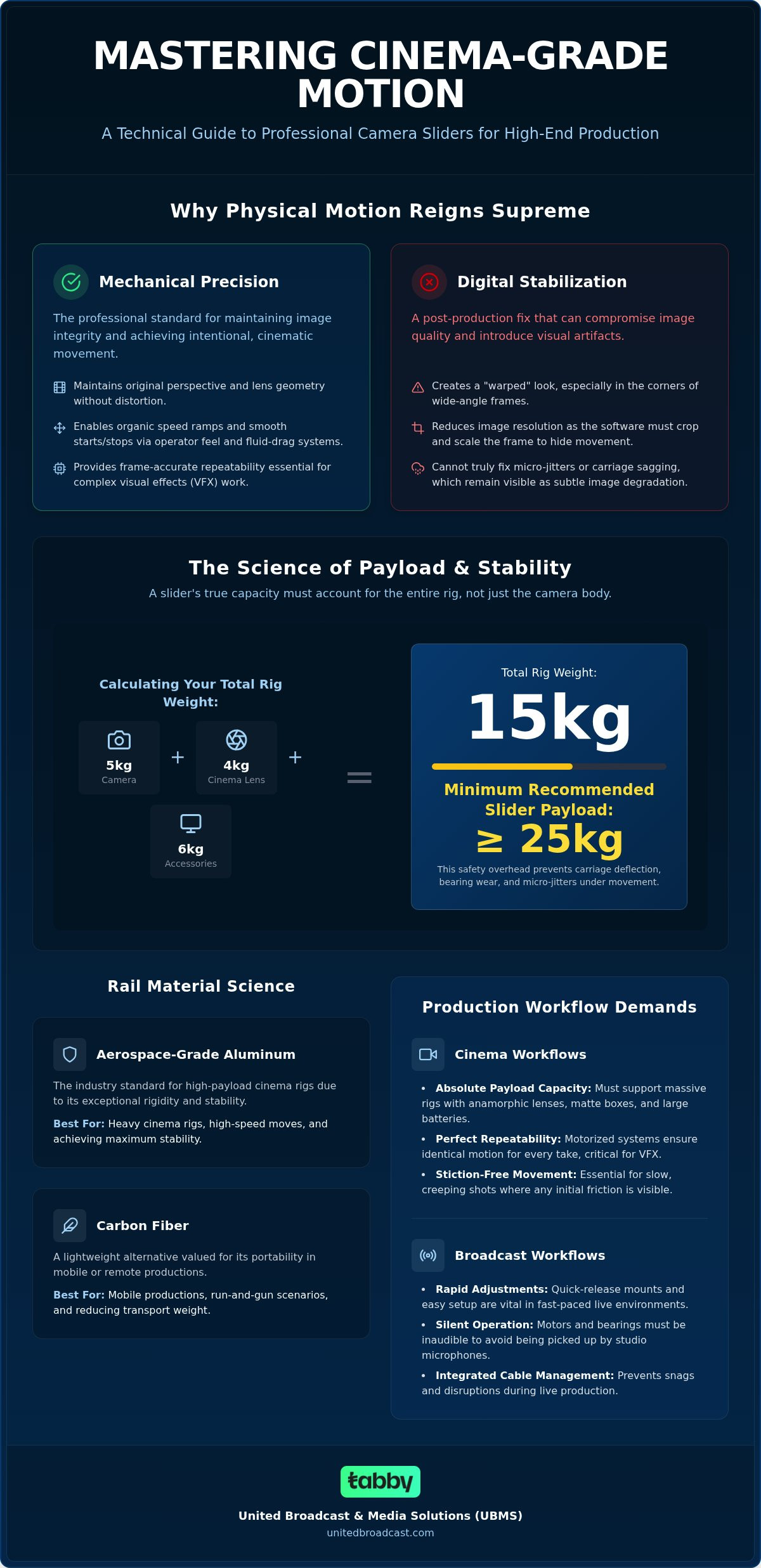
Digital post-stabilization often creates a "warped" look, especially in the corners of wide-angle frames. This occurs because software fixes three-dimensional movement errors in a two-dimensional space. By using a physical slider, you maintain the original perspective and lens geometry throughout the move. High-end sliders use precision-ground stainless steel or carbon fiber rails that minimize rolling resistance. This allows the operator to feel the shot, using the carriage's natural inertia to create organic ramps in speed.
Fluid-drag is a mechanical feature that uses viscous internal resistance to provide consistent, adjustable tension, smoothing out manual operator inputs for a more professional finish.
Broadcast vs. Cinema Workflows
Live environments demand equipment that can be adjusted in seconds without disrupting the production flow. Broadcast sliders often feature quick-release mounts and integrated cable management to prevent snags during fast-paced segments. Silence is also paramount; the slider must operate without audible motor noise or mechanical grinding that could be picked up by studio microphones.
In contrast, cinema workflows prioritize the ability to support massive rigs. When you're using professional video cameras equipped with anamorphic glass, matte boxes, and large batteries, the slider's payload capacity is the primary concern. Modern digital cinema sensors capture incredible detail, making any mechanical failure or "stiction" immediately obvious to the viewer. Therefore, the slider must offer perfect repeatability, ensuring that the motion remains identical whether it's the first take or the fiftieth. This reliability is what separates a professional tool from a consumer-grade accessory.
Technical Specifications: Materials, Mounts, and Payload Dynamics
Selecting a professional camera slider requires a rigorous evaluation of its structural composition and mechanical limits. Aerospace-grade aluminum is the industry standard for high-payload cinema rigs because of its exceptional rigidity and resistance to thermal expansion. While carbon fiber offers a lightweight alternative for mobile productions, it often lacks the physical mass required for high-inertia manual moves. The choice of material affects more than just transport weight; it dictates how the rail responds to the extreme stresses of a fully rigged cinema camera moving at high speeds.
Calculating payload capacity is a critical safety step. You shouldn't just consider the camera body. A professional setup includes heavy cinema lenses, monitors, wireless follow-focus motors, and high-capacity batteries. If your total rig weighs 15kg, you should utilize a slider rated for at least 25kg. This overhead prevents carriage deflection and ensures the bearing system doesn't develop flat spots under pressure. Stainless steel wheels on precision-ground rails offer the lowest rolling resistance, which is essential for slow, creeping shots that require "stiction-free" movement. In contrast, polymer bushings are often preferred for harsh environments, as they're self-lubricating and less prone to damage from sand or grit.
The Science of Payload and Stability
Stability is directly tied to the center of gravity. As the camera carriage moves toward the ends of the rail, the weight distribution shifts, which can cause the track to sag or the tripod to tip. Outrigger feet are indispensable for ground-level shots, providing a wider base to counteract these leverage forces. For rails exceeding 1.2 meters, dual-tripod support becomes mandatory to maintain a perfectly level plane. The load-bearing capacity of a slider increases exponentially with the diameter of its rails, as thicker tubes offer significantly higher resistance to torsional stress and bending.
Professional Mounting Ecosystems
Mitchell mounts remain the definitive standard for cinema because they provide a flat, ultra-stable interface that can handle the massive torque of heavy fluid heads. For smaller configurations, 100mm or 75mm bowls offer faster leveling on uneven terrain. These mounting systems must integrate seamlessly with your professional lighting equipment and grip gear to ensure a safe and efficient workflow. If you're unsure about the compatibility of your current tripod head with a specific rail system, our technical team can provide expert guidance on the necessary adapters and mounting plates for your production.
Manual vs. Motorised Sliders: Choosing the Right Drive System
The choice between a manual and a motorised drive system dictates the "feel" and functionality of your camera movement. A professional camera slider is often judged by its ability to provide either total organic control or absolute mathematical precision. While manual sliders offer a tactile connection to the shot, motorised systems transform the rail into a sophisticated motion control (MoCo) tool capable of repeating complex paths with sub-millimeter accuracy. Understanding the technical limitations of each system is essential for maintaining a high-tier production standard.
Noise is a critical factor when choosing a drive system, especially in intimate dialogue scenes or quiet studio environments. Most high-end motorised sliders utilize either stepper motors or coreless motors. Stepper motors are valued for their high torque and precise positioning, yet they can produce a distinct electronic whine. Coreless motors offer near-silent operation and smoother starts, making them the preferred choice for live broadcast and high-fidelity audio sets. Power management also requires planning; while manual systems require no external energy, motorised rigs usually demand 12V to 24V inputs, often supplied via V-mount or Gold-mount batteries for extended field operations.
Manual Operation: The Cinematographer’s Touch
Manual sliders remain a staple on fast-paced sets because they allow the operator to react instantly to an actor's performance. Achieving a "feathered" start and stop—where the movement begins and ends without a noticeable jerk—is a hallmark of a skilled operator. To assist with this, many professional systems incorporate a flywheel. These weighted discs attach to the drive belt or carriage, using centrifugal force to add artificial inertia. This resistance smooths out the micro-tremors of human touch, resulting in a fluid, organic motion that feels more cinematic than a perfectly linear robotic move.
Motorisation and Motion Control (MoCo)
When a production requires frame-accurate repeatability for visual effects or complex multi-pass plates, motorisation is mandatory. Modern systems often integrate with multi-axis heads to synchronize sliding with panning and tilting. This creates a 3-axis motion path that can be saved and replayed indefinitely. These systems are typically controlled via dedicated hardware consoles for low-latency response or smartphone applications for intuitive keyframe programming. Such precise movement is frequently paired with high-end lighting solutions for professional sets, ensuring that shadows and highlights track perfectly with the camera's travel path. This level of integration is what allows small crews to execute high-concept shots that previously required massive industrial robots.
Selection Guide: Matching Your Slider to Your Production Needs
Choosing a professional camera slider is a strategic decision that depends on your specific camera ecosystem and production environment. If you're operating with a mirrorless system, a lighter carbon fiber rail might provide the agility needed for run-and-gun shoots. However, full-size digital cinema cameras demand high-mass aluminum or steel rails to counteract the vibrations inherent in larger sensor stabilization systems. You must consider not just the current weight of your camera body, but the total mass of your most complex build, including cinema lenses and wireless transmission systems.
Rig Weight and Travel Distance
The "golden ratio" of slider length usually falls between 60cm and 100cm for interior work. Shorter rails are inherently stiffer, reducing the risk of mid-rail bowing when supporting heavy rigs like ARRI Production Kits and Accessories. While a 1.5-meter rail offers dramatic travel distance for exterior landscapes, it requires significantly more support infrastructure to remain stable. If your workflow involves tight studio spaces, a compact, high-payload slider often yields better results than a long, flexible one. Shorter rails also facilitate easier transport, which is a vital consideration for crews moving between multiple locations in a single day.
Durability in National Environments
Operating in regional climates presents unique challenges, specifically concerning dust ingress and thermal expansion. High-heat environments can cause metal rails to expand slightly, which may introduce friction or "sticking" points in the carriage's travel. To mitigate this, look for sealed bearing systems that prevent fine sand and grit from entering the internal mechanics. Regular maintenance becomes even more vital when equipment is exposed to these conditions. Understanding how your gear integrates with The Ultimate Guide to Professional Video Cameras in 2026 will help you build a resilient kit that withstands the elements.
Future-proofing your investment means choosing a system that grows with your lens collection. As you transition to heavier anamorphic glass or long telephoto primes, a lower-tier slider will quickly become a bottleneck. Selecting a modular system allows you to swap rails or upgrade motors as your production needs evolve. Always prioritize a professional camera slider with a payload rating that exceeds your current heaviest rig by at least 30 percent. This buffer ensures that your motion remains fluid even when you add specialized accessories like matte boxes or remote follow-focus motors.
Professional Maintenance and Technical Support
Maintaining a professional camera slider is a technical necessity that directly impacts the smoothness of your footage and the longevity of your investment. High-precision rails and bearing systems are engineered to microscopic tolerances. Even a small accumulation of grit can cause audible grinding or visible stiction in your shots. In regional climates where dust and heat are prevalent, a rigorous maintenance schedule is the only way to prevent premature mechanical failure and ensure your gear performs at its peak during high-stakes productions.
Routine Care for Precision Rails
For anodized aluminium rails, use a lint-free cloth dampened with a small amount of isopropyl alcohol to remove oils and debris. Carbon fiber requires even more care; you should avoid harsh chemical solvents that could degrade the resin binding the fibers. Instead, use a dry microfiber cloth or a dedicated carbon-safe cleaner to wipe down the tracks after every shoot. Regular cleaning prevents the buildup of "track grime" that can eventually pit the surface of the metal or wear down the carriage wheels.
- Inspect wheels for "flat spots," which occur when a heavy cinema rig is left stationary on the rails for extended periods.
- Check drive belts for proper tension and any signs of fraying or dry rot that could lead to a mid-shot failure.
- Verify that all mounting bolts and outrigger feet are tightened to prevent micro-vibrations from reaching the sensor.
Regularly cleaning your camera sensor is essential when changing rigs or mounting to a slider, as the process often exposes the internal cavity to airborne particulates. This routine care should be performed after every shoot in a challenging environment to ensure the carriage continues to glide without resistance. If the slider feels "crunchy" or requires more force than usual to move, stop immediately to avoid permanent scoring of the rails.
Expert Support and Integration
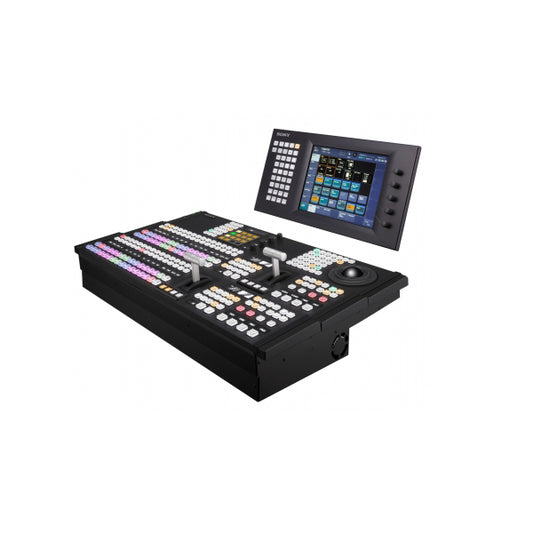
While routine cleaning can be handled on-set, mechanical wear often requires specialized intervention. If you notice a persistent "bump" in your travel or if your motorised system is losing its calibration, it's time to seek professional recalibration. United Broadcast & Media Solutions (UBMS) operates a dedicated service center staffed by technicians who understand the specific stresses placed on cinema equipment. This expertise extends beyond simple repairs to full system integration. We assist broadcast studios in setting up complex motion control environments where a professional camera slider must interface with automated switchers and multi-camera arrays.
Maintaining the optical path is just as critical as the mechanical one. Just as rails need cleaning, your glass requires expert attention to maintain its resolving power. For more on this, read our guide on Cinema Lens Repair and Optical Maintenance. By partnering with an industry pillar like United Broadcast & Media Solutions (UBMS), you ensure that every component of your production chain operates at a global standard of excellence.
Elevating Your Cinematic Motion Control
Achieving cinema-grade motion is a technical discipline that requires balancing material science with precise mechanical operation. By prioritizing high-payload stability and selecting the correct drive system for your specific workflow, you eliminate the micro-jitters that compromise high-end productions. A professional camera slider is more than a simple rail; it's a long-term investment in your narrative capability that demands rigorous selection and expert maintenance to sustain its performance over time.
Since 1997, United Broadcast & Media Solutions (UBMS) has served as a dedicated technical partner and industry pillar for the professional media community. As an authorized distributor for global brands, we provide both the hardware and the technical infrastructure needed to support it. Our expert service center and decades of experience in system integration ensure that your equipment remains recalibrated and reliable for years of intensive use. Whether you're building a broadcast studio or a specialized cinema kit, we offer the logistical excellence required for success.
We look forward to supporting your next production with the precision and dependability your vision demands.
Frequently Asked Questions
What is the difference between a video slider and a camera dolly?
A professional camera slider is a self-contained rail system designed for short, high-precision linear movements. In contrast, a camera dolly typically refers to a wheeled platform that runs on tracks or smooth floors for longer distances. While sliders are portable and can be mounted at various angles on tripods, dollies are better suited for expansive travel or shots involving complex curves. Sliders provide the rigidity needed for micro-movements that dollies often struggle to replicate.
How much weight can a professional carbon fiber slider support?
Professional carbon fiber sliders are engineered to support substantial payloads, often ranging from 10kg to 20kg depending on the rail diameter and construction. While carbon fiber is prized for its strength-to-weight ratio, it's vital to calculate the total mass of your camera, lens, and accessories. We recommend selecting a system with a payload capacity at least 30 percent higher than your heaviest rig. This overhead prevents rail deflection and ensures the carriage maintains smooth, consistent motion.
Do I need a specific tripod for a professional camera slider?
Most professional sliders require a heavy-duty tripod with a 75mm, 100mm, or Mitchell mount to ensure a stable foundation. Using a standard stills tripod often leads to "tipping" as the carriage moves toward the ends of the rail. For sliders exceeding 1.2 meters, we suggest using two tripods or dedicated slider stands to eliminate mid-rail sagging. This dual-support setup is essential when operating full-size digital cinema cameras that exert significant torsional stress on the mounting plates.
Can I use a motorised slider for live broadcast interviews?
You can certainly use a motorised professional camera slider for live broadcast, provided the motor system is designed for silent operation. Systems equipped with coreless motors are preferred because they don't produce the electronic whine common in cheaper stepper motors. Motorised systems allow for perfectly repeatable framing during interviews, enabling a single operator to manage multiple camera angles. This level of automation is a core component of modern broadcast studio gear and system integration services.
What is the best slider length for professional cinematic shots?
The ideal slider length depends on your environment, but 60cm to 100cm is considered the industry standard for professional interior shoots. This range provides enough travel for significant parallax shifts while remaining stiff enough to support heavy rigs without bowing. While 1.5-meter rails are available for wide exterior vistas, they require extensive support and are more difficult to transport. For most cinema applications, a shorter, more rigid rail yields higher-quality results than a longer, more flexible one.
How do I prevent micro-jitters when using a heavy cinema camera on a slider?
Micro-jitters are typically caused by mechanical friction or insufficient support under a heavy cinema rig. To prevent these, ensure your rail is clean and free of grit that could interfere with the bearing system. Utilizing aerospace-grade aluminum rails rather than thin-walled tubes provides the mass needed to dampen vibrations. Additionally, using a flywheel on manual systems adds artificial inertia, which helps smooth out the small, involuntary movements of the operator's hand for a more fluid result.
Is it necessary to use a fluid head with a camera slider?
While not strictly mandatory for the slider to function, using a fluid head is highly recommended for professional work. Mounting your camera on a fluid head atop the slider carriage allows you to perform simultaneous pan and tilt moves during the slide. This multi-axis movement creates more dynamic shots and helps track subjects through the frame. Most professional carriages feature 75mm or 100mm bowls to accommodate industry-standard fluid heads, ensuring seamless integration with your existing camera support gear.
How does heat and dust affect the performance of professional sliders?
Regional climates with high heat and fine dust can significantly impact slider performance by causing thermal expansion and mechanical abrasion. Metal rails may expand slightly in extreme temperatures, which can increase friction or create "sticking" points in the carriage travel. Fine sand can enter unsealed bearing systems, leading to permanent scoring of the rails. We advise using sealed bearing systems and performing daily maintenance with lint-free cloths to protect your equipment investment in these challenging environments.


