

The Best Cinema Zoom Lenses for 2026: A Professional Guide to High-End Optics
The long-held industry belief that only prime lenses can deliver true cinematic excellence is officially dead in 2026. Modern high-end productions now demand a level of versatility that fixed focal lengths simply can't match without slowing down the production workflow. Finding the best cinema zoom lenses involves more than just checking focal ranges; it requires an optic that maintains its character across the entire throw while covering the latest large-format sensors.
You've likely experienced the frustration of distracting lens breathing during a critical narrative moment or the difficult trade-offs between weight and performance on a gimbal. We've compiled this guide to help you discover industry-leading glass that balances optical precision with the operational flexibility your projects require. We'll preview the latest 2026 innovations from manufacturers like Angenieux and Cooke, ensuring your investment is future-proof and backed by the reliable technical support your professional standards demand.
Key Takeaways
- Understand why modern high-end productions are shifting toward "zoom-first" workflows that prioritize efficiency without compromising on optical character.
- Identify the essential technical benchmarks, including parfocal stability and suppressed breathing, that define the best cinema zoom lenses in 2026.
- Compare flagship "Hollywood standard" optics against high-ROI options tailored for owner-operators to find the right balance for your specific production tier.
- Navigate the transition to large-format sensor coverage and evolving mount standards like LPL and mirrorless systems to ensure long-term gear compatibility.
- Discover the benefits of sourcing through authorized distributors to access professional system integration and dedicated technical support for your optical pipeline.
The Evolution of Cinema Zoom Lenses in 2026
The landscape of high-end cinematography has fundamentally shifted. While prime lenses once held the crown for absolute optical purity, the 2026 generation of cinema zooms has narrowed that gap to the point of near-indistinguishability. High-stakes productions now prioritize the best cinema zoom lenses to maintain momentum on set without sacrificing the aesthetic quality that defines premium content. This evolution is driven by a need for mechanical reliability that matches modern camera data workflows.
The industry is moving toward "zoom-first" workflows because the logistical cost of frequent lens changes is becoming unsustainable for tight production schedules. Large-format sensors, such as those found in the latest professional video cameras, have been the primary catalyst for this change. Designing glass that covers a 46.3mm image circle while maintaining a constant aperture is a complex engineering feat. Today, these lenses offer a value proposition that balances a higher upfront investment against the sheer efficiency gained during a shoot day.
Cinema Zooms vs. Photographic Zooms
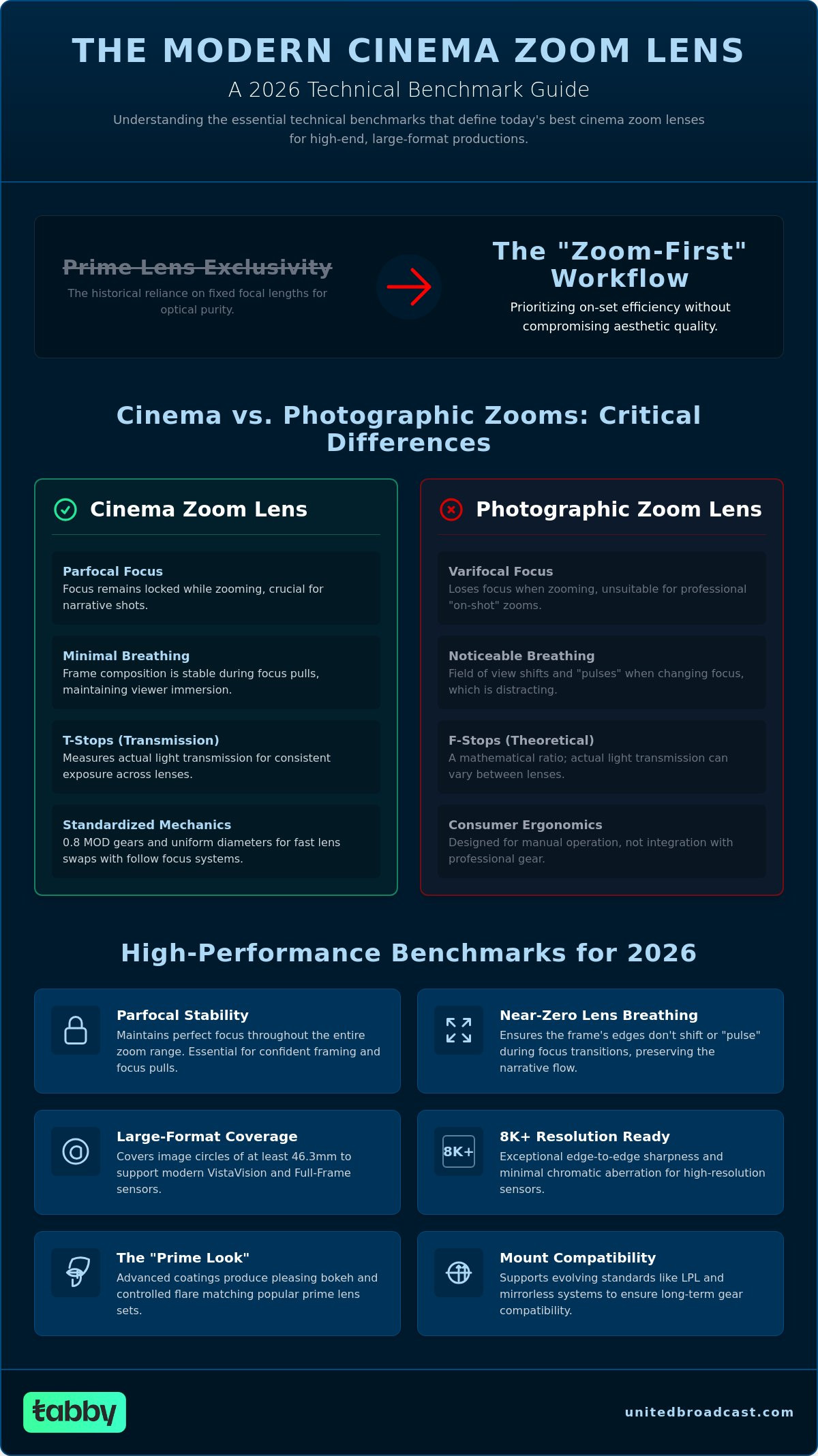
The distinction between professional optics and consumer-grade glass lies in the internal mechanics. A critical requirement for any production is the use of parfocal cine zoom lenses, which ensure that focus remains locked even as you change focal lengths. Photographic zooms often lose focus during the zoom, making them useless for narrative storytelling. Furthermore, cinema glass features standardized 0.8 mod geared rings and consistent front diameters, allowing focus pullers to swap lenses without repositioning follow-focus motors or matte boxes. T-stops are used instead of f-stops to provide an exact measurement of light transmission, ensuring exposure remains identical when switching between different pieces of glass.
The "Prime Look" in a Zoom Body
Modern optical coatings have successfully eliminated the clinical, overly sharp look associated with older zoom designs. Engineers now tune these lenses to produce pleasing bokeh and controlled flare characteristics that match the most popular prime sets. This allows DPs to use one of the best cinema zoom lenses for the majority of a production, only switching to specialized primes when an extreme aperture or specific vintage flare is required. Integrating a high-performance zoom for B-roll or action units no longer results in a jarring shift in image texture, providing a seamless visual experience across the entire project.
Technical Benchmarks: What Defines a High-Performance Cinema Zoom?
Selecting the best cinema zoom lenses in 2026 requires a deep dive into specifications that directly impact the viewer's immersion. While early examples in the history of the zoom lens were often criticized for technical flaws, today's benchmarks are incredibly rigorous. For a lens to qualify for high-end production, it must exhibit near-zero lens breathing. This ensures that when a focus puller transitions between subjects, the frame's edges don't shift or "pulse," which can distract the audience and break the narrative flow.
Parfocal stability is another non-negotiable benchmark. A true cinema zoom maintains its focus point perfectly throughout the entire focal range. This allows a cinematographer to zoom in to check focus and then zoom out to the desired framing, confident that the image remains sharp. As 8K sensors become the baseline for professional acquisition, lenses must also demonstrate exceptional edge-to-edge sharpness and minimal chromatic aberration. High-resolution sensors reveal even the smallest color fringing or softness, making optical precision more critical than ever before.
Optical Performance and Sensor Coverage
Full Frame coverage is no longer an optional luxury. As VistaVision and large-format sensors become the standard for flagship digital cinema cameras, the best cinema zoom lenses must cover image circles of at least 46.3mm. Future-proofing your optical pipeline ensures that your glass remains relevant as sensor technology continues to advance. Matching resolution and contrast across the entire zoom range is vital for maintaining a consistent look in 8K post-production workflows where every detail is scrutinized.
Ergonomics and Mechanical Reliability
Mechanical build quality determines how a lens survives the rigors of a high-intensity set. Weight distribution is a key factor; a well-balanced lens makes gimbal work and handheld operation significantly less taxing. Professional zooms feature standardized gear positioning for focus, iris, and zoom rings. This allows for rapid lens changes without the need to reposition follow-focus motors or matte boxes. Furthermore, robust weather sealing and durable housings ensure the optics remain protected in challenging environments, from desert heat to humid studio floors.
If you're unsure which mount standard or weight profile aligns with your current camera inventory, our technical team can provide a detailed compatibility assessment to help you make an informed decision.
Top Picks: The Best Cinema Zoom Lenses for Every Production Tier
Selecting the right glass requires balancing creative intent with fiscal responsibility. At United Broadcast & Media Solutions, we've identified that the best cinema zoom lenses in 2026 are those that offer a clear path to return on investment while meeting the rigorous standards of modern digital sensors. Whether you're equipping a global broadcast unit or a boutique narrative production, the hierarchy of available optics has never been more diverse. We've curated these selections based on mechanical reliability, optical character, and their ability to integrate into professional digital cinema camera workflows.
Premium Flagship Zooms
For flagship productions where compromise isn't an option, the Angenieux Optimo Ultra 12x stands as the industry benchmark. Its success stems from the Interchangeable Rear Optics (IRO) technology, which allows the lens to be configured for Super 35, Ultra 35, or Full Frame/VistaVision image circles. This versatility is matched by the Cooke Varotal/i FF series. These lenses, including the 19-40mm, 30-95mm, and 85-215mm options, provide a constant T2.9 aperture and the famous "Cooke Look." They're designed to match perfectly with S7/i and S8/i primes, ensuring visual consistency across a multi-camera set. For those seeking clinical perfection, the ZEISS cinema zoom range continues to lead with precision engineering that eliminates distortion even at the widest focal lengths.
High-Performance Mid-Range Options
The owner-operator sweet spot is currently defined by lenses that offer large-format excellence with a more accessible price-to-performance ratio. The Fujinon Premista series is a standout here, providing a cinematic character that isn't overly clinical, making it a favorite for high-end commercial work. Sony's cine-style zooms have also gained significant ground, specifically designed for seamless integration with the Venice and FX series metadata workflows. For productions requiring high-value entry points, the DZOFilm Catta and Pictor series offer professional results and robust builds. These options allow smaller crews to access the best cinema zoom lenses without the capital expenditure required for flagship glass, all while maintaining the standardized gear positions necessary for professional follow-focus systems.
Specialized and Anamorphic Optics
2026 has seen a surge in specialized zoom glass. The Statera 90-180mm T3.2 and the newly unveiled Zeiss Horizon series represent a shift toward anamorphic zooms that don't sacrifice usability. These lenses provide the sought-after horizontal flares and oval bokeh that DPs crave, but in a zoom form factor that speeds up the acquisition process. These specialized tools are becoming essential for narrative projects that want a distinct "character" look while benefiting from the logistical efficiency of a zoom-first workflow.
Sensor Coverage and Mount Compatibility: A Selection Framework
Choosing from the best cinema zoom lenses requires more than just looking at the glass; the physical connection to the camera body determines the integrity of your optical pipeline. While the PL-mount remains the industry workhorse, the LPL-mount (Large Positive Lock) has emerged as the necessary standard for modern large-format sensors. This wider mount and shorter flange focal distance reduce vignetting and allow lens designers to create faster, higher-performing optics for the latest VistaVision sensors.
We've also seen a significant rise in native mirrorless mounts, such as E-mount and RF-mount, within high-end cinema environments. These aren't just for secondary cameras anymore. Using native mounts often provides a more secure, wiggle-free connection than stacked adapters. However, if you must use adapters, maintaining optical alignment is critical. Even a microscopic deviation in the mount plane can lead to corner softness or a loss of parfocal stability. We recommend shimming your lenses regularly to ensure back-focus accuracy, especially when moving between different camera bodies on a multi-day shoot.
Matching Lenses to Camera Systems
To get the most out of your gear, it's vital to consider the Sony Alpha camera and lenses ecosystem, which has become a staple for B-roll and gimbal work on major sets. Integrating these with flagship professional video cameras requires a clear understanding of data communication protocols. Modern cinema zooms often feature i/Technology or LDS-2 contacts. These pins transmit real-time metadata, including focal length, iris position, and focus distance, directly to the camera. This data is indispensable for visual effects workflows and automated lens mapping in post-production.
The Importance of Image Circle
Before investing, you must calculate if your chosen lens will vignette on your specific sensor. A lens designed for Super 35 (approx. 31mm diagonal) will show heavy dark corners on a Full Frame sensor (approx. 43-46mm diagonal). Some cinematographers intentionally use Super 35 glass on larger sensors to achieve a vintage, vignette-heavy look, but this is a creative choice that limits your framing options. If you're looking to extend the life of your existing S35 glass, high-quality teleconverters and expanders can increase the image circle to cover Full Frame sensors, though this usually comes at the cost of one or two T-stops of light.
If you're planning a transition to a large-format workflow and need to verify the compatibility of your current lens inventory, contact our technical specialists for a comprehensive system audit.
Optimising Your Optical Pipeline with UBMS Solutions
System integration is at the core of our service model. We understand that a lens doesn't exist in a vacuum. It must work in perfect harmony with your camera body, matte boxes, and wireless focus motors. Our team specializes in building comprehensive packages that eliminate compatibility guesswork, allowing you to focus on the creative aspects of your project while we handle the technical infrastructure. This holistic approach ensures that every component in your signal chain is optimized for maximum performance.
Expert Support and Maintenance
Cinema zooms are marvels of mechanical engineering, often containing dozens of individual glass elements and complex cam-driven focus mechanisms. These components require regular calibration to maintain parfocal accuracy and suppressed breathing. The UBMS Service Centre is equipped with precision optical benches to handle these delicate tasks. In the challenging UAE climate, where heat and fine dust are constant factors, professional cleaning and fungus prevention are essential. Our certified technicians ensure that your investment remains in peak condition, minimizing downtime and protecting the long-term value of your glass.
Comprehensive Production Packages
Achieving a consistent visual style requires a unified approach to your gear list. We recommend pairing your premium optics with ARRI lighting to ensure consistent color rendering across the entire frame. The way a lens handles flares and contrast is deeply influenced by the quality of light hitting the sensor. By selecting the right lighting to complement your optical character, you can craft a truly unique cinematic identity. Whether you're outfitting a mobile broadcast unit or a permanent studio installation, our custom integration services provide a seamless bridge between your glass and your signal chain, ensuring your best cinema zoom lenses perform to their full potential on every shoot.
Investing in the Future of Your Optical Pipeline
The transition toward a zoom-first workflow is a strategic move for productions that value both efficiency and aesthetic excellence. Modern optics have closed the gap with prime lenses, offering the parfocal stability and large-format sensor coverage required for the next generation of high-resolution acquisition. Identifying the best cinema zoom lenses for your inventory is a long-term investment that requires more than just analyzing focal lengths; it demands a partnership with a technical expert who understands the high stakes of professional production.
United Broadcast & Media Solutions has been a leading system integrator since 1997, serving as an authorized distributor for industry pillars like ARRI, Sony, and ZEISS. Our dedicated UAE Service Centre provides the professional calibration and maintenance necessary to protect your glass from the rigors of the local climate. Whether you're outfitting a new broadcast studio or upgrading a narrative camera kit, our team offers the logistical excellence and technical support your vision deserves. Explore the full range of professional cinema lenses at UBMS and secure your optical future today. Furthermore, for those looking to amplify their presence in the regional media sector, you can explore Display Advertising and Sponsorship Fees to connect with a wider audience through GULFEED.
Frequently Asked Questions
What is the difference between a parfocal and varifocal zoom lens?
A parfocal lens maintains its focus point perfectly throughout the entire zoom range, while a varifocal lens loses focus when the focal length changes. In professional cinematography, parfocal design is essential because it allows you to zoom in to check focus and zoom back out to frame without losing sharpness. Varifocal lenses are typically found in still photography where autofocus systems can compensate for the shift during a shot.
Can I use full-frame cinema zoom lenses on a Super 35 sensor?
Yes, you can use full-frame cinema zoom lenses on a Super 35 sensor without any optical drawbacks. In most cases, this setup actually improves image quality because the smaller sensor only utilizes the "sweet spot" at the center of the lens's image circle. This results in superior edge-to-edge sharpness and significantly less vignetting compared to using the same glass on a full-frame or VistaVision camera body.
Why are cinema zoom lenses significantly more expensive than photo zooms?
Cinema optics are priced higher due to their sophisticated mechanical construction, including zero-breathing designs, parfocal stability, and precision geared rings. They utilize higher-quality glass elements with specialized coatings to ensure color consistency across an entire lens set. The manufacturing tolerances are also much tighter to ensure the best cinema zoom lenses can withstand the constant mechanical stress of professional follow-focus motors and high-intensity production environments.
Is it better to invest in a single high-end zoom or a set of prime lenses?
The decision depends on your specific workflow and production requirements. A high-end zoom offers incredible efficiency by reducing lens changes and covering multiple focal lengths in a single body. While primes often provide faster T-stops and a more compact form factor, many modern cinematographers now prioritize a "zoom-first" workflow for its logistical advantages, supplementing the kit with a few specialty primes for low-light or unique flare characteristics.
How do I maintain my cinema lenses in the UAE’s dusty environment?
Protecting optics in the UAE requires a proactive maintenance schedule to prevent dust ingress and potential fungus growth. You should always utilize a high-quality matte box and avoid changing lenses in windy, outdoor environments. After every shoot, clean the lens housing with a microfiber cloth and store the glass in a humidity-controlled cabinet. Regular professional servicing at a certified center is vital to ensure fine desert dust doesn't migrate into internal mechanisms.
What are the best cinema zoom lenses for gimbal use in 2026?
The best cinema zoom lenses for gimbal work in 2026 are lightweight, compact options that feature internal zooming mechanisms. Lenses like the Sony FE series or the DZOFilm Catta are ideal because their physical length doesn't change when focal lengths are adjusted. This maintains a consistent center of gravity, which prevents gimbal motors from straining and ensures you don't have to rebalance the camera rig after every focal length adjustment.
Does UBMS offer calibration services for PL-mount lenses?
Yes, the UBMS Service Centre provides comprehensive calibration and shimming services for PL-mount and LPL-mount lenses. Our certified technicians use precision optical benches to verify back-focus accuracy and ensure your glass performs to original manufacturer specifications. Regular calibration is essential for maintaining the parfocal relationship and ensuring that the distance markings on your lens barrel remain accurate for your focus puller during narrative productions.
What lens mount should I choose for future-proofing my equipment?
The LPL-mount is currently the most strategic choice for future-proofing large-format cinematography equipment. While the standard PL-mount remains widely compatible, the LPL-mount features a wider diameter and shorter flange focal distance optimized for the latest VistaVision sensors. Choosing lenses with interchangeable mount systems provides the most flexibility, allowing you to adapt your glass as camera standards evolve without needing to reinvest in an entirely new optical set.


