

Professional Cinema Filters: The Ultimate Buying Guide for UAE Filmmakers (2026)
Your high-end cinema sensor is only as good as the piece of glass sitting in front of it. In the intense, high-contrast light of the UAE, achieving perfect exposure is a constant technical battle against the elements. Most cinematographers agree that a slight magenta shift in a low-quality ND can compromise a premium production before the first day of color grading even begins. When you're shooting in harsh desert environments, the right filters do more than just manage light; they act as the primary line of defense for your expensive glass.
We understand that the stakes are high for professional filmmakers. This expert guide helps you master the art of optical control and image protection by selecting the right professional cinema filters for high-end production. We'll clarify the confusion between 4x4 and 4x5.65 matte box standards and examine the latest 2026 coating technologies designed to resist sand and heat. By the end of this article, you'll have a clear roadmap for building a filter kit that maintains color neutrality and protects your investment in any shooting scenario.
Key Takeaways
- Understand why physical in-camera filtration provides a superior technical foundation for color grading compared to digital post-production effects.
- Identify the essential filters required to maintain exposure consistency and manage harsh reflections in the high-contrast lighting conditions of the Middle East.
- Navigate the technical differences between circular screw-on systems and professional 4x5.65" matte box standards to ensure perfect lens compatibility.
- Evaluate critical glass purity and specialized coatings that prevent surface damage while maintaining image clarity in extreme environmental conditions.
- Discover how to build a versatile kit using industry-standard solutions from brands like Tiffen, Schneider, and NiSi for various production scales.
The Professional’s Guide to Optical Filters in Cinematography
An optical filter is a physical piece of glass or gelatin placed in the optical path, typically in front of the lens. Unlike the digital overlays found on social media platforms, professional photographic and cinematic filters manipulate light before it ever reaches the sensor. This distinction is critical for high-end productions. By controlling light physically, cinematographers can achieve results that software can't replicate without introducing noise or artifacts. It's about getting the image right at the source rather than trying to fix it later.
In the UAE's demanding environments, these glass elements serve a dual purpose. They act as a creative tool for light manipulation and a physical shield for expensive professional video cameras. Fine sand and intense heat can degrade lens coatings over time. A clear or UV filter provides a sacrificial layer that's far more cost-effective to replace than a cinema prime lens. Professional filters generally fall into three functional categories: exposure control, color correction, and creative effects. Each category addresses a specific challenge in the image-making process.
Optical Quality vs. Digital Post-Processing
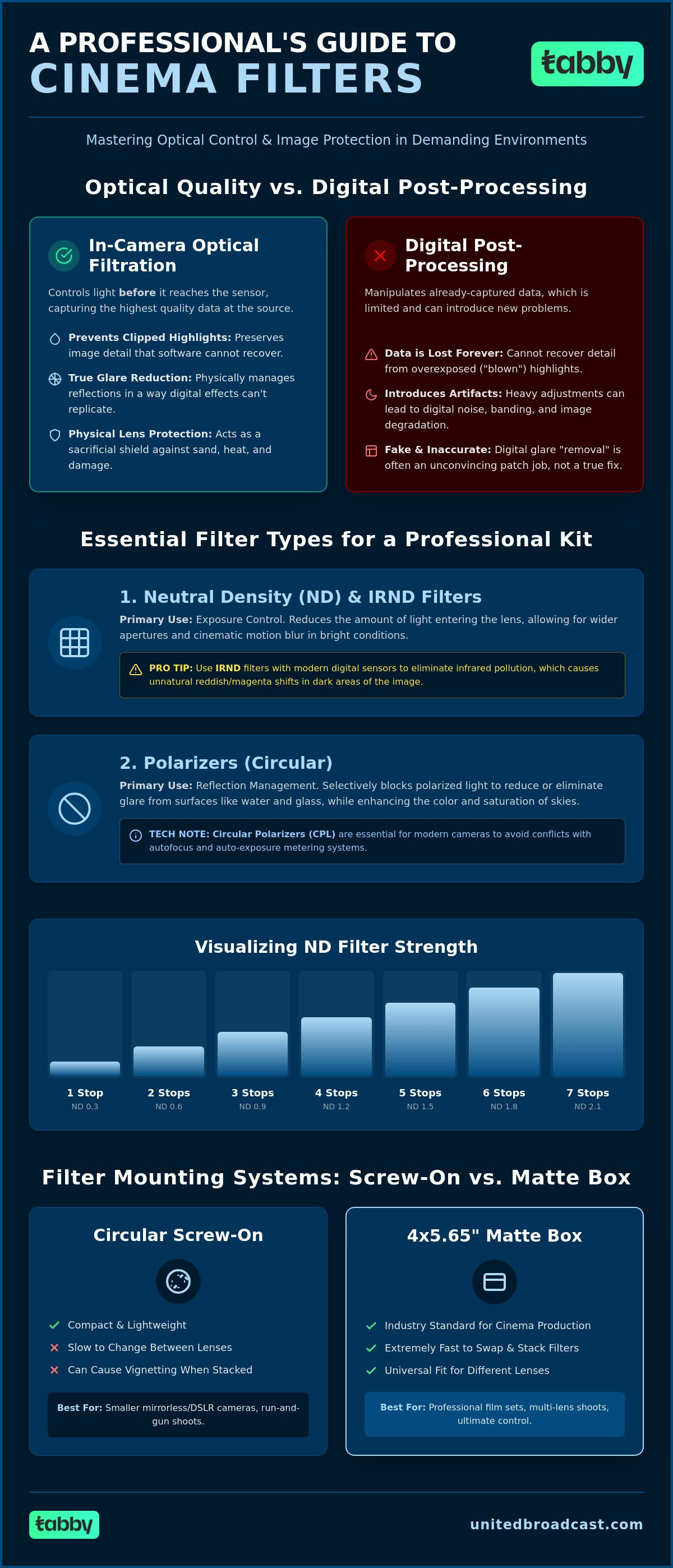
Capturing the correct exposure in-camera is the only way to prevent sensor clipping. Once a highlight is "blown" or clipped at the sensor level, that data is lost forever. Digital post-processing can't recover detail from a white pixel. Neutral Density (ND) glass allows you to maintain a wide aperture in bright sunlight, preserving the shallow depth of field essential for a cinematic look. While some color shifts can be fixed in a grading suite, certain physical properties are impossible to fake. For example, a polarizing filter manages reflections on glass or water and enhances sky saturation by blocking specific light waves. No software algorithm can accurately identify and remove physical glare after the shoot.
Essential Filter Terminology for Professionals
Understanding the technical specifications of glass is vital for consistent results. Professional filters are often categorized by their Optical Density (OD). For instance, an ND 0.3 represents a 1-stop reduction, while an ND 2.1 provides a 7-stop reduction. High-end productions favor water-white optical glass over standard glass because it lacks the green tint often found in lower-quality materials, ensuring maximum clarity. Color neutrality is the ability of a filter to reduce light without shifting the hue. Utilizing consistent, high-quality optics ensures that your multi-camera setups match perfectly, saving hours in the color suite during the final delivery phase.
Essential Filter Types for Every Professional Kit
Building a professional toolkit requires a strategic understanding of how different glass elements solve specific environmental and aesthetic challenges. In the UAE, where high-intensity sunlight and reflective desert landscapes are the norm, these tools are not optional; they are fundamental to achieving a broadcast-standard image. Choosing the right combination of filters allows a cinematographer to maintain technical consistency across a variety of shooting conditions.
Neutral Density (ND) and IRND Filters
Neutral Density filters are the cornerstone of exposure control. They allow you to maintain a 180-degree shutter angle and a wide aperture even in the peak of a Dubai summer. However, as you increase density to ND 1.2 or higher, many modern sensors become susceptible to infrared pollution. This results in a muddy, reddish tint in dark fabrics and shadows. Utilizing IRND filters is the professional standard to combat this, as they incorporate a dielectric coating to block infrared light. This level of precision is especially critical when pairing optics with high-performance systems like Sony Alpha Camera and Lenses, where maintaining color integrity is paramount for a fast turnaround.
Polarizers and Reflection Management
Managing glare is a physical challenge that software cannot accurately replicate. For a comprehensive guide to photographic filters, it's essential to understand the distinction between linear and circular polarizers. While linear options are common in traditional cinema, circular polarizers are necessary for cameras with complex autofocus systems to prevent metering errors. These tools are vital for cutting through atmospheric haze and deepening the saturation of the sky without shifting the overall color temperature. They are also the only effective way to eliminate distracting reflections from glass or water surfaces during automotive or architectural shoots.
Diffusion: Adding the Cinematic Glow
Modern cinema sensors are incredibly sharp, sometimes to a fault. While high resolution is beneficial for detail, it can often look clinical or unflattering on skin. Diffusion elements, such as Pro-Mist or Black Satin, bloom highlights and reduce fine contrast to add an organic, film-like texture to digital footage. This softening effect is a critical countermeasure for the hyper-detailed output of the sensors discussed in The Ultimate Guide to Professional Video Cameras in 2026. If you need assistance configuring a specific kit for your next production, our technical team can help you select the right optical solutions for your specific workflow.
In the UAE, clear and UV protectors aren't just for image quality; they are logistical necessities. In desert environments, wind-blown silt can act like sandpaper on a lens's front element. A high-quality clear protector ensures your primary optics remain pristine during high-stakes shoots, serving as a sacrificial layer that's easily replaced if damaged by the elements.
Understanding Filter Sizes and Mounting Systems
Selecting the physical mounting system for your optics is a decision that dictates your speed and flexibility on set. While many modern digital cinema bodies include internal ND units, external filters offer a level of precision and variety that internal systems cannot match. The choice typically falls between circular screw-on glass and professional square or rectangular tray systems. Each has its place depending on the size of your crew and the complexity of your shot list.
Circular vs. Square Filter Systems
Circular options are the preferred choice for compact, mobile setups where weight and profile are primary concerns. Many filmmakers use a single large diameter and adapt it to various lenses using step-up rings, though this can sometimes prevent the use of original lens hoods. Lenses like the Sony FE 100-400mm lens are frequently paired with circular polarizers or UV protectors for wildlife and documentary work. These screw directly into the front thread, offering a secure fit for run-and-gun scenarios. However, for wide-angle prime lenses, circular frames often introduce vignetting. Square and rectangular systems solve this by providing a larger surface area that sits further from the front element, allowing for unobstructed views even at wide focal lengths.
Integrating with Matte Boxes
A matte box is the structural hub for your filtration. It serves as both a light-shaping tool and a secure mounting point for industry-standard sizes like 4x4, 4x5.65, and 6.6x6.6. The 4x5.65 format, often called the Panavision size, is the current benchmark for 35mm digital cinema productions. The larger 6.6x6.6 size is reserved for massive front elements or ultra-wide anamorphic lenses where a smaller tray would cut into the frame. These systems are available in clip-on versions for lightweight gimbal work or rod-mounted configurations for heavy-duty studio setups.
Advanced rigging solutions, such as the ARRI Omnibar Production Kit, ensure that your matte box remains perfectly aligned with the optical axis even when using heavy lens accessories. When stacking multiple filters, a reliable matte box is essential to manage internal reflections. Professional trays allow for rapid glass swaps and often feature a slight tilt to prevent ghosting, a common artifact that occurs when light reflects between two parallel glass layers in high-contrast lighting environments.
Key Features to Compare When Buying Cinema Filters
When investing in professional glass, the internal quality of the material is just as critical as the external coatings. High-end cinema filters are distinguished primarily by the purity of their substrate. Water-white glass is the industry standard for premium productions because it lacks the iron content found in standard float glass. This prevents the subtle green or cyan tint that often plagues lower-quality optics, ensuring that the light reaching your sensor remains spectrally accurate. Beyond the glass itself, professional edge treatment is a vital feature. High-quality trays feature blackened edges to prevent light from entering through the side of the pane, which can cause internal reflections or "edge glow" in high-contrast scenes.
Durability in Regional Climates
The environmental conditions in the UAE present unique challenges for optical maintenance. High humidity and fine desert silt can quickly degrade the performance of untreated glass. Hydrophobic and oleophobic coatings are essential for professional workflows; they allow moisture and oil to bead off the surface rather than smearing. These advanced layers also provide a degree of scratch resistance, which is vital when shooting in wind-swept desert locations where sand acts like an abrasive. For a deeper look at safeguarding your entire rig, you can read more on Protecting Cinema Cameras from Humidity and Dust.
Evaluating Color Neutrality
Color shifts are the primary reason a production might reject a specific brand of glass. While many filters claim to be neutral, entry-level options often introduce a magenta or green cast, especially at higher densities like ND 1.8 or 2.1. Professional "Master" series glass ensures that every density in a kit provides an identical look. You can test this on set by filming a calibrated gray card under controlled lighting. If the RGB parade on your monitor shows a split between the channels when swapping glass, the filter isn't truly neutral. Maintaining this consistency across your entire set of NDs is what allows for a seamless match between shots during the final color grade.
Selecting the right combination of coatings and glass purity requires a balance between budget and the specific needs of your production environment. If you're unsure which series of glass best fits your current camera system, you can contact our technical specialists for a professional consultation regarding your kit requirements.
Standout Filter Solutions for Professional Production
Professional production requires equipment that meets global standards for reliability and performance. In the high-stakes environment of UAE filmmaking, choosing the right brand is as much about the manufacturer's reputation as it is about the glass quality. Tiffen remains a staple on Hollywood sets for their MPTV range, while Schneider-Kreuznach is often favored for their German technical precision. NiSi has also become a strong contender in the regional market by offering innovative multi-coating technologies that provide excellent value without compromising color neutrality. Selecting between these industry leaders often comes down to the specific "look" a cinematographer wants to achieve.
Investing in a comprehensive set of filters is a long-term strategy for any production house. High-quality glass doesn't become obsolete as quickly as camera bodies do. A well-maintained set of cinema glass can last through multiple camera generations, providing a consistent aesthetic even as you upgrade your sensors. It's a foundational investment that ensures your production value remains high, regardless of the specific gear used on a given day. Similarly, for filmmakers looking to invest in their professional growth through international education, Ideal Study Abroad offers expert admission assistance for undergraduate, postgraduate, and doctoral programs at top global institutions.
Professional Filter Kits for High-End Shoots
Most cinematographers don't purchase their glass piece by piece; they invest in matched sets. This ensures that when you swap an ND 0.6 for an ND 1.2, your color balance doesn't shift unexpectedly. A standard "Essential" kit usually includes a range of NDs, a polarizer, and a diffusion element like a mist filter. These kits are vital for managing complex Lighting scenarios, where balancing the intense ambient sun of the Middle East with artificial fixtures requires precise exposure control. Using matched sets is particularly important for multi-camera productions where maintaining a uniform look across all angles is a technical requirement.
Why Source Filters from United Broadcast?
Sourcing your optics from a dedicated technical partner provides more than just a simple transaction. At United Broadcast & Media Solutions, we maintain a comprehensive inventory of global brands, ensuring you have access to the latest 2026 optical technologies. Our role as an industry pillar means we don't just sell equipment; we provide the technical infrastructure to support your entire workflow. Whether you're a solo operator or a large-scale system integrator, our experts understand the specific needs of the regional media landscape and can help you build a kit that stands up to the rigors of professional use.
Our team is ready to assist you in selecting the perfect optical tools for your next project. We understand that every production has unique requirements, and we're committed to helping you find the right balance of performance and durability. Explore the full range of professional Filters at UBMS to find the ideal solutions for your cinema kit.
Elevate Your Production Standard with Professional Optics
Achieving a high-end cinematic look requires a commitment to quality at the very first point of light entry. By prioritizing physical in-camera control over digital post-processing, you preserve the dynamic range and technical integrity of your footage. We've explored how selecting the correct filters, understanding the nuances of 4x5.65 matte box systems, and investing in durable, water-white glass protects your sensors while maintaining perfect color neutrality in the UAE's challenging environments.
United Broadcast & Media Solutions serves as your dedicated partner in this pursuit of excellence. As an authorized distributor for industry leaders like Tiffen and Schneider, we maintain the largest inventory of professional broadcast gear in the region. Our UAE-based service center provides expert technical support to ensure your kit remains in peak condition for every shoot. Whether you're building your first kit or upgrading a studio setup, our team is ready to provide the professional guidance you need.
Browse the Professional Filter Collection at UBMS and secure the tools necessary for your next high-stakes production. We look forward to supporting your vision with the most reliable optical solutions available.
Frequently Asked Questions
What is the difference between an ND filter and an IRND filter?
An IRND filter includes a specialized coating to block infrared light, whereas a standard ND only reduces visible light. Modern digital sensors are highly sensitive to infrared radiation. When you use heavy standard ND filters, infrared light can bleed through and cause a muddy, reddish tint in your shadows. Using an IRND ensures your colors stay neutral even at high densities by blocking those invisible wavelengths.
Can I use square filters without a matte box?
You can use square filters with specialized filter holders that clip directly to the lens, but a matte box is the professional standard. Holders lack the light-shaping capabilities of top and side flags. In the high-glare environment of the UAE, using a matte box is essential to prevent stray light from hitting the glass and causing unwanted flares or a loss of contrast.
Which filter size is most common for professional cinema lenses?
The 4x5.65 inch format is the most common size for professional cinema lenses and matte boxes. This rectangular size, often called the Panavision standard, allows for a wider field of view without vignetting. While 4x4 options are available for smaller setups, the 4x5.65 size provides the versatility needed for modern large-format sensors and wide-angle cinema primes frequently used in high-end productions.
Do I really need a UV filter for my cinema camera?
A UV filter is primarily used as a sacrificial layer to protect your lens from physical damage in harsh environments. Most modern cinema cameras already have internal UV and IR cut filters. However, in the desert regions of the UAE, wind-blown sand can easily scratch expensive lens coatings. A high-quality clear or UV protector is a small investment that prevents costly front-element repairs.
How do I clean professional cinema filters without scratching them?
Start by using a manual air blower to remove loose dust and sand particles from the surface. Never wipe a dry filter, as sand is highly abrasive and will cause permanent scratches. Once the loose debris is gone, use a dedicated optical cleaning solution and a clean microfiber cloth. Wipe in a gentle, circular motion from the center outward to ensure a streak-free finish without damaging the coatings.
What is a "variable ND" and is it good for professional work?
A variable ND consists of two rotating polarizing layers that adjust the amount of light entering the lens. While they're convenient for fast-paced documentary work, they aren't typically used on high-end cinema sets. They can introduce "X" patterns at wide angles and often cause subtle color shifts. Fixed ND filters remain the preferred choice for maintaining maximum image quality and consistency across various shots.
Why do my images look red when using a heavy ND filter?
Images often appear red or magenta when using a heavy ND because of infrared pollution. Standard glass blocks visible light but allows infrared light to pass through to the sensor. Since the visible light is significantly reduced, the infrared light becomes dominant in the exposure. Utilizing an IRND filter or an additional IR-cut layer will resolve this issue by effectively blocking those infrared wavelengths during capture.
How many filters can I stack before image quality degrades?
Most professional matte boxes allow you to stack two to three filters simultaneously. While you can technically add more, each additional layer of glass increases the risk of internal reflections and ghosting. Stacking also progressively reduces image contrast and can lead to vignetting on wider lenses. For the best results, it's generally recommended to use a single, higher-density ND rather than stacking multiple lighter ones.


