

Professional Video Switchers in the UAE: A Comparison and Buyer’s Guide for 2026
If you still view your production hub as a simple button box, you're likely unprepared for the UAE’s rapidly evolving 4K and IP-driven media landscape. With the Middle East media market projected to reach a valuation of over AED 177 billion in 2026, the pressure to deliver flawless content via a high-performance professional video switcher has never been higher. You've probably felt the frustration of managing the transition from SDI to IP-based workflows while trying to ensure zero-latency performance in demanding 4K/UHD environments, often within the cramped confines of a mobile production unit.
It's a complex balancing act, but selecting the right hardware is the critical first step toward operational stability. This guide will teach you how to evaluate and select the ideal switching solution to anchor your broadcast or live production environment in the UAE. We'll compare leading solutions from brands like Ross Video and Blackmagic Design, explore the benefits of 12G-SDI for single-cable 4K workflows, and show you how to build a scalable infrastructure that's ready for future 8K or IP expansion.
Key Takeaways
- Understand the critical transition from traditional SDI to scalable IP-based workflows and how 12G-SDI infrastructure supports modern 4K and 8K production demands.
- Learn how to evaluate technical benchmarks such as Mix/Effects (M/E) bus capacity and sub-frame latency to ensure seamless performance during live events.
- Discover the reliability advantages of dedicated FPGA hardware over software-based solutions for high-stakes broadcast environments where tactile control is essential.
- Identify the specific features needed to select the ideal professional video switcher for your environment, from newsroom automation to high-frame-rate sports replay.
- Explore the benefits of partnering with local experts for system integration to ensure your studio backbone remains scalable and future-proof.
The Evolution of Professional Video Switchers: From SDI to IP and Hybrid Workflows
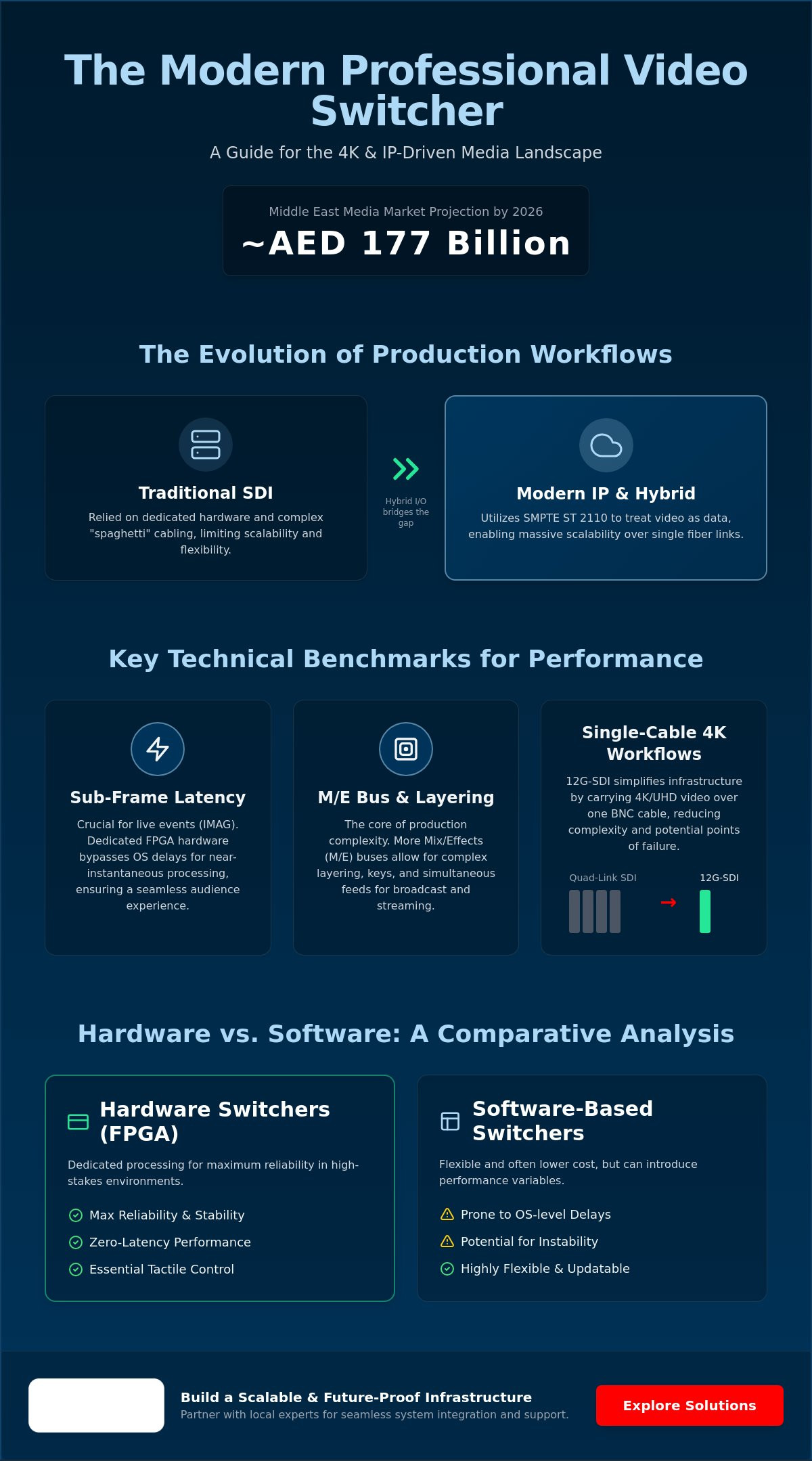
The shift from fixed-function hardware to software-defined production has fundamentally changed how we build control rooms in professional production environments nationwide. In the past, a professional video switcher relied on dedicated hardware circuits for every effect and transition. Today, processing happens in high-density FPGA chips or software layers, allowing for a level of flexibility that was once impossible. This evolution is driven by the sheer data volume of 4K and 8K productions. While 12G-SDI provided a temporary reprieve by allowing 4K over a single BNC cable, the industry is now pushing beyond those physical limits as workflows become increasingly decentralized.
The modern switcher serves as the "brain" of the studio. It doesn't just cut between sources; it synchronizes diverse formats and manages complex multi-destination routing. Whether referred to as a switcher or a Vision mixer, its role is now central to the IP fabric of the facility. It must orchestrate a symphony of inputs, from remote feeds to local studio cameras, ensuring that every transition is frame-accurate and artifact-free.
Understanding the Move to SMPTE ST 2110
Uncompressed video over IP, specifically the SMPTE ST 2110 suite, represents the future for national broadcast hubs in the UAE. By treating video as data packets, engineers can scale their operations without the "spaghetti" of traditional cabling. A single fiber optic link can carry dozens of signals that would have required a massive patch bay in the SDI era. However, this transition requires a shift in mindset. Video engineers must now understand multicast networking and PTP timing, which presents a significant learning curve for those accustomed to traditional sync signals.
The Strategic Importance of Hybrid I/O
Most UAE facilities aren't ready for a "rip and replace" approach. This is where the hybrid professional video switcher becomes essential. These systems allow you to maintain compatibility with your existing inventory of professional video cameras and high-end cinema lenses while slowly migrating the core to IP. By integrating current SDI assets into a new IP backbone, you significantly reduce initial CAPEX. Hybrid systems also provide a safety net; if an IP stream encounters a network bottleneck, the SDI side remains a rock-solid redundant path. It's about protecting your investment while preparing for a 100G future.
Key Technical Benchmarks: Evaluating Performance and Capacity
Selecting a professional video switcher requires looking beyond the number of physical inputs on the back of the rack. While entry-level units might boast high input counts, the true measure of a broadcast-grade system lies in its internal processing capacity and its ability to handle complex layering without hitting a "resource ceiling." For production houses in the UAE, where multi-camera 4K setups are the standard for high-profile events, understanding these technical benchmarks is the difference between a seamless show and a technical failure.
M/E Capacity and Layering Power
The Mix/Effects (M/E) bus is the core building block of production complexity. A single M/E allows for basic transitions and a few keys, but modern UAE broadcasts often require multiple M/E buses to manage separate feeds for the house screens, social media streams, and the main broadcast. Many contemporary systems now offer "virtual" M/Es or reconfigurable resources. These allow you to allocate processing power where it is needed most, whether that is for complex chroma keying or multi-window DVE layouts. To ensure your facility can handle future growth, you should speak with our system integration team about calculating the specific M/E requirements for your workflow.
Processing Depth and Colour Fidelity
As the industry moves toward high-dynamic-range (HDR) delivery, your professional video switcher must maintain 10-bit 4:2:2 processing throughout the entire signal path. This depth is essential to avoid banding in gradients and to ensure that the rich data captured by The Ultimate Guide to Professional Video Cameras in 2026 is preserved. Modern switchers handle HDR workflows natively, providing internal conversion between HLG, S-Log3, and SDR. This eliminates the need for external LUT boxes, simplifying the signal chain and reducing potential points of failure. Internal frame synchronizers and scalers on every input further enhance this reliability, allowing you to mix cameras of different resolutions and frame rates without external synchronization hardware.
Hardware vs. Software Switchers: A Comparative Analysis
The debate between hardware and software switching often centers on cost. For professional environments in the UAE, the decision usually hinges on operational risk. A dedicated hardware professional video switcher is built on Field-Programmable Gate Array (FPGA) architecture. Unlike a general-purpose computer running a standard operating system, an FPGA is hard-wired for specific video processing tasks. It won't crash due to a background software update or a driver conflict. In a high-stakes national broadcast, this level of stability is non-negotiable.
While software-based solutions offer lower entry costs, they often introduce recurring licensing fees. They also require high-performance IT infrastructure to maintain low latency. Hardware systems represent a significant upfront capital expenditure, but they offer a longer lifecycle and seamless integration with existing advanced broadcast studio gear. These units are designed to interface directly with tally systems, router control protocols, and studio automation. This creates a unified production ecosystem that is easier to manage and troubleshoot during live operations.
Tactile Reliability in Live Environments
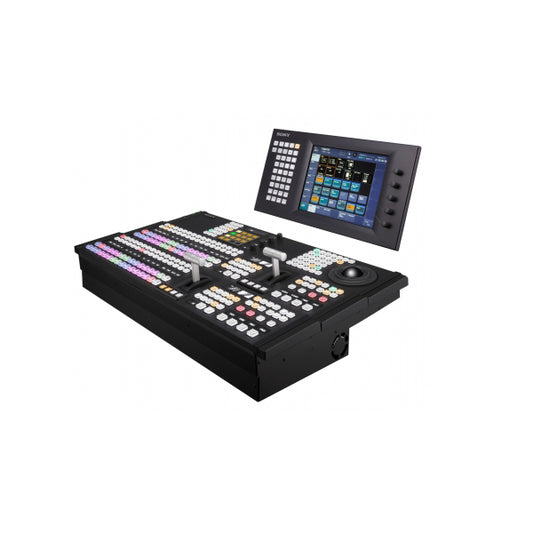
Muscle memory is a powerful tool for a vision mixer. Physical control surfaces with dedicated T-bars and tactile buttons allow operators to execute complex transitions without looking away from the multiviewer. Software interfaces lack the physical feedback required for split-second timing. Hardware switchers also include physical bypass features and redundant power supplies. If the main processing engine encounters an issue, the system can automatically route an emergency feed to the program output. This level of hardware redundancy is difficult to replicate in a purely software-driven environment.
Software Flexibility and NDI Integration
Software-defined switching, particularly using NDI protocols, has gained traction in the UAE media market. It's an effective choice for smaller corporate setups or remote production (REMI) workflows where portability is key. These systems allow for rapid deployment over standard network infrastructure, making them ideal for temporary event spaces. However, as production scale increases, the overhead of managing network bandwidth and CPU cycles becomes a factor. A dedicated hardware professional video switcher remains the gold standard for 24/7 broadcast operations where zero-failure performance is the minimum requirement.
Selecting the Right Switcher for Your Production Environment
Choosing a professional video switcher isn't a one-size-fits-all process. Your choice depends entirely on the specific demands of your workflow and the physical constraints of your facility. For news and talk shows, the priority is often automation and multi-destination delivery. You need a system that can trigger graphics, manage social media streams, and handle the main broadcast feed simultaneously. In contrast, live sports production demands high-frame-rate support and tight integration with instant replay servers. Every millisecond counts when you're cutting between high-speed camera feeds during a live match.
Virtual production environments present a different set of challenges. Here, low-latency tracking and uncompressed 4K pipelines are essential to prevent lag between the camera movement and the LED volume. Mobile production units, or OB vans, require a different strategy. In these cramped spaces, you need a compact footprint and low power draw without sacrificing I/O density. Every rack unit saved allows for more specialized equipment within the van. Consider these specific requirements for different environments:
- News Studios: Prioritize NMOS support and MOS protocol integration for newsroom computer systems.
- Live Sports: Ensure the hardware supports 12G-SDI for simple 4K signal paths and has dedicated tally outputs.
- Virtual Production: Look for switchers with precision genlock and sub-frame processing for LED wall synchronization.
- OB Vans: Focus on high-density modular frames that combine switching, multiviewing, and signal processing in one unit.
Environmental Factors for UAE Studios
Regional conditions in the UAE require specific hardware considerations that go beyond standard technical specs. High-density equipment racks generate significant heat. You must evaluate the thermal management and airflow patterns of your professional video switcher to ensure it can operate 24/7 in a climate-controlled but demanding studio environment. Dust-sealed control panels are another critical feature for long-term reliability. Fine particles can quickly degrade the performance of physical faders and buttons over time. Additionally, your infrastructure should be robust enough to handle regional power fluctuations, which often necessitates high-grade UPS systems and redundant power supplies.
Future-Proofing for 8K and Beyond
Investing in broadcast infrastructure is a long-term commitment. To protect your capital, look for modular systems that allow for I/O card upgrades. This ensures you can transition from 4K to 8K without replacing the entire chassis. The adoption of 100G IP interfaces is another hallmark of a future-proof system, providing the bandwidth needed for upcoming uncompressed standards. Beyond the hardware, consider the human element. The transition to IT-centric broadcast workflows requires ongoing training for your engineering team. If you're planning a facility upgrade or a new build, contact our system integration experts to design a scalable solution that meets your current needs while leaving room for future expansion.
Professional Switcher Solutions and Integration with UBMS
Achieving a high-tier production environment requires more than just procurement. It demands a partnership with a technical authority that understands the nuances of the UAE’s media infrastructure. At United Broadcast & Media Solutions (UBMS), we provide direct access to the world’s leading brands, ensuring your facility is equipped with a professional video switcher that meets global standards. Our role extends beyond sales; we act as a dedicated technical partner, offering customized workflow consultations for broadcast and cinema specialists who need to balance performance with long-term reliability.
The value of a switcher is only realized when it's perfectly integrated into your studio backbone. A poorly configured signal chain can lead to intermittent sync issues or signal degradation, regardless of the hardware’s quality. Our team provides comprehensive system integration services, designing end-to-end workflows that ensure your cameras, lenses, and switchers communicate flawlessly. Once the installation is complete, our service center provides ongoing technical maintenance and repairs, ensuring that your investment remains operational for years to come. This localized support is vital for maintaining 24/7 uptime in professional environments.
Expert System Integration Services
Designing a seamless signal chain involves more than just connecting cables. It requires a deep understanding of synchronization, color space management, and network topology. Our integration experts specialize in creating cohesive ecosystems, bringing together high-tier brands like Sony and Roland into a single, manageable interface. We handle everything from on-site commissioning to technical training for your production staff. This ensures your team is fully prepared to leverage the advanced features of your new professional video switcher from day one, reducing the risk of operational errors during live broadcasts.
Why National Broadcasters Partner with UBMS
National broadcasters across the UAE have relied on UBMS for over 25 years because we understand the high stakes of live television. Our legacy is built on technical excellence and a commitment to operational uptime. By partnering with us, you gain direct access to the latest professional video cameras and optics, backed by a local infrastructure designed for rapid support. We don't just sell equipment; we provide the logistical and technical foundation that allows your creative team to focus on storytelling without worrying about the underlying technology. This long-term approach to partnership is why we remain a pillar of the regional media community.
Securing Your Broadcast Infrastructure for a 4K Future
Selecting a professional video switcher is a strategic decision that dictates your studio's long-term scalability. The transition to IP-based workflows and the rising demand for uncompressed 4K performance require more than just a hardware purchase. You need a technical partner who understands the local landscape and the high stakes of live production. At UBMS, we bridge the gap between global innovation and regional operation. As an authorized distributor for Sony, Roland, and other industry leaders, we provide the tools required for 24/7 broadcast stability.
Our expert system integration team brings decades of experience to every project. We ensure your signal chain is optimized for today's standards and tomorrow's 8K expansion. If you're ready to upgrade your facility or design a new workflow, Contact Our Integration Experts for a Custom Switcher Solution. We also maintain a dedicated UAE service center for professional equipment repair to keep your production running without interruption. We look forward to helping you build a more resilient and efficient media backbone.
Frequently Asked Questions
What is the difference between an SDI and an IP video switcher?
SDI switchers use traditional BNC cabling for point-to-point connections, offering a familiar and stable environment for most engineers. IP switchers route video as data packets over network infrastructure using protocols like SMPTE ST 2110. IP systems provide significantly more scalability and flexibility for large-scale facilities but require a robust IT backbone to manage the high bandwidth requirements.
How many M/Es do I need for a standard news broadcast?
A standard news production typically requires 2 to 3 Mix/Effects (M/E) buses. This capacity allows your operator to manage the main program mix on the first M/E while using the others to control studio monitor walls, social media feeds, or clean feeds for international syndication. Reconfigurable resources in modern units can sometimes stretch this capacity further through virtual M/Es.
Can I use a professional video switcher for live streaming to social media?
Yes, many modern systems include built-in hardware encoders that allow for direct RTMP streaming to platforms like YouTube or LinkedIn. For high-stakes productions, we recommend using a professional video switcher that provides dedicated hardware outputs to interface with external streaming servers. This ensures your stream remains stable even if the local network encounters bandwidth fluctuations.
What is the benefit of a hardware-based switcher over software like vMix?
Hardware switchers utilize dedicated FPGA chips that offer sub-frame latency and superior reliability. Unlike software solutions that run on a general-purpose operating system, hardware units are not vulnerable to background software updates, driver conflicts, or system crashes. This makes them the preferred choice for live national broadcasts where zero-failure performance is the minimum requirement.
Does UBMS provide technical training for new switcher installations?
UBMS provides comprehensive on-site commissioning and technical training as part of our system integration services. We ensure your staff is fully proficient in operating the professional video switcher and managing its role within your specific signal chain. Our goal is to minimize the learning curve and ensure your team can handle complex live scenarios with confidence.
Are modern 4K switchers compatible with my existing HD cameras?
Modern 4K units are designed with backwards compatibility in mind. Most professional models feature internal frame synchronizers and scalers on every input, allowing you to mix legacy HD camera signals with new 4K feeds seamlessly. This allows for a phased upgrade of your studio equipment rather than requiring a total replacement of your existing camera inventory.
How does thermal management affect switcher reliability in the UAE?
High-density equipment racks generate substantial heat, which can lead to thermal throttling or hardware failure if not managed correctly. In the UAE, it's critical to select equipment with robust internal cooling and efficient airflow patterns. Proper thermal management ensures that the internal processing engines stay within safe temperature limits during 24/7 broadcast operations in demanding environments.
What is SMPTE ST 2110 and why does it matter for my studio?
SMPTE ST 2110 is the global standard for transporting uncompressed professional media over IP networks. It matters because it allows for the independent routing of audio, video, and metadata, which provides far more efficiency than traditional SDI. Adopting this standard ensures your studio backbone is future-proof and capable of scaling to 8K or beyond without replacing your entire cabling infrastructure.


