

Best Film and Broadcast Production Monitors: 2026 Guide
A production monitor is never just a screen; it's a critical exposure and calibration instrument that defines every creative choice on set. Reliable production monitors must bridge the gap between blinding ambient daylight and unforgiving color-grading suites, yet matching display hardware to specific technical pipelines often feels needlessly complicated.
You already know the frustration of battling outdoor glare, diagnosing signal latency across 12G-SDI and wireless links, or deciding whether an integrated monitor-recorder outweighs a dedicated reference panel. Investing in the wrong display compromises focus, destroys color confidence, and creates costly bottlenecks between the camera department and post-production.
This comprehensive guide gives you the technical criteria and display standards required to select the ideal monitor for your exact operational needs. We'll examine nit brightness thresholds, color gamut volume, signal routing, and proven hardware platforms suited for on-camera focus pulling, mobile DIT carts, and broadcast studio mastering.
Key Takeaways
- Understand the critical engineering differences that separate true production monitors from standard screens, including native 10-bit pipelines, zero-latency processing, and robust chassis design.
- Establish precise nit brightness and color gamut thresholds to guarantee reliable exposure decisions across harsh daylight exteriors and darkened mastering suites.
- Identify the optimal monitor form factors and software toolsets tailored to focus pullers, DIT carts, video village, and studio control rooms.
- Evaluate the workflow advantages of all-in-one monitor-recorders and integrated 6 GHz wireless displays compared to dedicated reference panels.
- Future-proof your signal infrastructure by navigating high-bandwidth 12G-SDI baseband standards and SMPTE ST 2110 IP video transport.
Understanding Production Monitors: How They Differ from Standard Displays
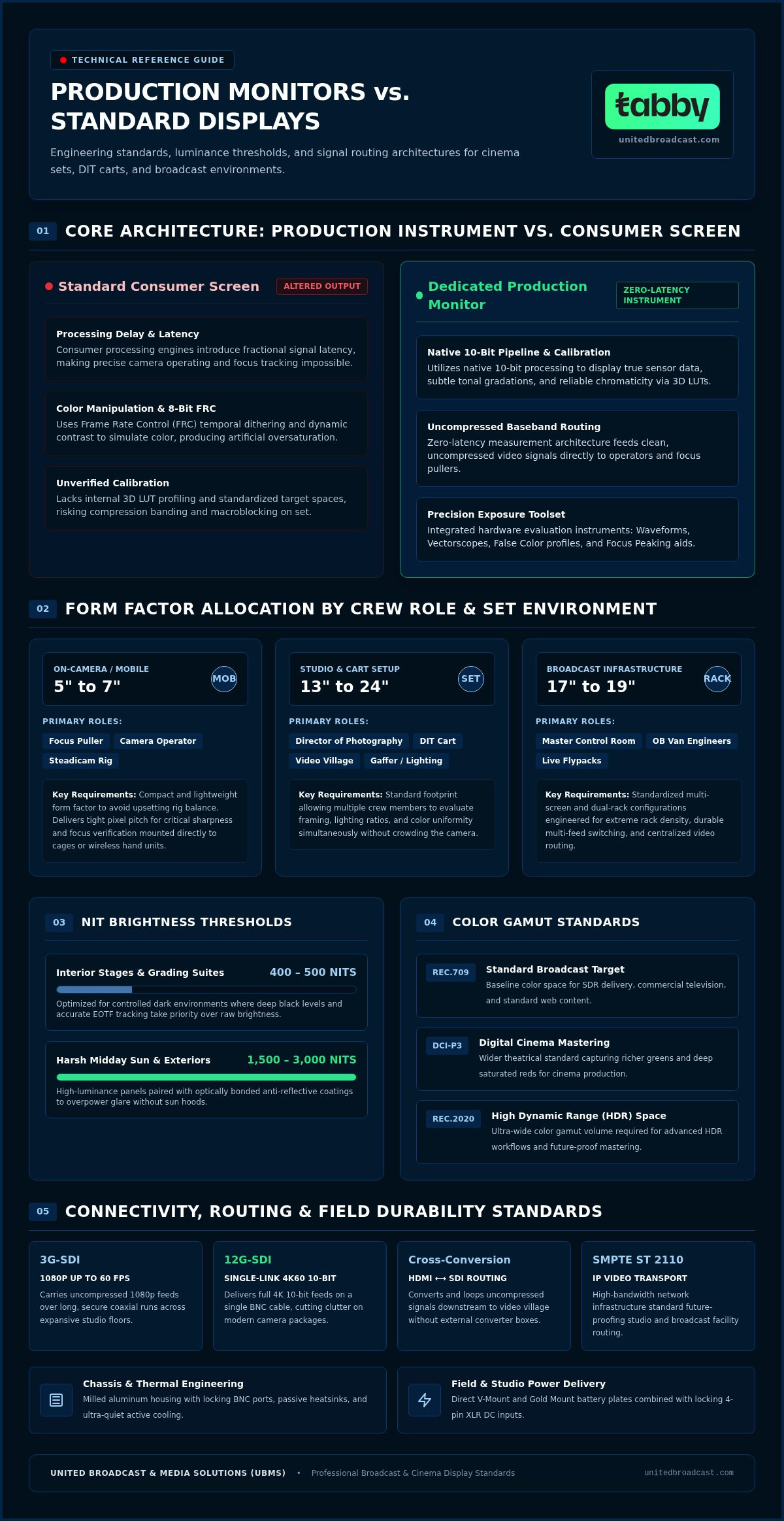
Consumer televisions and computer screens enhance footage with dynamic contrast, motion smoothing, and oversaturated profiles designed for viewer pleasure. Dedicated broadcast reference monitors and field displays do the opposite; they expose raw reality. Professional production monitors function as zero-latency measurement instruments, displaying exact sensor data without artificial image processing. They combine uncompressed signal paths, hardware calibration, and precision exposure tools such as waveforms, vectorscopes, false color, and 3D LUT support so technical decisions hold up in the color suite.
Color Accuracy and Gamut Coverage
Consumer panels frequently rely on 8-bit architecture with Frame Rate Control (FRC) temporal dithering to simulate broader color palettes. In contrast, true production displays utilize native 10-bit processing pipelines to reveal subtle tonal gradations and expose compression banding or macroblocking before post-production. These panels adhere strictly to standardized target spaces, covering Rec.709 for standard broadcast, DCI-P3 for digital cinema mastering, and wide Rec.2020 gamuts for high dynamic range deliverables. Factory calibration protocols and internal 3D LUT profiling maintain absolute chromaticity across continuous shooting days.
Broadcast Signal Integrity and Low Latency
Live production demands zero processing delay. Camera operators and focus pullers cannot afford the fractional latency introduced by standard consumer processing engines. Professional displays prioritize uncompressed baseband connections:
- 3G-SDI: Carries uncompressed 1080p signals up to 60 fps over long, secure coaxial runs.
- 12G-SDI: Delivers single-link 4K60 10-bit feeds, cutting cable clutter on modern camera rigs.
- Loop-Through and Cross-Conversion: Built-in hardware converts between HDMI and SDI formats, routing clean, latency-free signals downstream to video village without external distribution boxes.
Rugged Mechanical Design and Power Options
Field environments are harsh on gear. Production displays feature milled aluminum chassis and impact-resistant housings rather than consumer plastics. They use locking BNC ports that prevent accidental disconnections during rapid camera repositions. Advanced thermal management, utilizing passive heatsinks or quiet active fans, keeps internal processors cool under intense desert sun without introducing audio noise. Flexible field power options include direct V-Mount or Gold Mount battery plates alongside locking 4-pin XLR DC inputs, ensuring uninterrupted uptime when working away from mains power.
Key Criteria for Choosing the Right Production Monitor
Screen Size and Mounting Form Factors
Display size directly dictates mobility and viewing distance across different departments:
- 5 to 7 Inches: Built for camera operators, Steadicam rigs, and focus pullers. These lightweight screens mount directly to camera cages or wireless hand units, delivering tight pixel pitch for sharpness verification without throwing off rig balance.
- 13 to 24 Inches: The standard footprint for on-set DIT carts, mobile video village setups, and director stations. These larger panels allow multiple crew members to evaluate framing, lighting ratios, and makeup without crowding the camera.
- 17 to 19-Inch Rackmounts: Standardized multi-screen and dual-rack configurations built for outside broadcast (OB) vans, live flypacks, and master control environments where rack density and signal routing matter most.
Brightness, Contrast, and Daylight Visibility
Ambient lighting dictates your required panel brightness. Controlled interior stages and grading suites thrive with 400 to 500 nits, where maintaining deep black levels and accurate EOTF tracking is paramount. For harsh midday sun, panels must deliver between 1,500 and 3,000 nits alongside optically bonded anti-reflective coatings to overpower glare without relying on bulky sunhoods.
Modern HDR monitoring also demands adherence to wide color spaces such as ITU-R BT.2020 standards. While ultra-bright LCDs excel in direct sunlight, high-end DITs often leverage OLED or QD-OLED panels for dark-environment grading to achieve absolute black retention and zero haloing artifacts.
Professional Operating Systems and Monitoring Tools
Hardware specs mean little without an agile operating system. Field crews need swift access to exposure analysis tools, including customizable waveforms, vectorscopes, and stop-based false color systems like EL Zone. Focus assistants rely on customizable peaking algorithms and instant 1:1 pixel zoom to confirm critical focus under tight schedules. Furthermore, monitors must feature rapid 3D LUT switching, anamorphic de-squeeze multipliers, and custom frame guides to match diverse aspect ratios.
When selecting professional gear for demanding productions, reviewing field-tested production monitors tailored to exact department workflows guarantees absolute color confidence from capture to post.
Matching Production Monitors to Specific Crew Roles and Environments
No single display meets the operational demands of every production department. A 1st AC tracking high-speed tracking shots requires physical mobility and instantaneous latency response, while a live studio director evaluates multiple camera angles simultaneously across a calibrated rackmount bank. Successful deployment relies on aligning technical capabilities directly with departmental tasks.
On-Camera Operators and 1st AC Focus Pullers
Focus pullers and camera operators depend on compact 5-inch to 7-inch displays that deliver exceptional sharpness without adding unnecessary weight to the rig. For wireless focus units, integrated zero-delay video receivers eliminate bulky brackets and loose interconnect cables. Tactile controls, such as physical assignable buttons and high-friction rotary dials, remain essential; they allow operators to toggle edge peaking or 1:1 pixel zoom instantly during active takes without pulling their eyes away from the subject or fumbling with touchscreen menus.
Director Video Village and DIT Stations
Collaborative decision-making centers around 15-inch to 24-inch production monitors positioned at video village or integrated into mobile DIT carts. These larger displays must provide wide viewing angles so key creative heads can evaluate scene framing without off-axis color shifts. Essential features for this tier include:
- Multi-Input Quad-Split: Enables real-time side-by-side evaluation of multi-camera setups or direct comparisons against visual effects plates.
- Downstream LUT Processing: Passes live CDL (Color Decision List) adjustments and show LUTs downstream to client monitors without altering the raw log camera feed.
- Rugged Power and Rigging: Integrates hot-swappable dual V-Mount or Gold Mount plates and standardized C-stand baby pin mounts for rapid field deployment.
Broadcast Studios, OB Vans, and Master Control
Studio environments and outside broadcast (OB) vehicles demand space-efficient 19-inch rackmount chassis housing dual or triple panels. These units operate within standard 19-inch equipment racks, handling 24/7 video feeds. Beyond basic image display, master control monitors require specialized broadcast infrastructure: hardware tally lights, embedded 12G-SDI multi-channel audio meters, and native support for Hybrid Log-Gamma (HLG), an essential standard developed in part through BBC R&D's High Dynamic Range research. In live control rooms, matching talent reference screens to prompters ensures on-air talent sees exact program returns with zero synchronization drift.
Integrated Workflows: Monitor-Recorders, Wireless Receivers, and Streamers
Modern sets move fast. The days of stacking separate receivers, power splitters, external recorders, and converter boxes onto a single rig are quickly disappearing. Today's production monitors increasingly consolidate these disparate hardware components into unified, highly optimized systems. This engineering convergence streamlines rigging, eliminates common cable failure points, and dramatically accelerates editorial turnarounds.
Monitor-Recorders for Instant Playback and Backup
Capturing uncompressed or lightly compressed video direct to high-capacity SSDs in codecs like Apple ProRes, Avid DNxHR, or raw formats delivers immediate practical value. It establishes reliable hardware redundancy alongside the camera's internal media. It also transforms on-set review. Directors and script supervisors can scrub takes and inspect takes directly on the display without halting the camera team or interrupting shooting schedules. Many modern monitor-recorders also generate lightweight 10-bit proxy files with matching camera timecode, enabling rapid Camera-to-Cloud handoffs while production is underway.
Integrated Zero-Delay Wireless Video Systems
Rigging modular wireless receivers requires articulating arms, D-Tap breakout cables, and loose SDI jumpers that invite technical hiccups. Integrated wireless production monitors eliminate this clutter. Displays with built-in RX modules operating on the newly authorized 6 GHz frequency band sidestep crowded 5 GHz Wi-Fi channels, delivering zero perceptible latency under 0.001 milliseconds. A unified wireless monitor powers the panel and receiver from a single V-Mount or Gold Mount pack. This reduction in rig weight and bulk is invaluable for 1st ACs pulling focus on moving actors.
All-in-One Multi-Camera Switcher Displays
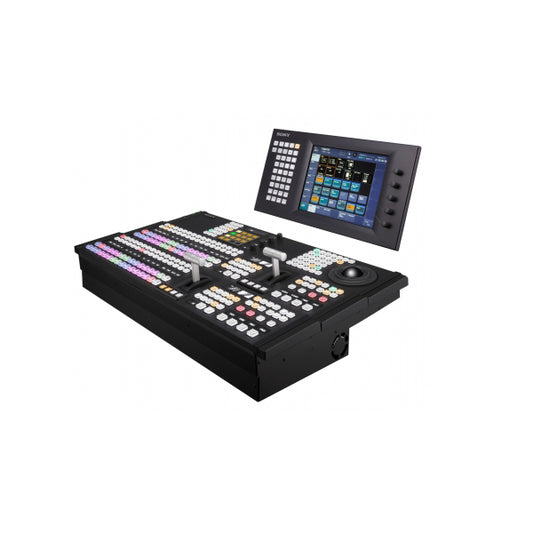
Live event broadcasts, multi-camera interviews, and corporate live streams benefit heavily from monitors with built-in switching capabilities. These hybrid systems merge multi-view monitoring, touch-driven video switching, and multi-channel ISO recording into a single tabletop console. Technicians can switch live program feeds, fire graphics overlays, and record every input stream independently for post-production finishing without packing full-sized switcher racks.
Featured Production Monitors: Standout Options from the Collection
Selecting the right hardware hinges on matching display architecture to practical production demands. As an authorized national distributor and systems integrator, United Broadcast & Media Solutions (UBMS) provides fully backed inventory from industry-leading manufacturers, supported by an authorized technical service center for precision calibration, repairs, and studio integration.
On-Camera and Wireless Focus Displays
For compact camera rigs and focus pullers, tactical visibility and responsive operating systems are non-negotiable:
- Atomos Shinobi II: A slim 5-inch display delivering 1,500 nits of brightness with intuitive camera control for mirrorless and digital cinema systems.
- SmallHD INDIE 5: Features rapid PageOS touchscreen navigation, customizable focus tools, and crisp pixel density in an ultra-compact footprint.
- SmallHD ULTRA 7 with Bolt 6 RX 1500: Built for high-end 1st ACs, integrating a 2,300-nit panel with an internal zero-delay 6 GHz wireless receiver.
- Hollyland Pyro 7 Wireless Transceiver Monitor Kit: Provides dual-monitoring agility, switching seamlessly between transmitter and receiver modes across dynamic sets.
Studio, DIT, and Master Reference Displays
Large-format monitoring demands absolute color consistency across critical viewing pipelines:
- SmallHD Cine 18 4K High-Bright Production Monitor: Combines daylight-viewable 4K clarity with a rugged unibody aluminum chassis engineered for DIT carts and mobile video village.
- SWIT 21.5-inch High Bright HDR Production LCD Monitor: A dependable field and studio workhorse featuring multi-format SDI connectivity and robust internal scopes.
- Sony BVM-X300 4K V2 OLED Master Monitor: The definitive reference standard for broadcast color suites, providing pixel-accurate black levels and critical HDR mastering.
- Autocue 22-inch Talent Monitor: Purpose-built for broadcast studios, offering crisp program return feeds and high visibility for on-air presenters.
Rackmount and Multi-Camera Production Hardware
Live control rooms, flypacks, and OB trucks require robust infrastructure engineered for continuous operation:
- Blackmagic Design SmartView 4K G3: A 15.6-inch rackmount DCI 4K broadcast monitor with optical ST 2110 IP video connectivity and 12G-SDI baseband inputs.
- Blackmagic Design SmartScope Duo 4K: Features independent dual 8-inch screens for simultaneous waveform, vectorscope, and picture monitoring.
- Atomos Sumo 19 SE HDR: Combines a 1,200-nit 19-inch HDR panel with real-time quad-HD switching and multi-channel ISO recording directly to SSDs.
Browse our extensive inventory of professional production monitors to equip your next production with hardware tailored to your technical workflow.
Elevate Your Vision with Precision Display Hardware
Selecting the right display isn't merely about screen dimensions or peak brightness. It's about matching native bit depth, low-latency signal paths, and specialized exposure tools directly to your operational workflow. Reliable production monitors ensure that framing, focus, and color decisions made on set translate seamlessly to final mastering suites without costly surprises.
Backed by over two decades of national broadcast systems integration leadership, United Broadcast & Media Solutions (UBMS) delivers dependable technical partnership. As an authorized distributor for industry leaders including Sony, SmallHD, Blackmagic Design, Atomos, and SWIT, our specialized technical service center provides precision hardware calibration, repairs, and engineering support to keep your gear performing at global standards.
Equip your team with display solutions built for continuous reliability and uncompromised color accuracy.
Frequently Asked Questions
What is the main difference between an on-camera monitor and a studio production monitor?
On-camera monitors prioritize compact portability, lightweight rigging, and high nit brightness for field framing, whereas studio production monitors focus on panel size, strict color uniformity, and extensive signal routing. On-camera displays typically range from 5 to 7 inches and run on hot-swappable batteries. Studio panels measure 17 to 31 inches or mount into standard 19-inch equipment racks, featuring dual 12G-SDI loop-throughs, SMPTE ST 2110 IP connectivity, and precision reference calibration for grading.
How many nits of brightness do I need for shooting video outdoors in direct sunlight?
You need a minimum of 1,500 nits to view an image clearly in bright daylight, with 2,000 to 2,500 nits preferred for direct, overhead sun. Standard interior screens operate around 400 to 500 nits, which washes out completely in outdoor environments. High-bright production monitors paired with optically bonded, anti-reflective glass allow focus pullers and directors to evaluate exposure, focus peaking, and framing accurately outdoors without relying on bulky sunhoods.
Why do professional production monitors rely on SDI connections instead of standard HDMI?
Professional displays use BNC SDI connections because they lock securely and carry uncompressed video over long cable runs without signal degradation. Consumer HDMI cables lack locking mechanisms and often suffer physical damage or accidental disconnects on active sets. In contrast, 3G and 12G-SDI connectors twist-lock in place, handle robust 10-bit broadcast pipelines, support embedded timecode and tally data, and can run dozens of meters to video village without signal boosters.
Can I use a consumer 4K OLED TV as a professional production or color grading monitor?
No, consumer 4K OLED TVs are unsuitable as master reference displays because they employ aggressive auto-dimming and lack zero-latency broadcast inputs. Consumer screens feature dynamic contrast algorithms and automatic brightness limiters that artificially alter luminance across changing scenes. They also lack native 12G-SDI connectivity, internal 3D LUT profiling capacity, and sub-frame latency processing, which prevents accurate exposure verification and reliable color critical evaluation on professional productions.
What is the advantage of using an integrated monitor-recorder over a standard field monitor?
An integrated monitor-recorder captures clean, high-bitrate video directly to SSD media while displaying camera feeds with real-time exposure tools. This setup provides instantaneous backup recording alongside internal camera cards and allows directors to review previous takes immediately without interrupting camera operation. These units also generate lightweight proxy files automatically, streamlining camera-to-cloud handoffs so editorial teams can begin working while principal photography continues.
How does an integrated wireless production monitor improve workflow for focus pullers?
An integrated wireless production monitor eliminates separate receiver brackets, loose jumper cables, and secondary battery packs from the focus rig. By combining a high-bright panel and a zero-delay receiver into a single chassis, 1st ACs gain maximum mobility. Operating across clean 6 GHz wireless frequencies with latency under 0.001 milliseconds, these units ensure pullers can judge critical focal planes on moving subjects without signal dropouts, excessive rig weight, or loose cable failure points.
What video scopes are essential to look for in a professional production monitor operating system?
Essential video scopes include a calibrated waveform monitor, vectorscope, histogram, and customizable false color tools. Waveforms allow operators to judge exact exposure levels and dynamic range clipping across luminance channels. Vectorscopes guarantee accurate skin tones and color balance. Advanced operating systems also feature stop-based false color, like EL Zone, alongside focus peaking and anamorphic de-squeeze, giving crews real-time diagnostic data to make technical choices before wrapping a scene.


