

Professional On-Camera Batteries: 2026 Buying Guide
Professional power is a strategic ecosystem rather than a simple commodity. The right choice in on camera batteries manages data communication and heat dissipation just as much as it manages raw voltage. You likely understand the high stakes of a power failure during a critical take or the confusion that stems from evolving 2026 flight regulations and watt-hour limits. These technical hurdles can disrupt even the most meticulously planned production if your gear isn't properly vetted for the task at hand.
We've designed this guide to help you master the technical nuances of professional power solutions. You'll discover how to choose the perfect battery for any environment, from high-end studio setups to agile field reporting. We will examine the latest 2026 FAA protocols for battery labeling, the integration of USB-C for versatile charging, and the importance of smart battery systems that provide real-time health data. By the end, you'll have the expertise to build a future-proof power ecosystem that ensures uninterrupted shooting days and total compatibility across your entire camera rig.
Key Takeaways
- Differentiate between V-Mount and Gold Mount standards to determine the most stable and versatile mounting system for your specific camera rig.
- Apply the Watt-hour formula to ensure your on camera batteries meet the stringent 2026 airline safety requirements for professional travel.
- Assess the utility of integrated D-Tap and USB-C PD ports to streamline power distribution across your monitors, transmitters, and accessories.
- Understand how smart battery communication delivers critical runtime data and health status directly to your camera’s monitoring system.
- Adopt professional storage and charging cycles to maximize the lifecycle of your power solutions and prevent premature cell degradation.
Understanding On-Camera Battery Standards and Mounting Systems
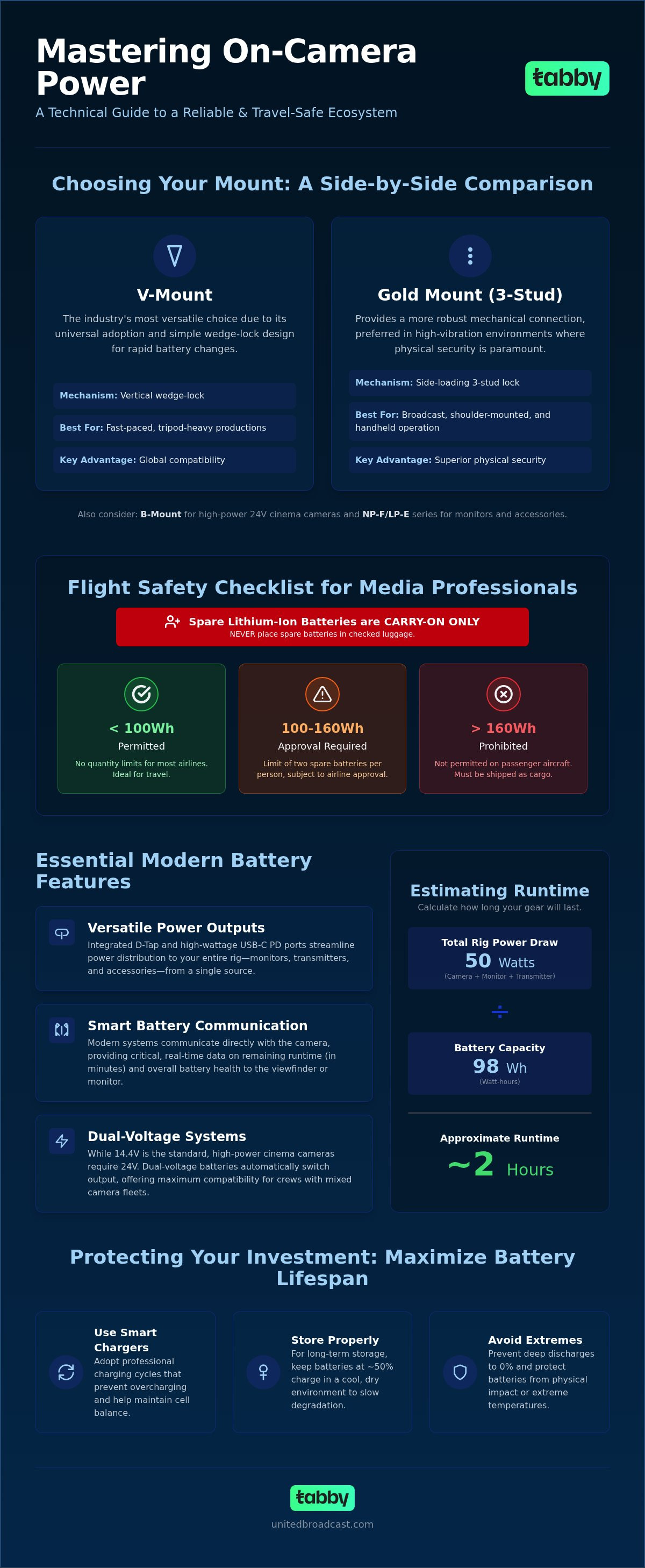
Selecting the appropriate mounting system is the foundational step in building a reliable power ecosystem. V-Mount remains the industry's most versatile choice due to its universal adoption by manufacturers worldwide. Its simple wedge-lock design allows for rapid battery changes during fast-paced shoots, making it the primary interface for most professional on camera batteries. This global standard ensures that you can find compatible chargers and accessories in almost any production environment.
Gold Mount (3-stud) systems provide a more robust mechanical connection by utilizing a side-loading mechanism that locks into three distinct points. This design is the preferred standard for high-vibration broadcast environments where a battery must stay seated despite heavy physical movement or shoulder-mounted operation. While V-Mount is more common globally, Gold Mount is often chosen by operators who prioritize physical security over universal compatibility.
The industry is also seeing the emergence of B-Mount to address the 24V power requirements of modern high-end cinema cameras. This standard provides a high-capacity interface that supports the increased wattage demands of advanced sensors and processing engines. For smaller setups, NP-F and LP-E series batteries remain essential. These small-format options are the ideal solution for powering external monitors, wireless transmitters, and compact mirrorless rigs where a full-sized cinema battery would be too cumbersome.
V-Mount vs. Gold Mount: Which Ecosystem Should You Join?
Mechanical security is often the deciding factor between these two formats. V-Mount uses a vertical slide that is quick to operate but can develop "play" or wobble over years of heavy use. Gold Mount requires a side-load twist that locks the battery more firmly against the plate, which is why it remains a staple for heavy-duty broadcast work. You should evaluate your typical workflow; tripod-heavy productions benefit from the speed of V-Mount, while handheld operators often prefer the locked-in feel of Gold Mount. You can explore our range of professional video cameras to see which mounting plates are natively supported by the latest systems.
Voltage Requirements: 14.4V vs. 24V Systems
Modern Lithium-ion battery technology has evolved to support different power draws. Standard 14.4V systems are the baseline for most professional gear, but high-performance cinema cameras often require 24V to power all internal components and high-speed frame rates. Using the wrong voltage can lead to system instability or hardware failure. Nominal Voltage refers to the average voltage a battery maintains during its discharge cycle, serving as a standardized rating between its peak charge and its functional cutoff point. Dual-voltage on camera batteries are an excellent solution for crews managing mixed-camera fleets, as they automatically switch their output based on the detected mounting plate.
Calculating Capacity: Watt-Hours and Flight Regulations
Capacity isn't just about the physical size of the cell; it's about the energy density required to keep a professional rig operational for a full production day. Watt-hours (Wh) provide a standardized measurement of energy by multiplying the battery's nominal voltage by its Amp-hour rating. To accurately estimate your runtime, you must aggregate the total wattage draw of your camera body, external monitors, wireless transmitters, and lens motors. If your total rig consumes 50 watts and you use a 98Wh battery, you can expect roughly two hours of continuous operation before a swap is required.
The 2026 Flight Safety Checklist for Media Professionals
Transporting on camera batteries requires strict adherence to international safety protocols. As of 2026, aviation authorities have enforced more rigorous verification of lithium-ion safety standards. Spare lithium batteries are strictly prohibited in checked luggage and must remain in carry-on bags at all times. According to current FAA flight regulations, batteries under 100Wh are generally permitted without prior restriction. Those rated between 100Wh and 160Wh typically require airline approval, while any battery exceeding 160Wh is prohibited on passenger aircraft. Clear, unambiguous labeling of the Watt-hour rating on the battery casing is now a non-negotiable requirement for airport security clearance.
Mini V-Mount and Nano batteries have become the industry's preferred "Travel-Safe" category. These compact units provide high energy density while staying comfortably under the 100Wh threshold, allowing crews to carry multiple spares without violating safety limits. If you're planning a complex international shoot and need to verify your gear's compliance, you can consult our technical team for a comprehensive power audit.
Power Draw and Thermal Management
High-performance cinema cameras recording at high-speed frame rates or in 8K resolutions put immense strain on internal battery cells. This demand makes the C-Rating a critical specification; it's a value that describes the discharge current a battery can safely deliver relative to its maximum capacity. A higher C-Rating ensures the battery can handle peak power spikes without inducing thermal runaway or damaging internal circuitry. Effective thermal management in professional on camera batteries is vital for protecting the longevity of the cells, especially when shooting in high-ambient-temperature environments where heat dissipation becomes more difficult.
Key Features to Evaluate in a Professional Battery
Professional power solutions are defined by their ability to do more than just provide current. High-tier on camera batteries act as intelligent data hubs that communicate vital performance metrics to the camera operator. While consumer-grade batteries often rely on simple voltage bars, professional units utilize advanced data protocols to provide a granular view of remaining runtime and overall cell health. This distinction is critical for maintaining a predictable workflow during high-pressure productions where every minute of uptime counts.
The Importance of SMBus and Battery Metadata
Modern power systems utilize SMBus (System Management Bus) protocols to exchange metadata with the camera's internal processing engine. This technology allows cameras like the Sony Alpha series and high-end cinema bodies to display an accurate "Time to Empty" reading in the viewfinder. Instead of guessing based on a fluctuating voltage percentage, you receive a calculated minute-by-minute countdown that adjusts dynamically based on your current power draw. This level of precision is also vital when managing large-scale setups, as noted in this professional video battery guide. These data-rich ecosystems even allow professional lighting controllers to monitor battery status remotely, ensuring that no light fails unexpectedly during a complex shot.
Accessory Ports: Beyond the Main Connector
A professional battery serves as the primary power distribution point for your entire rig. Integrated D-Tap (also known as P-Tap) ports are the industry standard for powering essential accessories like wireless video transmitters and follow-focus motors. Many 2026 models now incorporate USB-C Power Delivery (PD), which enables you to use your on camera batteries to charge a laptop or mobile device between setups. When evaluating these ports, it's essential to distinguish between regulated and unregulated outputs. Regulated outputs maintain a consistent voltage, such as a steady 12V, protecting sensitive electronics from the natural voltage drop that occurs as a lithium-ion battery depletes. Unregulated ports pass the battery's native voltage directly to the accessory, which is suitable for gear with wide input tolerances but potentially hazardous for less robust hardware.
Field durability remains a core consideration for any professional investment. Look for casings constructed from fire-retardant materials with high drop-test ratings to ensure the battery can withstand the rigors of location work. Advanced units often feature built-in OLED or LED displays that provide immediate access to cycle counts and internal temperature. Monitoring these metrics allows you to retire aging cells before they become a liability on set, ensuring your power fleet remains reliable year after year.
Top On-Camera Battery Recommendations for 2026
Selecting the right power source requires matching the battery's discharge capabilities with your camera's specific electronic architecture. High-capacity workhorses exceeding 200Wh are essential for high-end studio environments where minimizing battery swaps is a priority. These larger units provide the sustained current needed for digital cinema cameras equipped with multiple accessories. Conversely, the rise of "Micro" and "Nano" V-Mounts has revolutionized gimbal and drone work. These compact on camera batteries provide a high energy-to-weight ratio, allowing for longer flight times and easier balancing on stabilized heads without sacrificing professional features like D-Tap outputs.
For productions utilizing next-generation cinema sensors, B-Mount solutions have become the standard for high-voltage 24V rigs. These batteries offer the robust power delivery required for high-speed frame rates and advanced processing. Independent creators looking for a balance between reliability and cost should consider the SWIT PowerCell series. Launched in early 2026, these models provide a professional-grade alternative for Sony, Canon, and mirrorless systems, ensuring that even smaller productions can benefit from stable power delivery.
Standout Brands in the UBMS Collection
Sony continues to set the gold standard for native integration. Their battery systems are designed to communicate perfectly with their own camera bodies, providing the most accurate metadata and longest service life. SWIT remains a leader in innovation, frequently incorporating built-in OLED displays and multi-port designs that allow you to monitor cell health and power accessories simultaneously. For high-draw applications, Core SWX and their Hypercore series are frequently chosen by broadcast professionals for their ability to handle massive power spikes without overheating. These brands represent the pinnacle of current on camera batteries technology.
Browse the full range of 70+ on-camera batteries at UBMS.
Specialized Power for Lighting and Monitors
The utility of professional batteries extends far beyond the camera body. High-capacity V-Mount and Gold Mount batteries are increasingly replacing AC adapters for portable LED panels, providing a cable-free solution for location lighting. When choosing power for ARRI lighting or other high-draw fixtures, it is vital to check the maximum continuous draw rating to prevent premature battery shutdown. Smaller-format batteries, such as the NP-F series, remain the preferred choice for directors' monitors and wireless receivers due to their slim profile and widespread compatibility with third-party mounting plates.
Maintenance and Longevity: Protecting Your Power Investment
Professional power solutions represent a significant financial commitment. Protecting that investment requires a disciplined approach to storage and environmental management. Lithium-ion chemistry is sensitive to state-of-charge extremes; storing on camera batteries at 100% for weeks induces high-voltage stress, while leaving them at 0% can lead to a deep-discharge state that permanently disables the cells. The optimal "sweet spot" for long-term storage is between 40% and 60% capacity. It's also vital to store your equipment in a climate-controlled environment, as excessive heat accelerates the chemical degradation of the internal components.
Internal resistance is the primary indicator of a battery's age and health. As cells cycle, this resistance increases, eventually causing the battery to struggle under high-draw loads even if it appears fully charged. You should monitor your fleet for physical signs of failure, such as casing deformation or cell swelling. A swollen battery is a serious safety hazard and must be retired immediately. Regular inspections of the contact pins for oxidation or debris ensure a clean electrical connection and prevent arcing that could damage your camera's battery plate.
Charging Strategies for Maximum Lifecycle
Your choice of charger directly impacts the total number of cycles you'll get from your cells. While fast chargers are convenient for quick turnarounds on set, they generate significant heat that can shorten a battery's lifespan over time. Slow, controlled charging is always preferable when the production schedule allows. Sequential chargers are an efficient choice for overnight use, as they focus all current on one battery at a time before moving to the next. Simultaneous chargers are better for heavy-use environments where multiple on camera batteries must be ready at once. Modern Lithium-ion cells do not suffer from the 'memory effect' that plagued older nickel-based chemistries, meaning you can top them up at any charge level without reducing their capacity.
Professional Support and Recalibration
Accurately assessing the remaining life of an older battery requires more than just looking at a display. As cells age, the reported capacity may no longer match the actual runtime available. Utilizing the UBMS service center for professional equipment health checks allows you to verify the true discharge capacity of your power fleet. Our technicians can perform load tests to identify which units are nearing the end of their functional life. This proactive maintenance prevents the risk of a battery failing during a critical take. If your testing reveals significant capacity loss, it's time to refresh your ecosystem with modern, high-density cells.
Ensure your gear stays powered—shop the latest on-camera batteries today.
Securing Reliable Power for Your Next Production
Mastering professional power is about more than just simple runtime. It's about ensuring your on camera batteries comply with the latest 2026 flight safety standards and integrate seamlessly with your camera metadata. By prioritizing smart communication and disciplined maintenance, you protect your equipment from premature degradation and ensure every take is safely captured.
As an authorized distributor for Sony, SWIT, and Core SWX, UBMS provides the industry's most reliable solutions backed by national UAE delivery. Our technical team is ready to help you build a future-proof power ecosystem, while our dedicated service center handles the long-term maintenance required for high-stakes broadcast environments.
We're here to support your workflow from the first charge to the final wrap. Trust in professional power and keep your creativity moving forward.
Frequently Asked Questions
Can I take on-camera batteries on a plane in 2026?
You can take professional batteries on a plane, provided they remain in your carry-on luggage. As of 2026, batteries under 100Wh are generally permitted without restriction, while those between 100-160Wh require airline pre-approval. Any battery exceeding 160Wh is typically prohibited on passenger aircraft. Always ensure the Watt-hour rating is clearly labeled on the casing to satisfy updated security verification protocols during travel.
What is the difference between V-Mount and Gold Mount batteries?
The primary difference lies in the mechanical locking mechanism and regional industry preference. V-Mount utilizes a vertical wedge-shaped bracket that is popular globally for its speed of attachment. Gold Mount, or 3-stud, uses a side-loading system with three pins that provide a more secure, vibration-resistant connection. While both deliver the same power, they require specific mounting plates that are not cross-compatible without an adapter.
How many Watt-hours do I need for a full day of shooting?
Calculating your requirement involves adding the wattage of your camera and all active accessories. If your total rig draws 50 Watts and you shoot for ten hours, you need 500Wh of total capacity. This usually translates to five 98Wh batteries or three high-capacity 190Wh units. It's best to carry 20% more than your calculated minimum to account for environmental factors and standby power consumption.
Is it safe to use third-party batteries with my Sony or ARRI camera?
It is safe to use high-quality third-party on camera batteries from authorized brands like SWIT or Core SWX. These manufacturers design their products to match the communication protocols of Sony and ARRI systems, ensuring accurate metadata and safety protections. However, you should avoid unbranded or extremely cheap alternatives that lack the sophisticated cell balancing and thermal management circuits required to protect high-end cinema electronics.
What is a D-Tap port and what can I power with it?
A D-Tap, also called a P-Tap, is a standardized two-pin power output found on most professional battery plates and cells. It provides a direct connection to the battery's voltage, typically between 12V and 16.8V. You can use it to power a wide range of accessories, including wireless video transmitters, external monitors, follow-focus motors, and even small LED lights, effectively turning your main battery into a central power hub.
How long do professional on-camera batteries typically last?
Professional Lithium-ion batteries typically maintain peak performance for 300 to 500 full charge cycles. Depending on your frequency of use, this usually equates to two to four years of reliable service. You'll notice a gradual increase in internal resistance and a decrease in total runtime as the cells age. Once a battery's actual capacity drops below 80% of its original rating, it's time to consider a replacement.
Do I need a special charger for different battery brands?
While V-Mount and Gold Mount are standardized interfaces, using a charger from the same manufacturer as your on camera batteries is highly recommended. Brand-specific chargers often utilize proprietary communication protocols to optimize the charging curve and balance the internal cells more effectively. Some third-party chargers are universal, but they might not provide the same level of detailed health monitoring or fast-charging capabilities as a dedicated ecosystem.
What happens if I use a battery with the wrong voltage on my rig?
Using the wrong voltage can cause immediate hardware failure or trigger protective shut-down circuits. Most standard professional gear operates on 14.4V, but modern high-performance cinema cameras may require 24V. Connecting a 14V battery to a 24V system will likely result in the camera failing to boot. Conversely, forcing 24V into a 14V device without a regulator can permanently damage internal circuitry and void your equipment warranty.


