

Professional Microphones Buying Guide: Choosing the Right Audio Gear for 2026
Imagine you're on a high-stakes cinema set in the middle of the Dubai desert, and just as the lead actor delivers a whisper-quiet monologue, a burst of RF interference from a nearby broadcast tower ruins the take. It's a frustrating reality for many production teams when their microphones and wireless systems aren't properly shielded or coordinated for the local environment. You likely agree that nothing undermines a professional production faster than poor audio quality, regardless of how stunning the 8K visuals look.
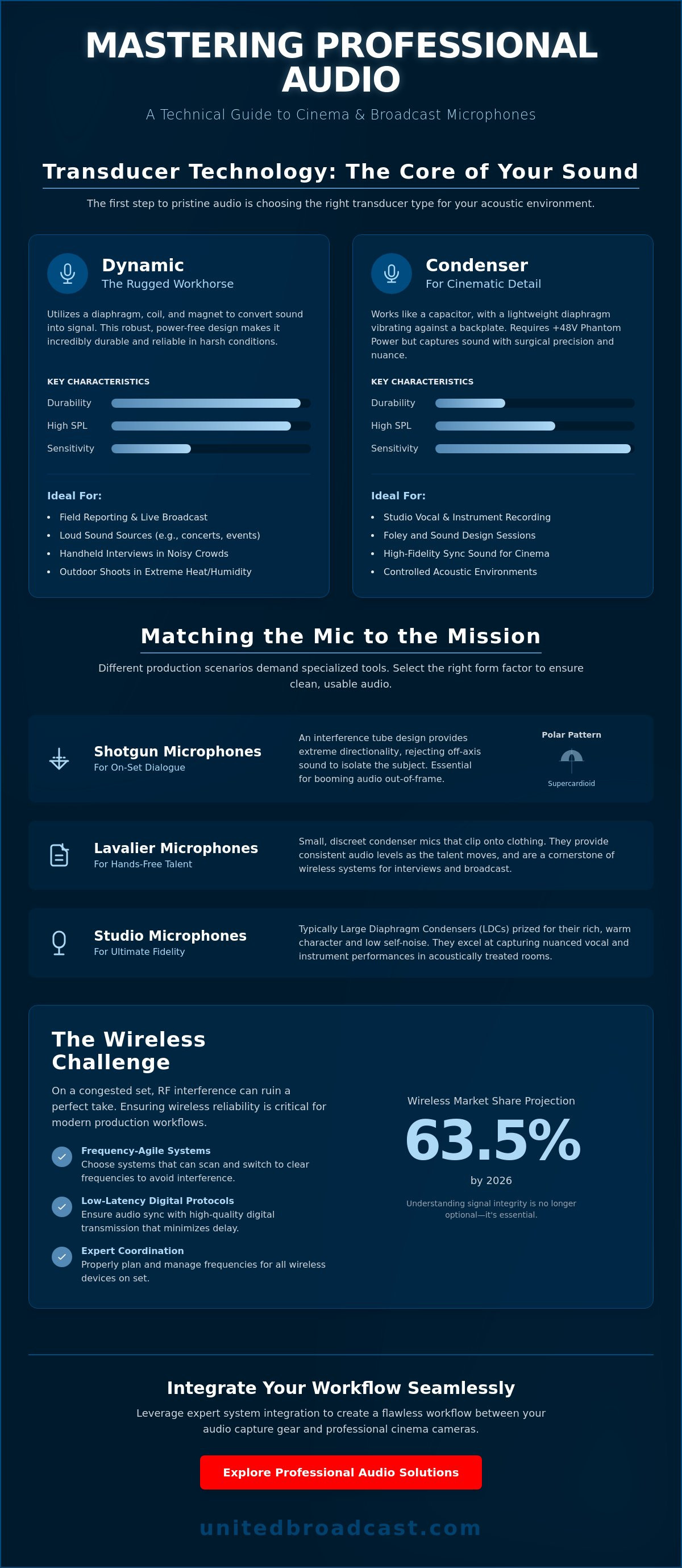
This guide provides a technical roadmap to selecting professional-grade audio gear tailored for the cinema, broadcast, and studio sectors in the UAE. With the wireless segment projected to account for 63.5% of the total market in 2026, understanding frequency coordination and signal integrity is more critical than ever. We'll help you solve common challenges like poor wind rejection during outdoor shoots and the technical friction between high-end microphones and professional cinema cameras. By the end of this article, you'll understand how to achieve crystal clear dialogue and seamless equipment integration for your upcoming projects. We'll preview the essential hardware categories, from frequency-agile wireless systems to high-fidelity studio transducers.
Key Takeaways
- Distinguish between dynamic and condenser transducers to select the correct hardware for either high-pressure field reporting or controlled studio recording.
- Match professional microphones to specific use cases, such as shotgun mics for cinema or lavaliers for talent, to guarantee consistent dialogue clarity.
- Ensure wireless reliability on congested sets by prioritizing frequency-agile systems and low-latency digital transmission protocols.
- Utilize polar patterns like supercardioid and hypercardioid to maximize off-axis rejection in noisy or acoustically untreated environments.
- Leverage expert system integration to create a seamless workflow between your audio capture gear and professional cinema cameras.
Understanding Professional Microphone Transducers: Dynamic vs. Condenser
A Microphone acts as a transducer, which means its primary function is to convert acoustic energy into an electrical signal. In professional broadcast and cinema workflows, this conversion happens through two primary technologies: electromagnetic induction or electrostatic capacitance. Understanding the physics behind these transducers is the first step in building a reliable audio kit that can withstand the demands of a high-stakes production environment.
Dynamic microphones utilize a simple yet robust design where a diaphragm is attached to a copper coil suspended within a magnetic field. When sound waves hit the diaphragm, the coil moves, creating a small electrical current. This passive process doesn't require external power and makes the hardware exceptionally durable. Conversely, condenser microphones rely on a capacitor system where a thin diaphragm vibrates against a solid backplate. This design requires +48V Phantom Power to charge the plates, but it allows for a much lighter diaphragm that reacts to sound with surgical precision.
Dynamic Microphones for High-Pressure Environments
Dynamic microphones are the industry's preferred tools for field reporting and live broadcast because they're built to survive. Their mechanical simplicity makes them resistant to moisture and extreme heat, which is a vital consideration for outdoor shoots in the UAE. They handle high Sound Pressure Levels (SPL) without internal clipping, making them ideal for recording loud sound sources or handheld interviews in noisy crowds. While they lack the high-frequency extension of condensers, their ability to ignore background chatter and focus on the primary subject is a technical advantage in uncontrolled environments.
Condenser Microphones for Cinematic Detail
When the priority is capturing the subtle nuances of a whisper or the intricate textures of a foley session, condenser microphones are the standard. They're categorized by diaphragm size. Large diaphragm condensers (LDCs) are typically used in studio environments for rich, warm vocal capture. Small diaphragm condensers (SDCs) are often found in pencil-style microphones and are prized for their flat frequency response and exceptional transient response. This speed allows the microphone to capture the "attack" of a sound accurately, providing the clarity needed for high-fidelity sync sound. For the best results, professionals integrate these sensitive tools directly with high-end professional video cameras that feature high-quality preamps and dedicated XLR inputs capable of providing stable phantom power.
Choosing between these two transducers isn't about which is better, but which matches your acoustic environment. If you're in a treated studio, the sensitivity of a condenser is your greatest asset. If you're reporting from a construction site or a humid coastline, the rugged reliability of a dynamic mic will ensure you don't lose the take.
Choosing by Application: Shotgun, Lavalier, and Studio Mics
Selecting the right hardware requires a deep understanding of the acoustic challenges inherent in your specific production environment. While a high-quality transducer is essential, the form factor and pickup pattern of professional microphones determine their utility on a busy set or in a quiet studio. Matching the tool to the application ensures that you capture clean, usable audio that requires minimal correction in post-production.
The Role of Shotgun Microphones in Film
Shotgun microphones are the primary choice for localized audio on film and television sets. Their distinct long, slotted barrel is known as an interference tube. This design uses phase cancellation to reject sound coming from the sides, focusing exclusively on the source directly in front of the capsule. Choosing between a long and short shotgun depends on your environment and boom pole reach. Long shotguns offer extreme directionality, making them ideal for wide outdoor shots where the microphone must remain out of the frame. Short shotguns are more forgiving in smaller rooms where excessive side-rejection can lead to unnatural-sounding off-axis coloration.
For outdoor shoots in the UAE, environmental protection is non-negotiable. High winds can create low-frequency turbulence that overloads the microphone's preamp. Utilizing a full "blimp" windshield system with a synthetic fur "dead-cat" cover is the only way to maintain signal integrity during coastal or desert productions. These accessories provide the necessary air gap to dissipate wind energy before it reaches the diaphragm.
Lavalier Systems for Professional Interviews
Lavalier microphones provide a discrete solution for interviews and talent-led content where a boom is impractical. For hybrid shooters using compact setups like Sony Alpha cameras and lenses, a high-quality lavalier system is essential for achieving professional dialogue. You must choose between omnidirectional and cardioid capsules based on the location. Omnidirectional lavaliers are standard for most talent because they're less sensitive to wind noise and head movement. However, in noisy environments, a cardioid lavalier provides better isolation, though it requires more precise placement to avoid the "thin" sound associated with being off-axis.
When deploying wireless lavaliers, managing the RF environment is critical for avoiding dropouts. Referencing standards for Wireless Signal Integrity and Frequency Coordination helps operators understand how to navigate crowded spectrums. While wired lavaliers offer the most reliable signal path, wireless systems provide the mobility required for dynamic, unscripted broadcast environments.
Integrating these microphones into your workflow also involves considering the physical balance of your camera rig. A heavy shotgun microphone can shift the center of gravity on a lightweight gimbal setup, requiring counterweights or offset mounting solutions. If you need assistance configuring a balanced audio-visual kit, you can consult with our technical specialists for a tailored equipment assessment.
Wireless Signal Integrity and Frequency Coordination
Reliable transmission is the backbone of any professional production, especially as the wireless segment is projected to account for 63.5% of the total microphone market in 2026. While choosing the right capsule is a priority, the signal's journey from the transmitter to the receiver is where many productions fail. Moving from analog to digital systems has become the industry standard because digital transmission offers superior encryption and a significantly lower noise floor. While analog systems are prized for near-zero latency, modern digital microphones have reduced latency to negligible levels, making them the preferred choice for secure corporate events and complex broadcast environments.
The global expansion of 5G networks has significantly squeezed the available RF spectrum, making frequency agility a mandatory feature for professional gear. High-tier systems must operate across multiple bands to avoid the congestion caused by mobile data and local broadcast signals. As noted in Cornell University's guide to microphone types, the complexity of your environment dictates the level of sophistication required in your wireless infrastructure. Failing to account for these shifts can lead to unpredictable dropouts during critical takes.
Managing RF Interference in the UAE
In high-density areas like Dubai Media City, frequency coordination is essential to prevent intermodulation distortion when using multi-microphone setups. Wide-band tuning allows receivers to scan a broader range of the spectrum to find clean windows for operation. Diversity Reception is the use of two antennas to eliminate signal nulls. By constantly comparing the signal strength between two separate paths, the receiver ensures that physical obstructions or reflections don't result in an audible dropout.
Battery Life and Logistical Reliability
Field production requires a power strategy that balances runtime with weight. While many creators use internal rechargeable batteries, professional broadcast workflows often favor standard AA ecosystems or smart lithium-ion packs that provide accurate telemetry. Modern receivers allow engineers to monitor signal strength and remaining battery life directly from the camera or mixer. It's also vital to maintain physical distance between your audio receivers and high-output lighting equipment to avoid electromagnetic hum and RF interference. Coordinating these elements ensures that your audio remains as clean as your visual output.
Critical Specifications: Polar Patterns and Sensitivity
Technical specifications define the functional limits of professional microphones in a production environment. Beyond the transducer type, the polar pattern dictates how a microphone "hears" its surroundings, while sensitivity and self-noise determine the fidelity of the captured signal. Mastering these metrics allows engineers to select hardware that complements the acoustic profile of a set rather than fighting against it.
- Cardioid: This heart-shaped pattern captures sound primarily from the front while rejecting audio from the rear. It's the standard for studio vocals and broadcast booths where the source is stationary and front-facing.
- Supercardioid and Hypercardioid: These patterns provide narrower pickup angles than a standard cardioid, offering maximum side-rejection. They're essential for cinema sets and noisy environments where isolating dialogue from ambient spill is the priority.
- Omnidirectional: By capturing sound equally from all directions, omnidirectional capsules provide a natural, open sound. They're ideal for capturing room ambiance or for lavalier placement where the talent might turn their head away from the capsule.
- Figure-8: Known as a bidirectional pattern, it captures sound from the front and rear while rejecting the sides. This is a specialized tool for face-to-face interviews or advanced mid-side (M/S) stereo recording techniques.
Understanding Sensitivity and Self-Noise
Low self-noise is the hallmark of a high-end professional microphone. It represents the level of "hiss" generated by the microphone's own internal circuitry. In quiet studio environments or when recording delicate foley, a high self-noise floor can ruin a recording. You must also match the microphone's sensitivity to your preamp's gain stage. A low-sensitivity mic requires a high-gain, low-noise preamp to achieve usable levels without introducing electronic artifacts. SPL handling determines the maximum volume a mic can record before distorting.
Connectivity: XLR, TRS, and Digital Outputs
Balanced XLR remains the professional standard because it uses two signal wires and a ground to cancel out electromagnetic interference over long cable runs. This is critical in broadcast environments where cables often run alongside high-voltage power lines. However, we're seeing a rise in digital microphones that offer direct-to-NLE (Non-Linear Editor) workflows, bypassing traditional interfaces for faster turnarounds in newsgathering.
Adapting professional audio to mirrorless setups requires specific attention to connectivity and mounting. Wildlife cinematographers using long-range glass like the Sony FE 100-400mm often require specialized shock mounts and TRS-to-XLR adapters to maintain a small footprint without sacrificing audio quality. Ensuring your connectors are gold-plated and shielded prevents signal degradation during critical takes in the field.
If you're unsure which polar pattern best suits your specific studio or field application, contact our technical specialists for a detailed equipment compatibility review.
Investing in Quality: The UBMS Professional Advantage
Professional production requires more than just high-tier hardware; it demands a technical partnership that extends beyond the point of sale. At United Broadcast & Media Solutions (UBMS), we provide access to a curated inventory of over 220 professional microphones, ensuring that every cinema, broadcast, and studio environment has the specific tool required for the job. While retail-only vendors focus on transaction volume, we prioritize the technical suitability of the gear for the UAE's specialized media landscape. Investing in professional-grade audio means securing equipment that carries genuine manufacturer warranties and is backed by local technical expertise.
Choosing the right audio gear involves understanding how individual components function within a complex signal chain. Lower-tier pricing often comes at the cost of after-sales support and technical guidance. For specialists in cinema and broadcast, the reliability of a microphone is as important as its acoustic performance. We ensure that our clients receive hardware that meets global standards for durability and signal integrity, providing a level of confidence that consumer-grade alternatives cannot match.
Beyond the Mic: System Integration
Microphones don't exist in isolation; they're critical components of a larger infrastructure that includes mixers, recorders, and digital interfaces. Our team specializes in expert system integration, helping clients design complete broadcast studio infrastructures from the ground up. This involves syncing high-end audio with Advanced Broadcast Studio Gear to ensure that latency is minimized and signal paths remain clean. Whether you're building a national newsroom or a specialized cinema set, we customize kits to meet your specific production needs, ensuring that every piece of hardware integrates seamlessly into your existing ecosystem.
Service and Technical Support
The longevity of your investment is protected by the UBMS Service Center, where we provide authorized maintenance and repair services. Professional audio gear is subject to demanding conditions, particularly in field production environments where dust and heat are constant factors. Regular servicing prevents signal degradation and ensures that your equipment operates within its original factory specifications. Our staff consists of industry veterans who understand the high stakes of professional media. They provide the type of grounded, factual advice that only comes from years of experience in the regional market. This level of comprehensive support ensures that your equipment remains a reliable asset throughout its operational life.
Selecting the right microphones is a decision that directly impacts the perceived quality of your final output. Technical precision and reliable transmission are the hallmarks of a professional production. Explore our full range of professional microphones and audio solutions to find the perfect match for your next project.
Future-Proofing Your Audio Infrastructure
Securing professional-grade audio in 2026 involves more than just selecting a high-end capsule; it requires a deep understanding of how transducers, polar patterns, and wireless signal integrity interact. By prioritizing hardware that offers high SPL handling and frequency agility, you protect your production from the unpredictable variables of field and studio recording. These technical considerations ensure your microphones deliver the clarity and reliability expected in the modern broadcast landscape.
United Broadcast & Media Solutions (UBMS) stands as a dedicated partner for filmmakers and broadcasters across the region. With 25+ years of industry expertise and a comprehensive technical service center in the UAE, we provide the authorized support and system integration necessary to maintain a world-class audio-visual ecosystem. Our role is to ensure your equipment performs at its peak, regardless of the environmental challenges or technical complexity of the set.
If you're ready to elevate your audio standards, connect with our specialists to shop our professional collection. We look forward to helping you capture every nuance of your next production with absolute clarity.
Frequently Asked Questions
What is the difference between a dynamic and a condenser microphone?
Dynamic microphones use a moving coil and magnet system to convert sound, making them exceptionally durable and capable of handling high Sound Pressure Levels. Condenser models utilize a sensitive capacitor system that requires external power. While dynamic mics excel in loud, high-pressure environments, condensers are preferred for capturing the subtle nuances and high-frequency detail required in studio environments or for cinematic foley.
Do I need an external recorder for my professional microphone?
You don't always need an external recorder if your camera has professional XLR inputs and high-quality preamps. However, dedicated field recorders offer a significantly lower noise floor and features like 32-bit float recording, which prevents digital clipping. Using an external device also allows for safety tracks recorded at a lower gain level, providing a backup if the primary signal peaks during an unscripted moment.
What is phantom power and why is it required for some microphones?
Phantom power is a DC voltage, typically +48V, sent through an XLR cable to power the active electronic circuitry of a condenser microphone. It's required because condenser capsules are electrostatic and won't function without a charge. Most professional mixers and cameras provide this power internally. It's important to ensure your device's phantom power is switched off when using ribbon microphones to avoid potential damage to the delicate internal ribbon.
Which polar pattern is best for recording dialogue on a busy film set?
Supercardioid and hypercardioid patterns are the most effective for recording dialogue on a busy film set. These highly directional patterns offer maximum side-rejection, allowing the operator to isolate the talent's voice while minimizing background noise from crew movements or equipment. This precision is critical for maintaining a high signal-to-noise ratio in uncontrolled environments. Shotgun microphones typically utilize these patterns through their interference tube design to achieve surgical focus.
How do I choose between a wired and a wireless microphone system?
Choosing between these systems depends on the talent's mobility and the RF environment of your location. Wired connections are the gold standard for reliability and signal integrity, making them ideal for static interviews or studio desks. Wireless systems are necessary for dynamic movement on set but require careful frequency coordination to avoid interference. In the UAE's crowded spectrum, a high-quality wireless system with wide-band tuning is essential for professional results.
Can I use professional XLR microphones with my mirrorless camera?
You can use professional XLR microphones with mirrorless cameras by employing an XLR adapter or a dedicated audio interface module. These devices convert the balanced XLR signal into a 3.5mm TRS input that the camera can process. For the best results, use an adapter that provides phantom power and physical gain knobs, as this bypasses the often-limited internal preamps and menu-based controls of the camera body.
What are the essential accessories for a shotgun microphone?
A professional shotgun microphone requires a shock mount to eliminate handling noise and a high-quality boom pole for positioning. For outdoor use, a full blimp system and a synthetic fur cover, often called a dead-cat, are non-negotiable for wind protection. These accessories dissipate air turbulence before it reaches the capsule, ensuring that you don't lose the take to low-frequency rumble or wind-induced distortion during coastal or desert shoots.
How does the UAE climate affect professional microphone maintenance?
The UAE's high humidity and fine desert dust can significantly impact the longevity of your audio gear. Dust particles can settle on microphone diaphragms, affecting frequency response and increasing self-noise over time. Regular professional maintenance at an authorized service center is essential for cleaning sensitive capsules and ensuring that connectors remain free of corrosion. Storing equipment in humidity-controlled dry cases when not in use further protects the internal electronics from environmental degradation.


