

How to Choose a Professional Video Camera: Entry-Level vs. High-End Cinema Systems
What if the primary factor limiting your production's growth isn't your creative vision, but a camera body that lacks the technical infrastructure to scale? Most professional filmmakers understand the pressure of choosing between entry-level vs high-end cinema cameras while balancing immediate budget constraints against rising client expectations. You've likely felt the fear of outgrowing your equipment too quickly or struggled to decipher whether a specific sensor's specs will actually translate into better real-world performance on set.
A camera is a long-term investment in your business's capability, not just a tool for a single project. This guide details the critical technical and operational differences between these equipment tiers to ensure you make a choice that yields a high return on investment. We'll examine the nuances of sensor performance, internal RAW recording standards, and the logistical advantages of high-end cinema systems in professional workflows. You'll gain a clear technical checklist to help you select a system that meets global delivery standards and supports your specific production scale.
Key Takeaways
- Distinguish between entry-level professional cameras that bridge the gap from mirrorless and flagship systems designed for uncompromising cinema performance.
- Discover why dynamic range and signal-to-noise ratios are more critical than resolution when evaluating entry-level vs high-end cinema cameras for narrative work.
- Identify the essential operational features, including full-size I/O and environmental sealing, required for reliable performance in demanding production environments.
- Evaluate the impact of industry-standard codecs and RAW data rates on your post-production infrastructure and overall media storage costs.
- Calculate your long-term return on investment by analyzing project frequency, equipment depreciation, and the value of professional technical support.
Defining the Cinema Camera Spectrum: Entry-Level vs. High-End
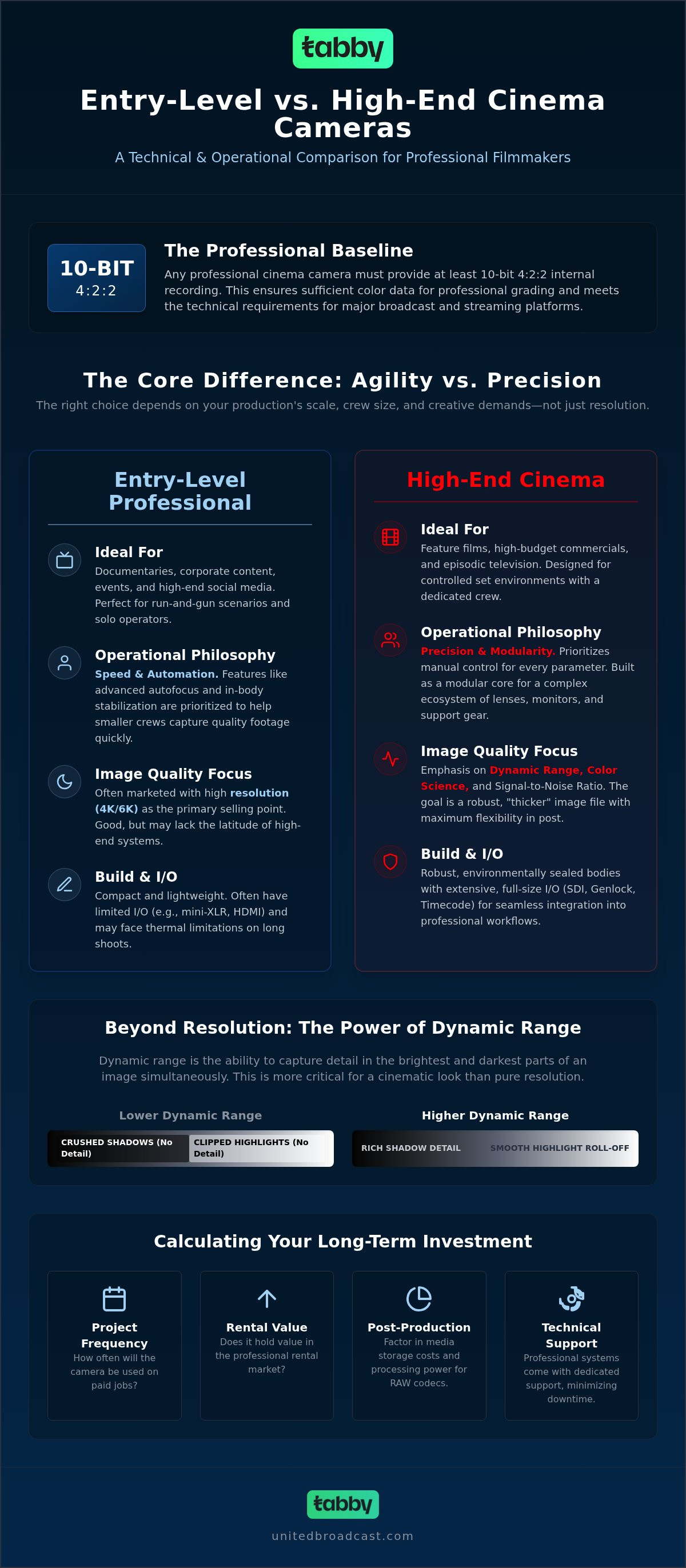
The professional imaging market has shifted significantly, creating a clear distinction between tools designed for agility and those built for cinematic precision. When evaluating entry-level vs high-end cinema cameras, the choice often depends on the scale of the production infrastructure rather than just the resolution on the spec sheet. By 2026 standards, the baseline for any pro-level camera is 10-bit 4:2:2 internal recording. This ensures enough color information for professional grading and meets the technical requirements of most broadcast and streaming platforms. For a foundational Professional Video Camera Overview, it's helpful to look at how these systems evolved from ENG (Electronic News Gathering) units into the modular cinema tools we use today. This evolution has led to a market where the entry-level is no longer synonymous with amateur, but rather represents a specific operational philosophy focused on speed and solo operation.
The Role of Entry-Level Professional Cameras
Entry-level professional cameras serve as the bridge between high-end mirrorless hybrids and dedicated cinema systems. These tools are ideal for documentaries, corporate communications, and high-end social content where speed is essential. For example, the Sony Alpha camera and lenses ecosystem offers sophisticated autofocus and internal stabilization that allow solo operators to capture high-quality footage without a full crew. These cameras are built for portability and lower power requirements, making them perfect for run-and-gun scenarios. However, these compact systems often face limitations in thermal management during long shoots and lack the specialized I/O, such as full-size SDI or Genlock, required for complex multi-camera environments.
The Flagship Cinema Standard
High-end cinema flagships are built for uncompromising image quality and the rigors of a feature film set. These systems prioritize manual control and modularity, allowing a dedicated camera crew to fine-tune every aspect of the image. Unlike entry-level models, flagship professional video cameras often feature global shutters to eliminate motion distortion and support high-speed frame rates for stylized slow motion. They are designed to be part of a larger production ecosystem, integrating seamlessly with professional wireless video transmitters, follow-focus systems, and high-capacity battery solutions. These cameras are engineered with robust, weather-sealed bodies that can withstand extreme environments, ensuring reliability when the stakes are high. This shift from automation to manual precision is what enables the consistency and specific look required for high-budget commercial and narrative work.
Technical Divergence: Sensors, Color Science, and Dynamic Range
Resolution is frequently the primary focus of marketing materials, yet it is rarely the defining factor of a cinematic image. The technical gap between entry-level vs high-end cinema cameras is most evident in how the sensor processes light and color. High-end systems prioritize a superior signal-to-noise ratio and greater latitude, ensuring the image remains clean even in low-light environments. Dynamic range is the measurable ratio between the brightest highlights and the darkest shadows a sensor can capture without losing detail, directly impacting the ability to recover information in high-contrast scenes. While an entry-level professional camera might offer 4K or 6K resolution, a flagship system provides the "texture" and depth that audiences associate with high-budget productions.
Choosing the right sensor size is equally critical for narrative style. Super 35 remains the industry standard for its classic cinematic perspective and vast lens compatibility. Large Format (Full Frame) sensors have gained popularity for their shallower depth of field and unique bokeh characteristics. When evaluating High-End vs. Entry-Level Camera Differences, sensor architecture plays a pivotal role in color science. Manufacturers like ARRI and Sony differentiate their systems through proprietary color pipelines. ARRI is renowned for its natural, filmic skin tones and gentle highlight roll-off. Sony systems often lean toward technical precision and high-speed performance, making them staples for both broadcast and cinema. If you require guidance on matching a camera to your specific visual goals, consult with our technical specialists.
Dynamic Range and Latitude
High-end cinema systems typically offer 14 to 17 stops of dynamic range, providing significant flexibility in post-production. This latitude allows colorists to pull detail from shadowed areas or bright skies that would be "clipped" on lesser sensors. Advanced thermal management and active sensor cooling play a role here; they minimize electronic noise that can muddy the shadows. Furthermore, dual-base ISO technology enables operators to switch to a higher sensitivity without a proportional increase in grain. High-end professional video cameras also include robust internal ND filter systems. These allow cinematographers to maintain a specific aperture and depth of field even under the harsh midday sun of the UAE.
Bit Depth and Color Sampling
The transition from 10-bit to 12-bit or 16-bit RAW recording represents a massive leap in data density. A 10-bit file contains roughly 1.07 billion colors, while 12-bit offers over 68 billion. This extra data is vital for avoiding "banding" in gradients like sunsets or clear skies. High-end cameras often support uncompressed or lightly compressed RAW internally, providing the highest possible image quality. Entry-level professional models may require external recorders to achieve similar bit depths, which adds complexity to the signal chain. Flagship systems streamline this workflow, ensuring that every nuance of the performance is captured with absolute color accuracy.
Operational Realities: Ergonomics, I/O, and Build Quality
When comparing entry-level vs high-end cinema cameras, the physical interface is often the first thing a professional operator notices. High-end systems are designed for crew-based environments where reliability and speed of setup are paramount. They feature dedicated, full-size ports that eliminate the need for fragile adapters or consumer-grade connectors. This includes full-size XLR for professional audio, BNC-style SDI for secure video transmission, and dedicated Timecode In/Out for precise multi-camera synchronization. These Expensive Cinema Camera Features are not just luxuries; they are essential for maintaining a professional workflow on a fast-paced set where equipment failure is not an option.
Connectivity and On-Set Integration
A key differentiator in this tier is the ability to feed multiple monitors simultaneously without signal degradation. Flagship professional video cameras typically offer multiple independent SDI outputs. This allows the director, focus puller, and client to each have a dedicated feed with different metadata overlays. High-end systems also support advanced wireless video integration and remote camera control, which are vital for crane, gimbal, or drone work. In contrast, entry-level models often rely on a single HDMI port. These are prone to accidental disconnection and lack the robust locking mechanisms required for professional use.
Power management also scales significantly with the camera tier. Entry-level systems usually utilize smaller NP-F or LP-E6 style batteries. While portable, these often lack the capacity for a full day of high-bitrate recording or powering external accessories. High-end systems utilize V-Mount or Gold Mount systems, which provide long-lasting power and can also distribute electricity to monitors and wireless transmitters through D-Tap or Lemo ports. The modular build of a flagship system, adhering to industry standards like 15mm or 19mm rods, allows for rapid rigging changes. This enables the crew to swap lenses, matte boxes, or follow-focus units in seconds, maintaining the momentum of the production.
Thermal Management and Reliability
Operating in the challenging UAE climate requires equipment that can handle extreme heat and humidity. High-end cinema cameras use active cooling systems with sophisticated internal fans and dedicated heat pipes to prevent thermal shutdowns during intense outdoor shoots. Many entry-level professional cameras rely on passive heat sinks or smaller fans that can struggle under direct sunlight. Dust and fine sand are also constant threats to internal components and sensor glass. Regular Service Center Repairs and technical maintenance are necessary to ensure your investment remains operational. Proper environmental sealing in flagship models protects the sensitive electronics from the ingress of moisture and particulates, extending the lifespan of the gear.
Post-Production Workflow and Delivery Standards
The technical distinction between entry-level vs high-end cinema cameras extends far beyond the physical sensor into the digital architecture of the recorded file. High-end systems utilize robust codecs like Apple ProRes 4444 or uncompressed RAW, providing maximum flexibility for colorists to manipulate exposure and hue. These files contain massive amounts of metadata, including lens information and camera position, which are vital for visual effects and consistency across multi-camera productions. Professional workflows often adopt ACES (Academy Color Encoding System) to ensure that colors remain accurate from the initial capture through to the final grade and delivery.
Codec Efficiency and Grading Flexibility
Entry-level professional cameras often rely on highly compressed H.265 or H.264 formats to save space. While these are efficient for fast turnarounds, they have a lower "breaking point" in post-production. Pushing a highly compressed 10-bit file too far in grading can lead to macroblocking and noise artifacts. High-end systems avoid this by utilizing high-speed media like CFexpress Type B or proprietary SSD modules. These cards handle the sustained write speeds necessary for uncompressed data, ensuring that every nuance of the signal-to-noise ratio is preserved for the final master.
Meeting Network and Streaming Requirements
Many high-end productions are bound by strict delivery standards set by networks like Netflix or the BBC. These organizations maintain approved camera lists that dictate which systems are mandatory for "Original" content. These requirements often focus on sensor resolution, bit depth, and the ability to record in specific aspect ratios. High-end flagships provide built-in tools for anamorphic desqueeze and custom frame guides, which are critical for cinematic storytelling. For productions requiring a smaller footprint without sacrificing these professional standards, the Sony Alpha camera and lenses ecosystem offers compact options that integrate well into professional post-production pipelines.
ROI and Investment: Choosing the Right Partner for Your Gear
Calculating the return on investment (ROI) for a camera system requires an analysis of project frequency against the rate of equipment depreciation. High-end cinema cameras often represent a more stable long-term investment compared to entry-level professional electronics. While the initial capital outlay is higher, flagship systems from industry-leading brands retain a significant portion of their resale value over several years. In contrast, the rapid release cycle of entry-level gear can lead to faster obsolescence. Professionals must weigh the immediate cost savings of entry-level vs high-end cinema cameras against the potential for higher day rates and the longevity of a flagship system.
Purchasing from an authorized national supplier provides a layer of security that grey-market vendors cannot match. This ensures that your equipment is covered by a valid regional warranty and that you have direct access to manufacturer-certified technical support. For organizations looking to scale, this partnership extends into the design of complete production environments. Whether you're outfitting a fixed broadcast studio or a mobile unit, choosing a partner with expertise in complex logistics is essential for operational success. Since 1997, United Broadcast & Media Solutions has served as a dependable industry pillar, providing the technical infrastructure necessary to support high-stakes productions.
The Value of After-Sales Support
After-sales support is the foundation of a professional production business. Authorized service centers offer the specialized technical expertise required to minimize downtime through rapid diagnostics and repairs. Routine maintenance, such as sensor cleaning and optical calibration, is vital for maintaining peak performance throughout the equipment's lifecycle. For those managing large-scale infrastructures, utilizing professional System Integration Services ensures that every component of your signal chain works in harmony, from the camera body to the final broadcast output.
Final Checklist for Your Purchase
Before finalizing your investment, evaluate your needs against this technical and operational checklist:
- Budget: Factor in the total rig cost, including media, power systems, and lenses, rather than just the body price.
- Crew Size: Determine if you require the automation and autofocus of an entry-level system or the manual precision of a crew-centric flagship.
- Client Standards: Verify that the camera meets the mandatory delivery requirements of your target networks or streaming platforms discussed in previous sections.
- Hands-on Testing: Conduct side-by-side demos to evaluate ergonomics and menu navigation in a professional environment.
Visit our showroom to buy professional video cameras in the UAE and consult with our experts to find the right solution for your production needs.
Scaling Your Production with Professional Precision
Deciding between entry-level vs high-end cinema cameras is a strategic choice that defines your production's technical ceiling and long-term scalability. The right system balances immediate budgetary needs with the requirements of global delivery standards and professional post-production workflows. While entry-level units provide essential portability for solo operators, high-end flagships offer the latitude and modularity necessary for high-stakes commercial and narrative environments.
United Broadcast & Media Solutions serves as your dedicated technical partner in the UAE. We're an authorized distributor for Sony, ARRI, and RED, providing access to the industry's most advanced imaging tools. Our commitment to your success includes full technical support through our local on-site service center and expert system integration for studios and OB vans. We'll ensure your investment delivers peak performance and reliability on every set.
We look forward to helping you select the imaging solution that best aligns with your creative vision and business objectives.
Frequently Asked Questions
What is the main difference between a mirrorless camera and an entry-level cinema camera?
The primary distinction lies in the operational design and thermal management. While mirrorless cameras are hybrid tools for stills and video, entry-level cinema cameras feature video-centric hardware like built-in ND filters, professional XLR audio inputs, and cooling fans. These features allow for sustained recording without the overheating issues common in compact mirrorless bodies.
Do I really need a high-end camera for corporate video production?
An entry-level professional camera is often sufficient for most corporate and social media projects. However, high-end systems become necessary when clients demand specific network-approved delivery standards or advanced color science for brand consistency. The choice between entry-level vs high-end cinema cameras for corporate work usually depends on whether the project requires high-speed frame rates or extreme highlight recovery.
Why do high-end cinema cameras often have lower megapixel counts than consumer cameras?
High-end systems prioritize the size of each individual pixel rather than the total count. Larger pixels, or photosites, capture more light and produce less electronic noise. This results in the superior dynamic range and low-light performance that define professional cinema. Consumer cameras often use high megapixel counts for marketing, but this can actually compromise the "cinematic" texture of the video.
What are the essential accessories I should budget for when buying a high-end camera?
You must budget for a complete power solution, high-speed media, and a professional support system. Most high-end bodies require V-Mount or Gold Mount batteries and expensive CFexpress or proprietary SSD cards to handle high bitrates. Additionally, a robust tripod and a modular cage system are necessary to manage the weight and connectivity requirements of a full cinema rig.
Is internal RAW recording necessary for professional broadcast delivery?
Internal RAW is not strictly mandatory for all broadcast work, as many networks accept high-quality 10-bit 4:2:2 codecs like ProRes or XAVC. However, recording in RAW provides the maximum latitude for color grading and visual effects. It's the preferred format for high-budget commercials and narrative content where technical perfection is required for the final master.
How does the UAE climate affect the choice between different camera cooling systems?
The extreme heat and humidity in the UAE make active cooling systems essential for outdoor productions. High-end cinema cameras utilize internal fans and dedicated heat pipes to move air through the body without exposing the sensor to dust. Passive cooling systems often found in smaller cameras can trigger thermal shutdowns within minutes under direct desert sunlight.
Can entry-level cinema cameras be used as B-cams for high-end productions?
Entry-level models are frequently utilized as B-cams because they can be matched to flagship systems during the color grading process. The key is ensuring both cameras are set to a similar color space and bit depth. This allows production teams to use smaller, more agile cameras for gimbal or drone work while maintaining visual consistency with the primary A-cam footage.


