

Full Frame vs Super 35 Lenses: The Professional Cinema Guide 2026
The perceived superiority of large format sensors is often a misunderstanding of optics rather than a rule of cinematography. You've likely felt the pressure to migrate to full-frame glass to keep up with industry trends, yet the technical complexities of crop factors and vignetting can make that transition feel like a significant risk. When evaluating full frame vs super 35 lenses, the choice isn't about finding a better resolution. It's about understanding how image circle geometry and sensor coverage dictate the specific narrative texture of your film. We know the frustration of trying to calculate focal length equivalence while worrying about whether your expensive new glass will actually cover your sensor.
As a professional, you require tools that offer precision and reliability without the guesswork. This guide provides a clear framework for mastering these technical and creative differences to help you make the right investment for your next production. You'll gain a thorough understanding of image circle coverage, a comparison of visual characteristics, and the confidence to manage cross-compatibility between various camera formats and lens mounts. Whether you are choosing between the latest ARRI Alexa 35 or a large format system, this guide ensures your glass matches your creative vision.
Key Takeaways
- Understand how image circle diameter determines sensor coverage and why full-frame glass is essential for large-format cinematography.
- Master the technical calculations for full frame vs super 35 lenses to accurately predict field of view and focal length equivalence.
- Learn the resolution trade-offs and sensor windowing techniques required when mounting Super 35 optics on high-resolution full-frame cameras.
- Evaluate the aesthetic shift between the immersive depth of field in large format and the classic optical texture of traditional Super 35 cinematography.
- Develop a professional framework for selecting cinema glass based on specific production demands, from lightweight documentary setups to high-end commercial projects.
Understanding Image Circles: The Core Difference Between Full Frame and Super 35 Lenses
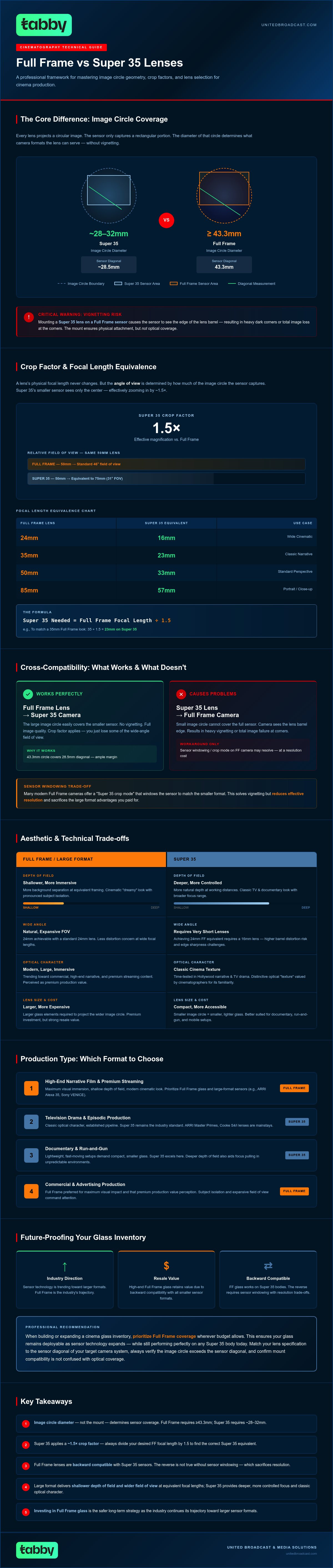
The fundamental distinction when comparing full frame vs super 35 lenses lies not in the glass elements themselves, but in the diameter of the light they project. Every lens produces a circular image, yet only a rectangular portion of that circle is captured by the camera sensor. An image circle is the circular area of light projected by a lens onto the sensor plane, typically measuring at least 43.3mm for Full Frame and approximately 28mm to 32mm for Super 35. If the image circle is too small for the sensor, you'll encounter the dark corners known as vignetting.
Professional cinematography has seen a massive shift toward "Large Format" systems. This evolution, often referred to as Full Frame in Cinematography, allows for a more immersive field of view and distinct depth of field characteristics. Understanding this coverage is the most critical factor when selecting your toolkit. If you're using professional video cameras with larger sensors, your lens choice must be precise to avoid optical failure at the edges of the frame.
The Physics of Coverage
Sensor formats are defined by their diagonal measurement. A standard Super 35 sensor usually has a diagonal of about 28.5mm, while a Full Frame sensor requires a 43.3mm circle to cover its 36x24mm area. When you mount a Super 35 lens on a Full Frame camera, the sensor sees the edge of the lens barrel. This results in heavy vignetting or a total loss of image at the corners. Lens mounts like PL, EF, and E-mount play a role here too. While the mount ensures the lens physically attaches, it doesn't guarantee the image circle will cover the sensor. You must always verify that the optics are designed for the specific sensor diagonal of your camera body.
Future-Proofing Your Glass Inventory
Investing in Full Frame lenses is a strategic move for any production house. While Super 35 remains a staple for many television and documentary projects, the industry's trajectory is clearly toward larger sensors. High-end Full Frame glass retains its resale value because it's backward compatible. You can use a Full Frame lens on a Super 35 sensor without issue, but the reverse isn't true without significant sensor cropping. This versatility makes Full Frame optics a safer long-term investment. Whether you're browsing Sony Alpha cameras and lenses or high-end cinema primes, prioritizing coverage ensures your inventory remains relevant as sensor technology continues to expand.
Field of View and Crop Factor: Calculating Focal Length Equivalence
The physical focal length of a lens is an immutable property of its optics. It does not change based on the camera it's mounted to. A 50mm lens remains a 50mm lens regardless of the sensor size. However, the angle of view changes significantly. When evaluating full frame vs super 35 lenses, the confusion usually stems from the crop factor. Because a Super 35 sensor is smaller than a Full Frame sensor, it only captures the center portion of the image circle. This results in a narrower field of view, making the image appear zoomed in by approximately 1.5 times.
Practical application illustrates this clearly. If you mount a 50mm lens on a Full Frame camera, you receive a standard perspective. Mount that same lens on a Super 35 camera, and your framing effectively matches that of a 75mm lens on Full Frame. This shift makes wide-angle cinematography notably more complex on Super 35. To achieve the expansive 24mm field of view common in large format filmmaking, a cinematographer must utilize a 16mm lens. These shorter focal lengths often present greater challenges in controlling barrel distortion and maintaining edge-to-edge sharpness.
The Equivalence Math for DPs
Calculating the equivalent focal length is essential for maintaining visual continuity across a multi-camera production. To match the framing of a 35mm lens on a full-frame sensor, you must use a 23mm lens on a Super 35 body. This precision ensures that your close-ups and wide shots feel cohesive when intercut. Professional DPs frequently rely on digital viewfinders and field-of-view calculators like pCAM or Artemis to ensure consistency during pre-visualization and on-set adjustments.
Studio and Broadcast Implications
In constrained indoor environments, the smaller sensor format offers distinct functional advantages. Many broadcast environments utilize professional video cameras with smaller sensors because they allow for deeper focus and more compact, high-ratio zoom lenses. This is vital in news and sports where keeping multiple subjects in focus is more critical than achieving a shallow depth of field. Managing these technical nuances requires a deep understanding of optical physics and sensor geometry. If you need assistance selecting the right camera and lens combination for your facility, our team can provide a technical consultation to ensure your gear meets your specific production requirements.
Cross-Compatibility: Can You Use Super 35 Lenses on Full Frame Sensors?
Integrating Super 35 optics into a full-frame workflow is a common requirement on modern sets. While the image circle of a Super 35 lens won't cover a full-frame sensor, most high-end digital cinema cameras offer internal solutions to bridge this gap. This flexibility allows DPs to utilize vintage glass or specialized Super 35 primes on large-format bodies without the risk of heavy vignetting. Understanding the technical trade-offs of full frame vs super 35 lenses in these scenarios is vital for maintaining image quality.
Using a Super 35 lens on a larger sensor requires a sacrifice in resolution. When you crop into the sensor, you're effectively using a smaller canvas. For example, shooting with an 8.6K full-frame sensor in a Super 35 crop mode typically yields a 5.8K or 4K image, depending on the camera's specific architecture. While this is often sufficient for a 4K delivery, it limits your ability to reframe in post-production compared to a full-sensor readout.
Sensor Modes and Windowing
Professional systems from manufacturers like ARRI and Sony include dedicated sensor modes to accommodate various lens formats. Windowing is the technical process of utilizing only a specific center portion of a camera's sensor to match the smaller image circle projected by a lens designed for a different format. Engaging these modes changes how the camera processes data. Because the camera reads fewer pixels, you might see a shift in data rates or even an increase in maximum frame rate capabilities. This can be a strategic advantage when high-speed recording is more important than total sensor coverage.
The 'Sweet Spot' Effect
Mounting full-frame glass on a Super 35 camera provides a distinct optical advantage often called the "sweet spot" effect. Lenses are almost always sharpest at the center of their image circle, with performance naturally degrading toward the edges where chromatic aberration and soft corners are more prevalent. By using Sony Alpha lenses or other large-format glass on a smaller sensor, you're only utilizing the highest-quality center portion of the optics. This results in superior edge-to-edge sharpness and minimal distortion. It's a reliable way to ensure maximum performance from your glass, even when you aren't using a large-format camera body.
Speed Boosters and Focal Reducers
Speed boosters are a common sight in the prosumer market, but they're treated with more caution on high-stakes professional sets. These adapters use optical elements to concentrate a full-frame image circle onto a smaller sensor, effectively increasing the lens's speed by about one T-stop and widening the field of view. While they can be useful, adding extra glass between the lens and the sensor plane can introduce unwanted flares or reduce overall contrast. Most professionals prefer to use native glass or sensor windowing to maintain the purest possible signal path and avoid optical artifacts.
Aesthetic and Technical Trade-offs: Depth of Field vs. Optical Character
The visual signature of a project is heavily influenced by the choice between full frame vs super 35 lenses. While large format sensors are the current trend, the decision involves more than just sensor size. It's about the aesthetic rendering of space and the physical behavior of light. Full-frame systems provide a shallower depth of field at equivalent focal lengths and apertures, which many DPs describe as an immersive or three-dimensional look. Conversely, Super 35 maintains a specific optical texture that has defined cinema for over a century. The choice between them dictates how you guide the audience's eye through the frame.
Anamorphic cinematography also varies significantly across these formats. Traditional Super 35 anamorphic lenses typically utilize a 2x squeeze factor to fill the 4:3 sensor area. In contrast, many modern full-frame anamorphic lenses utilize 1.5x or 1.8x squeeze factors to better fit the wider 3:2 or 16:9 sensor dimensions. These differences affect everything from the shape of the bokeh to the intensity of the lens flares. Additionally, while T-stops represent a lens's light transmission, the larger surface area of a full-frame sensor often translates to better signal-to-noise ratios in low-light environments. This allows for cleaner images even when shooting at higher ISOs or in challenging lighting conditions.
The 'Classic Cinema' Aesthetic
For many directors of photography, the Super 35 format remains the gold standard for narrative storytelling. It offers a familiar perspective that doesn't distract the viewer with excessively shallow focus. From a technical standpoint, managing depth of field on a full-frame set can be a nightmare for focus pullers. When the plane of focus is only a few centimeters deep, even the most experienced operators face challenges. Preserving the unique character of these legacy or specialized optics is essential. Regular maintenance through cinema lens repair Dubai services ensures that the specific texture and flare characteristics of your glass remain consistent over time.
Large Format Immersion
Modern digital cinema has embraced the large format look to create a sense of scale previously reserved for 65mm film. This medium format aesthetic changes how subjects relate to their backgrounds. It allows for wider shots that still maintain a degree of separation, pulling the audience into the frame. To truly capitalize on these textures, DPs often use ARRI lighting to sculpt the light and shadow across the larger sensor area. This combination of high-end glass and precision illumination creates a polished, high-production-value image that clients in 2026 increasingly expect.
Selecting the Right Glass: How Production Type Dictates Your Lens Choice
Finalizing your equipment list requires a pragmatic assessment of your project's logistical and commercial requirements. While the technical debate over full frame vs super 35 lenses often focuses on sensor physics, the reality on set is dictated by weight, cost, and client expectations. A documentary filmmaker trekking through remote locations has vastly different needs than a commercial DP shooting a high-budget automotive spot in a controlled studio environment. Choosing the wrong format for the specific production type can lead to unnecessary fatigue or technical limitations that compromise the final image.
In the documentary and run-and-gun sectors, Super 35 remains a dominant force. The smaller image circle allows for lenses that are significantly more compact and lighter than their full-frame counterparts. This weight advantage is critical for long days of handheld operation or when balancing a camera on a gimbal. Conversely, for high-end commercials in 2026, full-frame acquisition has become the baseline expectation. Agencies and brands often demand the specific aesthetic of large-format sensors to ensure their content feels contemporary and high-tier. Meeting these expectations is often a prerequisite for securing high-value contracts.
Production Workflow Logistics
Workflow efficiency often hinges on the physical footprint of your glass. Super 35 lenses offer a clear advantage for drone and specialized rig work where every gram impacts flight time and motor performance. Cost is another major factor. A comprehensive set of professional Super 35 primes is generally more affordable than an equivalent full-frame set, allowing for a wider variety of focal lengths within the same budget. For those designing permanent installations, our system integration services help facilitate the selection of professional video cameras and optics that match the specific spatial constraints of a studio build. This ensures that your facility is equipped with tools that maximize both creative potential and operational efficiency.
The Professional Verdict
Your choice should ultimately align with the visual language of the story. Super 35 is often the preferred choice for projects requiring a vintage or period-accurate aesthetic, as many of the most iconic cinema lenses in history were designed for this format. However, if your deliverable requirements include 8K or higher resolution masters, full-frame glass is often mandatory to fully utilize the sensor's pixel count without windowing. Use this checklist for your next acquisition:
- Physical Constraints: Does the lens weight allow for the intended camera movement, especially on gimbals?
- Client Requirements: Does the project demand a specific "large format" look or high-resolution delivery?
- Zoom Requirements: Do you need a high-ratio zoom lens that is only physically viable in Super 35?
- Future-Proofing: Will this glass remain compatible with the next generation of camera sensors in your inventory?
Balancing these factors ensures that your investment provides both immediate utility and long-term value. Whether you're building a new broadcast facility or upgrading a single camera package, choosing the right glass is the most significant decision you'll make for your image quality. If you're unsure which path fits your workflow, our technical team is available to help you evaluate the best options for your specific production needs.
Future-Proofing Your Lens Investment
Mastering the technical nuances of sensor coverage and image circles is essential for any modern production workflow. Whether you prioritize the immersive depth of field found in large format or the classic optical texture and logistical efficiency of Super 35, your choice of glass remains the most significant factor in your visual storytelling. Understanding the specific differences between full frame vs super 35 lenses ensures you can maintain visual consistency across diverse camera systems and high-resolution delivery requirements.
United Broadcast & Media Solutions has served the UAE media industry since 1997 as a trusted advisor for professional filmmakers. As an authorized dealer for global leaders including ARRI, Sony, and ZEISS, we provide more than just equipment. Our expert in-house technical center offers specialized support and calibration to ensure your optics meet the highest industry standards. We're here to help you navigate the complexities of lens acquisition with confidence and precision.
We look forward to partnering with you to select the ideal optics for your next professional production.
Frequently Asked Questions
Can I use a Super 35 lens on a Full Frame camera without cropping?
No, you cannot use a Super 35 lens on a full frame sensor without encountering heavy vignetting or a total loss of image in the corners. The image circle projected by a Super 35 lens is typically between 28mm and 32mm, which is insufficient to cover the 43.3mm diagonal of a full frame sensor. To use these lenses, you must engage the camera's windowing or crop mode to utilize only the center portion of the sensor.
Is Full Frame always better than Super 35 for professional video?
Full frame is not objectively superior; the choice depends entirely on your production's creative and logistical needs. Super 35 remains a professional standard for narrative television and documentaries due to its manageable depth of field and more compact lens options. While full frame offers better low light performance and a distinct immersive look, Super 35 provides a classic cinematic texture and significant weight advantages for handheld or gimbal operation.
How do I calculate the crop factor for my cinema camera?
To calculate the crop factor, divide the diagonal measurement of a standard full frame sensor (43.3mm) by the diagonal of your camera's sensor. For most Super 35 systems, this results in a multiplier of approximately 1.5x. Multiplying your lens's focal length by this factor helps you determine the equivalent field of view. For example, a 50mm lens on a Super 35 sensor provides the same framing as a 75mm lens on a full frame body.
Do I lose resolution when using a Super 35 lens on a Full Frame sensor?
Yes, you lose a significant amount of resolution when windowing a sensor to accommodate full frame vs super 35 lenses. Because the camera only records from the center portion of the sensor to match the smaller image circle, you are physically using fewer pixels. An 8K full frame sensor might only yield a 5.8K or 4K image in Super 35 crop mode. Always check your camera's manual to verify the final resolution in windowed modes.
What is the difference between a lens mount and a sensor format?
A lens mount is the mechanical interface, such as PL, LPL, or E-mount, that physically connects the lens to the camera body. A sensor format refers to the physical dimensions of the sensor itself, like Full Frame or Super 35. It's a common mistake to assume that a lens will cover a sensor just because it shares the same mount. You must always confirm that the lens's projected image circle is large enough for your sensor's format.
Why are Full Frame cinema lenses more expensive than Super 35 lenses?
Full frame cinema lenses require larger glass elements and more sophisticated optical designs to maintain sharpness across a wider 43.3mm image circle. Correcting for edge distortion and chromatic aberration over a larger area increases manufacturing complexity and material costs. These lenses are also engineered to resolve the higher pixel densities of 8K and 12K sensors, requiring tighter mechanical tolerances during the assembly and calibration process at the factory.
Can I use E-mount photo lenses for professional cinema production?
You can use E-mount photo lenses, but they lack the specialized features required for high-end cinema workflows. Photo lenses often suffer from focus breathing, where the field of view changes when adjusting focus, and they rarely have geared rings for follow focus systems. Dedicated cinema lenses provide consistent T-stops, standardized front diameters for matte boxes, and manual iris control, which are essential for maintaining a professional and efficient workflow on set.
What happens to the depth of field when switching from S35 to Full Frame?
The depth of field becomes shallower when you switch to a larger sensor while maintaining the same field of view and aperture. To match the framing of a 35mm lens on Super 35, you must use a 50mm lens on a full frame camera. This longer focal length naturally results in a thinner plane of focus. This is a primary aesthetic consideration in the full frame vs super 35 lenses transition for DPs wanting more subject separation.


