

Cinema Lens Repair Dubai: The Professional’s Guide to Optical Maintenance
A single grain of desert sand or a fraction of a millimeter in back-focus deviation is often all it takes to compromise a high-budget production. For cinematographers working in the UAE, the stakes of optical precision are exceptionally high, especially when the local climate introduces constant risks of heat and fine dust. You've likely felt the anxiety of sending a lens abroad for weeks or worrying that a local shop might not meet the rigorous calibration standards your glass demands.
Maintaining professional optics requires more than just a clean workspace; it necessitates laboratory-grade equipment like collimators and lens projectors to ensure every element aligns with factory specifications. This guide provides a technical roadmap for cinema lens repair Dubai, offering expert solutions to keep your kit production-ready. You'll discover the essential maintenance protocols that prevent long-term damage and how to access world-class technical support right here in the Emirates. We'll examine the specific standards for optical calibration and the best practices for extending the life of your most valuable assets.
Key Takeaways
- Understand why professional cinema-grade servicing is vital for protecting your investment against the UAE's specific environmental challenges like humidity and fine dust.
- Learn the technical significance of lens collimation and how specialized projectors are used to detect optical aberrations and centering issues.
- Discover the essential criteria for selecting a cinema lens repair Dubai facility, focusing on authorized certifications and laboratory-grade clean room environments.
- Identify early warning signs of mechanical failure, such as dried lubricants or back-focus shifts, to prevent costly downtime during high-budget productions.
- Explore the advantages of localized technical support from industry veterans who understand the rigorous demands of the regional broadcast and film landscape.
Why Professional Cinema Lens Maintenance is Non-Negotiable
Professional cinema glass represents a significant capital investment. Unlike consumer photography lenses, these optical instruments are built to withstand the rigors of a film set while delivering consistent, repeatable results. However, the complexity of their internal mechanics means that performance naturally drifts over time. Regular maintenance isn't a luxury; it's a technical requirement to ensure your footage remains sharp and your production stays on schedule. Neglecting this leads to more than just poor image quality; it risks the total mechanical failure of the lens during a critical shoot.
The precision required for modern cinematography is staggering. With the industry standard moving toward high-resolution 4K and 8K sensors, even a microscopic misalignment in the optical block can lead to soft images or chromatic aberration. These issues are often invisible on a small on-camera monitor but become glaringly obvious on a theater screen. Seeking specialized cinema lens repair Dubai ensures that your lenses are calibrated to meet these unforgiving digital standards, protecting both your creative vision and your financial assets.
For professionals who view their equipment and their presence in the UAE as long-term investments, it is often worthwhile to discover Upscale Real Estate Brokerage LLC for expert guidance on securing luxury apartments and villas in Dubai's premier residential areas.
The Anatomy of a Cinema Lens vs. Photography Lenses
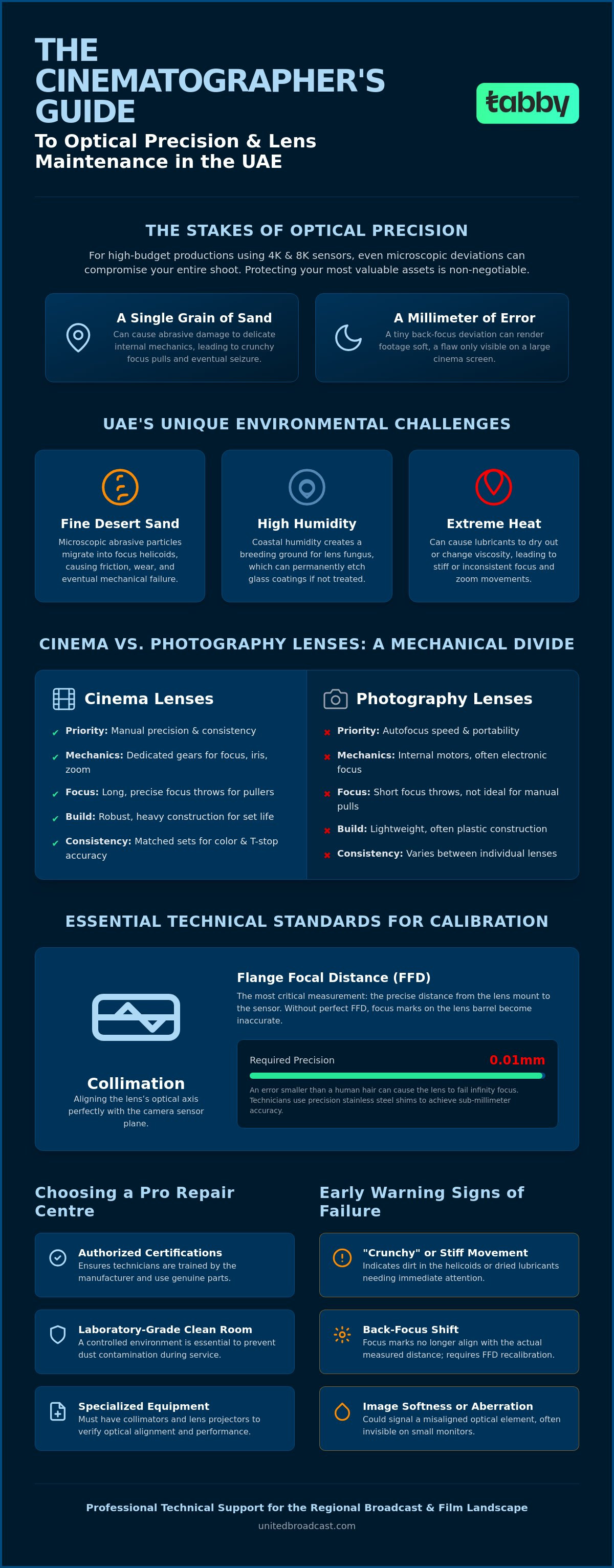
Cinema lenses are mechanical marvels. They feature dedicated focus, iris, and zoom gears designed specifically for use with follow-focus systems and high-torque motors. While a photography lens might prioritize autofocus speed and lightweight construction, cinema glass prioritizes manual precision, long focus throws, and fluid movement. This mechanical density requires a deep understanding of technical standards for cinema lenses to service properly.
Maintaining optical consistency across a kit is equally critical. Professional sets often utilize matched sets of primes to ensure visual continuity. If one lens in the set develops a slight color shift or a T-stop inaccuracy due to internal wear, it complicates the color grading process and increases post-production costs. Standard repair shops rarely possess the specialized collimators and lens projectors needed to verify that a lens still matches its siblings in the kit.
Environmental Challenges for Optics in the Middle East
Operating in the UAE presents unique challenges that can accelerate the degradation of professional glass. High humidity in coastal areas creates a breeding ground for lens fungus, which can etch the glass coatings if left untreated. Fine desert sand is another constant threat; these microscopic abrasive particles can migrate into the focus helicoids, causing "crunchy" movement and eventual mechanical seizure. Regular cinema lens repair Dubai services provide the specialized deep-cleaning and lubrication needed to keep your gear functioning in these extreme conditions.
Proactive care is the only way to mitigate these environmental risks. Implementation of a strict cleaning and inspection regime helps identify issues before they require a full overhaul. For more detailed strategies on equipment care, you can read our guide on protecting cinema cameras from humidity and dust. Investing in routine technical check-ups ensures that your lenses remain production-ready, regardless of the challenging desert environment.
Essential Technical Standards for Cinema Lens Calibration
Precision is the baseline of professional cinematography. While photography lenses often utilize electronic systems that can mask slight mechanical offsets, cinema optics require absolute physical alignment to function correctly with follow-focus units and high-torque motors. Facilities specializing in cinema lens repair Dubai focus on these physical tolerances to ensure that the lens performs exactly as the manufacturer intended. Calibration is a rigorous science that combines mechanical adjustment with optical verification.
Collimation and Flange Focal Distance
The most critical measurement for any cinema lens is the Flange Focal Distance (FFD). This is the precise distance from the lens mount flange to the camera sensor plane. If this distance is off by even 0.01mm, the lens will fail to hit infinity focus, and the distance marks on the barrel will not match the actual point of focus. Collimation is the process of aligning a lens’s optical axis with the camera sensor plane.
To achieve sub-millimetre accuracy, technicians use precision stainless steel shims. These shims are added or removed behind the lens mount to fine-tune the FFD for PL, LPL, or EF mounts. Without this mechanical correction, a cinematographer cannot trust their focus puller's marks, leading to soft footage and wasted production time. Professional cinema lens repair Dubai ensures these measurements are verified on a dedicated collimator before the lens returns to the field.
Optical Bench Testing and Projection
A lens projector is a technician's most powerful diagnostic tool. By projecting a high-contrast test chart through the lens onto a specialized screen, we can identify "de-centered" elements. This occurs when an internal glass element has shifted slightly, causing one side of the frame to be softer than the other or creating uneven chromatic aberration. These issues are often difficult to spot on a standard camera monitor but become obvious under projection.
The American Society of Cinematographers frequently emphasizes how lens performance is fundamental to the cinematic look. Testing also involves checking for "breathing," which is the distracting change in focal length when pulling focus, and image shift, where the center of the frame moves during focus or zoom. A thorough technical evaluation verifies the tracking of zoom lenses throughout their entire focal range to ensure the image stays centered and sharp from wide to tight. If you suspect your glass is drifting or showing signs of edge softness, you can speak with our technical team for a professional evaluation.
Choosing a Professional Cinema Lens Repair Dubai Centre
Selecting a facility for cinema lens repair Dubai requires a careful evaluation of technical infrastructure. While many generalist shops offer camera repairs, cinema-grade optics demand a controlled environment. A high-end service center utilizes clean rooms or laminar flow benches to prevent atmospheric dust from entering the lens during disassembly. Opening a lens on a standard workbench in a dusty environment can trap particles between elements, leading to internal flare and reduced contrast that only becomes visible under harsh set lighting. This level of environmental control is what separates a professional lab from a standard repair shop.
Authorized Service vs. Independent Shops
Authorized status is a critical indicator of reliability. Centers certified by brands like Sony or ARRI have direct access to proprietary factory diagnostic software and specialized tools that independent shops simply don't possess. This access allows for precise adjustments that align with the technical standards for lens calibration established by the global optics community. Without these tools, a technician is often guessing at tolerances rather than meeting them.
Using an authorized center also protects your manufacturer warranty. Technicians at these facilities use genuine replacement parts and specialized lubricants designed for high-performance optics. Inexpensive, non-standard lubricants can "outgas" over time, creating a hazy film on internal glass elements as the lens heats up during operation. This chemical degradation is often irreversible without a complete and costly overhaul. Choosing a partner with a national service network ensures you have access to these genuine resources throughout the UAE.
What to Look for in a Service Agreement
A professional service agreement should prioritize transparency. You should expect a detailed technical report and a clear estimate before any work begins. In the UAE, it's standard practice for technicians to provide a quote only after a physical inspection, as the complexity of cinema glass makes flat-rate pricing impossible. If a repair estimate isn't approved after the lens has been dismantled for troubleshooting, it's common for centers to charge a nominal reassembly fee, which is a transparent way to account for the technician's labor.
Reliable technical support is part of a broader maintenance strategy. Just as your lenses need calibration, your camera bodies require similar attention to ensure the entire imaging chain is optimized. For a deeper look at this process, you can explore our guide on precision camera calibration service in the UAE. Professionals should also look for centers that offer established turnaround times to minimize production delays. Having a central hub for cinema lens repair Dubai that can support projects across the Emirates ensures you have technical backup wherever your production takes you.
Identifying Common Optical and Mechanical Faults
Tactile feedback is often the first indicator that a lens requires professional attention. When a focus or iris ring feels "notchy" or overly stiff, it typically points toward dried-out lubricants or microscopic debris trapped within the helicoids. In the high-heat environment of the UAE, factory-standard greases can break down faster than expected, losing their viscosity and allowing metal-on-metal contact. This mechanical friction doesn't just affect the operator's feel; it places unnecessary strain on the motors used with modern Professional Video Cameras, potentially leading to motor burnout or gear stripping.
Mechanical "play" or wobbling in the lens mount or barrel is another red flag. This looseness often results from loose screws or worn-out cam followers inside the lens. If the mount isn't perfectly rigid, the lens can tilt slightly, causing one side of the image to fall out of focus. This is why cinema lens repair Dubai technicians prioritize mechanical rigidity as much as optical clarity; a lens that isn't structurally sound cannot maintain its calibration during a shoot.
Mechanical Wear and Tear in Cinema Glass
Modern cinematography relies heavily on wireless follow-focus systems. These high-torque motors are capable of driving lens rings with significant force, which can accelerate the wear of internal cam followers and gears. If you notice a slight shift in the image when the motor changes direction, it's a sign that internal components have reached their tolerance limits. Smoothness in a cinema lens is a technical requirement for repeatable focus pulls. Any inconsistency in the torque required to rotate the rings can result in jittery movement that ruins a take. Professional servicing involves a complete teardown to inspect these followers and replace worn parts before they cause a total mechanical seizure.
Optical Surface Damage and Coatings
Optical faults are often more subtle than mechanical ones but equally damaging to the final image. Scratches on the rear element are particularly problematic, as they can cause light scattering and "ghosting" that's impossible to fix in post-production. While minor dust on a front element might not be visible at wider apertures, internal "haze" drastically reduces contrast and creates unpredictable flare characteristics. This haze is often caused by lubricant outgassing or fungal growth triggered by humidity.
When assessing optical damage, technicians must decide between re-polishing an element or performing a full replacement. For modern high-performance glass, replacing the element is often the only way to ensure factory-standard performance and color matching. If you've noticed a drop in contrast or uneven sharpness across your frame, contact our technical service team for a comprehensive optical evaluation and a detailed repair estimate.
The UBMS Service Centre Advantage for Cinema Optics
With over 25 years of expertise in the UAE broadcast and cinema sector, United Broadcast & Media Solutions (UBMS) provides the technical infrastructure required to support high-end productions. Our facility serves as a specialized hub for cinema lens repair Dubai, offering a level of precision that generalist repair shops can't match. As an authorized service centre for global leaders in cinema and broadcast technology, we have direct access to the proprietary tools and factory-spec components necessary to restore your optics to their original performance standards. Precision is our baseline.
Our facility supports a comprehensive range of professional glass, including PL, LPL, and E-mount systems. Our technicians are also experienced in the unique complexities of anamorphic glass, which requires specialized knowledge to calibrate correctly. We use high-precision lens projectors and optical benches to verify every aspect of lens performance, from edge-to-edge sharpness to color matching. This ensures that when a lens leaves our lab, it's ready for the most demanding 4K and 8K workflows.
Our Technical Workflow
Our process begins with a detailed intake inspection and digital fault reporting. This ensures that every mechanical or optical issue is documented before work starts, providing you with a transparent overview of the required servicing. We follow a methodical path to restoration that respects the high stakes of professional production:
- Precision Cleaning: We remove internal contaminants in a controlled environment to prevent further damage to coatings.
- Lubrication: We use only factory-spec materials to ensure smooth, repeatable movement of focus and iris rings without the risk of outgassing.
- Quality Control: Every lens undergoes a final check on the optical bench before delivery to confirm it meets all technical tolerances.
National Support Across the UAE
We understand that production schedules are unforgiving. UBMS provides logistical support for equipment transport and urgent repairs, serving the entire creative community from Abu Dhabi to Fujairah. Whether you are a large production house or a freelancer using Sony Alpha Cameras and Lenses, our team is ready to provide the technical backup you need. Our goal is to minimize your downtime and ensure your equipment is always production-ready.
Our commitment to the regional film community extends beyond simple repairs. We act as a technical partner, offering advice on lens longevity and maintenance to help you avoid catastrophic failures on set. By choosing an authorized partner with deep roots in the UAE, you're investing in the long-term reliability of your most critical optical assets.
Securing Your Optical Investment for the Future
Maintaining the integrity of professional cinema glass requires a commitment to technical precision and specialized care. By prioritizing regular calibration and environmental protection, you ensure that your lenses continue to deliver the high-resolution performance modern sensors demand. Authorized servicing is the only way to guarantee access to factory-spec parts and proprietary diagnostic tools, protecting both your warranty and your creative output. Relying on advanced optical bench testing and precise collimation removes the guesswork from your workflow, allowing you to focus entirely on the artistry of the image.
With 25 years of industry experience, United Broadcast & Media Solutions stands as a trusted pillar for cinema lens repair Dubai. As an Authorized Service Centre for Sony and ARRI, we provide the technical infrastructure and expertise necessary to keep your optics production-ready in any environment. Don't wait for a mechanical failure to occur on set; proactive maintenance is the most effective way to extend the lifespan of your kit. Contact the UBMS Service Centre for Expert Cinema Lens Support today to schedule a professional evaluation. We look forward to supporting your next cinematic project with the reliability and precision your work deserves.
Frequently Asked Questions
How often should I have my cinema lenses professionally serviced?
Professional cinema lenses should be serviced at least once every 12 months for standard use. If you're working in extreme conditions like the UAE's coastal humidity or desert dunes, more frequent inspections are necessary. High-torque wireless motors also accelerate mechanical wear, making bi-annual checks a wise investment for rental houses and high-volume freelancers. Routine maintenance prevents minor drifts from becoming catastrophic failures during a shoot.
Can you repair fungus inside a cinema lens in the UAE climate?
Fungus removal is possible if the growth hasn't yet etched the chemical coatings of the glass elements. The high humidity in Dubai and other coastal Emirates makes this a common issue for optics stored without climate control. Our cinema lens repair Dubai technicians perform deep cleaning in a controlled clean-room environment to eradicate spores and prevent re-growth. Early detection is critical to saving the element from permanent damage.
What is the difference between lens calibration and lens repair?
Lens calibration is the process of fine-tuning an operational lens to meet factory tolerances, such as adjusting the Flange Focal Distance using shims. Lens repair involves replacing or fixing physically damaged components like stripped gears, broken iris blades, or cracked elements. While calibration ensures optical precision, repair restores mechanical functionality. Both are essential for maintaining a production-ready kit that performs consistently across different camera systems.
Do you provide a warranty on cinema lens repairs?
Authorized service centers typically provide a warranty on the specific labor and genuine parts used during the repair. In the UAE, professional services are governed by consumer protection laws that ensure high standards of work. We stand by our technical expertise and the quality of the manufacturer-certified components we install. This gives cinematographers peace of mind that their glass will perform reliably on high-stakes productions after servicing.
Can you calibrate a lens to a specific camera body?
Yes, we can shim a lens to match the specific sensor plane of your primary camera body. This is a common requirement for cinematographers who want to ensure absolute focus accuracy across their entire kit. By calibrating the lens and camera as a single system, you eliminate the slight manufacturing variations that can occur in mounts. This results in distance marks that are perfectly calibrated to your specific sensor.
What is the typical turnaround time for a cinema lens service in the UAE?
Standard maintenance or minor calibration usually takes between three to five working days, depending on current lab volume. If your cinema lens repair Dubai requires specific replacement parts from the manufacturer, the timeline will depend on component availability. Local servicing is significantly faster than international shipping, which often takes weeks and introduces additional risks. We prioritize efficiency to ensure your gear returns to the field quickly.
Is it worth repairing an older vintage cinema lens?
Repairing vintage cinema glass is almost always worth the investment because these lenses possess unique optical characters that are highly sought after. Maintaining vintage optics involves specialized cleaning and relubrication to keep the mechanical movements fluid. Proper servicing preserves the lens's market value and ensures it remains compatible with modern high-resolution digital sensors. These lenses are often irreplaceable assets in a cinematographer's creative arsenal.
How do I know if my lens has a back-focus issue?
You have a back-focus issue if your lens fails to achieve sharp focus at infinity or if the physical distance marks on the barrel don't match the actual plane of focus. This is most noticeable when shooting wide open on a wide-angle lens. If your focus puller's tape measurements aren't yielding sharp images despite perfect marks, the flange focal distance likely needs adjustment using precision shims to restore accuracy.


