

Broadcast Facility Design: Building Modern Media Hubs in 2026
Is your current production environment built to survive the transition to a fully IP-integrated landscape, or is it merely managing the legacy of the past? For many professionals, the shift toward modern broadcast facility design feels like a high-stakes puzzle where the pieces of SDI and IP do not always fit. You likely recognize that staying competitive in 2026 requires more than just a simple camera upgrade; it demands a fundamental rethink of how hardware and software work together. The complexity of ensuring cross-brand compatibility while preparing for AI-integrated workflows can be overwhelming for even the most seasoned technical directors.
We understand that your goal is to build a scalable, high-performance hub that eliminates technical friction and maximizes uptime. This article provides a clear roadmap to designing a future-proof facility that integrates cutting-edge IP workflows with professional-grade hardware for seamless media production. You will discover how to select the right equipment for long-term reliability and create a layout that grows alongside your production needs. From mastering SMPTE ST 2110 standards to optimizing your signal chain, we will cover the essential strategies to ensure your facility investment delivers professional results for years to come.
Key Takeaways
- Learn how the transition from traditional SDI to IP-based environments using SMPTE ST 2110 standards provides the scalability required for 2026 media production.
- Understand the critical role of strategic broadcast facility design in optimizing functional zones like the PCR and MCR for maximum operational efficiency.
- Discover a methodical process for workflow mapping that ensures your media signal travels seamlessly from the lens to the final transmitter.
- Identify the essential requirements for acoustic treatment and sound isolation to maintain professional-grade audio quality within your studio environment.
- Explore how expert system integration bridges the gap between high-end hardware selection and a fully commissioned, future-proof media hub.
The Evolution of Broadcast Facility Design in 2026
Broadcast facility design is the specialized architectural and technical planning required to create high-performance media production spaces. In 2026, this discipline has evolved beyond traditional signal routing; it now focuses on creating a unified ecosystem where hardware and software converge. The most significant shift is the transition from legacy Serial Digital Interface (SDI) infrastructures to Internet Protocol (IP) environments. This change allows for unprecedented flexibility, but it requires a deeper understanding of network topology and data management than ever before. Facilities are no longer static rooms with fixed hardware; they're dynamic, software-defined environments that adapt to changing production needs.
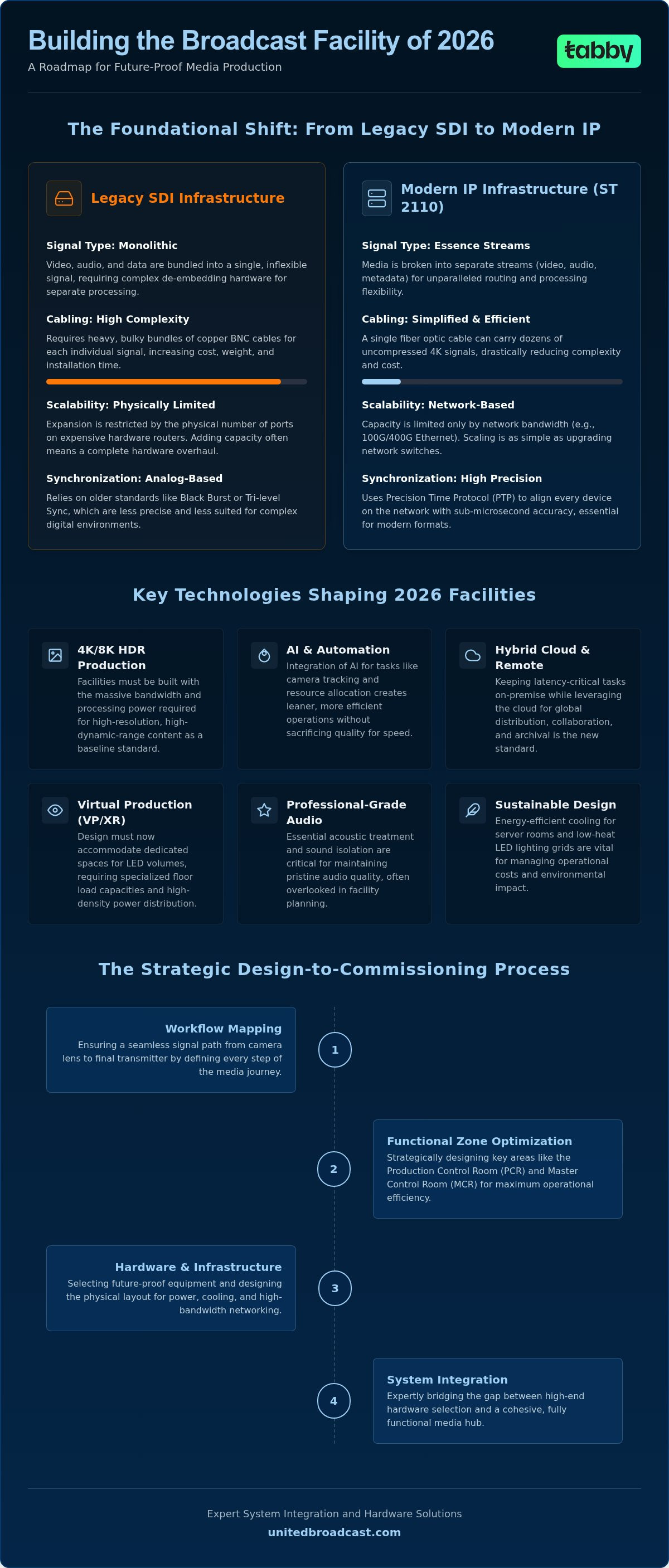
Modern facilities must support 4K, 8K, and High Dynamic Range (HDR) standards as a baseline. These formats demand massive bandwidth and sophisticated processing power, which directly impacts how you plan your server rooms and control centers. Additionally, AI and automation now play a central role in streamlining workflows. From automated camera tracking to AI-driven resource allocation, these technologies reduce the manual burden on production teams. This shift allows for leaner, more efficient operations that don't sacrifice quality for speed.
Key Trends Shaping Modern Facilities
The rise of remote production has popularized hybrid cloud and on-premise infrastructure. This model keeps latency-critical tasks on-site while leveraging the cloud for global distribution and archival. Sustainable design is also a priority for 2026. In the UAE, energy-efficient cooling for server rooms and low-heat LED lighting grids are essential to manage operational costs. We are also seeing a rapid integration of Virtual Production (VP) and Extended Reality (XR). Designing a television production studio now often involves dedicated space for LED volumes, which requires specific floor load capacities and specialized power distribution to handle the high-density hardware.
Why Professional Hardware Dictates Design
The choice of hardware is the foundation of any broadcast facility design project. For instance, the specific sensor requirements of high-end professional video cameras influence the entire studio lighting grid. High-dynamic-range sensors require precise color rendering and flicker-free illumination to perform at their peak. If the hardware isn't considered at the architectural stage, the production quality will suffer regardless of the room's aesthetic.
Bandwidth is another critical factor that dictates physical layout. Moving uncompressed video across a facility requires high-bandwidth networking solutions, often utilizing 100G or even 400G ethernet backbones. Without the right hardware at the start of the production chain, even the most beautifully designed room will fail to meet modern delivery standards. Successful design ensures that every piece of equipment, from the lens to the switch, operates within a frictionless technical environment.
Core Infrastructure: Transitioning to IP and ST 2110
Transitioning to an IP-based core is the most critical decision in modern broadcast facility design. The SMPTE ST 2110 suite of standards has replaced traditional "all-in-one" SDI signals with a more granular approach. By breaking down media into separate essence streams for video, audio, and metadata, ST 2110 allows for far greater flexibility in how data is routed and processed. This means a production team can send a single audio feed to a radio suite while the video goes to a social media stream, all without the need for complex de-embedding hardware.
The benefits of IP extend beyond simple routing. Scalability is vastly improved because you're no longer limited by the physical port count of a traditional hardware router. Instead, you're limited only by the bandwidth of your network fabric. This shift significantly reduces cabling complexity. A single fiber optic cable can carry dozens of uncompressed 4K signals, replacing heavy bundles of copper BNC cables. However, this transition requires a robust network synchronization strategy. In the IP world, Precision Time Protocol (PTP) serves as the "heartbeat," ensuring every device on the network is perfectly aligned with sub-microsecond accuracy.
Most facilities in the UAE currently operate in a hybrid state. Balancing legacy SDI equipment with a new IP backbone requires high-density gateways. These devices bridge the gap, allowing you to keep your trusted professional video cameras and monitors while benefiting from the speed of an IP-based infrastructure. It's a strategic way to future-proof your facility without a total "rip-and-replace" of existing assets.
The Backbone of Modern Broadcast Studio Gear
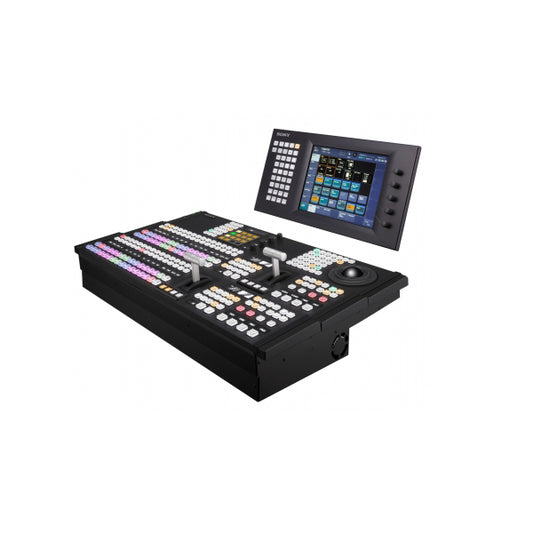
The heart of any IP-based facility is its switching and routing hardware. High-performance video switchers are now designed to handle uncompressed real-time processing of 4K and 8K signals across 100G or 400G network interfaces. Communication is equally vital; modern intercom systems have moved to IP, allowing for seamless production team coordination across multiple functional zones. For a detailed breakdown of the latest equipment standards, you can learn more about broadcast studio gear UAE.
Data Management and Storage Solutions
8K editing and playout demand storage solutions that can sustain massive throughput without dropping frames. High-speed storage arrays must be integrated directly into the facility design to ensure editors and playout servers have instant access to high-resolution assets. Redundancy is a non-negotiable part of this infrastructure. Implementing a robust Media Asset Management (MAM) system, combined with a clear disaster recovery plan, ensures that your content remains safe and searchable. If you're planning a new build or an upgrade, you can consult with our technical team to design a storage architecture that matches your specific production volume.
Optimizing Functional Zones: Studio, PCR, and MCR
Effective broadcast facility design relies on the strategic separation of functional zones to ensure operational fluidity. Production areas, such as the studio floor, must remain physically isolated from administrative traffic to prevent acoustic contamination and logistical bottlenecks. Sound isolation is paramount; professional studios require specialized wall construction and floating floors to achieve the low noise floor necessary for high-fidelity recording. Technical areas like the Master Control Room (MCR) serve as the central nervous system, where signals are monitored and distributed, while the Production Control Room (PCR) focuses on the creative execution of the live program.
In the PCR, ergonomics dictate the success of the production team. Directors and operators need unobstructed sightlines to multi-viewer displays and tactile access to switchers. Proper thermal management is equally vital, as high-performance consoles generate significant heat that must be silent-vented to maintain a comfortable working environment. By prioritizing the human element in these technical spaces, facilities can maintain higher levels of productivity during long production shifts.
Designing the Studio Floor
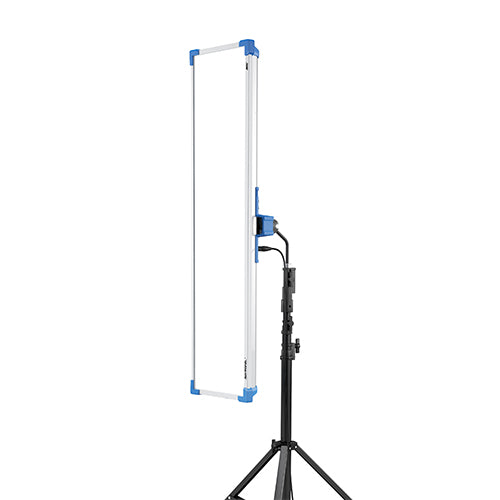
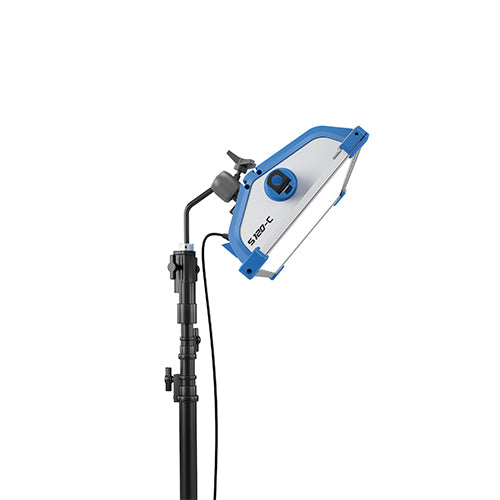
The layout of the studio floor must accommodate the physical footprint of pedestals, jibs, and crane systems. Clear "runways" for camera movement are essential to prevent cable snags and ensure smooth tracking shots. Overhead, the integration of professional lighting grids is a core requirement. High-end productions often rely on ARRI lighting solutions for their superior color accuracy and build quality. By utilizing a comprehensive lighting collection, designers can create versatile environments that support everything from traditional news sets to complex virtual production volumes.
The Control Room Ecosystem
A modern control room is a high-density environment where multi-viewer displays provide real-time monitoring of dozens of sources. Audio mixing consoles must support broadcast loudness standards while offering low-latency processing for live talent monitoring. Beyond the visual and auditory, the integration of intercom and tally systems is what truly binds the facility together. These systems ensure that the floor manager, camera operators, and the director remain in constant synchronization during high-pressure live broadcasts. Centralizing these technical operations within the MCR allows for streamlined maintenance and faster troubleshooting of the entire signal chain.
The Strategic Design Process: From Concept to Commissioning
Success in broadcast facility design begins with a rigorous needs assessment. You must define your production goals, whether it's 24/7 news playout or high-end episodic content, before a single cable is laid. This stage establishes the technical requirements and budget constraints that will govern the entire project. It's the foundation that ensures the final build actually serves the intended creative purpose. Without a clear definition of the production volume and delivery standards, even the most expensive hardware can become an operational bottleneck.
Once the goals are clear, the focus shifts to workflow mapping. This involves visualizing the complete path of a media signal from the camera lens to the final transmitter or Content Delivery Network (CDN). Every hop, conversion, and processing stage must be accounted for to minimize latency and maintain signal integrity. Strategic equipment selection follows this map, focusing on sourcing professional-grade gear that meets specific technical tolerances. This ensures that every piece of the chain, from the lens to the encoder, works in perfect harmony.
Technical Planning and Documentation
Detailed documentation is the blueprint for a reliable facility. This includes creating precise CAD drawings for equipment racks and comprehensive wiring schematics for every signal path. Power planning is equally critical; you need to calculate the total electrical load and design a robust Uninterruptible Power Supply (UPS) system to prevent outages during live broadcasts. These principles apply to fixed installations just as much as they do to mobile environments. For instance, you can discover the complexities of OB van system integration to see how these documentation standards adapt to compact, high-density spaces.
Sourcing and Integration
Partnering with a reliable system integrator is essential for successful hardware procurement and installation. An experienced partner manages the logistics of sourcing global brands and ensures all components work together as a unified system. This process typically involves Factory Acceptance Testing (FAT) at the integrator's premises followed by Site Acceptance Testing (SAT) once the equipment is installed in your facility. Commissioning is the final validation of system performance before live operations. After the technical validation, the final stage is staff training to ensure your engineers and operators are fully prepared for the new IP-based workflows.
UBMS: Expert System Integration and Hardware Solutions
United Broadcast & Media Solutions (UBMS) acts as a specialized bridge between the procurement of high-end hardware and the complex reality of broadcast facility design. Since 1997, we've established ourselves as more than a vendor; we're a dedicated technical partner for media entities across the UAE. We understand that a successful hub isn't just a collection of expensive boxes. It's a synchronized environment where every piece of equipment, from the switcher to the router, is optimized for peak performance. By providing access to world-class brands, we ensure that your facility is built on a foundation of global standards and reliability.
Our approach centers on creating customized solutions that address the specific needs of national broadcast environments. We don't believe in one-size-fits-all designs. Instead, we analyze your production volume, delivery standards, and long-term growth plans to build a scalable infrastructure. This focuses on a long-term technical partnership, moving beyond the initial sale to provide continuous support that evolves with your business. Whether you're building a new newsroom or upgrading an existing suite, our goal is to eliminate technical friction from your production chain.
Comprehensive System Integration Services
We provide turnkey solutions for TV studios, newsrooms, and post-production suites that prioritize operational efficiency. Our expertise in IP-based transitions is particularly relevant as the industry moves toward SMPTE ST 2110 and 4K/8K standards. A critical part of our integration process is the synergy between high-performance hardware and the facility's architecture. For instance, integrating professional video cameras and cinema lenses into a broadcast workflow requires precise signal management and specialized mounting solutions. We handle the technical heavy lifting, from initial wiring schematics to final site acceptance testing.
The UBMS Service Center Advantage
Maintaining a modern media hub requires more than just good design; it demands professional upkeep. Our dedicated service center provides specialized repairs and maintenance for professional equipment, ensuring maximum uptime for your critical broadcast infrastructure. In a live environment, equipment failure isn't an option. Our technicians are trained to handle the sophisticated electronics found in modern studio gear, providing a level of security that generic service providers can't match. This commitment to after-sales care is what allows our partners to focus on content creation while we manage the technical integrity of their facility.
Building the Future of UAE Media Production
The landscape of broadcast facility design is rapidly shifting toward a software-defined, IP-centric model that demands technical precision at every stage. You've seen how successful hubs in 2026 rely on the seamless integration of ST 2110 standards and ergonomic functional zoning to eliminate production friction. Whether you're upgrading an existing newsroom or designing a new 8K-ready studio, the quality of your hardware must be matched by a robust, scalable technical infrastructure.
UBMS has provided expert system integration since 1997, serving as an authorized distributor for the world's leading broadcast brands. Our dedicated technical service center ensures that your professional repairs are handled with the expertise required for mission-critical operations. We're here to bridge the gap between premium equipment procurement and complex system commissioning.
We look forward to helping you transform your media production goals into a reliable, future-proof reality that grows with your audience.
Frequently Asked Questions
What are the primary considerations for broadcast facility design in 2026?
The primary considerations for modern broadcast facility design include the transition to SMPTE ST 2110 standards, the integration of AI-driven automation, and the implementation of hybrid cloud workflows. Designers must prioritize high-bandwidth network fabrics over traditional cabling to handle uncompressed 4K and 8K signals. Additionally, energy-efficient cooling and sustainable lighting systems are essential for managing the high thermal loads of modern server environments while maintaining operational cost efficiency for national broadcasters.
How does SMPTE ST 2110 improve broadcast facility operations?
SMPTE ST 2110 improves operations by breaking down media signals into separate essence streams for video, audio, and metadata. This granular approach allows production teams to route and process specific parts of a signal without needing complex de-embedding hardware. It eliminates the physical port limitations of traditional SDI routers, providing a scalable network architecture that supports multiple simultaneous productions across a single high-speed fiber backbone while reducing overall cabling complexity.
Can legacy SDI equipment be used in a modern IP-based facility?
You can successfully use legacy SDI equipment in a modern IP-based facility by utilizing high-density gateways and converters. These devices bridge the gap between traditional BNC-connected hardware and the new IP network fabric, allowing you to keep your existing professional video cameras or monitors. This hybrid approach is a cost-effective way to transition toward a fully software-defined environment without requiring an immediate, total replacement of all your high-value hardware assets.
What is the typical timeline for a professional studio design and build?
A professional studio design and build typically spans from six months to over a year, depending on the project's scale and technical complexity. The process begins with a detailed needs assessment and workflow mapping, followed by several months of equipment procurement and specialized installation. Final stages include factory and site acceptance testing, along with comprehensive staff training, to ensure the facility is fully operational and "on-air" ready for high-stakes live media production.
Why is acoustic treatment critical in a broadcast studio environment?
Acoustic treatment is critical because it ensures a low noise floor and prevents sound leakage between different functional zones. Professional studios require specialized wall construction, floating floors, and bass traps to manage reflections and achieve the high-fidelity audio standards required for broadcast. Without proper isolation, ambient noise from server rooms or administrative areas can contaminate recordings, making it impossible to meet international loudness and clarity regulations during professional film or television production.
How does 4K/8K production impact facility infrastructure requirements?
4K and 8K production dramatically increase the demand for network bandwidth and high-speed storage solutions. A single uncompressed 8K stream requires massive throughput, often necessitating 100G or 400G ethernet backbones within the facility. Infrastructure must also include high-density storage arrays capable of sustained real-time playout and multi-layer editing, alongside robust thermal management and UPS systems to handle the heat and power requirements generated by high-performance processing hardware.
What role does system integration play in broadcast facility design?
System integration is the bridge between purchasing individual pieces of hardware and creating a unified, functional media hub. It involves the technical planning, installation, and commissioning of all components to ensure they operate as a single ecosystem. An expert integrator manages the complexities of cross-brand compatibility and signal integrity, which is essential for a successful broadcast facility design that minimizes technical friction and maximizes uptime during critical live operations.
How can I future-proof my broadcast facility for upcoming technology?
To future-proof your facility, you should prioritize a software-defined infrastructure that relies on COTS (Commercial Off-The-Shelf) networking hardware. This approach allows you to upgrade your capabilities through software updates rather than expensive hardware replacements. Focus on building a modular broadcast facility design with excess fiber capacity and scalable storage, ensuring your system can adapt to emerging AI-integrated workflows and even higher resolution standards like 12K or beyond without total reconstruction.


