

Professional Cinema Lenses in the UAE: The 2026 Cinematographer’s Checklist
With international film and TV productions in Dubai generating over AED 8.2 billion in direct spending recently, the stakes for technical precision have never been higher. You understand that your choice of glass defines the visual narrative, but in the UAE, optical excellence is only half the battle. When you invest in cinema lenses Dubai professionals rely on, you aren't just buying character and bokeh; you're investing in mechanical resilience against fine dust and extreme thermal shifts that can seize focus gears or degrade internal elements.
It's a common frustration to find that legacy glass fails to cover newer 8K large-format sensors or that a high-value lens set requires immediate servicing after a single desert shoot. This article provides a comprehensive technical roadmap for selecting and maintaining professional optics in 2026. We'll help you navigate the choice between prime and zoom configurations, verify sensor coverage for high-resolution workflows, and establish a reliable framework for protecting your investment in this unique production environment. We'll also examine the logistical realities of sourcing and servicing high-performance glass to ensure your equipment remains a dependable asset on every set.
Key Takeaways
- Master the technical distinction between T-stops and f-stops to ensure consistent exposure and visual character across your entire production.
- Use our performance checklist to evaluate focus breathing and chromatic aberration, which are critical factors when filming under the intense glare of the UAE sun.
- Verify sensor coverage and mount compatibility to ensure your cinema lenses Dubai investment supports the latest 8K and large-format camera systems.
- Implement specific maintenance protocols to mitigate the risks of thermal expansion and fine dust ingress in extreme desert climates.
- Learn why partnering with an authorized distributor is essential for accessing manufacturer-backed technical support and critical firmware updates for high-end glass.
Defining True Cinema Lenses: Why Optical Character Matters
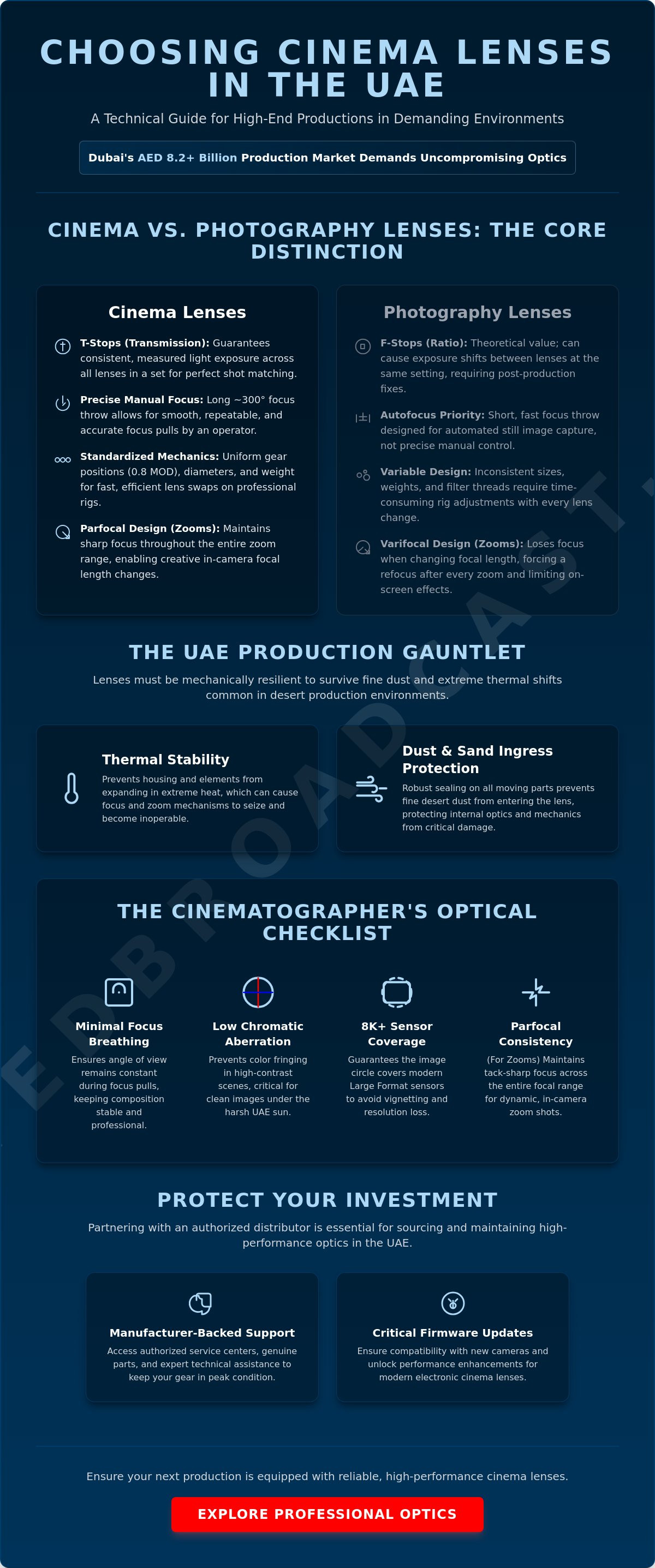
Cinema lenses are optics designed specifically for the continuous motion and mechanical demands of film production. While still photography lenses prioritize high-speed autofocus and compact size, professional cinema glass focuses on visual consistency and tactile control. When selecting cinema lenses Dubai cinematographers often prioritize "character" over clinical sharpness. This character is defined by how the glass renders out-of-focus areas, the texture of the bokeh, and the specific way the lens handles flares when exposed to high-contrast environments. For those transitioning from photography to high-end production, understanding What is a Cinema Lens? involves recognizing that these tools are built for repeatability and reliability under professional stress.
T-Stops vs. F-Stops: Precision in Exposure
The most critical technical distinction in cinema optics is the use of T-stops rather than f-stops. An f-stop is a mathematical ratio of the focal length to the diameter of the entrance pupil, but it doesn't account for the light lost as it passes through the various glass elements. T-stops, or transmission stops, measure the actual amount of light that reaches the sensor. This precision is vital when you're swapping focal lengths mid-scene; it ensures that a T2.8 on a 35mm lens provides the exact same exposure as a T2.8 on an 85mm lens. Without this consistency, your color grader would face significant challenges matching shots in post-production. When evaluating a new lens set, use this checklist to verify transmission quality:
- Confirm that the T-stop rating is consistent across the entire focal range of the set.
- Check for color neutrality to ensure the glass doesn't introduce a warm or cool cast.
- Verify that light fall-off at the edges of the frame is minimal at wide-open apertures.
Mechanical Consistency and Standardized Housing
True cinema lenses feature standardized mechanical designs that allow for efficient workflows on set. Most professional sets utilize 0.8 mod (pitch) gearing on the focus, iris, and zoom rings. This allows follow-focus systems and lens motors to interface seamlessly without reconfiguration. Furthermore, high-end cinema glass typically offers a long focus throw, often up to 300 degrees, allowing for precise focus pulls that are impossible on short-throw photo lenses. This level of control is essential when pairing glass with professional video cameras during complex tracking shots.
Standardized housing also extends to the front diameter of the lens. Uniform sizes, such as 95mm or 114mm, mean that matte boxes and filters don't need to be swapped or adjusted when changing lenses. Non-rotating front elements are equally important; they ensure that graduated filters or polarizers remain in the correct orientation during focus shifts. Finally, consider the weight and balance of the housing. For gimbal and drone cinematography, a lens set with consistent weights across different focal lengths prevents the need for re-balancing the rig, saving valuable production time.
The Optical Performance Checklist for High-End Production
High-end production requires more than just raw sharpness. As modern sensors push toward 8K and 12K resolutions, the choice of cinema lenses Dubai experts select must account for micro-contrast and resolution consistency across the entire frame. While a standard photo lens might look sharp in a still image, cinema glass must maintain that quality across every frame of a motion sequence without introducing artifacts that distract the audience. Evaluating optical performance involves a rigorous check of how the glass handles light, focus transitions, and high-frequency detail.
For cinematographers using zoom lenses, a parfocal design is non-negotiable. It ensures the lens maintains focus throughout the entire focal range, allowing for snap zooms or slow focal adjustments without losing the subject. This mechanical precision distinguishes professional cinema zooms from their photography counterparts, where focus often drifts during focal length changes. If you're unsure which optical characteristics best suit your next project, our technical team can provide expert guidance on the latest glass available in the region.
Managing Focus Breathing and Image Stability
Focus breathing occurs when the focal length appears to shift during a focus pull, creating a distracting "zoom" effect. This technical flaw breaks the viewer's immersion by drawing attention to the camera's mechanics. High-end cinema glass utilizes sophisticated internal floating elements to minimize this movement. To test for breathing, perform a rack focus between a foreground object and a background element while observing the edges of the frame. If the frame expands or contracts significantly, it can make editing between different takes difficult. True professional optics ensure that the framing remains stable, keeping the viewer's attention exactly where the director intended.
Evaluating Flare and Ghosting in High-Contrast Environments
The intense direct sunlight common in UAE shoots presents a unique challenge for optical coatings. While modern anti-reflective coatings are engineered to suppress ghosting and maintain high contrast, some directors prefer the organic "vintage" flare of older glass. Choosing the right coating depends on the project's visual language. The 'Cooke Look' is defined as a balance of warmth and sharpness preferred by cinematographers for its flattering skin tones and smooth roll-off.
Evaluating chromatic aberration is equally critical in high-contrast regional shoots. You should look for purple or green color fringing in high-frequency areas, such as the silhouette of a building against a bright midday sky. Professional-grade cinema lenses Dubai professionals trust use extra-low dispersion glass to correct these artifacts. This ensures clean edges and accurate color reproduction even when shooting at wide-open apertures in harsh lighting conditions.
Camera Compatibility and Sensor Coverage Analysis
Ensuring compatibility between your camera and optics is the foundation of a stable technical workflow. While Super 35 has been the industry standard for decades, the rapid adoption of large-format sensors has shifted the criteria for cinema lenses Dubai professionals choose. If your lens image circle is smaller than your sensor area, you'll face vignetting or severe corner softness. It's critical to verify the sensor diagonal against the lens specifications to ensure clean coverage across all aspect ratios. You can explore our range of Sony Alpha cameras and lenses to see how mirrorless mounts are enabling more versatile cinema workflows.
Large Format and VistaVision Coverage
Modern production flagships like the Sony VENICE or the ARRI Alexa 35 require glass that can cover a diagonal of 43.3mm or 33.5mm respectively. Calculating image circle requirements isn't just about sensor size; it's about the specific crop mode and target aspect ratio. Investing in full-frame or VistaVision-capable glass provides a significant future-proofing advantage. It ensures that your optical kit remains compatible with the next generation of high-resolution sensors, even if you're currently shooting on a Super 35 system. This versatility makes full-frame glass a more secure long-term investment for professional operators.
Mount standards are also undergoing a transition. The PL (Positive Lock) mount is still the benchmark for reliability because its heavy-duty design prevents any movement or play during focus pulls. However, the rise of mirrorless mounts like E, RF, and L has introduced a new level of flexibility. These mounts allow for shorter flange focal distances, making it easier to adapt a wide variety of glass or use compact, high-performance optics designed for mirrorless cinema cameras. Choosing the right mount often depends on whether you value the universal standard of PL or the adaptability of modern mirrorless systems.
Lens Metadata and Modern Post-Production
The ability to record electronic lens data has become a requirement for modern VFX-heavy productions. Systems like Cooke /i Technology and ARRI LDS-2 automate the tracking of lens settings that once required manual logs. Professional lens metadata records the T-stop, focus distance, and focal length for every frame. This information allows post-production teams to quickly correct lens distortion and accurately integrate CG elements into the live-action plate. Using metadata-capable glass streamlines the pipeline and ensures that the technical intent of the cinematographer is preserved through every stage of the edit.
Operational Resilience: Managing Heat, Dust, and Humidity
High-performance optics are precision instruments with extremely tight mechanical tolerances. In the UAE, environmental factors are a primary cause of equipment failure and costly downtime. When deploying cinema lenses Dubai cinematographers must account for ambient temperatures that often exceed 45°C during summer shoots. These extreme thermal shifts cause internal materials to expand, which can shift focus calibration or cause mechanical resistance in the focus and iris gears. Keeping lenses shaded and allowing them to acclimate slowly to temperature changes is essential for maintaining optical alignment and preventing long-term damage.
Protecting Optics from Desert Conditions
Fine desert sand is highly abrasive and can permanently pit front elements if not handled correctly. We recommend using high-quality clear protective filters as a standard precaution; they act as a sacrificial layer that doesn't compromise the visual character of the glass. Your cleaning protocol is equally important. Never wipe a dry lens. Use filtered compressed air to remove loose particles before using specialized lens tissues and dedicated cleaning solutions. Pairing your glass with essential lighting equipment for outdoor shoots allows you to manage harsh regional sunlight while focusing your attention on environmental protection.
Storage and Climate Control Best Practices
Coastal humidity in the region is a significant risk factor for the growth of lens fungus. Long-term storage requires the use of dry cabinets that maintain relative humidity between 35% and 45%. If you move equipment from a heavily air-conditioned studio directly into a humid outdoor environment, internal condensation can form. This moisture leads to element separation or the failure of electronic metadata components. Look for spider-web-like patterns on internal elements as an early warning sign of fungus. If you notice any mechanical resistance or optical haze, contact our authorized service center for a professional technical evaluation.
A disciplined maintenance routine extends the life of your investment. Follow this checklist to ensure your kit remains production-ready:
- Daily: Inspect front and rear elements for dust or smudges. Check the lens mount for physical wear or debris.
- Weekly: Test focus, iris, and zoom rings across their entire range for smooth operation. Verify that electronic metadata is communicating correctly with the camera.
- Monthly: Perform a flange focal distance (back focus) check. Clean the electrical contacts on the mount using a dedicated contact cleaner or isopropyl alcohol.
Sourcing Professional Optics and Technical Support in the UAE
Selecting the right glass is an investment in your career visual signature. When you're searching for cinema lenses Dubai professionals must look beyond the initial purchase price to consider the long-term support infrastructure. Your optics are only as reliable as the technical partner standing behind them. Pairing high-performance glass with professional video cameras for high-end cinema requires a deep understanding of both optical and electronic integration. As Dubai continues to grow as a global production hub, having a local partner for sourcing and support is a significant competitive advantage.
Why Authorized Distribution Matters
Purchasing through an authorized distributor ensures you receive genuine products backed by full manufacturer warranties. Grey market equipment often lacks valid regional support, leaving you without recourse if a lens develops a mechanical fault or requires a critical firmware update. We provide access to industry-leading brands including Sony, ARRI, Zeiss, and Cooke, ensuring that your kit meets global production standards. Our relationship with these manufacturers means you get direct access to technical bulletins and original spare parts that unauthorized sellers can't provide. This is especially important for modern lenses that rely on electronic metadata systems to communicate with the camera body.
Professional Service and Calibration
Precision is the hallmark of professional cinematography. Regular maintenance at a dedicated service center is necessary to keep your lenses performing at their peak, particularly after exposure to the harsh environmental conditions discussed earlier. One of the most critical services is the calibration of the flange focal distance, commonly known as back focus. If this distance is off by even a fraction of a millimeter, your lens won't hold focus throughout a zoom or across the focus scale. The UBMS Service Center is equipped with specialized tools and manufacturer-trained technicians to handle these delicate adjustments and ensure your sensor-to-lens alignment is perfect.
For a broader look at the hardware driving the industry, read The Ultimate Guide to Professional Video Cameras in 2026. By choosing a partner that offers both sales and technical infrastructure, you ensure that your equipment remains a dependable asset for years to come. Reliability isn't just about the brand name on the lens barrel; it's about the expertise available to you when a deadline is approaching and your gear needs to perform without fail.
Future-Proofing Your Optical Toolkit
Navigating the technical requirements of modern cinematography requires a balance between artistic vision and mechanical reliability. You've seen how critical it is to prioritize sensor coverage for 8K workflows and why environmental protection is a non-negotiable aspect of production in the Middle East. Selecting cinema lenses Dubai professionals can rely on means choosing glass that offers consistent T-stops, minimal focus breathing, and the precise metadata communication required for high-end post-production.
United Broadcast & Media Solutions brings over 25 years of industry expertise to your production. As an authorized distributor for Sony, ARRI, Zeiss, and Cooke, we provide more than just equipment; we offer a dedicated UAE-based Technical Service Center for expert calibration and long-term support. Whether you're building a new prime set or looking for a versatile zoom for field production, our team is ready to help you find the right solution. View the full range of professional cinema lenses at United Broadcast and ensure your gear is ready for the demands of the 2026 production landscape.
Frequently Asked Questions
What is the difference between a cinema lens and a photography lens?
Cinema lenses are engineered for the specific demands of motion picture production, featuring manual geared rings for focus, iris, and zoom. Unlike photography lenses that prioritize autofocus and compact size, cinema glass uses T-stop ratings for precise light transmission. They also offer long focus throws and standardized housing to ensure consistency across an entire lens set.
Why are cinema lenses so expensive compared to high-end DSLR glass?
The cost of cinema glass reflects the complex mechanical engineering required to eliminate focus breathing and maintain parfocal stability. These lenses utilize superior glass elements and robust, weather-sealed housings designed for decades of professional use. The manufacturing process involves tighter tolerances to ensure that every lens in a series matches in color and contrast.
Can I use Full Frame cinema lenses on a Super 35 sensor camera?
Yes, you can use Full Frame cinema lenses on Super 35 sensors without any loss in image quality. Because the image circle of a Full Frame lens is larger than the Super 35 sensor, it provides complete coverage. This is a strategic way to future-proof an investment in cinema lenses Dubai professionals make as they transition between different camera systems.
What is lens breathing and why does it matter in cinematography?
Lens breathing is a visible change in focal length that occurs when you pull focus between subjects at different distances. In cinematography, this effect is distracting because it makes the frame appear to zoom in or out during a rack focus. High-quality cinema optics are designed with internal floating elements to minimize this shift and maintain a stable composition.
Is it better to buy a cinema zoom lens or a set of prime lenses?
The decision depends on your workflow; prime lenses typically offer wider apertures and more unique optical character, while zooms provide speed and versatility. Primes are often preferred for narrative features where lighting is controlled. Cinema zooms are invaluable for documentary or broadcast environments where frequent lens changes would result in missed shots or production delays.
How do I protect my cinema lenses from the heat and dust in the UAE?
You should use high-quality clear filters to protect front elements from abrasive sand and store your kit in humidity-controlled dry cabinets. Avoid moving glass quickly from cold air conditioning to extreme outdoor heat to prevent internal condensation. Regular professional calibration at a regional service center is also necessary to manage the effects of thermal expansion on mechanical parts.
What is a PL mount and why is it the industry standard for cinema?
The PL (Positive Lock) mount is a high-strength, four-flange system designed to hold heavy cinema optics securely without any mechanical play. It has remained the industry standard because it provides a highly accurate and repeatable flange focal distance. This stability is essential when using wireless follow-focus motors that apply significant torque to the lens barrel.
Do cinema lenses have autofocus capabilities?
Most professional cinema lenses are strictly manual to provide cinematographers and focus pullers with absolute control over the focal plane. While some newer hybrid lenses for mirrorless mounts include autofocus, traditional high-end glass avoids electronic focus motors to maximize mechanical reliability. Manual operation ensures that focus transitions are smooth, intentional, and repeatable across multiple takes.


