

Broadcast Equipment Maintenance Dubai: The 2026 Professional Checklist
A single outdoor shoot in the Rub' al Khali or a humid afternoon at Dubai Marina can do more damage to a cinema camera than five years of studio use. For professionals in the UAE, broadcast equipment maintenance Dubai isn't just a routine chore; it's a critical technical necessity. You likely already know how quickly fine sand can infiltrate lens mounts or how humidity causes fungal growth in high-end optics during the summer months.
The MENA media market is projected to reach US$48.43 billion in 2026, which means the stakes for production reliability and equipment uptime have never been higher. This professional checklist offers a specialized framework designed to combat local environmental stressors and ensure zero downtime during critical live broadcasts. We'll examine the essential steps for maximizing the lifespan of your cinema cameras and lenses, ensuring your gear remains a reliable asset and maintains its resale value in a fast-paced industry.
Key Takeaways
- Learn why the UAE's environmental stressors necessitate a shift from reactive repairs to a proactive, preventive maintenance strategy.
- Implement a tiered maintenance schedule using essential tools like contact cleaners and high-volume blowers to safeguard gear during outdoor shoots.
- Understand the technical requirements for sensor cleaning and lens calibration to ensure precision focus and image integrity on large-format sensors.
- Master environmental safeguards, including acclimatization protocols and the use of humidity-controlled cabinets to prevent fungal growth in optics.
- Discover how a professional partnership for broadcast equipment maintenance Dubai ensures 100% reliability and rapid turnaround for critical studio components.
The Critical Role of Preventive Broadcast Equipment Maintenance in the UAE
High-stakes production environments in the UAE require a fundamental shift in how technical teams manage their assets. Relying on reactive repairs is a strategy that invites failure. When a professional video camera or a digital cinema camera fails mid-shoot, the consequences extend far beyond a simple repair bill. You're looking at the compounded costs of crew stand-by time, location permits, and the potential loss of irreplaceable footage. In the broadcast world, where every second of uptime is critical, preventive maintenance is the only way to ensure 100% reliability.
Effective broadcast equipment maintenance Dubai involves recognizing that our environment accelerates the degradation of even the most robust gear. While basic broadcast engineering protocols provide a foundation, the specific combination of extreme heat and fine desert sand requires a more rigorous schedule. There's a significant difference between user-level cleaning, such as dusting off a lens body, and the deep technical servicing performed at an authorized center. The latter involves internal sensor cleaning, firmware optimization, and mechanical recalibration.
Regional Environmental Stressors for Media Gear
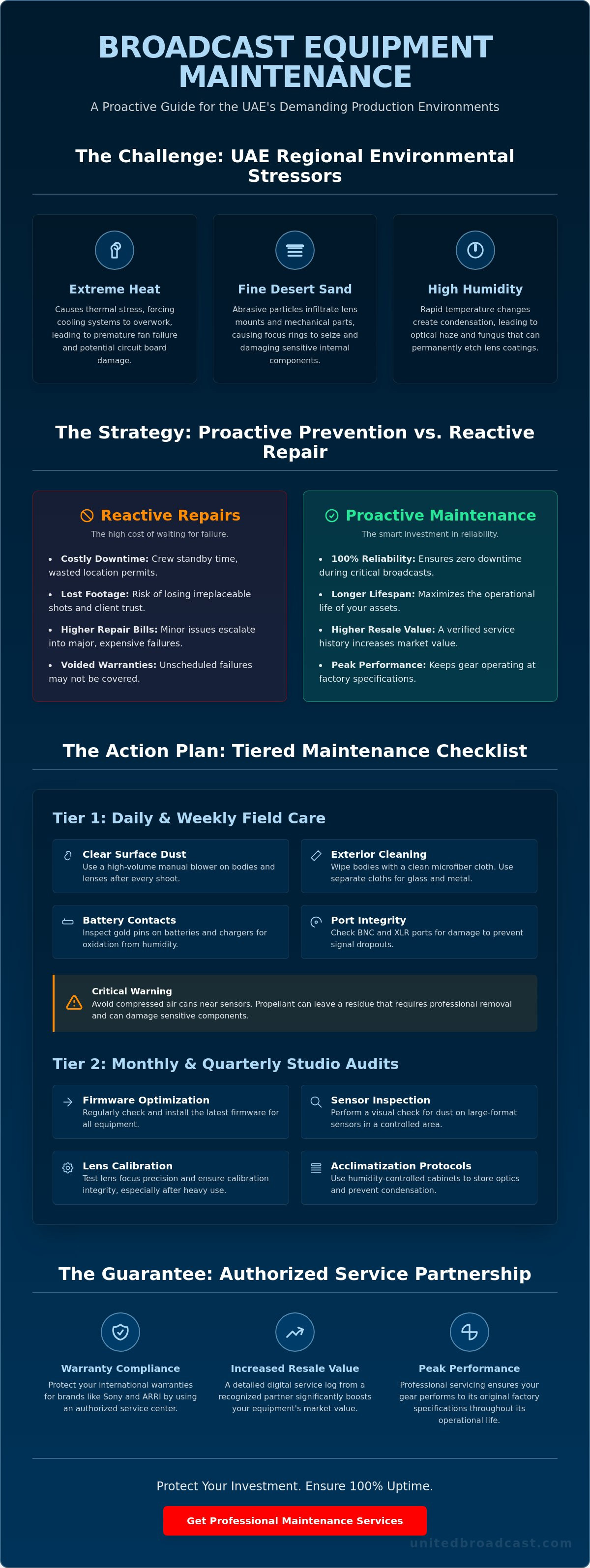
The UAE climate presents three primary threats to production hardware. Thermal management is the first hurdle; extreme ambient temperatures force internal cooling systems to run at maximum capacity, which can lead to premature fan failure or circuit board warping. Secondly, fine particulate ingress is a constant danger. Desert dust is abrasive and can easily find its way into the mechanical components of cinema lenses, causing focus rings to seize. Finally, moving gear from chilled studios to humid outdoor sets creates condensation. If not managed, this moisture leads to optical haze and fungal growth that can permanently etch lens coatings.
Warranty Compliance and Authorized Servicing
Protecting your investment means adhering to manufacturer-sanctioned service protocols. For high-end brands like Sony and ARRI, using an authorized service center is non-negotiable. Attempting an unauthorized opening of a camera body or lens housing will immediately void international warranties, leaving you liable for the full cost of future major failures. We recommend maintaining a detailed digital service log for every asset. This isn't just for internal tracking; a verified service history from a recognized partner significantly increases the resale value of your gear when it's time to upgrade your kit with an ARRI production kit or similar professional tools. Consistent servicing ensures that your equipment performs to its original factory specifications throughout its operational life.
A Comprehensive Broadcast Equipment Maintenance Checklist
A structured approach is the backbone of any professional production house. For broadcast equipment maintenance Dubai, we recommend a tiered system that separates immediate field care from deep technical audits. This prevents minor environmental wear from developing into expensive hardware failures. Without a formal schedule, technical debt accumulates, eventually leading to a failure at the most critical moment of a shoot.
Daily and Weekly Equipment Care
The primary goal of daily maintenance is to remove contaminants before they enter the internal housing. After every shoot, especially those on location, use a high-volume manual blower to clear surface dust from camera bodies and lens barrels. Avoid using compressed air cans near sensors or optics. The propellant can leave a residue that is difficult to remove without professional intervention.
Follow these weekly protocols to maintain your kit:
- Exterior Cleaning: Use a clean microfiber cloth for the camera body. Never use the same cloth for glass and metal surfaces to avoid cross-contamination of oils and grit.
- Battery Contacts: Inspect gold pins and contact pads on batteries and chargers. Dubai's humidity can lead to subtle oxidation, which increases resistance and causes intermittent power issues.
- Port Integrity: Check BNC and XLR ports for physical deformation. A loose connector can lead to signal dropouts during a live broadcast, which is often a symptom of poor cable management on set.
Monthly and Quarterly Studio Audits
While daily care focuses on the physical, monthly audits address the operational health of your studio-bound gear. This is the time to look beyond the camera body at the entire ecosystem. This includes professional lighting equipment and audio signal paths that are often overlooked during the rush of production.
Key audit areas include:
- Firmware Synchronization: Ensure all cameras, switchers, and recorders are running on manufacturer-recommended versions. Mismatched firmware can cause metadata errors or communication glitches between devices.
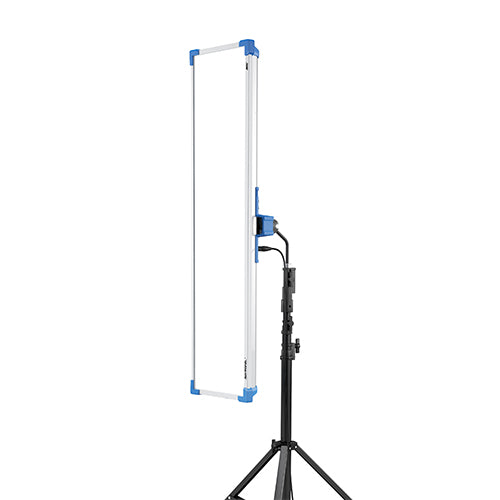
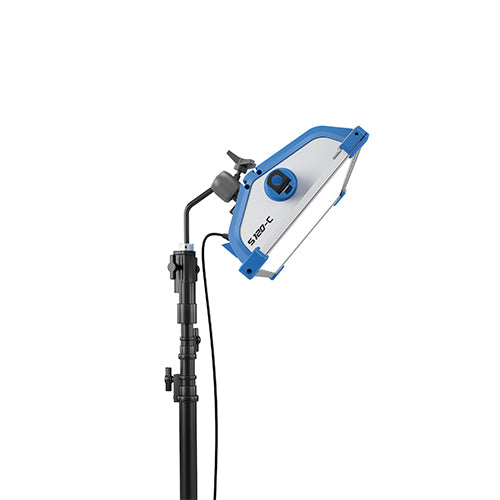
- Lighting Thermal Management: Inspect the intake fans and filters on LED panels. Dust buildup in these areas leads to overheating, which causes the light to shift color temperature or shut down entirely.
- Audio Signal Integrity: Test wireless systems for RF interference and physical crackle in the signal path. In a city with a dense RF environment like Dubai, keeping your wireless gear calibrated is essential for clean sound.
Implementing this tiered schedule ensures your gear remains in peak condition for years. If your team requires assistance setting up a formal maintenance protocol for a new facility, consult with our technical specialists to tailor a plan for your specific workflow.
Sensor Integrity and Optical Calibration Requirements
The sensor is the most critical component of your digital cinema camera, yet it's often the most misunderstood in terms of care. While a manual air blower can remove loose surface particles, it cannot address the "stuck" dust or oil spots that often result from lens changes in the field. For comprehensive broadcast equipment maintenance Dubai, sensor care must be treated as a precision engineering task rather than a quick cleaning chore. Failure to maintain sensor cleanliness leads to persistent artifacts that are often impossible to fix in post-production without degrading the image.
User Cleaning vs. Professional Sensor Service
Field cleaning is a temporary fix at best. Professionals often use a sensor loupe to identify subsurface dust that is invisible to the naked eye, but even this has its limits. Attempting laboratory-grade "wet cleaning" in a standard office or on-set environment carries high risks. Micro-scratches on the OLPF (Optical Low Pass Filter) can occur from a single grain of abrasive desert sand caught on a swab. For a deeper look at the technical process, refer to our Professional Camera Sensor Cleaning in Dubai: The Complete 2026 Maintenance Guide.
Beyond physical debris, sensor integrity involves monitoring electronic health. Over time, sensors can develop "dead" or "hot" pixels, especially after exposure to high-intensity lighting or long exposures. Identifying these early through sensor mapping is essential to prevent ruined footage. If you're seeing persistent artifacts, it's time for a Precision Camera Calibration Service in the UAE to re-align the sensor's performance and map out defective pixels.
Lens Maintenance and Back-Focus Calibration
The shift toward large-format sensors has made optical precision more demanding than ever. A lens that appears sharp on a small monitor may reveal significant "softness" or back-focus issues when viewed on a 4K broadcast screen. Regular broadcast equipment maintenance Dubai must include checking the flange focal distance to ensure the lens remains sharp throughout its entire zoom range. This is particularly vital for cinema lenses where the distance between the rear element and the sensor must be exact to a fraction of a millimeter.
Cinema lenses require specific mechanical attention that differs from standard photography glass. This includes the periodic lubrication of iris and focus rings to maintain the smooth, tactile response required for manual pulling. If you are operating a fleet of Sony Alpha Camera and Lenses, you'll know that even high-end autofocus systems rely on the mechanical health of the lens to perform accurately. We recommend a quarterly check of all mount points and internal elements to ensure no particulate ingress has affected the optical path.
Environmental Safeguards: Managing Heat and Humidity on Location
Dubai's environmental conditions are among the most challenging in the world for delicate media electronics. While previous sections focused on internal mechanics and sensor health, the external environment dictates how often those services are required. Effective broadcast equipment maintenance Dubai relies heavily on how you manage the transition between controlled studio environments and the harsh realities of location shoots. Neglecting these environmental factors doesn't just cause immediate failure; it leads to cumulative damage that shortens the operational life of your entire kit.
The most immediate threat on a UAE shoot is condensation. When you move a cold camera from a climate-controlled vehicle into humid outdoor air, moisture instantly forms on every surface, including internal circuit boards and optical elements. To prevent this, always allow your gear to acclimatize inside its flight case for at least 45 to 60 minutes before opening. This slow temperature equalization is the simplest way to avoid internal fogging that can lead to long-term electronic corrosion and optical haze.
Advanced Storage Solutions for Professional Gear
Long-term preservation requires more than just a padded case. Professional cinema glass is highly susceptible to fungal growth if stored in environments with relative humidity levels above 60%. Utilizing laboratory-grade dry cabinets is a standard requirement for maintaining the clarity of high-end optics. These units provide a stabilized, low-humidity environment that prevents microscopic spores from taking root on lens coatings.
Thermal management also extends to your power solutions. Storing lithium-ion batteries in high-temperature environments accelerates chemical degradation, leading to a permanent loss of charge capacity. Similarly, when using high-output ARRI Lighting, ensuring that cooling vents remain unobstructed is vital. These fixtures are engineered for high performance, but their sophisticated heat-sink systems require clear airflow to maintain color consistency and prevent lamp failure. Regularly checking and cleaning the intake filters on your LED panels is a core part of broadcast equipment maintenance Dubai.
On-Set Protection Strategies
Protection on set should be proactive rather than reactive. Even in clear, dry weather, the fine particulate matter in the UAE air acts as an abrasive on moving parts. Rain covers aren't just for water; they serve as an excellent barrier against wind-blown sand that can enter the cooling vents of a digital cinema camera. Proper cable management is equally essential. Keeping BNC and power connectors off the ground prevents sand from entering the ports, which can cause physical damage or signal interference.
Thermal throttling is the automatic reduction of a camera's processor speed to lower heat generation, often resulting in dropped frames or system shutdown. To avoid this during summer shoots, utilize active cooling solutions such as portable fans or shaded cooling stations for gear between takes. If you're planning an extended production in challenging terrain, contact our technical team to discuss specialized environmental protection kits for your fleet.
Establishing a Professional Technical Support Partnership
Production reliability isn't just about the tools you own; it's about the technical infrastructure that supports them. In a region where environmental factors accelerate mechanical wear, having a local partner for broadcast equipment maintenance Dubai is a strategic advantage. Shipping high-end gear back to manufacturer headquarters in Europe or Japan causes unacceptable delays that few production schedules can accommodate. A local, authorized service center provides the rapid turnaround necessary to keep your projects on track and your equipment in the field.
Maintaining Tier-1 brands like Sony and ARRI requires more than just technical skill. It demands access to genuine spare parts and laboratory-grade diagnostic tools that generic repair shops simply don't possess. Using non-authorized components might seem cost-effective initially, but it compromises the performance of professional video cameras and can lead to catastrophic failure during a live broadcast. A professional partnership ensures that every repair meets original factory specifications, preserving both the performance and the long-term resale value of your assets.
UBMS Service Center Capabilities
The UBMS service center is engineered to handle the complexities of modern media workflows. Our facility provides authorized repair levels for a wide range of professional gear, ensuring that even the most delicate sensor or optical calibrations are handled with precision. Beyond individual unit repairs, we offer technical support for complex system integration. This holistic approach ensures that your studio's entire signal path is optimized for performance. We also provide customized maintenance contracts for production houses and broadcast studios, moving your operations from a reactive "break-fix" model to a predictable, proactive maintenance schedule.
Next Steps for Production Managers
Transitioning to a professional maintenance framework requires a systematic approach. We recommend that production managers take the following steps to secure their equipment's future:
- Inventory Audit: Conduct an immediate audit of your current equipment inventory to identify gear that has missed its annual service window.
- Fleet Calibration: Schedule a professional calibration session for your primary camera fleet to ensure color consistency and focus accuracy across all units.
- Technical Consultation: Contact the UBMS technical team to discuss your specific operational challenges and establish a tailored maintenance protocol.
Effective broadcast equipment maintenance Dubai is a continuous process of evaluation and care. By establishing a relationship with an authorized service partner, you gain more than just a repair facility; you gain a technical advisor dedicated to your production's success. Don't wait for a hardware failure to address your equipment's health. Reach out to our specialists today to ensure your gear is ready for the demands of the 2026 production season.
Securing the Future of Your Production Assets
Transitioning from reactive repairs to a proactive maintenance framework is essential for maintaining a competitive edge in the UAE's thriving media sector. By implementing tiered checklists and specialized environmental safeguards, you protect your gear from the aggressive stressors of heat, sand, and humidity. Precision tasks like sensor mapping and lens calibration ensure that your output remains consistent with global broadcast standards and retains its long-term market value.
Professional broadcast equipment maintenance Dubai requires a partner with deep technical infrastructure and localized knowledge. With over 25 years of industry expertise in the Middle East, UBMS serves as an authorized service center for Sony, ARRI, and Canon. Our certified Level 3-4 repair technicians provide the precision and reliability your high-end gear demands. Don't leave your production uptime to chance. Book a Professional Maintenance Service with UBMS to ensure your fleet is ready for the high stakes of the 2026 season. We're here to help you maintain excellence in every frame.
Frequently Asked Questions
How often should I have my professional camera sensor cleaned in the UAE?
Professionals in the UAE should ideally have their sensors cleaned every three months if they are shooting on location frequently. The fine desert dust and high humidity can cause particles to bond to the sensor glass, making manual blowing ineffective. If you notice persistent spots in your footage at apertures above f/11, it's a clear indicator that a professional deep clean is required to maintain image integrity.
Can I use standard compressed air to clean my cinema lenses?
You should never use standard cans of compressed air to clean cinema lenses or camera sensors. These products often contain chemical propellants that can leave an oily residue on the delicate optical coatings, which is difficult to remove without professional solvents. Instead, use a high-volume manual air blower or a dedicated electronic blower designed specifically for precision broadcast equipment maintenance Dubai to clear loose particles safely.
What are the signs that my broadcast equipment needs professional calibration?
Key indicators include back-focus issues where a zoom lens doesn't hold focus throughout the range, or "soft" images on large-format sensors despite correct lens settings. You might also notice color shifts between multiple cameras in a studio setup or "hot" pixels in low-light shots. If your gear is consistently failing to meet factory performance specifications during testing, it requires professional recalibration at an authorized service center.
Is it safe to store cinema cameras in a standard office environment?
Storing cinema cameras in a standard office environment isn't recommended for long-term preservation in the UAE. Standard air conditioning often fluctuates, leading to humidity spikes that can encourage fungal growth in optics. It's safer to use humidity-controlled dry cabinets that maintain a consistent relative humidity level between 35% and 45%. This specialized storage prevents the "fungus" effect that often ruins expensive cinema glass.
How does humidity affect the electronics inside a broadcast switcher?
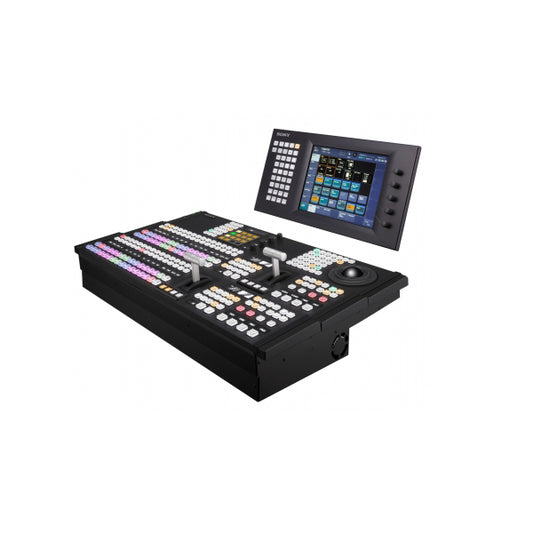
High humidity levels can cause microscopic condensation on the internal circuit boards of a broadcast switcher, leading to oxidation and eventual component failure. Over time, this moisture creates conductive paths that can result in short circuits or intermittent signal dropouts. Maintaining a stable, climate-controlled environment for your broadcast studio gear is essential for preventing the long-term degradation of complex electronic switching systems.
What should I do if sand gets inside my camera lens mount?
If sand enters your camera lens mount, stop using the equipment immediately to prevent the abrasive grains from scratching the sensor or damaging the mount's electrical contacts. Don't attempt to wipe it away with a cloth, as this can push the grit deeper into the housing. The safest course of action is to use a manual blower for surface particles and then send the unit to a technician for a professional internal inspection.
Does firmware updating count as part of regular maintenance?
Firmware updates are a critical component of professional broadcast equipment maintenance Dubai. These updates often include patches for system stability, improved thermal management, and expanded metadata support for newer lens models. Keeping your entire production fleet on synchronized firmware versions prevents communication glitches between cameras, switchers, and recorders, ensuring a seamless workflow during high-stakes live broadcasts or cinema shoots.
Why is it important to use an authorized service center for ARRI or Sony gear?
Using an authorized service center is vital because it ensures that your gear is handled by technicians trained to manufacturer standards using genuine spare parts. Authorized centers for brands like ARRI or Sony provide Level 3-4 repairs that go beyond simple part replacement. Furthermore, having your equipment serviced by an unauthorized shop will void your international manufacturer warranty, potentially leading to significantly higher costs if a major component fails later.


