

PL vs EF Mount: Professional 2026 Cinema Guide
The decision between a PL mount vs EF mount for cinema in 2026 is no longer just a matter of lens preference; it's a strategic choice that dictates the mechanical stability and data integrity of your entire production. While the ubiquity of EF glass remains undeniable, the shift toward high-torque remote motors and virtual production has exposed the limitations of stills-origin hardware on professional sets. You've likely experienced the frustration of subtle mount play during a critical rack focus or the anxiety of relying on adapters that may not withstand the rigors of a high-stakes environment.
We recognize that your equipment is a significant capital investment that must deliver reliable results over many years. This guide provides a comprehensive technical and commercial breakdown to help you navigate the 8mm flange focal distance gap and the nuances of lens metadata. You'll gain a clear framework for choosing a mount based on your specific production type, whether you're an owner-operator or managing a full-scale studio. We will explore mechanical tolerances, the evolution of bridge mounts, and why certain standards offer better long-term financial protection for your optical inventory.
Key Takeaways
- Understand the mechanical distinctions between the 52mm PL standard and the 44mm EF bayonet to eliminate mount play during high-torque focus pulls.
- Evaluate the PL mount vs EF mount for cinema based on your specific production requirements, from narrative features to run-and-gun documentary workflows.
- Identify why high-end PL-mount optics maintain superior resale value and mechanical longevity compared to electronic-dependent lens systems.
- Explore how mirrorless bridge mounts and professional adapters allow you to integrate legacy glass into modern 2026 camera ecosystems.
- Learn the importance of precision shimming and technical calibration to ensure your equipment meets global broadcast and cinema standards.
Understanding the Standards: What are PL and EF Mounts?
Choosing between a PL mount vs EF mount for cinema is the foundational decision for any professional camera package. This choice dictates the mechanical stability of your rig and defines which lenses you can use without complex adaptation. While both standards share a 54mm inner throat diameter, their mechanical execution and intended environments differ significantly. A locking mount uses a rotating outer collar to pull the lens flange flush against the camera body without rotating the lens barrel, whereas a bayonet mount requires the entire lens to twist until a spring-loaded pin locks it into place.
This technical distinction influences your entire lens ecosystem and the long-term resale value of your kit. Professional optics are a significant capital investment. Mechanical PL glass often maintains its value for decades because its physical integrity remains universal. In contrast, EF systems rely heavily on electronic protocols that can face manufacturer-driven obsolescence. As an authorized distributor for top-tier brands, we've seen how mount choice impacts workflow efficiency on high-stakes sets.
The Legacy of the Arri PL Mount
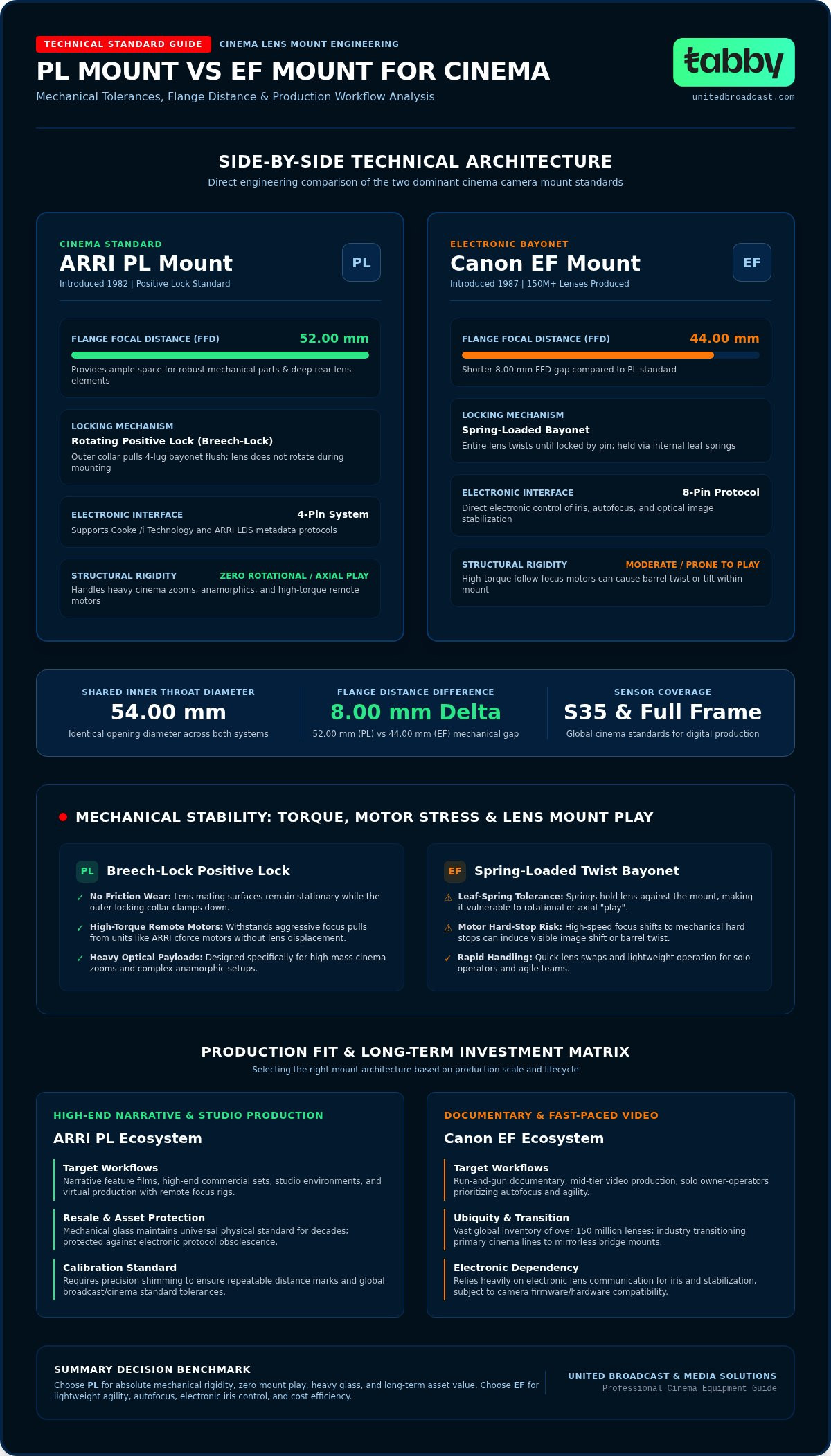
Introduced in 1982, the Arri Positive Lock (PL) mount was engineered specifically for the rigors of professional film sets. It features a 52.00 mm flange focal distance (FFD), providing ample room for robust mechanical components and deep rear lens elements. The four-lug bayonet sits inside the receiver, and the locking collar ensures zero rotational or axial play. This rigidity is essential when using heavy digital cinema cameras and large zoom lenses. It remains the global standard for both Super 35 and Full Frame sensors because it handles the torque of professional follow-focus motors without the lens shifting within the mount.
The Evolution of the Canon EF Mount for Video
The Canon EF mount originated in 1987 for 35mm SLRs but achieved dominance in digital cinema following the DSLR revolution and the subsequent launch of the Cinema EOS line. With a 44.00 mm flange focal distance, it is a shorter system compared to PL. You can find detailed technical data in the Canon EF lens mount specifications, which highlight its 8-pin electronic interface. This protocol allows for direct camera control over iris, image stabilization, and autofocus. While Canon transitioned its primary cinema production to the RF mount in mid-2026, the legacy of over 150 million EF lenses ensures its continued ubiquity. It offers a lightweight, electronic-rich workflow that is particularly effective for documentary and mid-tier productions where speed and agility are prioritized.
Mechanical Integrity: Stability and Precision on Set
The mechanical performance of your camera system often determines the success of a high-stakes production. When evaluating a PL mount vs EF mount for cinema, you're choosing between two fundamentally different engineering philosophies. The PL mount prioritizes rigidity and repeatable precision, whereas the EF mount emphasizes speed and electronic integration. This distinction is most apparent when using heavy cinema zooms or anamorphic glass, where the weight of the optics can exceed several kilograms.
| Feature | ARRI PL Mount | Canon EF Mount |
|---|---|---|
| Flange Focal Distance | 52.00 mm | 44.00 mm |
| Locking Mechanism | Rotating Positive Lock | Spring-Loaded Bayonet |
| Electronic Interface | 4-pin (Cooke /i, LDS) | 8-pin (Canon Protocol) |
| Structural Capacity | High (Heavy Zooms) | Moderate (Lightweight) |
Positive Lock vs. Bayonet Mechanisms
The core difference in stability lies in how the lens attaches to the camera body. A PL mount uses a breech-lock system where a rotating outer collar clamps the lens lugs firmly against the flange. Because the lens itself doesn't rotate during mounting, there's no friction-based wear on the mating surfaces. This creates a rock-solid connection with zero rotational or axial play. In contrast, the EF bayonet system relies on internal leaf springs to hold the lens in place. While this allows for rapid lens changes, it introduces the risk of "mount play." When high-torque follow-focus motors, such as the ARRI cforce units, rapidly spin a lens to its hard stop, the torque can cause the lens barrel to twist or tilt slightly within an EF mount. This results in a visible frame shift that can ruin an otherwise perfect take.
Flange Focal Distance and Optical Performance
The 52.00 mm flange focal distance of the PL system isn't arbitrary. This deeper depth allows lens designers to incorporate larger, more complex rear optical elements, which is critical for maintaining telecentricity and reducing vignetting on large-format sensors. It also provides the necessary space for professional technicians to use precision metal shims, ranging from 0.01 mm to 0.1 mm, to calibrate the mount. Professional technicians must check back-focus on every camera-lens pairing to ensure that focus markings on the lens barrel accurately correspond to the physical distance of the subject. If you find your focus marks are drifting or your mount feels loose, you can contact our technical service team for a professional calibration and mount inspection.
The Lens Ecosystem: Assessing Versatility and Investment Value
Investing in optics requires a long-term perspective on both performance and capital preservation. When weighing the benefits of a PL mount vs EF mount for cinema, you're looking at a fundamental difference in lens lifecycle. High-end optics are designed to outlast multiple camera generations, but the mount standard determines how easily those lenses integrate into future workflows. While the EF mount provides a versatile entry point for hybrid shooters, the PL system remains the primary choice for those investing in professional cinema lenses that hold their value over decades of use.
Professional Cinema Lenses and PL Dominance
Industry leaders like ZEISS, Cooke, and ARRI prioritize the PL mount because it accommodates the massive glass elements required for superior resolution and character. Anamorphic shooting particularly demands the mechanical precision of a locking mount. Large anamorphic sets are physically heavy and require perfect alignment to avoid optical artifacts. The PL mount's four-lug system ensures the lens remains perfectly centered on the sensor, even when rigged with heavy matte boxes or wireless lens motors. For productions requiring absolute reliability and remote control, using the ARRI Omnibar Production Kit allows crews to manage these high-end lens systems with the precision that professional sets demand. This ecosystem is built for durability; it's common to find 30-year-old PL lenses still performing flawlessly on modern 8K sensors.
The Hybrid Advantage of EF Lenses
The EF mount offers a distinct advantage for owner-operators who need to balance budget with high-quality output. It serves as a cost-effective gateway into 4K and 8K production, utilizing a massive library of existing glass. A key factor here is electronic communication. EF lenses allow for advanced autofocus capabilities, which are often a necessity for solo operators or documentary filmmakers. In modern production environments, the role of Sony Alpha camera and lenses has grown significantly for B-roll and gimbal work, often adapted from or used alongside EF systems. This hybrid approach allows for a lighter kit and faster setup times, though it lacks the mechanical "hard stops" found on cinema-grade PL glass.
From an investment standpoint, PL glass is a mechanical hedge against technology shifts. Because EF lenses rely on internal motors and proprietary electronic iris mechanisms, they face a higher risk of service obsolescence now that manufacturers have shifted focus to mirrorless mounts. A purely mechanical PL lens doesn't have these failure points. It's a stable asset that retains a high percentage of its original price on the secondary market. If your production values long-term ROI and mechanical dependability, the PL ecosystem is the clear professional choice.
Choosing the Right Mount for Your Production Workflow
The decision between a PL mount vs EF mount for cinema often hinges on the specific demands of your production environment and the expectations of your clients. High end narrative projects and feature films almost exclusively utilize the PL standard for the primary camera. This choice isn't merely technical; it signals a level of professional commitment to agencies and stakeholders. Conversely, documentary workflows and solo operators often find the agility and electronic features of the EF system more suited to their fast paced requirements.
Workflow: Narrative vs. Commercial
Precision is the hallmark of narrative cinema. Assistant Cameramen (ACs) prefer the PL system because it supports lenses with consistent focus marks and standardized gear positions. This allows for repeatable, high torque focus pulls that are essential for storytelling. For commercial work involving gimbals or drones, the choice becomes more nuanced. While the EF mount offers a lighter profile that helps balance smaller rigs, the PL mount provides superior security for expensive glass. When your project scales up to include multiple professional video cameras, maintaining a unified mount standard simplifies the logistics of lens swaps and matte box configurations across the entire set.
Environmental Durability on UAE Sets
Operating in the Middle East presents unique challenges that favor the robust construction of the PL standard. Dust ingress is a constant threat on desert sets. The locking collar of a PL mount creates a more consistent seal against the camera flange than the spring loaded bayonet of an EF mount, which helps protect the sensor from fine particulates. Extreme heat also impacts equipment performance. High temperatures can cause subtle metal expansion, leading to shifts in back-focus calibration. The shimmable nature of PL mounts allows technicians to maintain optical precision despite these environmental stressors. Regular maintenance is vital in these conditions. We recommend scheduling a professional camera service to ensure your mount remains calibrated and free of debris after any outdoor shoot.
Future-Proofing Your Kit with Professional Mount Solutions
The technical landscape of 2026 has shifted the PL mount vs EF mount for cinema debate from a fixed hardware choice to a modular workflow strategy. Most modern cinema cameras now utilize ultra-short flange mirrorless mounts, such as the Sony E-mount or the L-mount, as a universal bridge. This architectural shift allows you to swap between PL and EF standards depending on the specific needs of a project. By investing in a camera body with an interchangeable mount system, like the ARRI ALEXA 35 or Sony VENICE 2, you protect your capital investment against future changes in lens technology.
Adapting Lenses: The Role of High-End Mount Converters
While mirrorless mounts offer flexibility, the quality of your adapter is the weakest link in your optical chain. Cheap, mass-market adapters are a significant risk to your sensor and optics; they often lack the structural rigidity to support heavy glass, leading to the mount play discussed in previous sections. Professional converters from manufacturers like Metabones or Vocas are engineered with precise tolerances to maintain the optical axis. Precision shimming is a non-negotiable step in this process. By adding or removing ultra-thin metal shims, you ensure that your lens reaches perfect infinity focus and that your distance marks remain accurate. Modern hybrid workflows often rely on versatile optics like the Sony FE 100-400mm lens, which provides the reach and autofocus performance that purely mechanical PL systems cannot match in fast-paced documentary scenarios.
Professional Support and Integration
Maintaining the integrity of your lens mount requires more than just high-quality hardware. United Broadcast & Media Solutions (UBMS) provides the technical infrastructure to support these sophisticated mount conversions and routine maintenance to ensure your gear meets global broadcast standards. We specialize in calibrating back-focus and inspecting mount seating to prevent the mechanical failures that can occur on high-stakes sets. For organizations building out permanent facilities, our system integration services help bridge the gap between cinema cameras and broadcast studio gear. We ensure that your data protocols, such as Cooke /i or ARRI LDS, communicate correctly through your adapters and into your control systems. To complete a high-tier production environment, we integrate these camera chains with Professional Lighting Equipment, ensuring that your optical precision is supported by a world-class lighting setup. This holistic approach to kit building ensures that your equipment remains a reliable asset for years to come.
Securing Your Optical Legacy in Professional Production
Determining the ideal PL mount vs EF mount for cinema configuration requires balancing technical needs with your commercial goals. While the PL standard offers the mechanical rigidity required for high-stakes narrative work, the EF system provides a cost-effective entry point for agile documentary crews. Your choice dictates the stability of your rig and the long-term resale value of your optical assets.
United Broadcast & Media Solutions (UBMS) brings over 25 years of industry expertise to the Middle East as an authorized distributor for ARRI, Sony, and Canon. Our dedicated technical service center ensures your equipment remains calibrated and set-ready through professional mount shimming and maintenance. Whether you're building a new studio or upgrading a field kit, we provide the infrastructure to support your creative vision.
We're here to help you make an investment that delivers precision and reliability on every frame.
Frequently Asked Questions
Can I use PL lenses on an EF mount camera?
Standard PL lenses cannot be used on native EF cameras without extreme physical modification. The 52.00 mm flange focal distance of the PL system is 8.00 mm deeper than the 44.00 mm EF standard. This means a PL lens would need to sit deep inside the camera body to achieve infinity focus. Most cinema lenses have protruding rear elements that would strike the sensor glass or internal baffles on an EF body.
Is PL mount better than EF for 8K cinematography?
Resolution is not restricted by the mount itself, but the PL standard is better suited for the high-performance glass required for 8K sensors. Its 54.00 mm throat diameter and 52.00 mm flange depth allow for telecentric lens designs that minimize light fall-off at the sensor edges. This ensures the maximum optical performance needed for high-resolution digital cinema cameras used in professional narrative and commercial productions throughout the UAE.
Do EF mounts have more lens options than PL mounts?
The EF system has a larger total volume of available lenses because it spans both photography and video markets. With over 150 million EF lenses produced, you'll find more budget-friendly and specialized stills glass for this mount. However, for professional cinema production, the PL mount is the global standard. It offers access to the world's most prestigious optics from manufacturers like Cooke, ZEISS, and ARRI, which are rarely available in native EF.
Why is the PL mount so expensive compared to EF?
The higher cost of a PL mount is due to its precision-engineered positive-locking mechanism and robust material standards. Unlike the spring-loaded bayonet of an EF mount, a PL mount uses a rotating collar to clamp the lens with zero rotational play. These components are manufactured to tolerances of 0.01 mm to ensure repeatable back-focus calibration. This mechanical complexity is necessary to support the weight and torque of professional cinema lens systems.
What happens if there is 'play' in my lens mount?
Mount play leads to optical misalignment and visible image shifts during focus pulls. If the lens can move even slightly within the mount, the sensor won't receive light at the correct angle. This causes soft images and can lead to mechanical failure of the electronic pins. If you experience movement in your setup, our technical service center can inspect the mount and provide the necessary shimming to restore a rock-solid connection for your camera.
Are mount adapters safe for heavy cinema lenses?
High-quality adapters are safe if they include a support bracket for the camera cage or rods. Using a PL mount vs EF mount for cinema adapter without proper support puts excessive strain on the camera's internal mount. This can lead to permanent damage or flange depth shifts. We recommend using shimmed adapters from reputable brands to ensure your heavy cinema lenses remain perfectly aligned with the sensor throughout the entire duration of your production.
Can I change the mount on my camera body myself?
You should only change the mount yourself if the camera is designed with a user-serviceable interchangeable mount system. Most cameras require a technician to perform back-focus calibration after a mount swap. Even a tiny misalignment can prevent your lenses from hitting infinity focus or cause uneven sharpness across the frame. Our service center handles these conversions professionally, using precision tools to ensure your camera remains within factory specifications for every shoot.
Which mount is better for autofocus performance?
The EF mount is the clear choice if your workflow relies on autofocus. It was built for electronic communication, allowing the camera to drive the lens's internal motors for rapid focus adjustments. When comparing the PL mount vs EF mount for cinema, the PL standard is almost exclusively manual. PL lenses are designed for use with external follow-focus motors and dedicated focus pullers, prioritizing mechanical precision and repeatability over automated electronic focus systems.


