

Cinema lenses for UAE production workflows
The right lens choice can keep a production moving while shaping the image. When comparing cinema lenses in the UAE, start with the camera format and demands of the shoot: primes offer fixed focal lengths, while zooms cover a range of focal lengths and can reduce lens changes. The choice between anamorphic and spherical capture also shapes the visual approach.
It’s easy to focus on focal length or aperture alone, but a lens needs to work with the camera, crew, and shooting conditions. For 8K filmmaking, optical resolution from center to edge, controlled distortion and chromatic aberration, consistent colour, reliable mechanics, and full-frame coverage all matter.
This guide explains how production workflows inform lens selection, where prime and zoom options fit, and what to consider when choosing anamorphic or spherical formats. It also covers practical ways to match a cinema lens to the camera system and the work at hand.
Key Takeaways
- Match lens coverage, optical performance, and mechanics to the camera format and production demands before narrowing your options.
- Choose primes when fixed focal lengths suit the shot plan; consider zooms when changing lenses would interrupt the workflow.
- Use the difference between anamorphic and spherical imaging to guide the visual format and lens choice.
- Compare lens models by focal range, mount, and camera compatibility to identify options suited to your UAE production setup.
- Understand how ownership or rental decisions depend on how often a lens is needed and the demands of each production.
Choosing lenses for production workflows
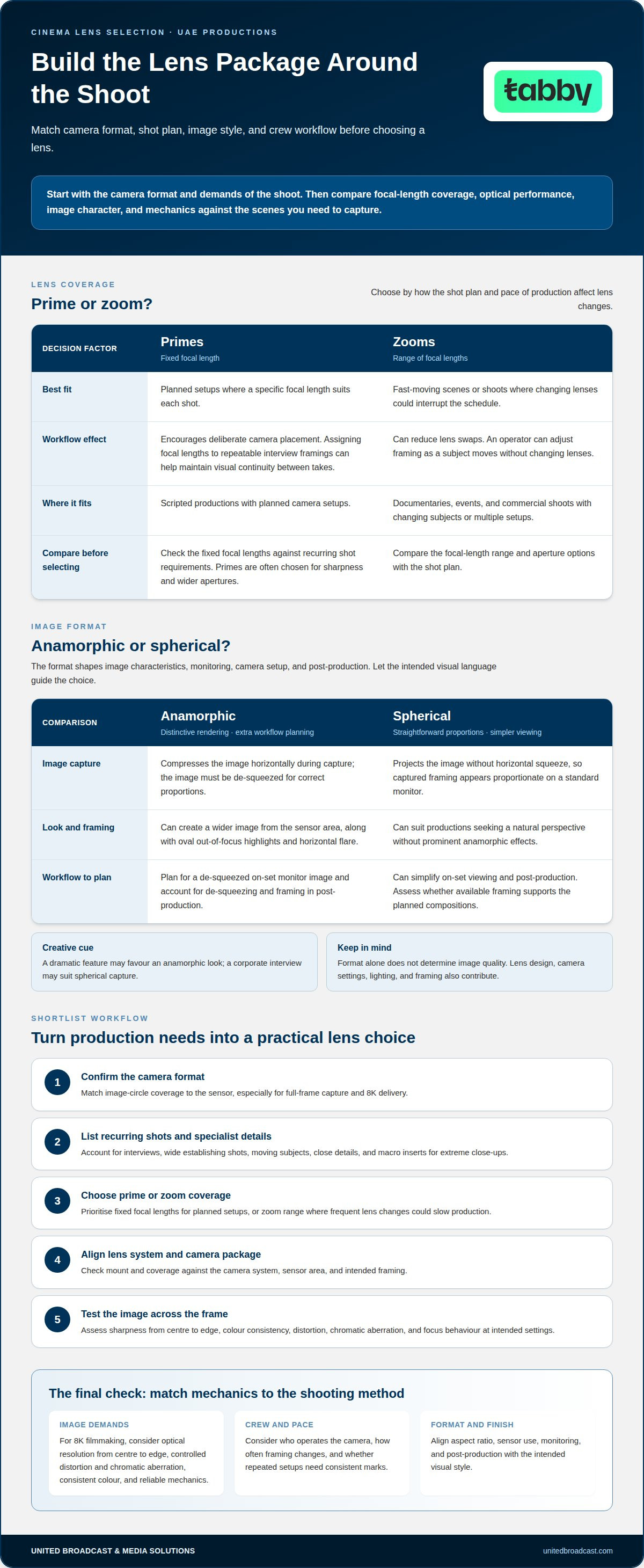
Start with the camera format and shot plan, then shortlist lenses around the work they must perform. An 8K production needs high optical resolution from image centre to edge, with limited chromatic aberration and distortion. Consistent colour, reliable mechanics, and full-frame coverage also matter when the camera uses a full-frame sensor. A lens that falls short in one area can affect framing, matching shots, or image detail across the finished production.
Map each scene to its likely focal lengths before selecting a lens set. A scripted production with planned setups may suit prime cinema lenses. Each prime has a fixed focal length, and primes are often chosen for sharpness and wider apertures. That fixed view encourages deliberate camera placement. For repeatable interview setups, for example, assigning a focal length to each framing can help the crew maintain visual continuity between takes.
Choose zooms when scenes move quickly or lens changes could interrupt the schedule. A zoom covers multiple focal lengths, making it useful for documentaries, events, and commercial shoots. At a live event, an operator can adjust framing as a subject moves without changing lenses. On a commercial shoot with several setups, zoom coverage can also reduce lens swaps. Compare the zoom’s focal-length range and aperture options with the shot plan.
Use this workflow to turn production needs into a practical shortlist:
- Confirm the camera format. Match image-circle coverage to the sensor, especially for full-frame capture and 8K delivery.
- List the recurring shots. Record interview, wide establishing, moving-subject, and close-detail requirements.
- Choose prime or zoom coverage. Prioritise fixed focal lengths for planned setups, or zoom range where frequent changes slow production.
- Check the lens system. Align mount and coverage with the camera package; for a Sony Alpha setup, review the Sony Alpha camera and lens range.
- Test the image across the frame. Assess sharpness, colour consistency, distortion, and chromatic aberration at the intended settings.
Include specialist shots in the plan rather than treating them as exceptions. Macro cinema lenses capture extreme close-up details, which can be useful for high-resolution product inserts or small practical elements. These shots may call for a dedicated lens, camera position, and focus approach. Listing them alongside standard coverage helps ensure the package accounts for more than wide and portrait shots.
Finally, match the lens’s mechanical demands to the shooting method. A controlled studio setup and a fast-moving event place different demands on focus and zoom operation. Consider who will operate the camera, how often framing changes, and whether repeated setups need consistent marks. Lens selection is also a workflow decision: choose an option that meets the image requirements and supports how the crew captures each scene.
Anamorphic and spherical lenses
Anamorphic and spherical lenses create different image characteristics and production requirements. The choice affects framing, monitoring, camera setup, and post-production. Decide which format supports the intended visual language before assembling the camera package. A dramatic feature may favour an anamorphic look, while a corporate interview may suit spherical capture. The format should serve the project rather than add complexity without a clear purpose.
Anamorphic lenses compress the image horizontally during capture, so it must be de-squeezed for correct proportions on a monitor or in post-production. This optical process can create a wider image from the sensor area, along with distinctive rendering such as oval out-of-focus highlights and horizontal flare. These characteristics can help establish a recognisable visual style. Consider them across scenes so the look remains deliberate rather than appearing only in isolated shots.
Spherical lenses project the image without horizontal squeeze. The captured framing appears proportionate on a standard monitor, which can simplify on-set viewing and post-production. For a documentary with rapidly changing locations, this straightforward monitoring workflow may be useful. Spherical lenses also suit productions seeking a natural perspective without prominent anamorphic effects. The format alone does not determine image quality: lens design, camera settings, lighting, and framing all contribute to the result.
Before choosing a format, align the creative brief with the camera and post-production workflow:
- Define the frame. Identify the intended aspect ratio and how much of the sensor the production will use.
- Plan monitoring. For anamorphic capture, establish how the crew will view a de-squeezed image on set.
- Review the look. Decide whether lens character, including flare and out-of-focus highlights, supports the scenes.
- Plan post-production. Account for de-squeezing and framing decisions in the editing and finishing workflow.
- Test the camera package. Check that the selected lens, sensor area, monitoring setup, and intended framing work together.
A short camera test can reveal workflow issues before principal photography. For example, shoot a dialogue scene and a wide exterior using the intended format. Review edge framing, focus behaviour, highlights, and the monitor image. With anamorphic lenses, include the de-squeezed view. With spherical capture, assess whether the available framing supports the planned compositions. This practical comparison helps the director and cinematographer choose a format based on actual scenes.
UAE productions may move between controlled interiors and bright exterior locations. Include representative lighting and backgrounds in a lens test, since highlights and flare depend on the scene as well as the lens. For a project with a settled camera package, share the production requirements as part of the format discussion. The useful choice is the one that meets the visual brief and fits the crew’s capture and finishing workflow.
Which UAE retailers and rental houses offer cinema lenses?
In the UAE, cinema lenses are sourced through two routes: equipment retailers for purchases and rental houses for temporary production needs. The right route depends on how often a lens will be used and whether a production needs a specific mount or focal range. A recurring documentary package may justify buying lenses, while a one-off shoot may call for temporary access to a specialist lens.
For a purchase, begin with the camera system and lens mount. A lens set with PL or EF mounts must match the production’s camera configuration and support plan. Sony E is another mount used in cinema lens packages. The useful match is a lens system suited to the camera, intended sensor coverage, and shooting requirements.
Rental houses serve a different workflow. They can provide temporary access to equipment for a defined production, which may suit a project requiring an unusual focal range or a lens used for only a small part of the shoot. The production team still needs to integrate that lens into its camera and focus workflow. For example, a two-lens zoom package can cover varied scenes while limiting lens changes during a fast-moving event.
Use these steps to decide which route fits:
- Set the use pattern. Identify whether the lens supports repeated productions or a single project.
- Define the camera match. Record the camera mount, sensor format, and required image coverage.
- Describe the shot needs. Note focal ranges, close-focus requirements, and whether the project needs a prime or zoom setup.
- Map the workflow. Consider lens changes, focus operation, and the time available for camera setup.
- Choose purchase or rental. A recurring package may suit ownership; a one-off specialist requirement may suit temporary access.
For productions across the UAE, logistics also shape the decision. A lens package must reach the set with the camera configuration and accessories needed for the planned shots. Build the equipment list around named mounts, such as PL, EF, or Sony E, rather than relying on a broad description like “cinema lens.” That detail helps avoid a mismatch between the lens and camera body.
Compare options by compatibility and workflow, not by retailer or rental-house category alone. A purchase supports repeated use and a stable lens package; temporary access can suit a shoot with a defined, short-term need. In either case, the final selection should match the production’s camera mount, image coverage, and shot plan. Those requirements narrow the field before price or package structure becomes the deciding factor.
What cinema lens brands and models are available in the UAE?
UAE listings include cinema lenses from SIRUI and DZOFilm, with prime and zoom options across different formats and mounts. Compare the model’s focal length, maximum aperture, sensor coverage, and mount against the camera package. A full-frame lens and a Super35 zoom address different coverage needs, so the product name alone isn’t enough to establish a match.
SIRUI’s Vision Prime range includes full-frame models at 15mm, 24mm, 35mm, 50mm, and 75mm. The listed aperture markings vary by focal length: the 15mm is T1.6, while the 24mm, 35mm, 50mm, and 75mm are T1.4. The Vision Prime 150mm T4.0 is a full-frame 1.5X macro cine lens, giving this range a close-detail option alongside its other focal lengths.
DZOFilm listings span primes, zooms, and multi-lens bundles. The VESPID Prime 7-Lens Kit is listed with PL and EF mounts. The Catta FF zooms include an 18-35mm T2.9 for Sony E, while Catta Ace zooms are offered with PL and EF mounts. These mount details help distinguish packages before comparing their focal ranges.
For Super35 coverage, DZOFilm’s Pictor T2.8 range includes a zoom three-lens bundle with PL and EF mounts. The Linglung range includes a 10-24mm T2.9 and a 20-70mm T2.9. These options illustrate why a shortlist should separate sensor format from focal-length coverage. A wide zoom may suit establishing shots, while a longer range can support tighter framing.
- Match coverage. Compare full-frame and Super35 descriptions with the camera sensor format.
- Check the mount. Distinguish PL, EF, and Sony E listings before choosing a lens package.
- Compare focal ranges. A 10-24mm zoom and a 70-135mm zoom serve different framing needs.
- Review aperture markings. Compare T-stops across the focal lengths used in the production.
- Identify specialist needs. The SIRUI 150mm macro listing offers a named close-detail option.
Model names also reveal whether a listing describes one lens or a set. DZOFilm Catta FF listings include 18-35mm paired with 70-135mm, and 18-35mm paired with 35-80mm. Catta Ace packages include two-lens and three-lens combinations. Read each focal range and mount as a separate specification, rather than assuming similarly named bundles share the same coverage.
For a working shortlist, record the camera format, mount, required focal lengths, and preferred aperture range. Then compare those needs with options such as SIRUI Vision Prime, DZOFilm Catta, Linglung, VESPID, and Pictor. This keeps brand preference secondary to the camera system and planned shots.
Cinema Lens Prices and Rental Rates in the UAE
In the UAE, cinema lens purchase prices vary by format, focal length, aperture, mount, and whether the listing covers one lens or a set. Rental rates follow a different calculation. They depend on the chosen lens package and rental period, as well as the production’s specific requirements. Compare options by total package needs, not by a model name alone.
Specifications help explain why models sit in different price positions. The SIRUI 24mm, 35mm, and 55mm T1.2 NIGHT WALKER lenses are Super35 options, while the SIRUI JUPITER 50mm T2.0 is a full-frame macro cine lens. Their formats, focal lengths, and intended close-focus use differ. Compare like with like before assessing a purchase option or rental package.
A single lens and a multi-lens bundle represent different purchasing decisions. A set can provide several focal lengths in one package, while individual lenses let a production build around selected shots. Mount also affects the comparison. A PL or EF package and a Sony E lens are not interchangeable unless the camera system supports that mount.
For rentals, clarify the scope of the booking before comparing rates. A short, defined shoot and an extended production period create different rental requirements. The selected focal range, number of lenses, and any accompanying equipment can also affect the package. A zoom covering varied framing needs may replace several lens changes, while a specialist macro lens may be needed only for close-detail scenes.
Build a practical cost comparison around these factors:
- Lens type: Record whether the requirement is for a prime, zoom, macro, or set.
- Camera fit: Match mount and sensor coverage to the camera package.
- Optical requirements: Compare focal length and aperture markings for the planned scenes.
- Use period: For rentals, specify the production dates and required rental duration.
- Package scope: Separate the lens itself from any additional equipment in the package.
- Repeat use: Consider whether a lens supports recurring work or a single project.
Ownership may suit a production that repeatedly needs the same focal lengths and mount. Renting can suit a project with a defined need for a specialist lens or temporary coverage. For example, a production using a 50mm macro lens for selected insert shots may weigh occasional rental against repeated use. Compare the full production requirement, including the camera match, rather than treating the lowest initial figure as the only deciding factor.
Prepare the model, mount, format, focal range, and required rental period to make a useful comparison. That specification helps distinguish between purchase options and temporary equipment needs without mixing unlike packages.
United Broadcast & Media Solutions (UBMS): Cinema Lenses
United Broadcast & Media Solutions (UBMS) offers cinema lenses for UAE productions choosing optics to suit a camera system and shot plan. Explore its cinema lens range when you’re ready to move from comparing formats, mounts, and focal lengths to selecting equipment. UBMS also offers professional video cameras, digital cinema cameras, and professional lighting equipment, allowing production teams to consider key elements of a camera package together.
Before selecting a lens, define the camera mount, sensor format, and focal lengths required for your work. These details narrow the options to lenses suited to the intended setup. For a coordinated equipment decision, consider camera and lighting requirements alongside the lens choice.
Contact United Broadcast & Media Solutions to discuss cinema lens options for your production.
Plan Your Next Camera Package
Use the lens decision to shape a camera package for upcoming productions as well as the current shoot. Consider how the camera system and chosen optics will work together as project requirements change. For cinema lenses in the UAE, a clear understanding of your production needs can guide the next equipment decision.
United Broadcast & Media Solutions (UBMS) offers cinema lenses alongside professional video cameras and digital cinema cameras. This makes UBMS a relevant contact when planning or refining a camera setup around your production requirements.
Take the next step by choosing a camera package that fits the work you want to create.
Frequently Asked Questions
Where can I buy cinema lenses in the UAE?
Buy cinema lenses in the UAE from United Broadcast & Media Solutions (UBMS), which sells cinema lenses for professional production workflows. Share your camera model, mount, and intended sensor format when discussing a purchase, so the lens choice can be considered in context. UBMS also sells digital cinema cameras and professional video cameras for teams planning a broader camera-system setup. UBMS does not provide equipment rentals.
What should filmmakers check before buying or renting a cinema lens in the UAE?
Check the mount, sensor coverage, and whether the lens fits the camera setup, including any matte box or follow-focus equipment. Inspect the glass for visible marks and operate focus and iris controls through their travel. A practical test with the intended camera can reveal framing or clearance issues before production. For a rental, record the lens’s condition at handover and confirm the rental period and included accessories.


